
A May 5, 2026 Nature feature titled "Testosterone therapy is trending. Who really needs it, and why?" captured a question that has been brewing for two years. Hormone therapy prescriptions are up 86 percent since 2021. Telehealth platforms are running aggressive direct-to-consumer campaigns. The FDA spent late 2025 and early 2026 stripping warnings and signaling expanded access.
Cultural surge meets clinical caution. The result: clinicians, patients, and regulators no longer agree on who actually qualifies for testosterone replacement therapy.
Key Takeaways
- Hormone therapy prescriptions up 86 percent since 2021; testosterone driving most of the surge in men
- Nature, NPR, NBC News, PBS, CNN have all run "is TRT being over-prescribed?" features in the last 60 days
- Hard threshold the data still supports: two morning total testosterone tests below 300 ng/dL plus symptoms
- Men in the 300 to 450 ng/dL range with vague symptoms should fix sleep, body composition, and meds first
- FDA April 16, 2026 announcement opened a pathway for low-libido idiopathic hypogonadism; formal approval still 12 to 24 months out
- Off-label TRT for age-related decline is legal and routine through reputable online TRT clinics
Why Testosterone Is Trending Now
Three regulatory and scientific shifts collided with a cultural moment.
TRAVERSE trial published clean safety data. The 5,246-man randomized trial found 7.0 percent major adverse cardiovascular events on testosterone versus 7.3 percent on placebo. After 20 years of warnings about heart attacks, the TRAVERSE results closed the cardiovascular safety question for appropriately selected men.
FDA removed black-box warnings. On November 10, 2025, the FDA initiated removal of the broad cardiovascular and breast cancer black-box warnings from hormone therapy products. A December 2025 expert panel then called testosterone replacement "a cornerstone of preventive health" and recommended expanded access.
Indication expansion announced. On April 16, 2026, the FDA opened a pathway for TRT manufacturers to seek approval for low libido in men with idiopathic hypogonadism. That category captures most age-related low testosterone.
Telehealth aggressively marketed. Major telehealth platforms launched branded oral testosterone products and direct-to-consumer campaigns. Prescriptions followed the marketing.
The Nature feature, published May 5, 2026, framed the resulting tension: as testosterone prescriptions surge, are we treating the right people?
Who Actually Qualifies in 2026
The answer comes down to two numbers and a list.
The Lab Threshold That Still Matters
Two separate morning total testosterone tests below 300 ng/dL.
That threshold has held across the FDA's April 16 announcement, the Endocrine Society guidelines, the European Association of Urology guidelines, and the BSSM (British Society for Sexual Medicine) position statement. The TRAVERSE trial enrolled men below 300 ng/dL. The real-world cohort study of 9,537 men used the same threshold. The European panel position statement reaffirmed it.
Why morning? Testosterone has a diurnal rhythm. Levels peak between 7 and 10 AM and drop 20 to 40 percent by afternoon. An afternoon test of 280 ng/dL might be 380 ng/dL at 8 AM. Always test before 10 AM, fasting, and confirm any low result on a second draw. We walk through the testing protocol in detail.
Free testosterone matters when total is borderline (250 to 350 ng/dL). High SHBG can bind enough testosterone that free levels are clinically low even when total looks normal. That is why we cover total versus free testosterone separately.
The Symptom List That Must Match
Lab numbers alone do not justify treatment. Symptoms must match.
Core hypogonadal symptoms:
- Loss of libido or sexual desire
- Loss of morning erections, soft erections, or erectile dysfunction
- Persistent fatigue not explained by sleep
- Loss of muscle mass despite training
- Increased visceral fat
- Mood changes: irritability, low motivation, depressive symptoms
- Loss of body hair, sparse beard regrowth
- Brain fog or reduced cognitive sharpness
- Hot flashes or night sweats (rare but specific)
A man with testosterone of 280 ng/dL and three or more of these symptoms qualifies. A man with testosterone of 280 ng/dL and no symptoms is more controversial - many clinicians would still treat, others would observe and recheck.
A man with testosterone of 480 ng/dL and the same symptoms list does not have a hypogonadism problem. He has a sleep problem, a body composition problem, a mental health problem, or all three. TRT is not the answer.
The Three Categories of Low Testosterone
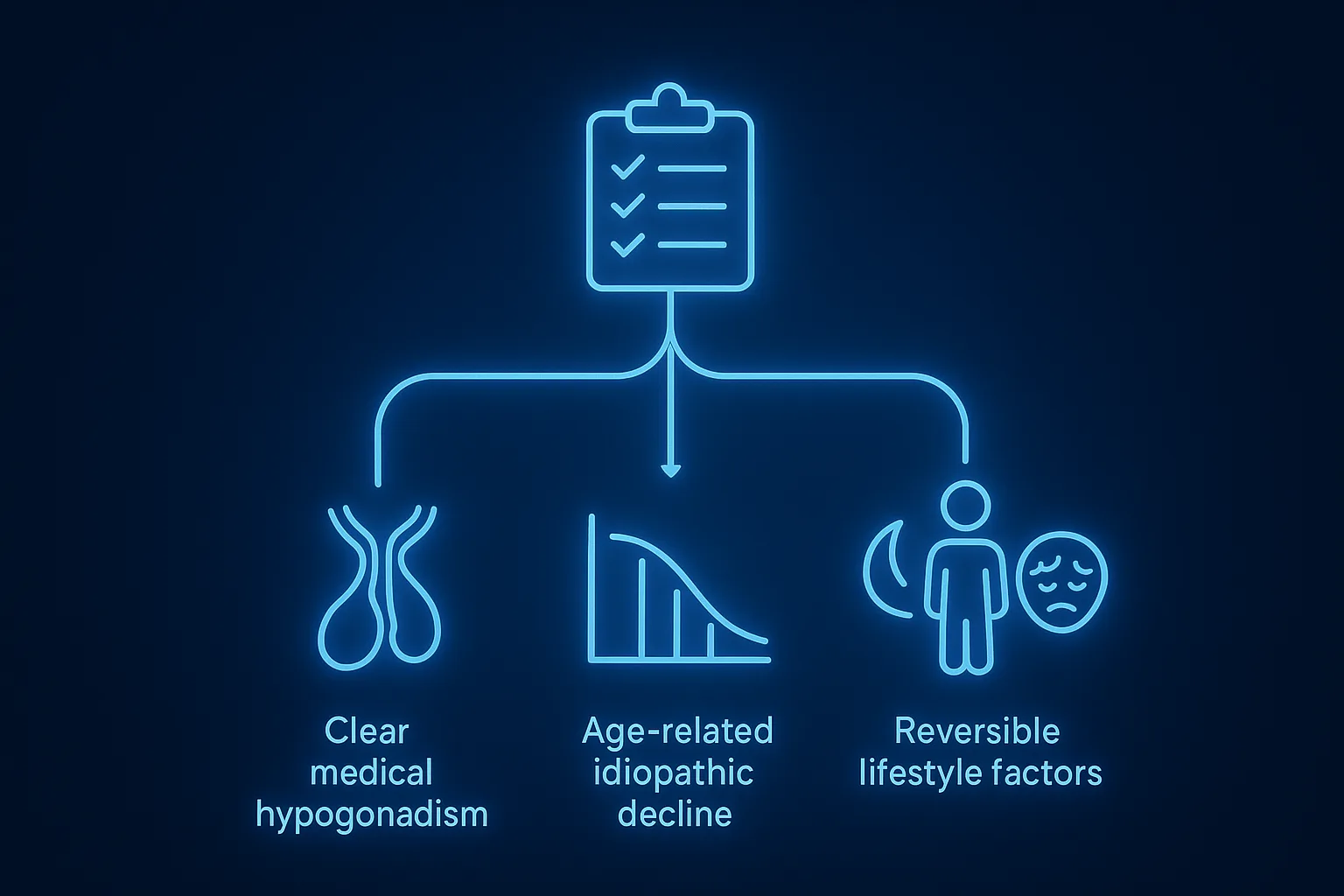
The Nature article highlighted that "low testosterone" is not one diagnosis. It is three.
1. Classical Hypogonadism
Clear, identifiable medical cause:
- Klinefelter syndrome
- Pituitary tumor or surgery
- Testicular injury, torsion, or surgery
- Radiation or chemotherapy
- Kallmann syndrome
- Severe head trauma
These men have always qualified for FDA-approved TRT. The diagnosis is straightforward and treatment is non-controversial. Roughly 5 to 10 percent of men on TRT fall into this category.
2. Idiopathic Hypogonadism (Age-Related Decline)
Low testosterone (under 300 ng/dL) with no identifiable disease. The pituitary is signaling normally, the testicles look fine on exam, but levels are still low.
This is the largest category and the focus of the April 16, 2026 FDA announcement. Most men on TRT through online clinics fall here. Testosterone declines roughly 1 to 2 percent per year after age 30 in healthy men, and faster in men with metabolic dysfunction. By age 60, a meaningful percentage of men sit below 300 ng/dL with no specific disease driving it.
The Nature feature pointed out the controversy: is age-related decline a "deficiency" worth treating, or is it a normal feature of aging? The TRAVERSE safety data and clinical symptom improvement studies have largely answered yes for symptomatic men. The FDA April 16 announcement formalizes that answer.
3. Functional Low Testosterone (Reversible)
Low testosterone caused by something fixable:
- Sleep deprivation or untreated sleep apnea
- Visceral obesity (fat tissue aromatizes testosterone to estradiol)
- Chronic heavy alcohol use
- Opioids, including prescribed pain medications
- Long-term high-dose statins (modest effect)
- Severe overtraining or under-eating
- Major depression
- Marijuana use (mixed evidence, likely modest)
A 35-year-old with testosterone of 320 ng/dL who sleeps 5 hours a night, drinks 4 nights a week, and carries a 38-inch waist does not have hypogonadism. He has a lifestyle problem with a hormone consequence. Six months of fixing sleep, cutting alcohol, losing 30 pounds of visceral fat, and lifting weights will move his testosterone 100 to 200 ng/dL on average.
This is the TRT versus natural optimization question, and it matters because telehealth platforms have a financial incentive to skip it.

How Telehealth Has Shifted the Picture
Online TRT clinics solved a real problem. Primary care physicians historically refused to test or prescribe, citing liability concerns. Endocrinologists had 6-month wait lists. Men with legitimate hypogonadism went undiagnosed for years.
Telehealth changed that. A man can now order morning bloodwork, upload results, complete a video consult, and receive testosterone within 7 to 14 days. For the man with 220 ng/dL and a year of fatigue and lost libido, that is a meaningful improvement.
The flip side: the same workflow can prescribe testosterone to a 32-year-old with 480 ng/dL who reports "I just don't feel as sharp as I used to." That is not hypogonadism. The Nature article and subsequent NBC, NPR, and PBS coverage zeroed in on this gap.
What separates a defensible telehealth model from an over-prescribing one:
| Practice | Defensible Model | Over-Prescribing Model |
|---|---|---|
| Bloodwork before prescribing | Two morning tests required | Single afternoon or no confirmation |
| SHBG and free testosterone | Measured when total is borderline | Skipped to save cost |
| Threshold for treatment | Below 300 ng/dL with symptoms | "Suboptimal" levels marketed at 400 to 600 ng/dL |
| Lifestyle counseling | Required before TRT for borderline cases | Skipped or perfunctory |
| Hematocrit and PSA monitoring | Every 3 to 6 months | Annual or skipped |
| Fertility preservation (hCG) | Offered to younger men | Rarely discussed |
| Provider | Licensed physician involved | NP or PA only |
We score online TRT clinics against these criteria.
What the FDA April 16 Announcement Actually Changed
Reading the headlines, you might think TRT is now FDA-approved for age-related decline. That is not what happened.
The April 16, 2026 announcement invited TRT manufacturers to submit supplemental new drug applications (sNDAs) for one specific indication: low libido in men with idiopathic hypogonadism. Sponsors had until April 30, 2026 to contact the agency about submission. Formal approval is likely 12 to 24 months out, contingent on data.
What the announcement did do:
- Signaled the FDA is now willing to approve TRT for sexual desire issues in men with no identifiable medical cause
- Validated the safety profile that TRAVERSE and the 9,000-man real-world study established
- Created cover for primary care physicians who had refused to prescribe off-label
What it did not do:
- Approve TRT for age-related fatigue, body composition, or mood
- Change Schedule III controlled substance status (separate FDA descheduling track)
- Mandate insurance coverage
- Lower out-of-pocket prices
For more on the regulatory specifics, see our coverage of the FDA descheduling expanded access discussion and the FDA low libido idiopathic hypogonadism announcement.
A Decision Framework for 2026
If you are considering TRT, work through these in order.
Step 1: Get morning bloodwork (twice). Total testosterone, free testosterone, SHBG, estradiol, LH, FSH, hematocrit, PSA (over 40), comprehensive metabolic panel. Two separate morning draws before 10 AM. We cover how to read testosterone labs line by line.
Step 2: Match labs to symptoms. Without consistent symptoms from the low testosterone symptoms list, even genuinely low numbers do not justify TRT.
Step 3: Rule out reversible causes. Sleep apnea screening, weight relative to waist circumference, alcohol intake, current medications, chronic stress, training load. If any of these are unmanaged, fix them first for 3 to 6 months and retest.
Step 4: Consider preservation alternatives. Younger men who want fertility preserved should consider enclomiphene versus TRT. Enclomiphene raises endogenous testosterone production and preserves sperm count. It is not for everyone (it does not work if pituitary signaling is dead), but it is the right starting point for many men under 40.
Step 5: Pick a clinic that does the work. A clinic that does not require two morning tests, does not measure free testosterone or SHBG, does not monitor hematocrit and PSA, and does not discuss fertility is the wrong clinic. Compare the questions to ask a TRT clinic before paying.
Step 6: Set expectations. Libido and morning erections often respond in 4 to 8 weeks. Energy and mood in 2 to 3 months. Body composition takes 6 to 12 months. Our TRT results timeline walks through what to expect.
Where the Debate Goes From Here
The Nature article framed the unresolved question: is the testosterone surge correcting decades of under-treatment, or creating a new generation of medicalized aging?
Both can be true. Men with documented low testosterone and clear symptoms have suffered through decades of dismissive primary care and 6-month endocrinology wait lists. They benefit from expanded access. The TRAVERSE data and the real-world safety record support that.
At the same time, men with normal-range testosterone and lifestyle-driven symptoms are being prescribed testosterone they do not need. That risks polycythemia, fertility suppression, and lifelong dependence on exogenous hormone replacement.
The honest answer in 2026: TRT works very well for the men who qualify, and not for the men who do not. The diagnostic threshold has not moved. The cultural conversation has.
Further Reading
- How TRT works: mechanism and timeline
- TRT versus natural optimization
- Real-world TRT safety: 9,537 men study
- European panel TRT cardiovascular position statement
- TRT cardiovascular and prostate cancer meta-analysis
- Best online TRT clinic 2026
Sources
- Nature. "Testosterone therapy is trending. Who really needs it, and why?" Published May 5, 2026. doi:10.1038/d41586-026-01408-9
- FDA. "FDA Takes Step Forward on Testosterone Therapy for Men." Press announcement, April 16, 2026.
- Lincoln R, et al. TRAVERSE Trial. "Cardiovascular Safety of Testosterone-Replacement Therapy." NEJM. 2023;389:107-117.
- Real-World Outcomes and Safety of Testosterone Therapy: A Longitudinal, Retrospective Cohort Study of Over 9,000 Men. World J Mens Health. 2025.
- Federal Register. "Potential New Indication for Testosterone Replacement Therapy." Published April 20, 2026.
- HHS. "FDA Initiates Removal of Black Box Warnings from HRT Products." November 10, 2025.
- NPR. "Why the 'mad scramble' to fill hormone therapy prescriptions for menopause." March 10, 2026.
- NBC News. "FDA panel calls to loosen restrictions on testosterone replacement therapy." December 2025.