Testosterone is the hormone most people associate with masculinity, but the reality is more nuanced. It is a steroid hormone that regulates dozens of physiological processes in both men and women, from muscle protein synthesis and bone mineral density to red blood cell production and cognitive function.
This article explains what testosterone is at the molecular level, how your body produces it, what it does, and what happens when levels fall outside the normal range.
Chemical Structure and Classification
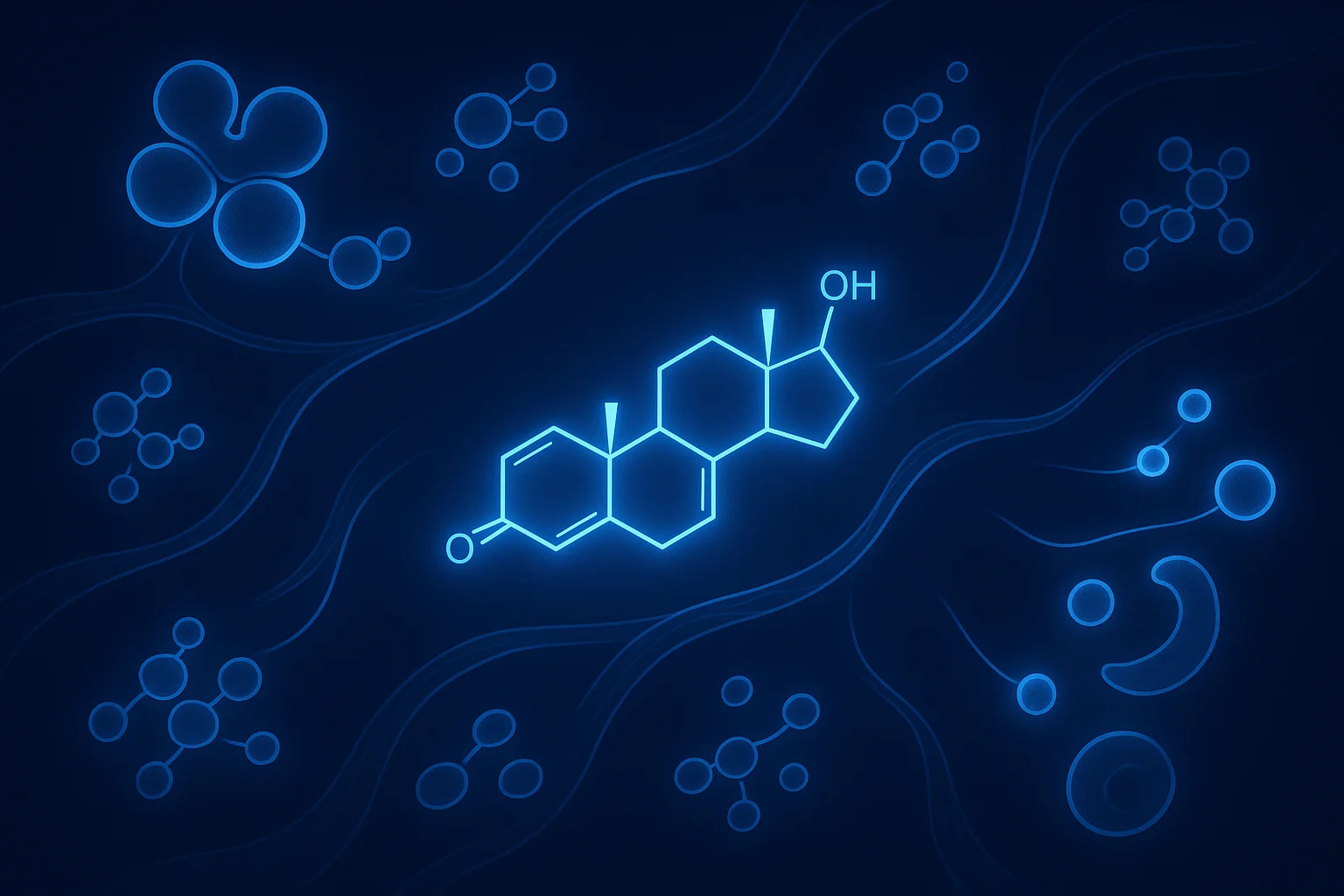
Testosterone belongs to the androgen class of steroid hormones. Its molecular formula is C19H28O2, with a molecular weight of 288.42 g/mol. The "C19" designation means it has 19 carbon atoms arranged in the four-ring steroid backbone common to all steroid hormones: three six-carbon rings and one five-carbon ring.
What makes testosterone distinct from other steroids like cortisol or estradiol is the specific arrangement of hydrogen atoms and functional groups attached to that backbone. A single enzyme can convert testosterone into dihydrotestosterone (DHT) by reducing one double bond, or into estradiol by aromatizing the A-ring. This chemical flexibility is why testosterone serves as a precursor to multiple other hormones.
How Testosterone Is Produced: The Biosynthesis Pathway
Testosterone production starts with cholesterol. The full pathway runs through several intermediate hormones:
Each step requires a specific enzyme. The rate-limiting step is the conversion of cholesterol to pregnenolone by the enzyme CYP11A1 (cholesterol side-chain cleavage enzyme), which occurs in the mitochondria of Leydig cells.
Leydig Cells
About 95% of circulating testosterone in men is produced by Leydig cells, which sit in the interstitial tissue of the testes between the seminiferous tubules. An adult male has roughly 200-700 million Leydig cells, and together they produce approximately 3-10 mg of testosterone per day.
The remaining 5% comes from the adrenal glands, which produce weaker androgens (DHEA and androstenedione) that can be converted to testosterone in peripheral tissues.
The HPG Axis: The Master Control System
Testosterone production is governed by the hypothalamic-pituitary-gonadal (HPG) axis, a three-level feedback loop:
Hypothalamus releases gonadotropin-releasing hormone (GnRH) in pulses every 60-120 minutes
Anterior pituitary responds to GnRH by secreting luteinizing hormone (LH) and follicle-stimulating hormone (FSH)
Testes respond to LH by producing testosterone in Leydig cells; FSH acts on Sertoli cells to support sperm production
When blood testosterone levels rise, the hypothalamus and pituitary detect this and reduce GnRH and LH output. This negative feedback loop maintains testosterone within a relatively narrow range for each individual.
This feedback mechanism is why exogenous testosterone (TRT) suppresses natural production. When you inject testosterone, the hypothalamus senses elevated levels and shuts down GnRH release, which in turn shuts down LH, which means the Leydig cells stop producing testosterone on their own. Understanding this is critical for anyone considering how TRT works.
Diurnal Rhythm
Testosterone follows a circadian pattern. Levels are highest in the early morning (typically peaking between 6-8 AM) and lowest in the late afternoon and evening, with a variation of 20-35% across the day. This is why testosterone testing should be done in the morning, ideally between 7-11 AM. Most online TRT clinics order morning draws as standard protocol.
This rhythm becomes less pronounced with age. Men over 60 show a blunted diurnal pattern, with morning levels only 10-15% above afternoon levels.
Testosterone acts on nearly every tissue in the male body. Its effects are mediated through two mechanisms: direct binding to androgen receptors (AR) and conversion to other active hormones (DHT via 5-alpha reductase, estradiol via aromatase).
Muscle Protein Synthesis
Testosterone is one of the most potent natural anabolic signals in the body. It increases muscle protein synthesis by activating satellite cells, promoting nitrogen retention, and upregulating IGF-1 expression within muscle tissue. Studies show a dose-response relationship: higher testosterone levels produce greater increases in lean body mass, even without exercise.
Bone Mineral Density
Testosterone maintains bone density through both direct effects on osteoblasts (bone-building cells) and indirect effects via conversion to estradiol. Men with hypogonadism have significantly increased fracture risk, and testosterone replacement has been shown to improve bone mineral density at the spine and hip.
Erythropoiesis (Red Blood Cell Production)
Testosterone stimulates erythropoietin (EPO) production in the kidneys and acts directly on bone marrow to increase red blood cell production. This is why men have higher hemoglobin and hematocrit levels than women, and why TRT can cause polycythemia (elevated red blood cells) as a side effect that requires monitoring.
Libido and Sexual Function
Testosterone is the primary hormonal driver of libido in both men and women. It is necessary for normal erectile function, though the relationship is not strictly linear. Most men maintain normal sexual function above 300 ng/dL, but the threshold varies individually. Below that, sexual symptoms become increasingly common.
Mood and Cognitive Function
Testosterone influences neurotransmitter systems including serotonin, dopamine, and GABA. Low testosterone is associated with increased rates of depression, irritability, reduced motivation, and cognitive decline. The brain is rich in androgen receptors, particularly in the hippocampus and prefrontal cortex.
Fat Distribution
Testosterone promotes a lean body composition by inhibiting lipid uptake into adipocytes (fat cells) and promoting lipolysis. Low testosterone is associated with increased visceral (abdominal) fat, which in turn increases aromatase activity, converting more testosterone to estradiol. This creates a self-reinforcing cycle where low T promotes fat gain, and fat gain further lowers T.
Free vs Total vs Bioavailable Testosterone
Not all testosterone in your blood is equally active. Understanding the three measurements is essential for interpreting lab results.
Total Testosterone
Total testosterone measures everything in your blood, both bound and unbound. The standard reference range is 300-1000 ng/dL (10.4-34.7 nmol/L), though this varies by lab and assay.
Free Testosterone
Only about 2% of circulating testosterone is unbound, or "free." This is the fraction that can enter cells and bind to androgen receptors directly. Normal free testosterone ranges are approximately 8-25 ng/dL (or 50-210 pg/mL, depending on the assay).
Bioavailable Testosterone
Bioavailable testosterone includes free testosterone plus the fraction loosely bound to albumin (about 54% of total). Albumin-bound testosterone can dissociate and become available to tissues, unlike testosterone bound to SHBG. For a deeper dive, see our total vs free testosterone guide.
SHBG: The Key Binding Protein
Sex hormone-binding globulin (SHBG) binds approximately 44% of circulating testosterone with high affinity. When SHBG is elevated (common in older men, men with liver disease, hyperthyroidism, or on certain medications), total testosterone can appear normal while free testosterone is low. This is one of the most common reasons men have symptoms despite "normal" levels.
Factors that increase SHBG: aging, liver disease, hyperthyroidism, low caloric intake, certain medications (anticonvulsants).
Testosterone levels peak in the late teens to early 20s and decline progressively afterward. The rate is roughly 1-2% per year starting around age 30, though there is significant individual variation.
Data from the Massachusetts Male Aging Study (MMAS), one of the largest longitudinal studies on the topic, showed that total testosterone declined an average of 1.6% per year and free testosterone declined 2-3% per year (faster because SHBG increases with age, binding more of the remaining testosterone).
By age 70, the average man has total testosterone levels 40-50% lower than his peak. Whether this decline is "normal aging" or a treatable condition remains debated. For more on this topic, read our article on testosterone decline with age.
Testosterone in Women
Women produce testosterone too, just in much smaller quantities. Normal levels in women are approximately 15-70 ng/dL, compared to 300-1000 ng/dL in men. Women produce testosterone in the ovaries and adrenal glands.
In women, testosterone contributes to:
Libido and sexual arousal (the primary hormonal driver, as in men)
Bone mineral density maintenance
Muscle mass and strength
Mood and energy levels
Cognitive function
Testosterone levels in women decline steadily from the 20s onward, with a sharper drop after menopause when ovarian production ceases. Low testosterone in women can cause fatigue, reduced libido, and loss of muscle and bone mass.
When Testosterone Levels Are Too Low
Clinically low testosterone, or hypogonadism, is generally defined as total testosterone below 300 ng/dL confirmed on at least two morning blood draws, accompanied by symptoms. The symptoms of low T are wide-ranging and can be subtle. See our complete guide to low testosterone symptoms for a detailed breakdown.
Treatment options range from lifestyle optimization (sleep, exercise, weight management, stress reduction) to medical interventions including TRT and alternative therapies like enclomiphene. If you suspect low testosterone, a qualified TRT clinic can run the right labs and walk you through your options.
Key Takeaways
Testosterone is a C19 steroid hormone produced primarily in Leydig cells, regulated by the HPG axis
It affects muscle, bone, blood cells, libido, mood, cognition, and fat metabolism
Only 2% circulates as free testosterone; SHBG binding determines how much is biologically active
Levels decline 1-2% per year after age 30, with free T declining faster than total T
Reference range of 300-1000 ng/dL for total T is a statistical range, not an individual optimum
This content is for informational purposes only and is not medical advice. Consult a qualified healthcare provider before starting any treatment.
Frequently Asked Questions
What exactly is testosterone?
Testosterone is a C19 steroid hormone with the molecular formula C19H28O2. It is the primary androgen in males, responsible for the development of male sexual characteristics, muscle and bone maintenance, red blood cell production, and cognitive function.
Where is testosterone produced in the body?
About 95% of testosterone is produced by Leydig cells in the testes. The remaining 5% comes from the adrenal glands. In women, testosterone is produced in smaller quantities by the ovaries and adrenal glands.
What is the HPG axis?
The hypothalamic-pituitary-gonadal (HPG) axis is the hormonal feedback loop that controls testosterone production. The hypothalamus releases GnRH, which signals the pituitary to release LH and FSH, which then stimulate the testes to produce testosterone.
What is the difference between free and total testosterone?
Total testosterone measures all testosterone in your blood. Free testosterone measures only the 2% that is unbound to proteins and available for tissues to use. About 44% is bound to SHBG, 54% to albumin, and only 2% circulates freely.
At what age does testosterone start declining?
Testosterone typically peaks in the late teens to early 20s and begins a gradual decline of roughly 1-2% per year starting around age 30. By age 70, many men have total testosterone levels 40-50% lower than their peak.
What is a normal testosterone level?
Most labs define the normal range for total testosterone as 300-1000 ng/dL (10.4-34.7 nmol/L). Free testosterone reference ranges are typically 8-25 ng/dL for adult males, though these vary by lab and assay method.
Do women produce testosterone?
Yes. Women produce about 5-10% of the testosterone that men do, with normal levels around 15-70 ng/dL. Testosterone plays a role in libido, bone density, muscle maintenance, and mood in women.