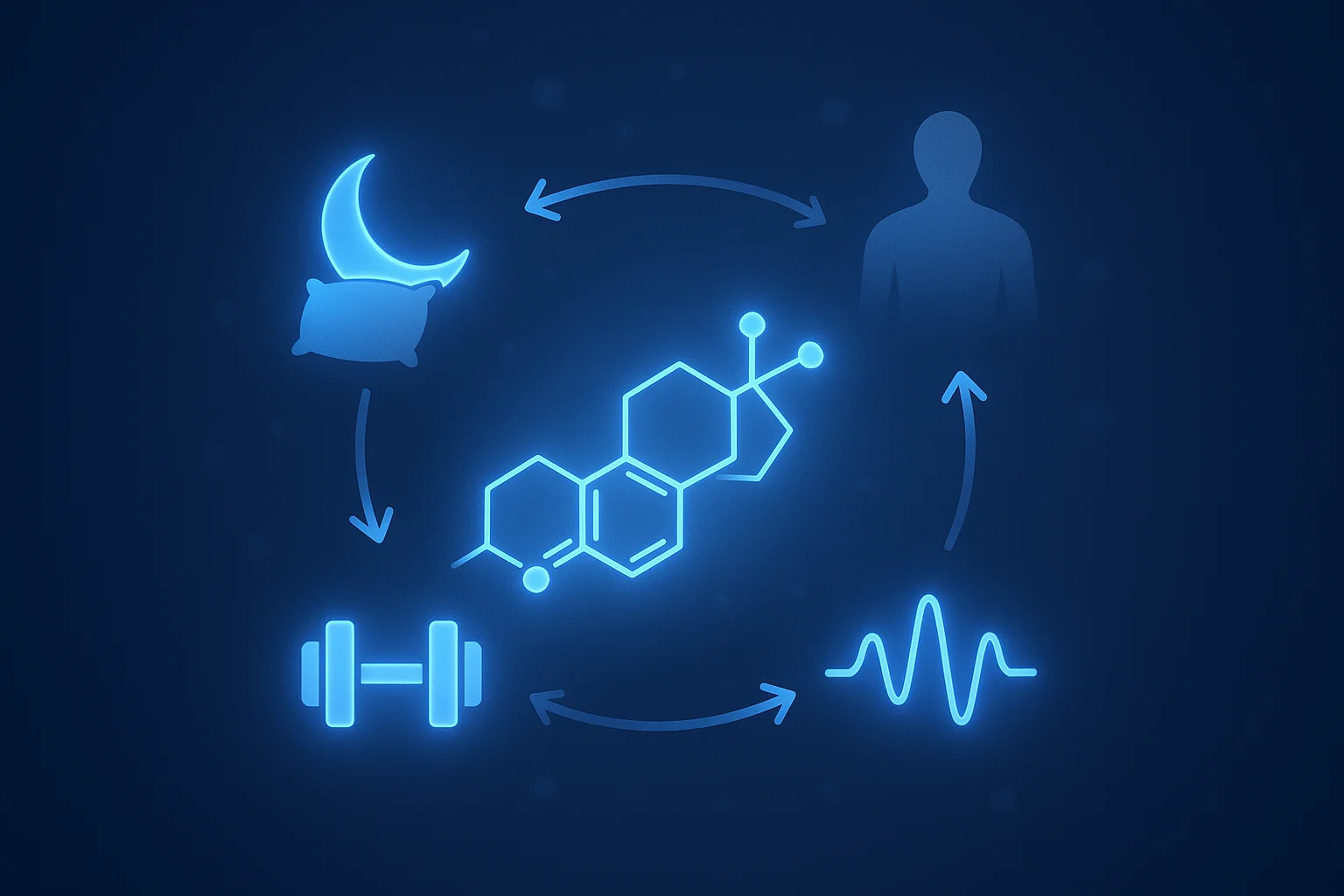
Testosterone does not fall off a cliff at a certain age. It is a slow, steady decline that starts in the early 30s and accumulates over decades. But the rate varies dramatically between individuals, and much of what gets attributed to "normal aging" is actually driven by weight gain, poor sleep, chronic stress, and other modifiable factors.
This article covers what the major longitudinal studies actually show, what accelerates decline, and where the line falls between normal aging and a condition worth treating.
What the Major Studies Show
Three landmark studies provide the best longitudinal data on testosterone decline. Their findings are broadly consistent but reveal important nuances.
Massachusetts Male Aging Study (MMAS)
The MMAS followed approximately 1,700 men in the Boston area from 1987 to 2004. Key findings:
Total testosterone declined an average of 1.6% per year
Free testosterone declined approximately 2.8% per year
The difference between total and free T decline rates reflects increasing SHBG with age
By age 70, the average man had total testosterone roughly 40% lower than at age 25
Decline was not uniform: some men maintained high levels into their 70s while others showed steep drops in their 40s
Baltimore Longitudinal Study of Aging (BLSA)
Running since 1958, the BLSA is one of the longest-running studies on human aging. Its testosterone data shows:
Approximately 20% of men over 60 have total testosterone below 300 ng/dL
Approximately 30% of men over 70 fall below that threshold
Approximately 50% of men over 80 are hypogonadal by standard criteria
The study also demonstrated that the decline is progressive and does not plateau at any specific age
European Male Ageing Study (EMAS)
The EMAS studied over 3,000 men aged 40-79 across eight European countries, making it the largest multinational study on male hormone aging:
Confirmed the 1-2% per year decline in total testosterone
Found that only 2% of men aged 40-79 met strict criteria for late-onset hypogonadism (low T plus three sexual symptoms)
Crucially demonstrated that much of the observed testosterone decline was explained by obesity and comorbidities rather than age alone
Among healthy, non-obese men, the age-related decline was significantly smaller
This last finding is important. It suggests that a substantial portion of what we call "age-related testosterone decline" is actually disease-related or lifestyle-related decline that happens to correlate with age.
Average Testosterone Levels by Age
Based on pooled data from multiple studies, approximate mean total testosterone levels by decade:
Age Range
Mean Total T (ng/dL)
Approximate Range
20-29
600-680
400-1000
30-39
550-630
350-900
40-49
500-580
300-850
50-59
450-530
250-800
60-69
400-480
200-700
70-79
350-430
150-650
These are population averages with wide standard deviations. An individual man's trajectory depends on genetics, body composition, health status, and lifestyle. Two 55-year-old men can have testosterone levels of 250 ng/dL and 700 ng/dL, and both are technically within the population distribution.
Free Testosterone Declines Faster
Free testosterone declines more steeply than total testosterone because SHBG increases approximately 1.2% per year with age. By the time a man reaches 70, his SHBG may be 50-80% higher than it was at 30, binding a larger fraction of his already-reduced total testosterone.
This means that free testosterone, the biologically active fraction, can be severely depleted even when total testosterone appears borderline. This is why checking both total and free testosterone is essential, especially in older men.
Not all testosterone decline is biologically programmed. Several modifiable factors dramatically speed up the process.
Obesity
This is the single largest modifiable risk factor. Adipose tissue (especially visceral fat) contains aromatase, which converts testosterone to estradiol. Higher body fat means more conversion, lower testosterone, and higher estrogen. Estrogen suppresses GnRH and LH through the HPG axis, further reducing testicular production.
Data from the EMAS showed that a BMI increase of just 4-5 points was equivalent to approximately 10 years of age-related decline in its testosterone-lowering effect. Conversely, weight loss of 10-15% can increase testosterone by 100-200 ng/dL in obese men.
Sleep Deprivation
Testosterone production depends on sleep, particularly deep (slow-wave) sleep. Restricting sleep to 5 hours per night for one week reduced testosterone by 10-15% in young healthy men in a controlled study. Chronic sleep restriction is likely even more damaging.
Obstructive sleep apnea compounds this effect by fragmenting sleep architecture and causing intermittent hypoxia, both of which suppress the HPG axis.
Chronic Stress and Cortisol
Cortisol and testosterone have an inverse relationship. Chronic psychological or physiological stress elevates cortisol, which suppresses GnRH pulsatility and directly inhibits Leydig cell function. Men in high-stress occupations, those with chronic anxiety, or those dealing with ongoing financial or relationship stress often show lower testosterone than their age would predict.
Sedentary Lifestyle
Regular exercise, particularly resistance training, supports testosterone production. Sedentary men show steeper testosterone decline than active men of the same age. The mechanism involves both direct effects (exercise stimulates acute testosterone production and improves insulin sensitivity) and indirect effects (exercise prevents obesity and improves sleep).
Alcohol and Substance Use
Chronic heavy alcohol use damages Leydig cells directly and disrupts the HPG axis. Even moderate drinking (2-3 drinks daily) is associated with measurably lower testosterone over time.
Opioid medications are particularly destructive to testosterone production. Chronic opioid therapy suppresses the HPG axis in up to 90% of men, often producing total testosterone levels below 200 ng/dL.
Endocrine Disruptors
Exposure to environmental chemicals with estrogenic or anti-androgenic properties, including BPA, phthalates, certain pesticides, and PFAS chemicals, has been linked to lower testosterone at the population level. While the effect of any single exposure may be small, the cumulative impact of widespread exposure is a plausible contributor to the generational decline in testosterone levels observed in population studies.
The "Andropause" Debate
The term "andropause" or "male menopause" is sometimes used to describe symptomatic testosterone decline in aging men. However, the comparison to female menopause is misleading.
Female menopause is a defined biological event: ovarian function ceases entirely over a relatively short period, estrogen drops by approximately 90%, and every woman goes through it.
Male testosterone decline is gradual, variable in rate, and does not involve complete cessation of production. Some men maintain healthy testosterone levels into their 80s. The Endocrine Society uses the term "late-onset hypogonadism" to describe symptomatic low testosterone in older men, explicitly avoiding the menopause analogy.
The clinical question is not whether decline happens, but at what point it crosses from "less than what you had at 25" to "low enough to cause harm and warrant treatment." This is where the distinction between normal reference ranges and optimal levels becomes clinically relevant.
Lifestyle Interventions That Slow Decline
While you cannot stop the biological clock entirely, several interventions have strong evidence for slowing testosterone decline:
Resistance Training
Heavy compound exercises (squats, deadlifts, presses, rows) performed 3-4 times per week maintain and can increase testosterone levels. The effect is both acute (testosterone rises post-workout) and chronic (consistent training improves body composition and insulin sensitivity). Resistance training is the single most effective non-pharmaceutical intervention.
Weight Management
Maintaining a BMI under 25, or at least minimizing visceral fat, removes one of the most potent drivers of testosterone decline. Even modest weight loss (5-10% of body weight) produces measurable testosterone increases in overweight men.
Sleep Optimization
Prioritizing 7-9 hours of quality sleep per night, treating sleep apnea if present, and maintaining consistent sleep/wake times support the natural testosterone production cycle. The payoff is significant: the difference between 5 hours and 8 hours of sleep can represent a 15-20% difference in morning testosterone.
Stress Management
Reducing chronic cortisol elevation through whatever means work (exercise, meditation, therapy, workload changes) removes a direct suppressor of testosterone production.
Micronutrient Optimization
Deficiencies in zinc, magnesium, vitamin D, and boron are associated with lower testosterone. Correcting true deficiencies (verified by bloodwork) can meaningfully improve levels, though supplementing above adequate levels has limited additional benefit. Most TRT clinics include micronutrient panels in their initial bloodwork. For more detail, see our guide on TRT vs natural optimization.
When Decline Becomes a Medical Issue
The transition from "normal aging" to "treatable condition" is not defined by a single number. It requires:
Confirmed low levels on at least two morning blood draws
Symptoms that align with hypogonadism and affect quality of life
Exclusion of reversible causes (obesity, sleep apnea, medications, pituitary tumors)
If reversible causes are addressed and symptoms persist with confirmed low testosterone, treatment options include TRT and alternatives like enclomiphene. The decision should be individualized, weighing benefits against potential side effects and the commitment to ongoing therapy. Understanding what to expect in the first month can help set realistic expectations. A good TRT clinic will evaluate the full picture -- labs, lifestyle, and medical history -- before recommending a protocol.
Key Takeaways
Testosterone declines approximately 1-2% per year (total T) and 2-3% per year (free T) starting around age 30
Major longitudinal studies confirm this trend but show enormous individual variation
Much of the observed decline is driven by obesity, sleep issues, and comorbidities, not just biology
Free testosterone declines faster than total T due to rising SHBG with age
Resistance training, weight management, sleep, and stress reduction meaningfully slow the decline
Not all decline is "normal" or inevitable; not all decline requires treatment
This content is for informational purposes only and is not medical advice. Consult a qualified healthcare provider before starting any treatment.
Frequently Asked Questions
How much does testosterone decline each year after 30?
Total testosterone declines approximately 1-2% per year after age 30. Free testosterone declines faster, at roughly 2-3% per year, because SHBG increases with age and binds more of the remaining testosterone.
Is testosterone decline inevitable with aging?
Some decline is normal, but the rate and severity vary enormously. The European Male Ageing Study found that about 25% of men over 70 still had testosterone in the healthy range. Maintaining a healthy weight, sleeping well, exercising, and avoiding chronic illness can significantly slow the decline.
What is andropause?
Andropause is a term used to describe age-related testosterone decline in men, sometimes called 'male menopause.' Unlike female menopause, it is not a universal event with a clear onset. It is a gradual process with wide individual variation, and not all men develop symptomatic deficiency.
What testosterone level is normal for a 50-year-old?
Average total testosterone for men aged 50-54 is approximately 500-550 ng/dL, though the individual range is very wide. A 50-year-old with 400 ng/dL may be 'normal' statistically but still experiencing symptoms. Context, symptoms, and free T all matter more than a single number.
Can you reverse age-related testosterone decline naturally?
You can slow and partially reverse lifestyle-driven decline through weight loss, resistance training, sleep optimization, and stress management. However, the age-related biological decline in Leydig cell function cannot be fully reversed through lifestyle alone.
Does testosterone decline cause weight gain, or does weight gain cause testosterone decline?
Both. It is a bidirectional relationship. Low testosterone promotes fat accumulation (especially visceral fat), and increased fat tissue produces more aromatase enzyme, which converts testosterone to estradiol. Breaking this cycle with either weight loss or testosterone restoration improves both.
At what age should I start monitoring my testosterone?
If you have symptoms, get tested at any age. For routine screening, consider baseline testing in your 30s so you know your personal starting point. Men with risk factors (obesity, diabetes, opioid use, sleep apnea) should be tested earlier regardless of age.
Is the rate of testosterone decline getting worse in younger generations?
Yes. Population-level data suggests that men born in later decades have lower testosterone at the same age compared to earlier generations. A study comparing men of the same age across different birth cohorts found roughly 1% lower testosterone per year of birth, independent of age. The causes likely include rising obesity rates, endocrine-disrupting chemicals, and lifestyle changes.