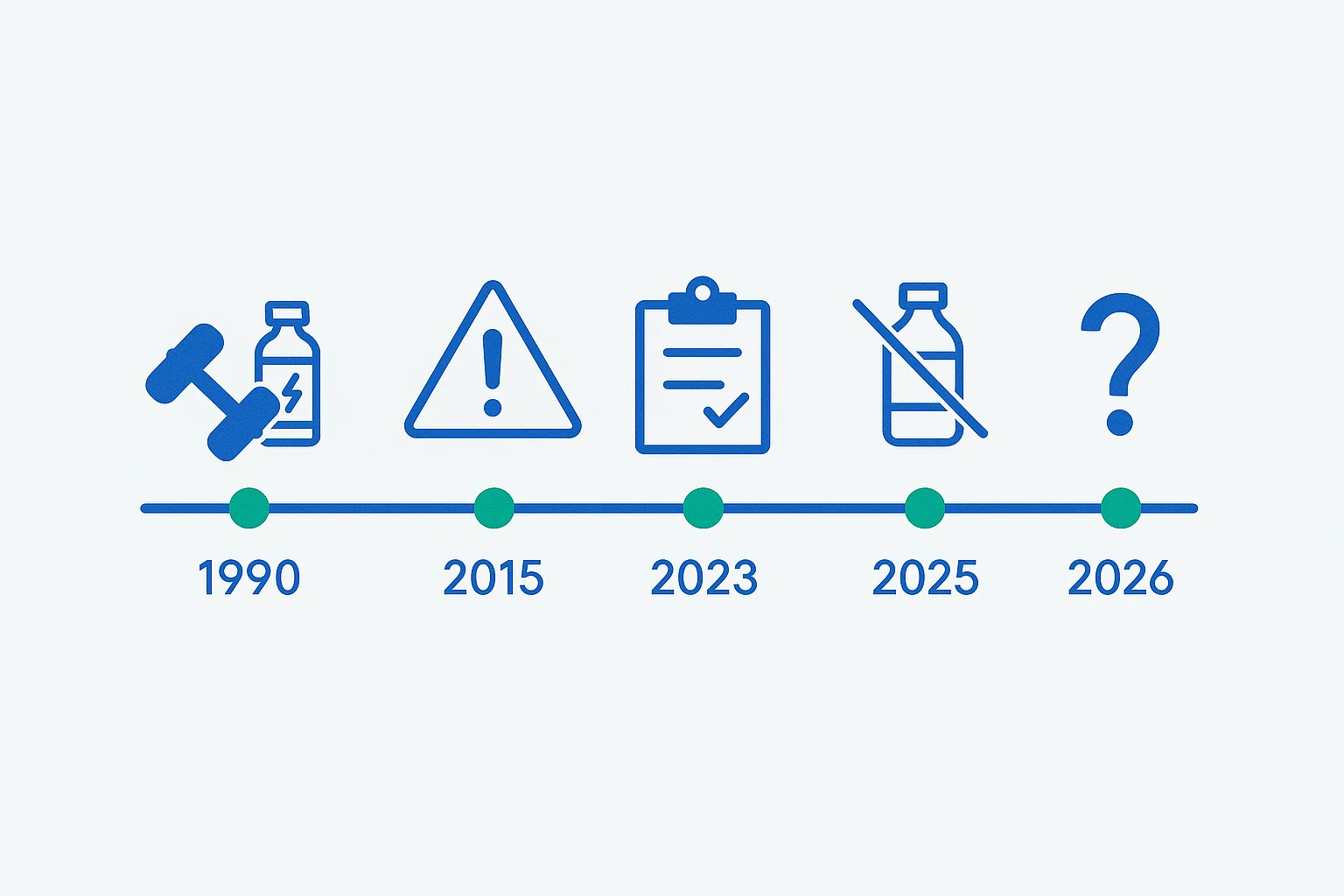
In December 2025, a 13-member FDA expert panel delivered recommendations that could fundamentally reshape testosterone therapy in America. The panel called for three major changes: removing testosterone's Schedule III controlled substance designation, expanding FDA-approved indications to include age-related low testosterone, and eliminating outdated prostate cancer warnings from product labels.
If the FDA acts on these recommendations, it would mark the biggest regulatory shift for testosterone since 1990 -- when Congress classified it alongside ketamine and anabolic steroids in response to sports doping scandals, not clinical evidence.
Key Takeaways
An FDA expert panel recommended removing testosterone's Schedule III controlled substance status
The panel also called for expanding FDA-approved TRT indications to include age-related low testosterone
The TRAVERSE trial and other evidence prompted removal of the cardiovascular boxed warning in February 2025
Over 2,000 public comments were submitted before the February 2026 deadline
No formal FDA action has been taken yet, but Commissioner Makary has signaled openness to change
What the FDA Panel Actually Recommended
On December 10, 2025, the FDA convened an expert panel of nine specialists -- urologists, endocrinologists, sexual health researchers, and pharmaceutical leaders -- to evaluate current testosterone regulations. The panel's recommendations were unanimous and sweeping.
Three Core Recommendations
Recommendation
Current Status
What Would Change
Remove Schedule III classification
Testosterone is a DEA-controlled substance (same category as ketamine)
No DEA oversight for prescribing; easier telehealth access; reduced pharmacy burden
Expand indications to age-related low T
FDA-approved only for "classical hypogonadism" from specific medical conditions
Men with symptoms + documented low levels could receive TRT regardless of cause
Remove prostate cancer contraindication
Labels warn against use in men with known or suspected prostate cancer
Updated labeling reflecting current evidence that TRT does not increase prostate cancer risk
The Science Behind the Recommendations
The panel didn't make these recommendations in a vacuum. They cited three major evidence shifts:
1. The TRAVERSE Trial (2023). The largest randomized controlled trial of testosterone safety enrolled 5,246 men with hypogonadism who already had or were at high risk for cardiovascular disease. After a mean follow-up of 33 months, TRT showed no increased risk of heart attack, stroke, or cardiovascular death. This trial directly led to the FDA removing its cardiovascular boxed warning in February 2025. We covered this in detail in our TRAVERSE trial breakdown.
2. Prostate Cancer Evidence. Multiple large studies, including data from the TRAVERSE trial, have found no increased risk of prostate cancer with testosterone therapy. The panel argued that the current contraindication is based on a decades-old hypothesis (the "Huggins myth") that has been disproven by modern evidence.
3. Real-World Safety Data. A 2026 retrospective cohort study of over 9,000 men treated for testosterone deficiency found significant quality-of-life improvements and favorable safety profiles across 12 months of follow-up, with most patients (89%) receiving subcutaneous testosterone injections.
Understanding the current classification requires context. Testosterone wasn't scheduled based on clinical evidence of addiction or abuse in therapeutic doses.
The 1990 Anabolic Steroids Control Act
In 1990, Congress passed the Anabolic Steroids Control Act, classifying testosterone and other anabolic steroids as Schedule III controlled substances. The legislation was a direct response to:
Olympic doping scandals of the 1980s (particularly Ben Johnson's 1988 disqualification)
Congressional hearings on steroid use in professional sports
Growing media attention on teenage steroid abuse in athletics
The DEA and the American Medical Association both opposed the scheduling at the time, arguing that testosterone did not meet the criteria for controlled substance classification -- specifically, that there was no evidence of physical dependence at physiological doses.
Congress overrode those objections. The result: for the past 36 years, a man with clinically low testosterone has faced the same prescribing restrictions as someone seeking ketamine.
What Schedule III Means in Practice
The controlled substance classification creates real barriers to TRT access:
DEA registration required. Every prescriber must have a DEA number, and every prescription is tracked in state prescription drug monitoring programs
Prescription limitations. Some states limit refills or require new prescriptions every 90 days
Pharmacy burden. Pharmacies must maintain special storage, record-keeping, and reporting for Schedule III drugs
Telehealth restrictions. The Ryan Haight Act limits controlled substance prescribing via telehealth, creating obstacles for online TRT clinics
Stigma. Patients and providers associate "controlled substance" with addiction risk, discouraging treatment
The Age-Related Low T Question
Currently, testosterone is FDA-approved only for "classical hypogonadism" -- meaning testosterone deficiency caused by specific, identifiable medical conditions like Klinefelter syndrome, pituitary tumors, or testicular injury. It is explicitly not approved for age-related testosterone decline.
This matters because the vast majority of men seeking TRT have age-related decline, not classical hypogonadism.
The Numbers
Testosterone levels decline approximately 1-2% per year after age 30. By the time a man reaches 60, his testosterone may be 30-50% lower than it was at 25. Common symptoms include:
Fatigue and low energy
Reduced muscle mass and increased body fat
Decreased libido and erectile function
Mood changes, irritability, and brain fog
Poor sleep quality
These are the same symptoms seen in classical hypogonadism. The difference is purely regulatory: if a pituitary tumor causes your low testosterone, you get FDA-approved treatment. If aging causes the same level of deficiency with the same symptoms, your treatment is technically off-label.
How Clinics Work Around This Today
Most online TRT clinics already prescribe for age-related low testosterone, since off-label prescribing is legal and common in medicine. But the lack of an FDA indication creates several problems:
Insurance companies can deny coverage more easily
Prescribers face theoretical legal exposure
Patients may hesitate to pursue treatment for an "unapproved" use
Research funding for age-related testosterone decline is harder to secure
The panel recommended aligning FDA indications with the reality of clinical practice and guidelines from the Endocrine Society and American Urological Association, both of which support TRT for symptomatic men with documented low testosterone regardless of cause.
Who Supports (and Opposes) the Changes
In Favor
The Endocrine Society submitted formal comments to the FDA in February 2026 supporting expanded indications
The American Urological Association has long advocated for broader TRT access
The Sexual Medicine Society of North America participated in the panel and supported all recommendations
FDA Commissioner Martin Makary publicly stated the agency is "open" to regulatory revisions
Over 2,000 public comments were submitted during the comment period (closed February 9, 2026)
Opposed or Cautious
Public Citizen (consumer advocacy group) submitted comments urging caution, citing concerns about overdiagnosis and pharmaceutical industry influence on the panel
Some endocrinologists worry that expanded indications could lead to inappropriate prescribing in men who don't truly need TRT
DEA has not publicly commented on potential descheduling
What This Means for You Right Now
As of April 2026, nothing has officially changed. Testosterone remains a Schedule III controlled substance, and the FDA indication has not been expanded. But the direction is clear, and there are practical steps you can take today.
If You're Currently on TRT
Your treatment is unaffected. If anything, these developments validate the safety and efficacy of your protocol. The removal of the cardiovascular boxed warning (already in effect since February 2025) and the panel's endorsement of TRT safety should reassure you and your provider.
Don't wait for regulatory changes to get evaluated. If you have symptoms of low testosterone, the first step is getting your levels tested. Understanding whether you have low vs. optimal levels gives you the foundation for any treatment decision.
Online TRT clinics already prescribe for age-related low testosterone legally through off-label prescribing. If your levels are low and you have symptoms, you can start treatment today through a reputable clinic. Our clinic comparison guide breaks down pricing, protocols, and what to look for.
What Descheduling Would Actually Change
If testosterone is eventually descheduled:
Easier prescribing. Your doctor won't need DEA registration specifically for testosterone, and prescriptions won't be tracked in drug monitoring databases
Better telehealth access. Online clinics could operate with fewer regulatory hurdles, potentially lowering costs
Reduced stigma. Removing the "controlled substance" label normalizes TRT as standard medical care
Potential insurance expansion. If age-related low T becomes an FDA-approved indication, insurers would have less basis for denying coverage. Read our insurance vs. cash-pay breakdown to understand current costs
More research. FDA recognition of age-related decline would likely accelerate clinical research funding
Timeline Expectations
The FDA has not announced a decision timeline. Based on typical regulatory processes:
Comment review: Ongoing (2,000+ submissions)
Label changes: Could happen within 6-12 months if the FDA follows the same path as the menopausal HRT label changes (which took about 2 months from panel to action in late 2025)
Descheduling: Would require coordination with the DEA and potentially Congress, making it a longer process -- likely 1-3 years at minimum
The Bigger Picture: A Regulatory Reckoning
The testosterone panel is part of a broader FDA rethinking of hormone therapy regulation. In November 2025, the FDA removed boxed warnings from menopausal hormone therapy products -- warnings that had discouraged HRT prescribing for over two decades based on flawed interpretations of the Women's Health Initiative study.
The parallel is striking. Both testosterone and estrogen therapy were restricted based on safety concerns that subsequent large trials disproved. Both restrictions led to widespread undertreatment. And both are now being reconsidered as the FDA acknowledges that the evidence has evolved.
For testosterone specifically, the arc from the flawed 2013-2014 observational studies, through the TRAVERSE trial, to the FDA panel's recommendations represents a complete reversal of the regulatory narrative. The question is no longer whether testosterone therapy is safe -- that's been answered. The question is how quickly regulators will update rules written 36 years ago to reflect what the science now shows.
References
FDA Expert Panel on Testosterone Replacement Therapy for Men, December 10, 2025. Federal Register Document FDA-2025-N-6743.
Lincoff AM, et al. Cardiovascular Safety of Testosterone-Replacement Therapy. N Engl J Med. 2023;389(2):107-117.
Endocrine Society Comments to FDA Expert Panel on Testosterone Replacement Therapy for Men, February 2026.
Real-World Outcomes and Safety of Testosterone Therapy: A Longitudinal, Retrospective Cohort Study of Over 9,000 Men. World J Mens Health. 2026.
FDA Issues Class-Wide Labeling Changes for Testosterone Products, February 2025.
Frequently Asked Questions
Is testosterone still a controlled substance?
Yes. As of April 2026, testosterone remains a Schedule III controlled substance. However, a December 2025 FDA expert panel recommended removing this classification, and the FDA has signaled openness to the change.
Can I get TRT for age-related low testosterone?
Currently, testosterone is only FDA-approved for 'classical hypogonadism' caused by specific medical conditions -- not age-related decline. The FDA panel recommended expanding indications to include age-related low testosterone, but this hasn't been formally approved yet.
When will the FDA make a decision on descheduling?
No official timeline has been announced. The public comment period closed February 9, 2026, and the FDA is reviewing over 2,000 submissions. The Endocrine Society and other medical organizations have submitted formal comments supporting expanded access.
Will descheduling make TRT cheaper?
Potentially. Removing Schedule III status would eliminate DEA prescribing restrictions, reduce pharmacy compliance costs, and could enable broader telehealth prescribing -- all of which could lower costs and increase competition among providers.
Does the FDA panel recommendation mean TRT is safe?
The panel cited the TRAVERSE trial (5,246 men) showing no increased cardiovascular risk, plus evidence that TRT does not increase prostate cancer risk. These findings led the FDA to remove its cardiovascular boxed warning in February 2025.