Key Takeaways: A Cleveland Clinic team published in Nature on May 6, 2026 that men with glioblastoma who were on supplemental testosterone for unrelated reasons had a 38% lower mortality risk than men not on testosterone, drawing on roughly 1,300 men in the NIH SEER database. Preclinical mouse work showed that removing androgens activated the hypothalamus-pituitary-adrenal axis, raised stress hormones, and created an immunosuppressive brain environment that accelerated tumor growth. The effect was sex-specific: female mice did not show the same response. The study is observational on the human side and the authors are explicit that it does not prove causation, but it adds to a growing body of evidence pointing the opposite direction from the older fear that testosterone fuels cancer. For men on TRT, the cancer-safety picture continues to look reassuring across the endpoints that have been carefully studied.
A Surprising Result From the NIH Cancer Network
For decades, the dominant assumption about testosterone and cancer ran in one direction: more testosterone equals more cancer growth. That assumption shaped how oncologists approached prostate cancer, how primary care physicians counseled men about TRT, and how regulators wrote labels.
A study published in Nature on May 6, 2026 by Justin Lathia, PhD, and his team at Cleveland Clinic's Brain Tumor Center pushes hard in the other direction -- at least for one of the most aggressive cancers in medicine [1]. Glioblastoma is the most common primary malignant brain tumor in adults, with a median survival measured in months, and it disproportionately affects men. The Cleveland Clinic group asked a question that almost nobody had asked: what role do normal male androgens play in the brain's defense against this tumor?
The answer is the opposite of what conventional wisdom would predict.
NCI Director Anthony Letai called the result "a welcome surprise" [2]. The research was funded by three NIH institutes -- the National Cancer Institute, the National Institute on Aging, and the National Institute of Neurological Disorders and Stroke -- which signals how seriously the federal cancer establishment views the finding.
What the Study Actually Did
The work has two halves: a preclinical mouse arm that worked out the mechanism, and a clinical arm that looked for the same pattern in real men.
The Preclinical Mouse Models
The team used established mouse models of glioblastoma and varied androgen exposure. In male mice, they tested what happened when androgens were removed -- chemically blocking testosterone production or surgically removing testes -- and tracked tumor behavior, immune cell trafficking into the brain, and stress hormone signaling.
Key preclinical findings:
- Androgen depletion accelerated tumor growth in male mice
- The hypothalamus-pituitary-adrenal (HPA) axis went into overdrive when androgens were removed, generating a sustained stress hormone response
- Stress hormones reinforced the blood-brain barrier and suppressed immune cell entry into the tumor microenvironment
- The same intervention did not produce the same effect in female mice, indicating a sex-specific mechanism
This is a non-obvious mechanism. The conventional thinking was that the brain is largely walled off from peripheral hormones and that testosterone effects on brain pathology should be modest. The Cleveland Clinic data argues the opposite: androgens are part of the system that keeps the brain's immune surveillance functioning, and removing them tilts the brain into a state that favors tumor escape.
The Clinical SEER Cohort
To test whether the mouse mechanism translates to humans, the group went to the NIH's Surveillance, Epidemiology, and End Results (SEER) database and identified roughly 1,300 men diagnosed with glioblastoma whose records also flagged whether they were receiving supplemental testosterone for unrelated reasons -- typically TRT for hypogonadism diagnosed before the cancer.
The result: men on testosterone supplementation at the time of glioblastoma diagnosis had a 38% lower risk of death than men not on testosterone [1]. The effect direction matched the preclinical work, supporting the mouse mechanism rather than contradicting it.
The authors are explicit about what this is and is not. It is not a randomized trial. It is observational data drawn from a registry. Men on TRT may differ from men not on TRT in ways the analysis cannot fully capture -- they may have better access to care, more frequent imaging, healthier baseline metabolic profiles. But the magnitude of the survival difference is large, the mechanistic story is coherent, and the sex-specificity in mice mirrors what would be expected if testosterone is doing real biological work in the male brain.
The Mechanism: Why Androgens May Protect the Brain
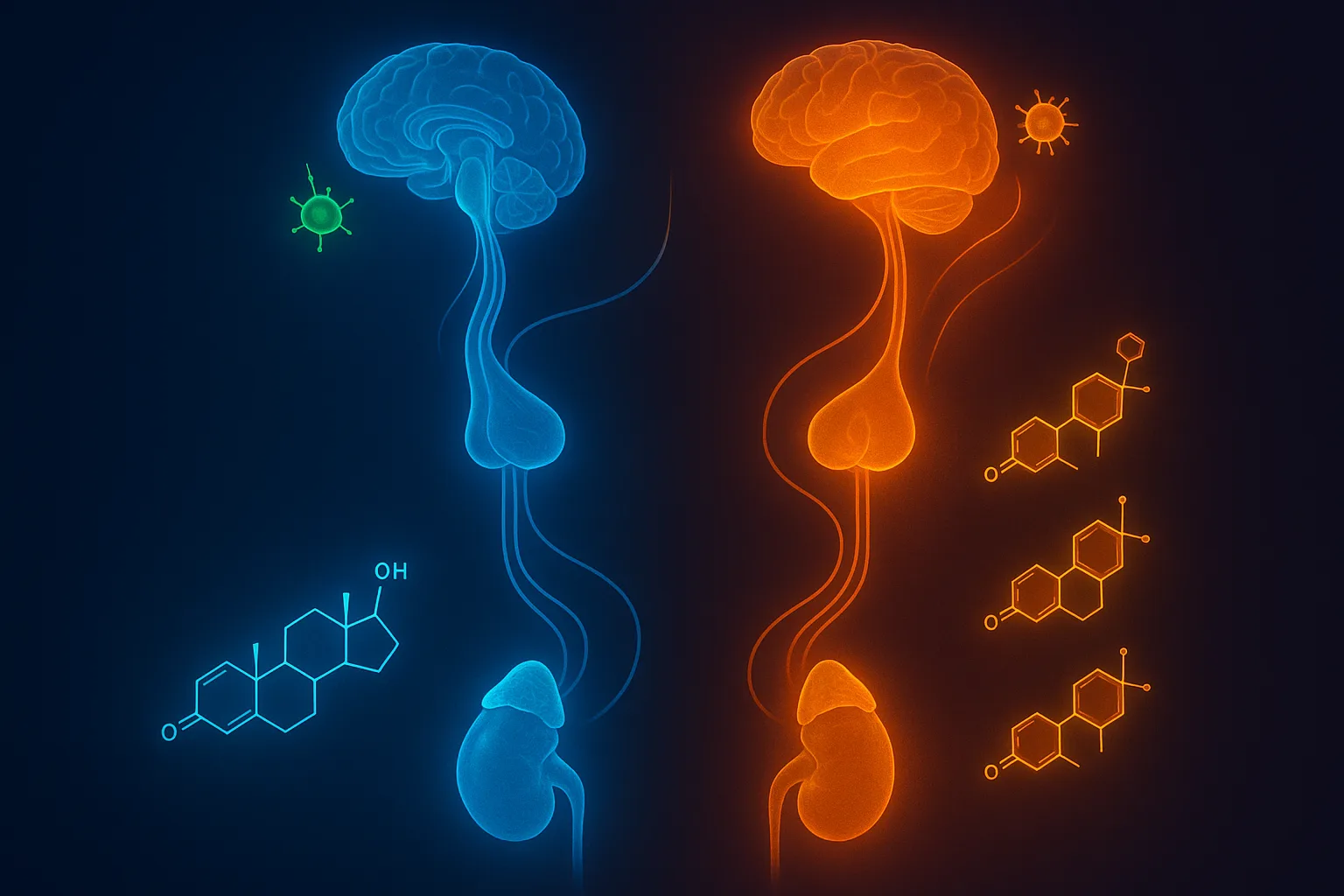
The mechanistic core of the paper is the link from androgens to the HPA axis to brain immunity.
Step 1: Androgens Calm the HPA Axis
The hypothalamus, pituitary, and adrenal gland together regulate the body's stress response. Cortisol is the major output. Under normal androgen levels, this axis runs at a balanced baseline. When androgens drop sharply -- for example, after castration, or in chronic untreated hypogonadism -- the HPA axis becomes hyperactive, producing more cortisol and related stress signals.
This is not new biology. Endocrinologists have long understood that androgens exert tonic suppression on parts of the stress response. What the Cleveland Clinic team showed is that this suppression is consequential for brain cancer biology.
Step 2: Stress Hormones Tighten the Brain's Immune Defense
Cortisol and related glucocorticoids have well-known effects on the immune system: they suppress T-cell proliferation, reduce inflammatory cytokine output, and broadly dial down anti-tumor immunity. In the brain specifically, sustained stress hormone elevation appears to:
- Reinforce the blood-brain barrier in ways that exclude peripheral immune cells
- Suppress microglial activation -- the brain's resident immune cells
- Create a tumor-permissive microenvironment where glioblastoma cells can grow without immune challenge
Lathia put it bluntly: "The brain has evolved to keep stuff out and that includes immune cells from elsewhere in the body" [2]. Glioblastoma exploits this exclusion. When androgens are absent, stress hormones make the exclusion worse.
Step 3: Tumor Escape
With anti-tumor immunity blunted, glioblastoma cells proliferate, migrate, and resist treatment more effectively. The preclinical data showed faster tumor growth and shorter survival in androgen-depleted male mice. Restoring androgens reversed the immunosuppressive environment.
This is a coherent three-step story: androgens regulate stress hormones, stress hormones regulate brain immunity, brain immunity controls tumor progression. Each link has independent supporting literature. The Cleveland Clinic paper is the first to put the full sequence together for glioblastoma in particular.
What This Does Not Mean
A finding this striking will be misread. It is worth being explicit about the limits.
This Is Not Treatment Guidance
The clinical data is observational. The preclinical mechanism is in mice. Neither establishes that giving testosterone to a glioblastoma patient improves outcomes. Lathia's group is calling for human clinical trials, which is the appropriate next step. A randomized trial of testosterone supplementation in male glioblastoma patients is the only way to know whether the survival signal in the SEER cohort reflects a real causal benefit.
Until such a trial exists, oncologists should not be starting testosterone in glioblastoma patients on the basis of this study alone. And patients on TRT who develop glioblastoma should make decisions about continuing therapy in consultation with their oncologist and their TRT clinician.
This Does Not Apply to All Cancers
The mechanism described is specific to the brain and to the HPA axis. It does not extend automatically to other cancers. Hormone-sensitive cancers like breast cancer and certain prostate cancers have different biology, where androgen exposure can directly influence tumor growth through receptor-mediated mechanisms. The Cleveland Clinic finding does not undermine standard oncology practice in those settings.
Sex Differences Are Real
The female mouse experiments did not show the same response. This is a male-specific finding so far. There is no implication that women with glioblastoma would benefit from testosterone or other androgens. Women's brain tumor biology has its own hormonal regulation, including roles for estrogen and progesterone receptors, and that work continues separately.