
Key Takeaways: The Women's Health Initiative scared millions of women off hormone therapy in 2002. The actual numbers are more nuanced. Estrogen-only HRT in women without a uterus reduced breast cancer mortality by 40% in long-term follow-up. Combined estrogen plus synthetic progestin produced about 1 extra breast cancer case per 50-70 women over 5 years of use. Estrogen plus micronized progesterone showed no measurable excess risk in the largest cohort study. The type of progestogen matters more than most women are told.
The 2002 Headline That Got Almost Everything Wrong
In July 2002, the Women's Health Initiative (WHI) halted its combined estrogen-progestin trial early. Headlines screamed that hormone therapy caused breast cancer. Within a year, HRT prescriptions in the United States dropped by more than 50%. A generation of women aged out of menopause without ever discussing hormone therapy with a clinician.
Two decades later, almost every aspect of that 2002 narrative has been revised. The trial enrolled women who were on average 63 years old at randomization, more than a decade past menopause. The "increased risk" was real but small in absolute terms. The estrogen-only arm of the same trial showed a decrease in breast cancer incidence and mortality. The progestogen used in the combination arm was a synthetic compound with different breast tissue effects than micronized progesterone.
None of this was widely reported. The damage from the 2002 communication failure is still being undone in 2026 [3].
This article walks through what the data actually shows: how much risk, for which women, with which formulations, for how long, and what the trade-offs are.
What the WHI Trials Actually Found
The WHI was not one trial. It was two parallel randomized trials of menopausal hormone therapy that produced very different results.
The Estrogen-Plus-Progestin Trial
This trial enrolled 16,608 postmenopausal women with an intact uterus and randomized them to conjugated equine estrogens (CEE) plus medroxyprogesterone acetate (MPA), a synthetic progestin, or placebo [1].
After a mean intervention period of 5.6 years and a long-term follow-up of about 20 years [1]:
| Outcome |
Hazard Ratio |
Absolute Excess |
| Invasive breast cancer |
1.28 |
~8 extra cases per 10,000 women per year |
| Breast cancer mortality |
1.45 (long-term follow-up) |
Small absolute increase |
| Hip fractures |
0.66 |
~5 fewer per 10,000 per year |
| Colorectal cancer |
0.62 |
~6 fewer per 10,000 per year |
The breast cancer signal was the headline finding. But the absolute increase was on the order of 1 extra case per 1,250 women per year of use.
The Estrogen-Alone Trial
This trial enrolled 10,739 postmenopausal women who had undergone hysterectomy and randomized them to CEE alone or placebo [1].
After a mean intervention of 7.2 years and 20-year follow-up:
| Outcome |
Hazard Ratio |
Direction |
| Invasive breast cancer |
0.78 |
23% reduction |
| Breast cancer mortality |
0.60 |
40% reduction |
| Hip fractures |
0.65 |
35% reduction |
This is the finding that almost no one heard about. Estrogen-alone therapy in women without a uterus did not increase breast cancer; it decreased it. And the mortality benefit was substantial. A 2020 JAMA analysis confirmed both effects persisted at long-term follow-up [1].
The takeaway from the two trials together: the breast cancer signal in WHI was driven by the synthetic progestin (medroxyprogesterone acetate), not by the estrogen.
Translating Hazard Ratios to Real Numbers
Hazard ratios are misleading without absolute risk context. Here is what the WHI numbers mean for an individual woman.
The baseline lifetime risk of invasive breast cancer for a U.S. woman is about 13% (1 in 8). Most of that risk accumulates after age 60.
For a 50-year-old woman starting 5 years of combined estrogen-plus-synthetic-progestin HRT, the 2019 Lancet meta-analysis estimated [2]:
- Without HRT: ~6.3 cases per 100 women between age 50 and 69
- With 5 years of estrogen + daily progestogen: ~8.3 cases per 100 women (~1 extra case per 50)
- With 5 years of estrogen + intermittent progestogen: ~7.7 cases per 100 women (~1 extra per 70)
- With 5 years of estrogen-only: ~6.8 cases per 100 women (~1 extra per 200)
These are real but modest absolute increases. They need to be weighed against absolute decreases in fracture risk, cardiovascular events (in women under 60), all-cause mortality (in early-menopause starters), and quality-of-life impacts from untreated symptoms.
For comparison, drinking 2 alcoholic drinks per day produces roughly the same breast cancer risk increase as combination HRT. Obesity (BMI over 30) produces a larger one.
Why the Type of Progestogen Matters
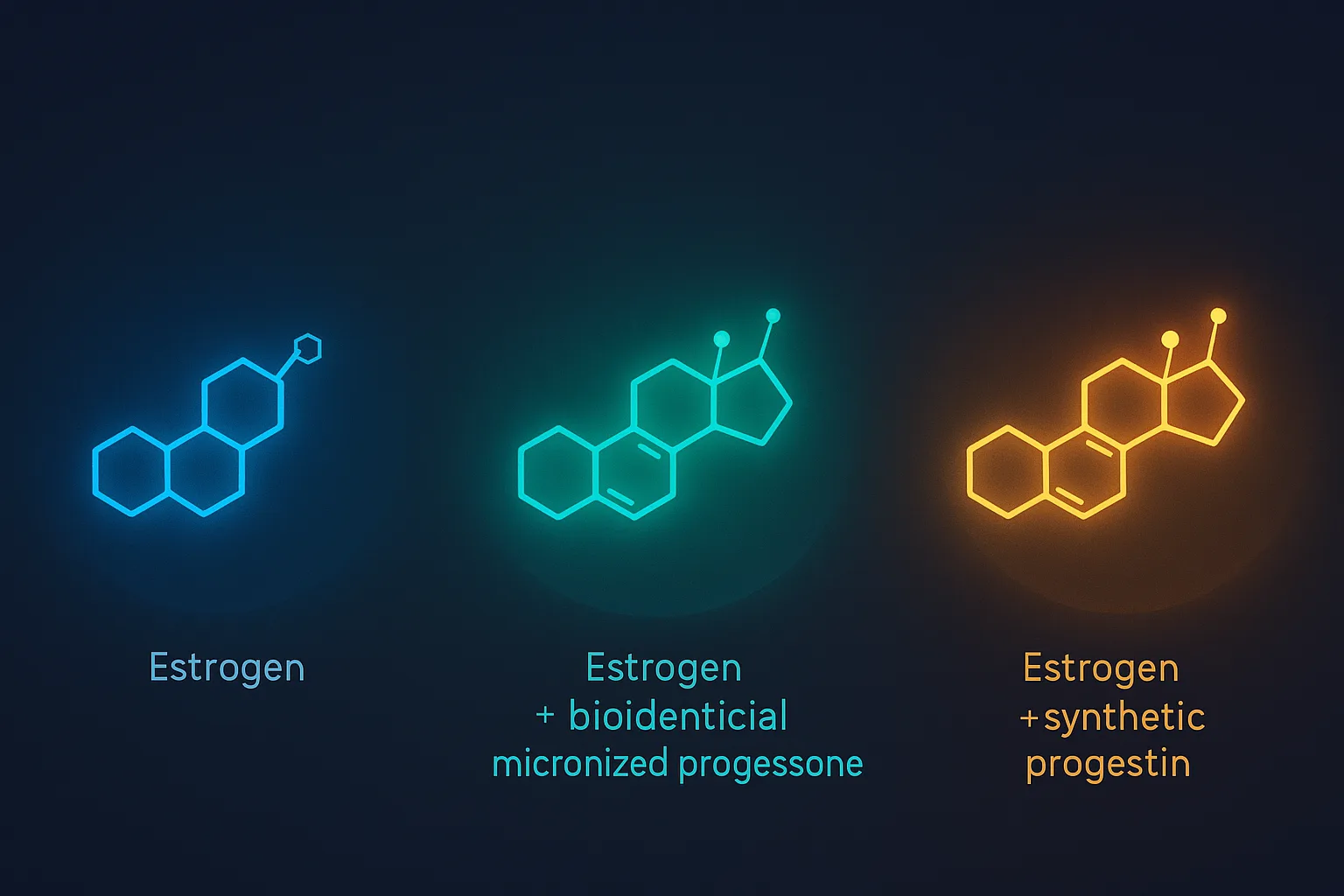
The WHI used medroxyprogesterone acetate (MPA), a synthetic progestin. Modern HRT often uses micronized progesterone, which is structurally identical to the progesterone the ovaries produce. The two compounds have different effects on breast tissue.
The E3N Cohort Data
The French E3N-EPIC cohort followed 80,377 postmenopausal women for a mean of 8.1 years, with 2,354 invasive breast cancer cases [4]. Unlike randomized trials, this study could compare specific HRT formulations as they were prescribed in real clinical practice.
The relative risk varied dramatically by progestogen type:
| Formulation |
Relative Risk |
95% CI |
| Estrogen + micronized progesterone |
1.00 |
0.83-1.22 |
| Estrogen + dydrogesterone |
1.16 |
0.94-1.43 |
| Estrogen + other synthetic progestins |
1.69 |
1.50-1.91 |
Translation: combining estrogen with bioidentical progesterone showed no measurable excess breast cancer risk in this cohort. Combining it with synthetic progestins showed a 69% relative risk increase.
This finding has been replicated in subsequent observational studies and is a major reason the 2024 menopause guidelines now favor micronized progesterone over synthetic progestins when a progestogen is needed [3].
What This Means in Practice
A woman with a uterus needs a progestogen alongside estrogen to prevent endometrial hyperplasia and endometrial cancer. The choice of progestogen is the lever that most affects breast cancer risk:
- Micronized progesterone (oral or vaginal): Preferred first-line based on E3N data
- Dydrogesterone: Second-line, lower risk than older synthetics
- Medroxyprogesterone, norethisterone, levonorgestrel: Older synthetic progestins, higher associated breast cancer risk
The estrogen choice (estradiol vs. conjugated estrogens, transdermal vs. oral) has a smaller measurable effect on breast cancer risk than the progestogen choice.
Duration Matters: The 2019 Lancet Meta-Analysis
The largest analysis of HRT and breast cancer ever conducted was published in The Lancet in 2019. It pooled individual participant data from 58 studies covering 143,887 postmenopausal women with breast cancer and 424,972 controls [2].
The Headline Findings
For current and recent HRT users, the 5-year duration effect:
| HRT Type |
RR After 5 Years |
| Estrogen-only |
1.33 |
| Estrogen + intermittent progestogen |
1.60 |
| Estrogen + daily progestogen |
2.08 |
For each additional year of use, risk continued to rise modestly. The risk attenuated after stopping, but some excess persisted for 10+ years if HRT had been used for more than 5 years. Use of less than 1 year carried minimal lasting risk.
What the Meta-Analysis Could Not Distinguish
The 2019 Lancet analysis pooled studies that mostly predated widespread micronized progesterone use. The "daily progestogen" category was dominated by synthetic progestins. This is a key limitation: the headline 2.08 relative risk likely overstates the risk for women on modern micronized progesterone regimens, whose risk profile in E3N looked closer to the estrogen-only group.
The Collaborative Group itself acknowledged this in their discussion. As more data accumulates on micronized progesterone over longer durations, the effect estimate for that specific regimen is likely to be revised downward [4].
The Window of Opportunity: Age at Initiation
When a woman starts HRT matters as much as what she takes.
The WHI enrolled women aged 50-79 at randomization, with a mean age of 63. Most participants were more than 10 years past menopause. Subsequent age-stratified analyses showed that the risk-benefit profile of HRT depends heavily on age at initiation [3]:
- Women starting HRT under age 60 or within 10 years of menopause: Lower cardiovascular risk, lower stroke risk, and a more favorable overall benefit-to-risk ratio. The breast cancer signal still applies but is set against substantial benefits.
- Women starting HRT over age 60 or more than 10 years past menopause: Higher cardiovascular and stroke risk, and a less favorable benefit-to-risk ratio.
This is the "timing hypothesis" or "window of opportunity" concept. It is now a core principle of menopause care. Starting HRT in the early postmenopausal years (within 10 years of the final menstrual period, ideally under age 60) appears to offer the strongest benefit-to-risk ratio for women without contraindications.
For more on this, see our bone density and HRT guide, which covers the same window-of-opportunity logic for skeletal protection.
Specific Risk Factors That Modify HRT Decisions
Not every woman has the same baseline breast cancer risk. Several factors modify the calculus.
Personal History of Breast Cancer
A personal history of estrogen-receptor-positive breast cancer is generally considered an absolute contraindication to systemic HRT. Vaginal estrogen at low doses for genitourinary syndrome of menopause may be considered after oncology consultation, with most evidence suggesting minimal systemic absorption and no measurable recurrence risk increase.
BRCA1 and BRCA2 Mutations
Women with BRCA1 or BRCA2 mutations who undergo risk-reducing oophorectomy face severe surgical menopause. Limited data suggests short-term HRT after risk-reducing surgery does not appear to increase breast cancer risk to clinically meaningful levels in this population, particularly for BRCA1 carriers (whose lifetime breast cancer risk is driven primarily by other factors). Decisions should involve both an oncologist and menopause specialist.
Family History Without Genetic Mutation
A first-degree family history of breast cancer increases baseline risk modestly but is not an absolute contraindication. The 2019 Lancet analysis found that the relative risk increase from HRT was similar in women with and without family history. The absolute excess remains small.
Dense Breast Tissue
Women with mammographically dense breasts have a higher baseline breast cancer risk and may have lower mammographic sensitivity. HRT (particularly combination therapy) can further increase breast density, potentially complicating screening. This warrants more frequent surveillance and shared decision-making but does not preclude HRT.
Prior Hysterectomy
Women without a uterus do not need a progestogen, which significantly improves the breast cancer risk profile. Estrogen-only therapy in this population shows neutral-to-protective effects on breast cancer in the WHI [1].
For more on this scenario, see our HRT after hysterectomy guide.
How to Lower Your Risk on HRT
If you decide HRT is right for you, several factors are within your control.
Choose Micronized Progesterone if You Need a Progestogen
Based on the E3N data, switching from synthetic progestins to micronized progesterone is the single largest modifiable risk factor for breast cancer on HRT. Discuss this with your provider if you are currently on a synthetic progestin.
Use the Lowest Effective Dose
Lower doses of estrogen still provide bone protection and adequate symptom control for many women. The dose-response relationship for breast cancer risk is modest but real. Starting at a moderate dose and titrating to symptom control rather than aiming for premenopausal estradiol levels is reasonable for most women.
Use Transdermal Estrogen if Available
Transdermal estradiol (patches, gels, sprays) avoids first-pass hepatic metabolism. While the breast cancer effect is similar to oral estrogen, transdermal delivery is associated with lower venous thromboembolism risk, which improves the overall safety profile.
Maintain Lifestyle Factors
Modifiable factors that lower baseline breast cancer risk independently of HRT:
- Limit alcohol to under 1 drink per day
- Maintain BMI under 30 (postmenopausal obesity is a major breast cancer risk factor)
- Exercise at least 150 minutes per week
- Avoid smoking
These factors operate independently of HRT and are arguably more impactful than HRT type for many women.
Maintain Surveillance
Annual mammography starting at age 40-50 (depending on guideline source) is recommended for women on HRT, with consideration of supplemental imaging (ultrasound or MRI) for women with dense breasts or elevated baseline risk.
What About Testosterone for Women?
Many women considering HRT also consider adding low-dose testosterone for libido, energy, mood, and body composition benefits. The breast cancer data for physiological-dose testosterone in women is limited but reassuring.
The 2019 Global Consensus Position Statement on testosterone therapy for women concluded that short-term testosterone at physiological replacement doses does not appear to increase breast cancer risk [6]. Some observational data even suggests a modestly protective effect, though long-term randomized data is lacking.
The mechanism is plausible. Testosterone at physiological doses in women is not significantly aromatized to estradiol. Direct androgen receptor stimulation in breast tissue may have neutral or anti-proliferative effects. Supraphysiological testosterone doses (such as those used in male transition or in performance contexts) are a different category and are not addressed by this evidence base.
For more on dosing, see our testosterone for women complete guide.

Putting the Risk in Context
For a woman in her early 50s with bothersome menopausal symptoms, the decision tree usually looks like this:
Step 1: Is there an absolute contraindication?
- Personal history of breast cancer
- Active venous thromboembolism
- Active or recent stroke or coronary disease
- Unexplained vaginal bleeding
- Active liver disease
If yes, systemic HRT is not appropriate. Vaginal estrogen and non-hormonal options remain.
Step 2: Is the woman within 10 years of menopause and under age 60?
- If yes, the window-of-opportunity benefits apply.
- If no, the risk-benefit calculus shifts and requires more individualized discussion.
Step 3: Does she have a uterus?
- If yes, a progestogen is needed. Strongly prefer micronized progesterone over synthetic progestins.
- If no, estrogen-only therapy is appropriate, with neutral-to-protective breast cancer effects.
Step 4: What is her baseline breast cancer risk?
- Family history, breast density, lifestyle factors, prior biopsies all factor in.
- Tools like the Tyrer-Cuzick or Gail model can quantify baseline risk.
Step 5: How severe are her symptoms?
- Severe vasomotor symptoms, sleep disruption, mood changes, and genitourinary syndrome have significant quality-of-life and downstream health costs that must be weighed against modest absolute risk increases.
For most women within the window of opportunity, on micronized progesterone (if needed), the absolute breast cancer risk increase is small enough that quality-of-life and other health benefits frequently outweigh it.
What the Updated Guidance Says
The 2024 update of the Women's Health Initiative review in JAMA, the 2022 Menopause Society position statement, and the 2024 European Menopause Society guidelines have converged on similar conclusions [3]:
- HRT is appropriate first-line therapy for bothersome menopausal symptoms in women under 60 or within 10 years of menopause without contraindications
- The breast cancer risk associated with HRT is real but modest and depends on formulation and duration
- Micronized progesterone is preferred over synthetic progestins when a progestogen is needed
- Estrogen-only HRT in women without a uterus does not increase, and may decrease, breast cancer risk and mortality
- The 2002 WHI communication created lasting harm; current guidance reflects more nuanced interpretation of the same and subsequent data
The FDA removed the black-box warning for systemic estrogen products in late 2025, citing the body of evidence accumulated since the 2002 trial halt [3]. This marks a meaningful shift in regulatory framing.
For more on the regulatory context, see our coverage of the FDA black-box warning removal.
Finding a Provider Who Understands the Nuance
Many primary care providers were trained during the post-WHI era and remain reflexively cautious about HRT. Finding a provider who understands the modern evidence base, distinguishes between progestogen types, and discusses the window-of-opportunity framework matters.
Specialty menopause clinics and telehealth platforms staffed by clinicians certified by the Menopause Society are generally better equipped to navigate these decisions than non-specialized primary care.
If you are considering HRT, see our guide to the best online HRT clinics for women for vetted options. For broader background on what HRT involves, see our bioidentical vs. synthetic HRT guide.
References
-
Chlebowski RT, Anderson GL, Aragaki AK, et al. Association of Menopausal Hormone Therapy With Breast Cancer Incidence and Mortality During Long-term Follow-up of the Women's Health Initiative Randomized Clinical Trials. JAMA. 2020;324(4):369-380. PMID: 32721007
-
Collaborative Group on Hormonal Factors in Breast Cancer. Type and timing of menopausal hormone therapy and breast cancer risk: individual participant meta-analysis of the worldwide epidemiological evidence. Lancet. 2019;394(10204):1159-1168. PMID: 31474332
-
Manson JE, Crandall CJ, Rossouw JE, et al. The Women's Health Initiative Randomized Trials and Clinical Practice: A Review. JAMA. 2024;331(20):1748-1760. PMID: 38691368
-
Fournier A, Berrino F, Clavel-Chapelon F. Unequal risks for breast cancer associated with different hormone replacement therapies: results from the E3N cohort study. Breast Cancer Res Treat. 2008;107(1):103-111. PMID: 17333341
-
Chlebowski RT, Rohan TE, Manson JE, et al. Breast Cancer After Use of Estrogen Plus Progestin and Estrogen Alone: Analyses of Data From 2 Women's Health Initiative Randomized Clinical Trials. JAMA Oncol. 2015;1(3):296-305. PMID: 26181174
-
Davis SR, Baber RJ, Panay N, et al. Global Consensus Position Statement on the Use of Testosterone Therapy for Women. J Sex Med. 2019;16(9):1331-1337. PMID: 31488288
-
Fournier A, Berrino F, Riboli E, Avenel V, Clavel-Chapelon F. Breast cancer risk in relation to different types of hormone replacement therapy in the E3N-EPIC cohort. Int J Cancer. 2005;114(3):448-454. PMID: 15551359
-
Chlebowski RT, Anderson GL, Gass M, et al. Estrogen plus progestin and breast cancer incidence and mortality in postmenopausal women. JAMA. 2010;304(15):1684-1692. PMID: 20959578
