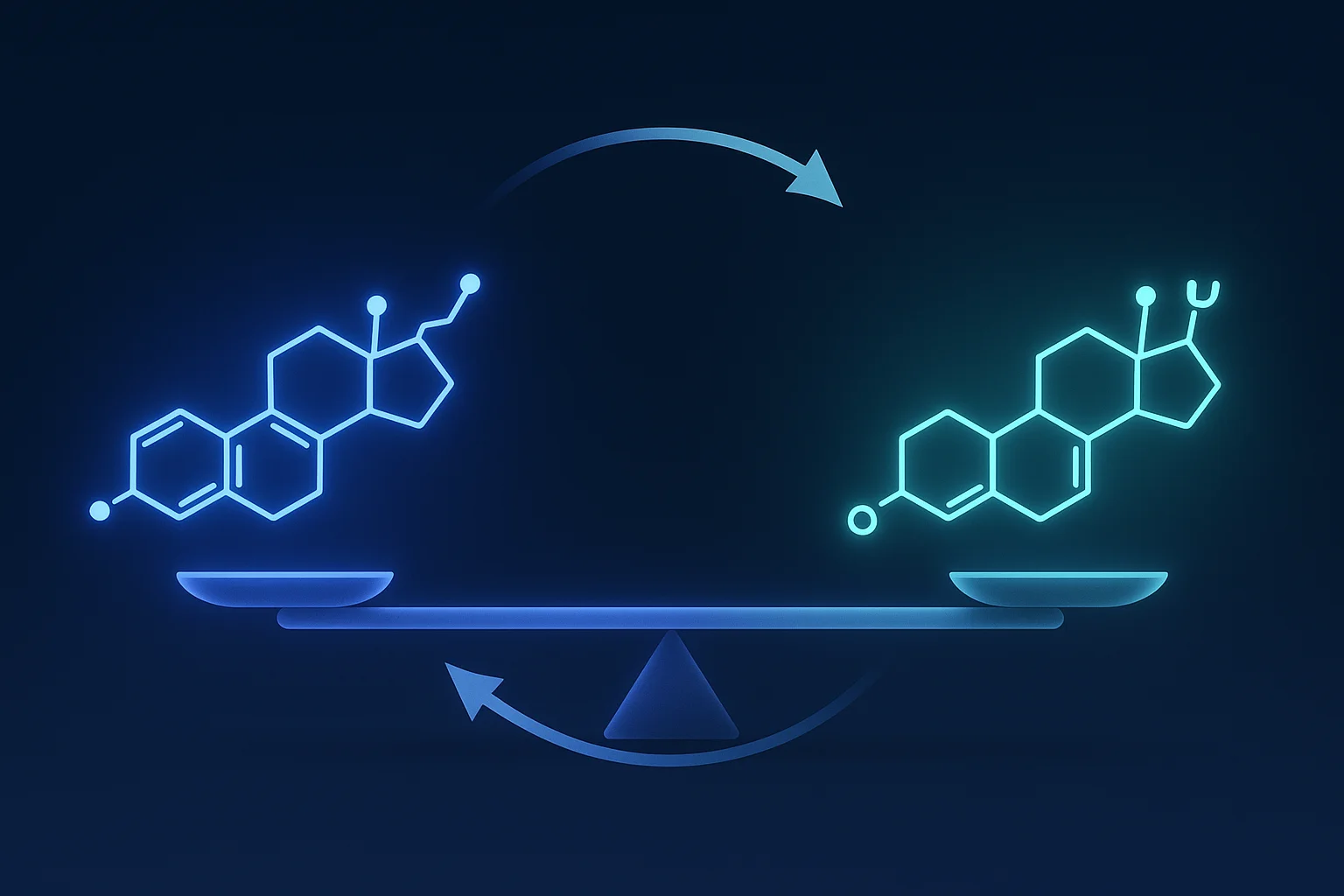
Estrogen management is arguably the most misunderstood aspect of TRT. For years, the default approach was to prescribe an aromatase inhibitor (AI) alongside testosterone to keep estrogen "under control." That approach is falling out of favor -- and for good reason. Crashing estrogen causes more harm than moderately elevated estrogen in most men.
This guide covers what estradiol actually does, when it's genuinely a problem, and how to manage it without reflexively reaching for an AI.
What Is Estradiol and Why Does It Matter?
Estradiol (E2) is the primary active form of estrogen in men. It's produced when the aromatase enzyme converts testosterone to estradiol. This happens primarily in adipose (fat) tissue, but also in the brain, bones, and blood vessels.
Men need estradiol. It's not a "female hormone" you want to eliminate -- it's an essential hormone that both sexes require for health.
What Estradiol Does in Men
Bone health: Estradiol is the dominant regulator of bone density in men, even more so than testosterone itself. Men with low estrogen develop osteoporosis. A landmark study in the New England Journal of Medicine (Finkelstein et al., 2013) demonstrated that estrogen deficiency -- not androgen deficiency -- was the primary driver of bone loss in men.
Cardiovascular protection: Estradiol has vasodilatory and anti-inflammatory effects on blood vessels. Men with very low estrogen have increased cardiovascular risk. The cardioprotective effect of estrogen in men is well-documented in epidemiological studies.
Brain function: Estradiol supports cognition, mood, and neuroprotection. Low estrogen in men is associated with increased depression, anxiety, and cognitive decline. The brain actually produces its own estradiol locally through neural aromatase.
Sexual function: Adequate estrogen is required for libido. This surprises many men, but low estrogen can kill libido just as effectively as low testosterone. The androgen-to-estrogen ratio matters, but both hormones need to be in range.
Joint health: Estradiol maintains synovial fluid production and joint lubrication. Men who crash their estrogen with AIs consistently report joint pain -- dry, achy, clicking joints that resolve when estrogen recovers.
Optimal Estradiol Range on TRT
There's no single perfect number. The commonly cited target of 20-35 pg/mL is a reasonable starting point, but context matters more than any single number.
The Sensitive Estradiol Test
Always request the sensitive estradiol test (LC/MS-MS method), not the standard immunoassay. The standard test is designed for female estrogen ranges and is inaccurate for male ranges. It frequently overstates estradiol by 20-30%, leading to unnecessary AI use. Quest Diagnostics and LabCorp both offer the sensitive assay -- make sure your provider orders the correct one.
Range by Context
Estradiol Level
Assessment
Below 15 pg/mL
Too low. Risk of bone loss, joint pain, depression, low libido
15-20 pg/mL
Low end. Monitor symptoms. Some men feel fine here; others feel better higher
20-35 pg/mL
Sweet spot for most men. Symptom-free, good bone and cardiovascular support
35-50 pg/mL
Mildly elevated. Many men are asymptomatic here. Only intervene if symptomatic
Above 50 pg/mL
Likely symptomatic. Investigate and address
The critical insight: The number on the lab report matters less than how you feel. A man with estradiol at 45 pg/mL who has no symptoms does not need an AI. A man with estradiol at 35 pg/mL who has significant water retention and nipple sensitivity may benefit from intervention. Treat the patient, not the lab value.
Symptoms of High Estradiol
Learn to recognize these symptoms so you can identify estrogen issues before they become significant:
Physical Symptoms
Water retention: Puffy face, swollen ankles, rings feeling tight, rapid weight gain (2-5 lbs over a few days) that isn't explained by diet
Nipple sensitivity or soreness: Early warning sign. The tissue behind the nipple may feel tender to touch
Gynecomastia: Actual breast tissue growth. This takes weeks to months of sustained high estrogen. If caught early (sensitivity/tenderness), it's reversible. Established glandular tissue requires surgery.
Acne: Particularly on the back and shoulders
Bloating: Abdominal distension unrelated to food intake
Anxiety: Particularly a generalized, unexplained anxiety
Erectile dysfunction: Specifically, difficulty maintaining erections despite adequate testosterone. Some men describe erections as "softer" with high estrogen.
Reduced libido: Paradoxically, both high and low estrogen can reduce sex drive
Important Caveat
Many of these symptoms overlap with other conditions. Water retention can be caused by high sodium intake. Mood swings can be caused by sleep deprivation. Erectile issues can be vascular. Don't assume every symptom is estrogen-related -- confirm with labs before making changes.
Bone pain: Aching bones, increased fracture risk long-term
Crashed estrogen takes 2-4 weeks to recover from after stopping an AI. During that time, the man feels terrible. This is why the modern TRT community has moved strongly toward avoiding AIs whenever possible.
When NOT to Use an Aromatase Inhibitor
Do not use an AI if:
Your estradiol is under 50 pg/mL and you have no symptoms
You're basing the decision solely on a lab number without symptoms
You haven't tried increasing injection frequency first
You haven't tried reducing your dose first
You're using the standard (non-sensitive) estradiol test and getting inflated results
You're a lean individual who doesn't aromatize heavily (body fat under 15%)
The reflexive prescription of an AI alongside every TRT protocol is outdated medicine. Many progressive TRT clinics no longer prescribe AIs as part of standard protocols.
Non-AI Strategies for Estradiol Management
Before reaching for a pharmaceutical, try these approaches. They work for the majority of men.
1. Increase Injection Frequency
This is the single most effective non-pharmaceutical estradiol management strategy.
Aromatase activity is proportional to testosterone concentration. Higher peaks mean more aromatization. By splitting your dose into more frequent injections (from weekly to twice weekly, from twice weekly to EOD or daily), you reduce peak testosterone levels without changing your total weekly dose.
Most men who switch from once weekly to EOD or daily injections see estradiol drop by 20-40% without any other intervention. See our injection frequency guide for detailed protocols.
2. Reduce Total Dose
If estradiol is high, your testosterone dose may be higher than you need. Reducing by 10-20mg per week lowers both testosterone and estradiol. If your trough testosterone is above 900 ng/dL and your estradiol is elevated, a dose reduction addresses both issues simultaneously.
3. Lose Body Fat
Adipose tissue is the primary site of aromatase expression. More body fat means more aromatase enzyme and more testosterone-to-estradiol conversion. A man at 30% body fat will aromatize significantly more than the same man at 15%.
This creates a virtuous cycle: TRT helps you lose fat, which reduces aromatization, which reduces estrogen, which further improves body composition.
4. Limit Alcohol
Alcohol increases aromatase activity acutely. Heavy drinking can spike estradiol noticeably. If you're struggling with estrogen management, reducing or eliminating alcohol may help.
5. Dietary Considerations
Certain dietary factors influence estrogen metabolism:
Cruciferous vegetables (broccoli, cauliflower, Brussels sprouts) contain indole-3-carbinol, which supports healthy estrogen metabolism through the 2-hydroxy pathway
Adequate fiber supports estrogen excretion through the gut
Zinc is a mild natural aromatase inhibitor. Most men on TRT benefit from 25-50mg daily
DIM (diindolylmethane) is a supplement derived from cruciferous vegetables that modestly supports estrogen metabolism. Evidence is limited, but some men report benefit at 100-200mg daily
These are adjuncts, not replacements for proper protocol management. Don't rely on supplements to fix a protocol problem.
When an AI IS Appropriate
Despite the anti-AI movement (which is largely correct), there are legitimate situations where an aromatase inhibitor is the right tool:
Symptomatic gynecomastia that's progressing despite frequency increases and dose reduction
Estradiol consistently above 50-60 pg/mL with symptoms despite optimizing injection frequency, dose, and body composition
Men who are genetically high aromatizers and have exhausted non-pharmaceutical strategies
Short-term use while making protocol changes that take weeks to show effect
If an AI is needed, the approach should be lowest effective dose, used temporarily while addressing root causes (frequency, dose, body composition). The goal is to use the AI as a bridge, not a permanent addition. See our aromatase inhibitor guide for specific protocols.
The Anti-AI Movement: Context and Nuance
The shift away from routine AI use in TRT is driven by several factors:
Bone health concerns: Long-term AI use reduces estradiol chronically, which impairs bone mineral density. In women with breast cancer, long-term AI therapy is associated with significant osteoporosis and fracture risk. While the doses used in TRT are much lower, the principle applies.
Lipid profile disruption: AIs tend to worsen lipid profiles, particularly reducing HDL cholesterol. This is counterproductive on TRT, where lipid management is already important.
Mood and quality of life: Men with estradiol below 20 pg/mL consistently report worse quality of life, mood, and sexual function than men with higher levels. Aggressive AI dosing pushes men into this zone.
Better alternatives exist: Increasing injection frequency and optimizing dose achieve the same estrogen control without the side effects of AIs.
That said, the anti-AI movement can go too far. Some men genuinely need an AI, and dismissing the tool entirely is as dogmatic as prescribing it to everyone. The nuanced position: exhaust non-pharmaceutical options first, use an AI only when truly necessary, and keep the dose as low as possible.
Monitoring Protocol
Test
Frequency
Notes
Sensitive Estradiol (LC/MS-MS)
Every 6-8 weeks during optimization, then every 6 months
Always use the sensitive assay
Total Testosterone (trough)
Same schedule
Interpret estradiol in context of testosterone levels
Free Testosterone
Same schedule
Estradiol correlates more with free T than total T
SHBG
Annually or if estradiol is unexpectedly high/low
High SHBG can affect estradiol metabolism
Draw labs at trough (morning of your next injection, before injecting) for the most clinically useful picture — see titrating TRT by trough levels for how prescribers anchor dose adjustments to these draws. Quality TRT providers order the sensitive E2 assay by default and adjust protocols based on symptoms, not just numbers -- see which clinics get estradiol management right.
The Bottom Line
Estradiol is your ally, not your enemy. Most men on TRT need no estrogen intervention beyond a sensible injection protocol. Learn to distinguish actual estrogen symptoms from unrelated issues, use the sensitive assay for accurate results, and exhaust non-pharmaceutical strategies before considering an AI.
The best estrogen management is a well-designed TRT protocol: appropriate dose, frequent injections, and healthy body composition. Everything else is a distant second.