
T:E2 Ratio on TRT: Target 12-22 for Libido & Mood

5/2/2026
5 min read
By The TRT Catalog

Why your testosterone-to-estradiol ratio predicts libido and erections better than either number alone. Target ranges, math, and protocol fixes.

Testosterone to estradiol ratio illustration showing balanced hormone scale

Key Takeaways: The testosterone-to-estradiol (T:E2) ratio captures the hormonal context that single numbers miss. Most men on TRT feel best with a ratio between 15 and 22. A ratio below 12 predicts erectile dysfunction with 90%+ specificity in published research. Ratios above 30 usually mean crashed estradiol from overzealous AI use. Calculate it once at every trough draw and watch how it tracks symptoms more reliably than either hormone alone.

Single-hormone targets miss the point. Two men with identical estradiol levels of 40 pg/mL can feel wildly different — one optimal, the other plagued with erectile issues — depending on where their testosterone sits. The T:E2 ratio captures that relationship. It is the most underused number on a standard TRT lab panel.

This guide covers what the ratio actually measures, how to calculate it, target ranges by goal, and protocol fixes when the math is off.

What the T:E2 Ratio Measures

Testosterone and estradiol are not opposing hormones in men. They are complementary. Aromatase converts a fraction of circulating testosterone into estradiol, and that estradiol drives bone density, cardiovascular protection, joint lubrication, mood, and a meaningful share of libido.

When prescribers track total testosterone and estradiol as separate numbers, they miss the interaction. The body responds to the relationship, not the absolutes.

A few clinical examples make the point:

  • A man with total T of 1100 ng/dL and E2 of 50 pg/mL has a ratio of 22. He likely feels great.
  • A man with total T of 500 ng/dL and E2 of 50 pg/mL has a ratio of 10. He likely has libido and erection complaints despite an estrogen number that looks "fine" in isolation.
  • A man with total T of 900 ng/dL and E2 of 18 pg/mL has a ratio of 50. He looks great on paper but his joints ache, his mood is flat, and his libido is suppressed by crashed estrogen.

Each of those men would receive different (and probably wrong) advice from a prescriber who only looks at single numbers.

How to Calculate Your Ratio

The formula is straightforward when both labs are in standard US units:

T:E2 ratio = total testosterone (ng/dL) ÷ sensitive estradiol (pg/mL)

A worked example: total T of 850 ng/dL with sensitive E2 of 38 pg/mL produces a ratio of 22.4. Use the free testosterone and total testosterone breakdown for context on which testosterone number to plug in — most published research uses total T, so total is the standard input.

Three rules make the math meaningful:

  1. Both samples come from the same draw. Comparing a trough testosterone from week 6 to a peak estradiol from week 2 produces nonsense.
  2. Estradiol must be the sensitive assay (LC/MS-MS). Standard immunoassay overstates male estradiol by 20-30%, which artificially deflates your ratio. Quest and LabCorp both offer the sensitive test — confirm it on the requisition.
  3. Draw at trough. Morning of your next injection, before injecting. Peaks distort the picture.

If your prescriber is not anchoring dose changes to trough draws, see how titrating by trough levels actually works.

Target Ranges

There is no single "perfect" ratio, but the published evidence and clinical observation converge on a workable framework.

Ratio Interpretation Typical Symptoms
Below 8 Estrogen dominance Water retention, gynecomastia risk, fatigue, low libido despite adequate T
8-12 Suboptimal Reduced morning erections, blunted libido, mood dips
12-15 Lower normal Many men feel acceptable here, especially with E2 around 30-40
15-22 Sweet spot for most TRT patients Strong libido, stable mood, good joint function
22-30 Upper normal Often fine, watch for joint pain or libido drop
Above 30 Estrogen-suppressed Joint pain, depressed mood, poor sleep, crashed libido, bone density risk

The 12.0 cutoff comes from a 2021 study in male hypogonadism patients. Researchers found that a T:E2 ratio of 12.0 predicted adequate erectile function (≥3 morning erections per week) with 93.8% sensitivity and 90.0% specificity — better than either testosterone or estradiol measured alone (PMID 34591405).

A 2016 study reached a complementary conclusion: T:E2 ratio was a useful predictive tool for erectile dysfunction and low sexual desire in hypogonadal men, capturing dynamics that absolute hormone values missed (PMID 27876434).

A 2025 review in the World Journal of Men's Health aggregated the available data and confirmed that healthy young men typically run ratios between 11 and 23, providing a useful reference range for TRT targets.
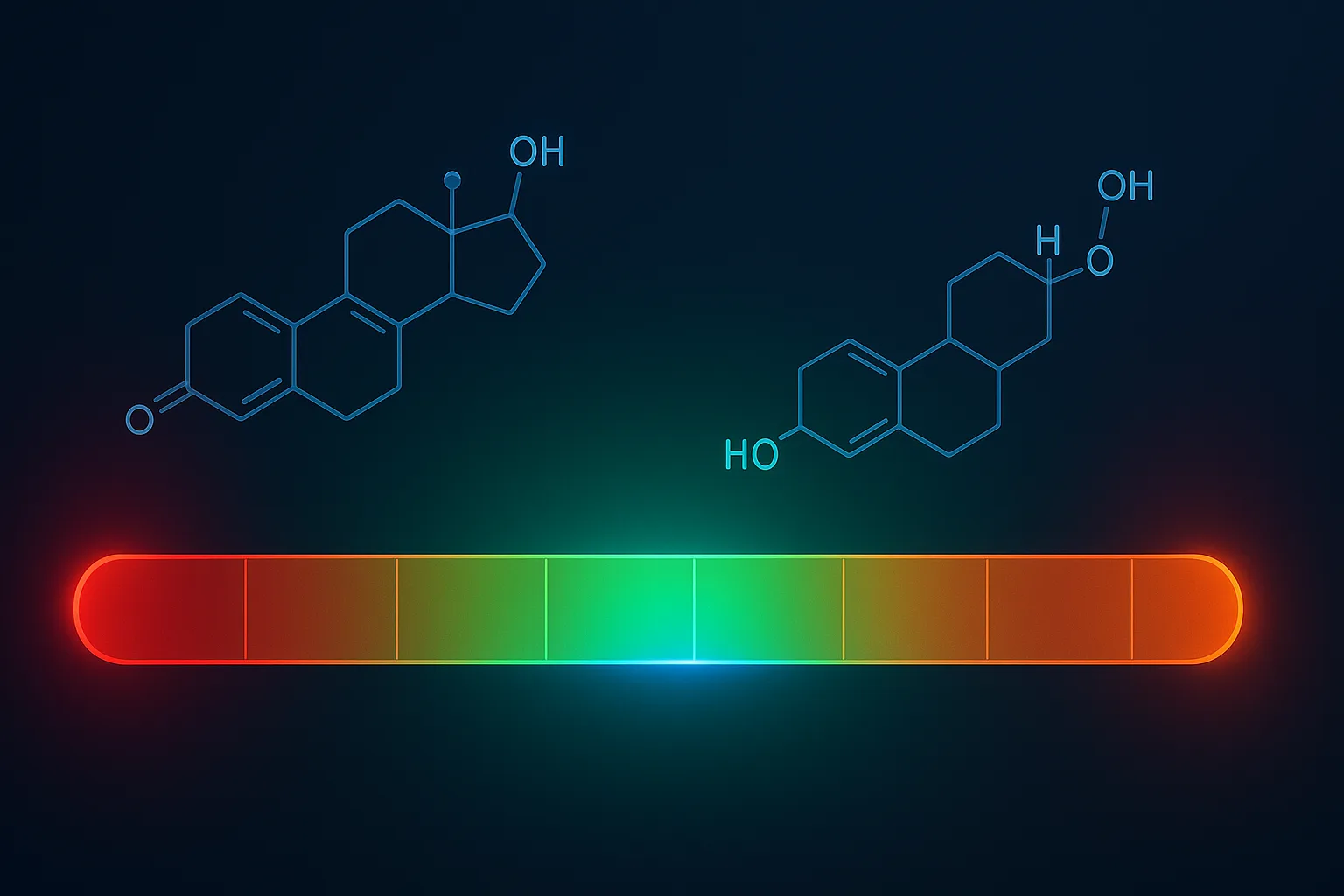
Hormone ratio table comparing optimal vs suboptimal testosterone-to-estradiol values

Why Single Numbers Mislead

The classic case is the "high estrogen panic." A man sees E2 of 45 pg/mL on his lab report, his prescriber adds an aromatase inhibitor, and within four weeks the man feels worse — joint pain, no libido, depressed mood. What happened?

The original ratio was healthy. Total T was 950 ng/dL, E2 was 45 pg/mL, ratio was 21. He felt great. The AI dropped E2 to 12 pg/mL while leaving testosterone at 950 ng/dL, pushing the ratio to 79. The number on the report looked "better" but the patient was now estrogen-suppressed.

Conversely, men with chronically suppressed estradiol from AIs often have testosterone in the 800-1000 range and feel terrible. The ratio explains why. They are not low T — they are low E2 in the context of normal T.

The lesson: single-number targets create false reassurance and false alarms. The ratio reads the actual hormonal context.

Goal-Specific Considerations

Different goals tilt the optimal ratio slightly.

Libido and erectile function: The 12-22 range is well-supported for sexual function. Below 12, expect problems. Above 30, the same problems return from the other direction.

Body composition: The Finkelstein 2013 NEJM trial (PMID 24024838) demonstrated that lean mass and strength were testosterone-driven while fat accumulation was estradiol-driven. A ratio in the 15-22 range supports both: enough androgen to build muscle, enough estrogen to keep fat regulation working.

Bone health: Estradiol is the dominant bone-density regulator in men. Ratios above 25 sustained for years correlate with bone loss. If you are on an AI and your ratio is consistently above 25, your skeleton is paying a slow tax.

Mood and cognition: Both extremes hurt. Ratios under 10 produce flat affect and low motivation. Ratios over 30 produce anxiety, depressed mood, and brain fog. The middle band is the only place mood reliably stabilizes.

Cardiovascular profile: Estradiol is vasoprotective in men. Ratios above 30 from chronic AI use worsen lipid profiles (lower HDL) and remove a layer of vascular protection.
Protocol Fixes for an Off Ratio

The first instinct when the ratio is wrong is to reach for a drug. Most of the time the protocol itself is the lever.

When the Ratio Is Too Low (Below 12)

This is estrogen dominance relative to testosterone. The fixes, in order of preference:

  1. Increase injection frequency. Once-weekly injections produce sharp aromatization spikes 24-48 hours after dosing. Splitting the same weekly dose across two or three injections, or going to every-other-day, smooths the peak and reduces total estradiol exposure without changing the dose. See injection frequency comparisons for the protocol math.
  2. Reduce body fat. Adipose tissue is the primary site of aromatase enzyme expression. A man at 28% body fat will aromatize substantially more than the same man at 16%. Body composition is a slower lever but it shifts the ratio durably.
  3. Reduce alcohol. Alcohol acutely upregulates aromatase. Heavy drinkers run lower T:E2 ratios on identical TRT protocols.
  4. Confirm the assay. Standard immunoassay can overstate male E2 by 20-30%, falsely depressing the ratio. Repeat with the sensitive assay before changing anything.
  5. Consider a low-dose AI as a bridge only if symptomatic and after the first four levers are exhausted. Anastrozole at 0.125-0.25 mg once or twice weekly is plenty for most aromatizers. See the aromatase inhibitor guide for AI-specific dosing logic and risks.

When the Ratio Is Too High (Above 30)

This is almost always crashed estradiol from too much AI. The fixes:

  1. Stop or reduce the AI. Most men on AIs are over-dosed. Cutting the dose in half is often enough; in many cases stopping entirely and waiting six weeks lets E2 climb back into range.
  2. Confirm injection frequency is appropriate. Daily microdosing or EOD injections produce smoother E2 curves than once-weekly, but the smoother curve sometimes runs slightly lower estradiol overall. If your ratio is high on EOD with no AI, you may simply need a slightly higher dose.
  3. Recheck total testosterone. A ratio of 35 with total T of 1300 means your dose is high and your AI use is suppressing E2 even further. Cut the testosterone dose first; the AI need usually disappears.

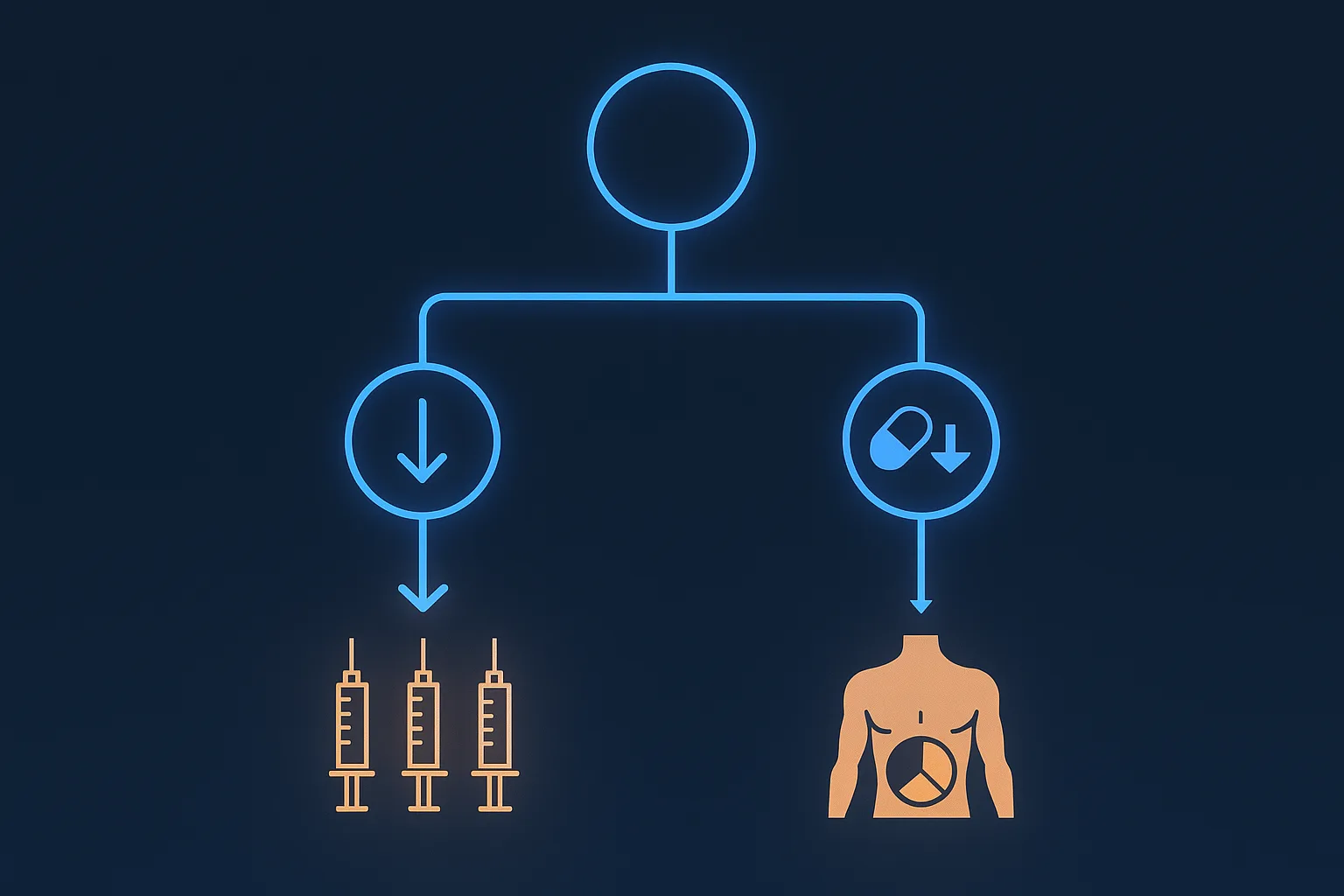
Protocol decision flow for adjusting testosterone-estradiol ratio

When to Recheck

Estradiol responds to protocol changes within roughly two weeks. The full new steady state takes about six weeks. Rechecking sooner produces noisy data.

A reasonable schedule:

  • Initial TRT or major protocol change: trough panel including sensitive E2 at 6-8 weeks
  • Minor dose adjustment: trough panel at 4-6 weeks
  • Maintenance: every 6 months once stable
  • Symptom flare: as soon as symptoms persist beyond two weeks

Always include sensitive E2 alongside total and free testosterone. A panel without estradiol cannot calculate the ratio, and a panel with standard immunoassay E2 produces an inaccurate ratio.

What This Means for Choosing a Clinic

A clinic that defaults to the standard immunoassay, prescribes anastrozole reflexively when E2 reads above 40, or never calculates the ratio is operating from a single-number framework. That framework produces predictable problems: AI overuse, joint complaints, libido issues despite "good" testosterone numbers.

Quality TRT providers in 2026 do three things differently: they order the sensitive E2 assay by default, they adjust dose and frequency before reaching for an AI, and they treat estradiol as a context-dependent value tied to total testosterone rather than a fixed target. Compare which TRT clinics get hormone management right before committing to a protocol.

The Bottom Line

The T:E2 ratio reads the hormonal interaction that single numbers cannot. Aim for 15-22 in most cases, recognize that ratios under 12 predict sexual dysfunction and ratios over 30 predict estrogen-suppression complaints, and treat the protocol — frequency, dose, body composition — before reaching for an aromatase inhibitor.

Calculate it at every trough draw. It is the single most useful piece of math you can do with a TRT lab panel.

References

  1. Tan RB, Suana AJ, et al. Role of testosterone to estradiol ratio in predicting the efficacy of recombinant human chorionic gonadotropin and testosterone treatment in male hypogonadism. Aging Male. 2021. PMID: 34591405
  2. Schulster M, Bernie AM, Ramasamy R. The role of estradiol in male reproductive function. Asian J Androl. T:E2 ratio diagnostic utility for ED and low sexual desire. PMID: 27876434
  3. Finkelstein JS, Lee H, Burnett-Bowie SAM, et al. Gonadal Steroids and Body Composition, Strength, and Sexual Function in Men. N Engl J Med. 2013;369:1011-1022. PMID: 24024838
  4. World Journal of Men's Health 2025 review: A Review on Testosterone:Estradiol Ratio — Does It Matter, How Do You Measure It, and Can You Optimize It? PMC12257316

Related Reading


This content is for informational purposes only and is not medical advice. Consult a qualified healthcare provider before starting any treatment.

Frequently Asked Questions

What is a healthy testosterone-to-estradiol ratio?

Healthy young men typically run a T:E2 ratio between roughly 11 and 23 when testosterone is reported in ng/dL and estradiol in pg/mL. On TRT most men feel best with a ratio of 15-22. Below 12 is associated with erectile dysfunction and reduced morning erections in published trials.

How do I calculate my T:E2 ratio?

Divide total testosterone in ng/dL by sensitive estradiol in pg/mL. Example: total T 850 / E2 35 = ratio of 24. Both samples should be drawn at the same trough draw and the estradiol must be the LC/MS-MS sensitive assay, not the standard immunoassay.

Is the T:E2 ratio more useful than estradiol alone?

Often, yes. A 2021 study found a T:E2 cutoff of 12.0 predicted adequate erectile function with 93.8% sensitivity and 90.0% specificity. Two men with the same E2 of 40 pg/mL can feel completely different depending on whether their testosterone is 600 or 1000 ng/dL — the ratio captures that context.

How do I raise a low T:E2 ratio without using an AI?

Increase injection frequency to flatten peak aromatization, reduce body fat to lower aromatase enzyme load, cut alcohol, and confirm you used the sensitive E2 assay. A low total dose with stable peaks usually fixes the ratio without anastrozole.

Can my ratio be too high?

Yes. A T:E2 above 30 typically means estradiol is suppressed — often from over-dosed aromatase inhibitor use. Symptoms include joint pain, low libido, depressed mood, and poor lipid profile. Bone density also drops over time. The fix is usually stopping or reducing the AI.