Why prescribers titrate TRT by trough labs, what target ranges published guidelines describe, and how the 6-8 week recheck cycle anchors dose decisions.
This article reports what published clinical guidelines and trial literature describe about lab-based titration of testosterone replacement therapy. It is not medical advice. TRT requires a licensed prescriber for individual dose decisions, lab interpretation, and titration.
The single most reliable signal in TRT dose management is the trough total testosterone level. Published clinical guidelines from the Endocrine Society, AUA, EAA, and BSSM all anchor dose decisions to lab values drawn at the trough — the lowest point in the dose interval, immediately before the next injection. Other signals matter (subjective response, hematocrit, estradiol, free testosterone), but the trough level is what prescribers titrate against. This page describes how the trough-driven titration cycle works, what target ranges show up in published literature, and how the 6-8 week recheck cycle anchors the dose decisions described in the TRT dosing ranges hub.
If you are working with a clinic that does not draw trough labs, or that adjusts dose without waiting for steady state, the literature below is what well-managed prescribing looks like.
Why Trough Is the Standard Timing Convention
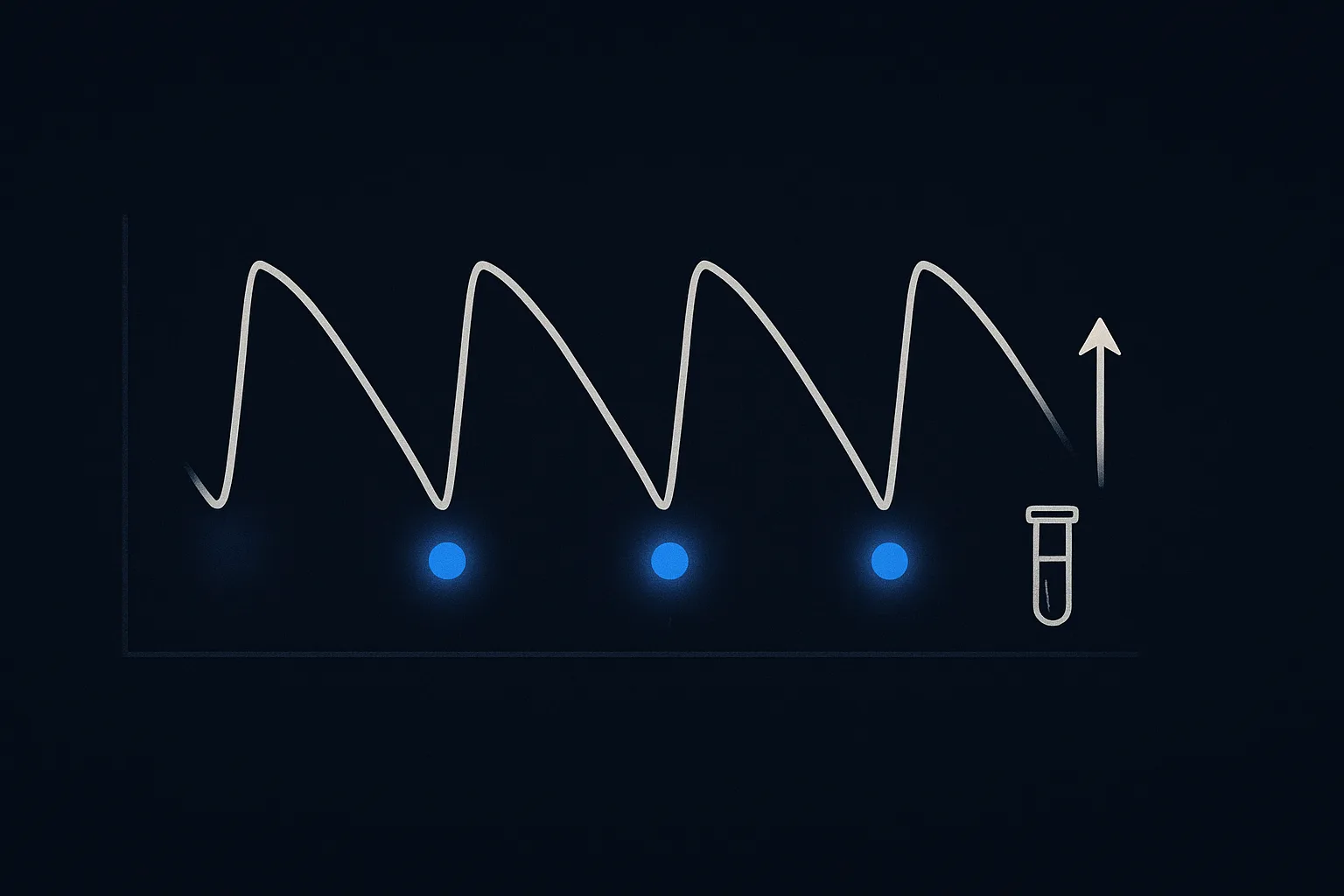
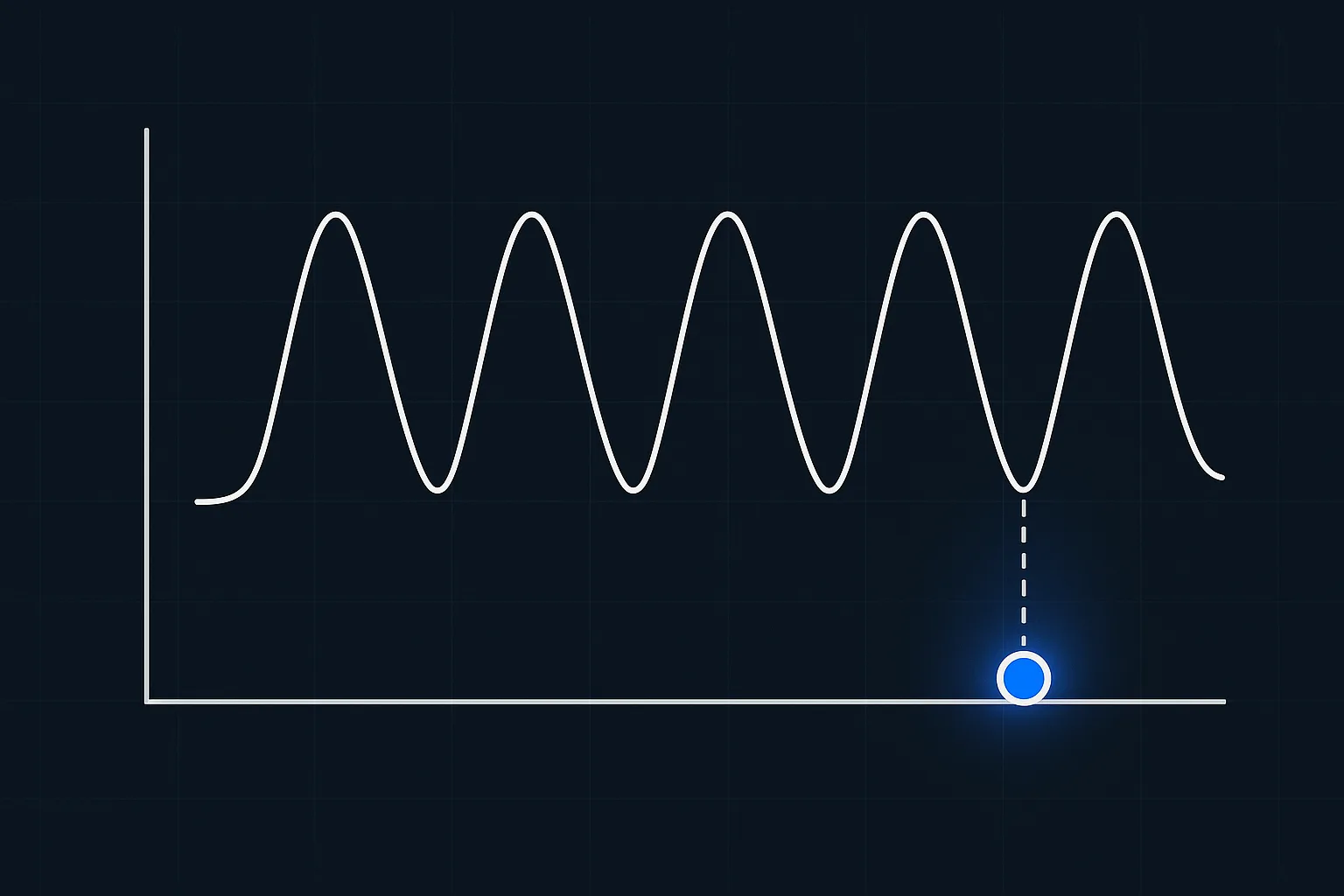
Long-acting testosterone esters — cypionate and enanthate are the two most commonly prescribed in the U.S. — produce a sawtooth pattern in serum levels. A 100 mg injection on day 1 produces a peak around day 2-3, a fall back to baseline by day 5-7, then a sharp rise again with the next injection. Three reasons published guidelines specify trough timing:
1. Trough levels are the most reproducible time point
Peak levels depend on exact timing relative to the last injection, which is hard to standardize across patients and visits. Trough levels are anchored to a defined point — the morning of the next injection, before the dose — which is the same across visits and across patients on the same dose interval. This makes longitudinal comparison meaningful.
2. Trough levels best predict the floor of the patient's exposure
Symptom response on TRT is driven by sustained testosterone exposure, not by transient peaks. The trough represents the floor of that exposure. A patient whose trough is 700 ng/dL spends the entire week between injections at or above 700 ng/dL — meaningful, sustained replacement. A patient whose trough is 350 ng/dL spends part of every week below physiologic replacement levels, regardless of how high the peak is.
3. Trough levels reduce the risk of overdosing
Targeting a peak of 800 ng/dL means accepting a trough that may fall well below normal. Targeting a trough of 700 ng/dL means accepting a peak that exceeds 1000 ng/dL on a standard twice-weekly cypionate protocol. Published guidelines uniformly favor the trough-targeting approach because it ensures the floor of exposure stays in the therapeutic range, even if the peak briefly exceeds it.
The Endocrine Society guideline states explicitly that for injectable testosterone esters, monitoring should be performed midway between injections (or at trough), not at peak.
Target Trough Ranges Described in Published Guidelines
Published guidelines describe target trough total testosterone ranges that overlap but are not identical:
Endocrine Society (Bhasin et al., 2018)
Target total testosterone in the middle tertile of the normal reference range for the laboratory and assay used. On Quest and LabCorp standard reference ranges (approximately 264-916 ng/dL), this works out to roughly 480-700 ng/dL.
AUA (Mulhall et al., 2018)
Target total testosterone in the middle tertile of the normal reference range, similar to the Endocrine Society. The AUA also notes that men should have symptom resolution alongside biochemical normalization — labs alone are not the endpoint.
EAA (Corona et al., 2020)
Target total testosterone "in the mid-normal range," again referencing the laboratory's reference interval. EAA emphasizes that the goal is restoration of physiologic levels, not supraphysiologic levels.
BSSM (Hackett et al., 2017)
Target total testosterone "in the upper half of the normal reference range," which is a slightly more aggressive target than the Endocrine Society recommendation but still within the normal reference. BSSM also discusses free testosterone targeting for men with abnormal SHBG.
What U.S. cash-pay practice looks like
Cash-pay telehealth clinics typically aim for trough total testosterone of 600-900 ng/dL — somewhat higher than the Endocrine Society middle tertile but still within or near the normal reference range top. This reflects a clinical preference for symptom-resolution dosing over strictly mid-range biochemical targeting. The TRAVERSE trial (Lincoff et al., 2023) used a target of 350-750 ng/dL for the testosterone group, with cardiovascular safety established at this level relative to placebo.
The pragmatic conclusion across guidelines and clinical practice: trough total testosterone in the 500-900 ng/dL range is what most prescribers aim for, with the exact target shaped by the patient's symptoms, SHBG, and the lab's reference interval.
Free Testosterone — The Second Anchor
Total testosterone is the primary anchor, but free testosterone (the unbound, bioavailable fraction) often drives symptom response more directly. Published guidelines describe two scenarios where free T matters more than total T:
High SHBG (above 50 nmol/L)
A man with total testosterone of 700 ng/dL and SHBG of 65 nmol/L can have free testosterone in the bottom quartile of normal because most of his total is bound. Published literature describes this pattern in older men, men with hyperthyroidism, and men with chronic hepatitis. The clinical workaround is targeting a higher total testosterone (often 800-1000 ng/dL trough) to push the free fraction into the optimal range.
Low SHBG (below 20 nmol/L)
A man with total testosterone of 500 ng/dL and SHBG of 15 nmol/L can have free testosterone above the upper limit of normal because little of the total is bound. Published literature describes this pattern in obesity, type 2 diabetes, and metabolic syndrome. The clinical workaround is targeting a lower total testosterone (often 500-700 ng/dL trough) to keep free testosterone in range. See low SHBG TRT protocol.
Most labs report free testosterone directly. When direct measurement is unavailable, calculated free T (from total T, SHBG, and albumin) is the standard substitute. The Endocrine Society guideline accepts both.
Typical target trough free testosterone described in guideline literature: 15-25 pg/mL (or the lab's middle-to-upper tertile of normal). For more on lab interpretation, see how to read your testosterone labs.
The mechanic of trough-based titration is anchored to the time required for testosterone esters to reach steady state. Published pharmacokinetic literature describes:
Testosterone cypionate and enanthate half-life: approximately 8 days
Time to steady state: approximately 5 half-lives, or 6 weeks
Recommended first lab recheck: 6-8 weeks after dose change
Drawing labs earlier than week 6 produces an underestimate of the eventual stable level. Drawing labs later than week 12 is acceptable but delays optimization. The 6-8 week window is the published standard.
The cycle in practice:
Week 0: Start dose, or change dose, on a defined Monday or Tuesday
Weeks 1-5: No labs, no adjustments — let levels stabilize
Week 6-8: Draw trough labs the morning of the next injection, before the dose
Decision: Hold or adjust based on lab gap
If adjusted: Restart the 6-8 week cycle
Published guidelines describe this cycle as the basic unit of TRT optimization. Most patients reach their stable maintenance dose in 2-4 cycles (3-6 months) when the cycle is followed.
How to Interpret Trough Labs
The lab interpretation framework most aligned with published guideline literature:
Trough total T below 400 ng/dL with persistent symptoms
The patient is undertreated. Published practice describes a 10-20 mg/week upward adjustment, with a recheck in 6-8 weeks. If trough is well below 300 ng/dL, the standard approach is also to verify injection compliance and technique before increasing dose.
Trough total T 400-700 ng/dL with symptom improvement
The patient is in the Endocrine Society and AUA target zone. Published practice usually holds the dose if symptoms are resolved. If symptoms persist despite mid-range total T, the next step is checking free testosterone and SHBG before considering a dose increase.
Trough total T 700-900 ng/dL with symptom resolution
The patient is in the upper-half target zone described by BSSM and most U.S. cash-pay practice. Published practice typically holds at this level if hematocrit, lipids, and estradiol are stable.
Trough total T 900-1100 ng/dL
Published literature describes this as the upper end of replacement. Some prescribers hold here if the patient is asymptomatic, has stable hematocrit, and tolerates well. Others adjust downward by 10-20 mg/week to bring trough into the 700-900 zone. Hematocrit monitoring becomes more frequent at this level.
Trough total T above 1100 ng/dL
Published guidelines describe this as supraphysiologic and recommend downward adjustment regardless of symptom report. The TRAVERSE trial protocol capped levels at 750 ng/dL and demonstrated cardiovascular non-inferiority at that ceiling; levels meaningfully above the normal reference range have not been established as therapeutically necessary in any major trial.
Hematocrit above 52%
Published guidelines describe immediate dose adjustment when hematocrit exceeds 52%. The standard approach is to reduce dose by 10-20 mg/week, increase injection frequency (which lowers peak levels and reduces the polycythemia signal), and consider therapeutic phlebotomy if levels remain elevated. The Endocrine Society guideline lists erythrocytosis as a contraindication to continued therapy at the same dose without intervention.
Adjustment Step Size
Published clinical practice converges on small dose adjustments rather than large jumps. Three reasons:
Pharmacokinetic stability. Small adjustments produce predictable, proportional changes in trough levels. Large jumps overshoot more often than not.
Side effect tolerance. Hematocrit, lipids, and estradiol all respond to dose changes. Small adjustments are easier to tolerate.
Optimization precision. A patient at 600 ng/dL trough who needs to reach 750 ng/dL will get there reliably with a 20 mg/week increase. A 50-100 mg jump risks overshooting to 1000+ ng/dL.
Standard adjustment increments described across guidelines: 10-20 mg/week for testosterone cypionate or enanthate. A patient on 100 mg/week with low trough levels would typically be adjusted to 110-120 mg/week, not 150 mg/week.
Trough Timing Variations by Protocol
The timing of the trough draw depends on the injection protocol:
Twice-weekly cypionate or enanthate
Trough is drawn the morning of the next injection. If injections are Monday and Thursday, the trough is drawn Thursday morning before the Thursday dose. Published guidelines treat the two trough points (Monday and Thursday mornings) as essentially equivalent on a stable twice-weekly protocol.
Once-weekly cypionate or enanthate
Trough is drawn 7 days after the last injection, immediately before the next dose. Trough levels on once-weekly protocols are lower and more variable than on twice-weekly protocols at the same total weekly dose.
Every-other-day or daily subcutaneous
Trough timing matters less because the curve is nearly flat. Most prescribers draw labs in the morning before the next dose, regardless of which day of the cycle.
Trough is drawn at the end of the dosing interval (typically 10-12 weeks) immediately before the next injection. Published literature describes a much wider peak-to-trough swing in early dosing intervals, narrowing as the depot accumulates.
Transdermal gels and creams
These do not have a clean "trough" the way injections do. Published guidelines describe drawing labs 4-12 hours after the last application for steady-state assessment, with the recognition that absorption variability is high.
Special Cases in Trough Interpretation
Three patient profiles where standard trough interpretation needs adjustment:
High-SHBG patients
These men often need higher trough total testosterone (800-1000 ng/dL) to achieve adequate free testosterone. Holding them at the standard 500-700 ng/dL middle-tertile target leaves free testosterone in the bottom of the range and symptoms unresolved.
Low-SHBG patients
These men often have elevated free testosterone at lower total testosterone levels. Targeting a 700+ ng/dL trough total T can push free testosterone above range and worsen estradiol-related symptoms. The published target for these patients is typically 500-650 ng/dL trough total T with free T in the middle of the range. See low SHBG TRT protocol.
Older men (65+)
The Endocrine Society guideline recommends against targeting the upper end of the normal reference range in older men, citing the risk-benefit shift with age. Standard trough targets for older men cluster in the 500-700 ng/dL range, with closer hematocrit monitoring described across guidelines.
What Good Lab Discipline Looks Like
A clinic that follows published guideline literature on trough-based titration shows three operational characteristics:
Consistent trough timing. Lab orders specify "morning of next injection, before injection" rather than allowing random timing.
6-8 week first-recheck cadence. No dose changes before week 6 unless an adverse event forces an earlier change.
Small adjustments. Dose changes in 10-20 mg/week increments, not larger jumps.
If you are evaluating a clinic, the directly testable question is what trough timing they specify on lab orders and how long they wait between dose changes and rechecks. Clinics that allow random-timing draws or adjust at 4-week intervals are out of step with major guideline literature. The clinic comparison hub ranks clinics on lab discipline and titration interval.
Bottom Line
Published clinical guidelines from the Endocrine Society, AUA, EAA, and BSSM converge on lab-based titration of TRT against trough levels, with target ranges in the 400-900 ng/dL zone for total testosterone (depending on guideline) and 15-25 pg/mL for free testosterone. The operational unit is a 6-8 week recheck cycle: change dose, wait for steady state, draw trough labs, adjust by 10-20 mg/week if off-target, repeat. Most patients reach their stable maintenance dose in 2-4 cycles. The system works because trough levels are reproducible, predictive of symptom response, and forgiving of small adjustments.
Bhasin S, Brito JP, Cunningham GR, et al. Testosterone Therapy in Men With Hypogonadism: An Endocrine Society Clinical Practice Guideline. J Clin Endocrinol Metab. 2018;103(5):1715-1744. PMID: 29562364
Mulhall JP, Trost LW, Brannigan RE, et al. Evaluation and Management of Testosterone Deficiency: AUA Guideline. J Urol. 2018;200(2):423-432. PMID: 29601923
Corona G, Goulis DG, Huhtaniemi I, et al. European Academy of Andrology (EAA) guidelines on investigation, treatment and monitoring of functional hypogonadism in males. Andrology. 2020;8(5):970-987. PMID: 32026626
Hackett G, Kirby M, Edwards D, et al. British Society for Sexual Medicine Guidelines on Adult Testosterone Deficiency, With Statements for UK Practice. J Sex Med. 2017;14(12):1504-1523. PMID: 29198507
Lincoff AM, Bhasin S, Flevaris P, et al. Cardiovascular Safety of Testosterone-Replacement Therapy. N Engl J Med. 2023;389(2):107-117. PMID: 37326322
Snyder PJ, Bhasin S, Cunningham GR, et al. Effects of Testosterone Treatment in Older Men. N Engl J Med. 2016;374(7):611-624. PMID: 26886521
This content is for informational purposes only and is not medical advice. Consult a qualified healthcare provider before starting any treatment.
Frequently Asked Questions
What is a trough testosterone level?
A trough is the lowest point in the dose interval — the level immediately before the next injection. For testosterone cypionate or enanthate dosed twice weekly, the trough is the morning of the next injection. For daily protocols, the trough is the morning before the next dose. Published clinical guidelines specify trough timing for follow-up labs because trough levels predict steady-state symptom response more reliably than peak or random levels.
What is a typical target trough total testosterone on TRT?
Published guideline literature describes target trough total testosterone ranges in the 400-700 ng/dL zone for the Endocrine Society guideline (mid-tertile of the normal reference range) and 500-800 ng/dL for many U.S. cash-pay clinical practices. The actual target a prescriber chooses depends on the lab's reference range, the patient's symptoms, and SHBG.
How long after a dose change should new labs be drawn?
Published clinical guidelines describe a minimum of 6 weeks between dose changes and follow-up labs for testosterone cypionate or enanthate. This is because long-acting esters take approximately 5 half-lives — about 40 days — to reach a new steady state. Labs drawn earlier than 6 weeks underrepresent the eventual stable level.
Why are peak levels less useful than trough levels?
Peak testosterone after a long-acting ester injection varies widely depending on injection timing, ester used, and absorption kinetics. Two men on identical protocols can have peak readings differing by 200-300 ng/dL based purely on the time elapsed since the last injection. Trough readings, drawn at a consistent time before the next dose, eliminate this timing variability and give a comparable data point across visits.
What happens if a trough level is too high?
Published clinical guidelines describe downward dose adjustment when trough total testosterone exceeds the upper bound of the normal reference range, typically above 1000-1100 ng/dL on the standard Quest or LabCorp ranges. Adjustment is typically by 10-20 mg/week, with a follow-up lab in 6-8 weeks. Persistently elevated levels increase the risk of polycythemia, lipid changes, and other supraphysiologic effects described in trial literature.
Should free testosterone or total testosterone drive titration?
Both. Total testosterone is the primary anchor in most guideline literature, but free testosterone (or calculated free T from total T plus SHBG) is the bioavailable fraction that drives symptom response. Men with high SHBG can have normal total T with low free T; men with low SHBG can have normal total T with elevated free T. Published guidelines recommend evaluating both in dose decisions.
How often should trough labs be drawn long-term?
Published guidelines describe lab monitoring at 3-6 month intervals for the first year of TRT, then every 6-12 months for stable patients. Hematocrit and PSA are typically monitored on the same schedule. Patients on changing doses or with intercurrent symptoms warrant more frequent labs.