This article reports what published clinical guidelines and trial literature describe about TRT initiation. It is not medical advice. Testosterone replacement therapy requires a licensed prescriber for individual dose decisions, lab monitoring, and titration.
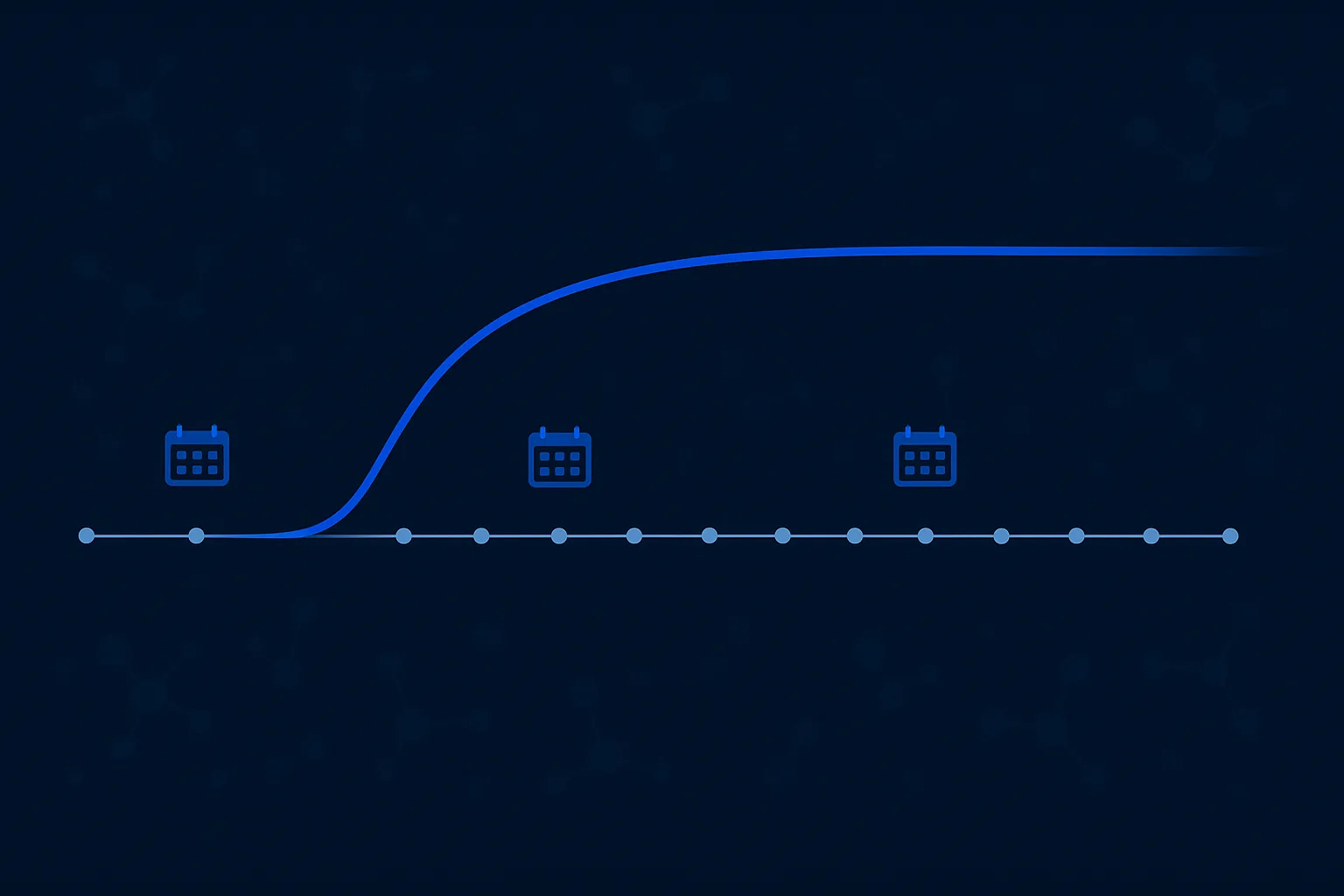
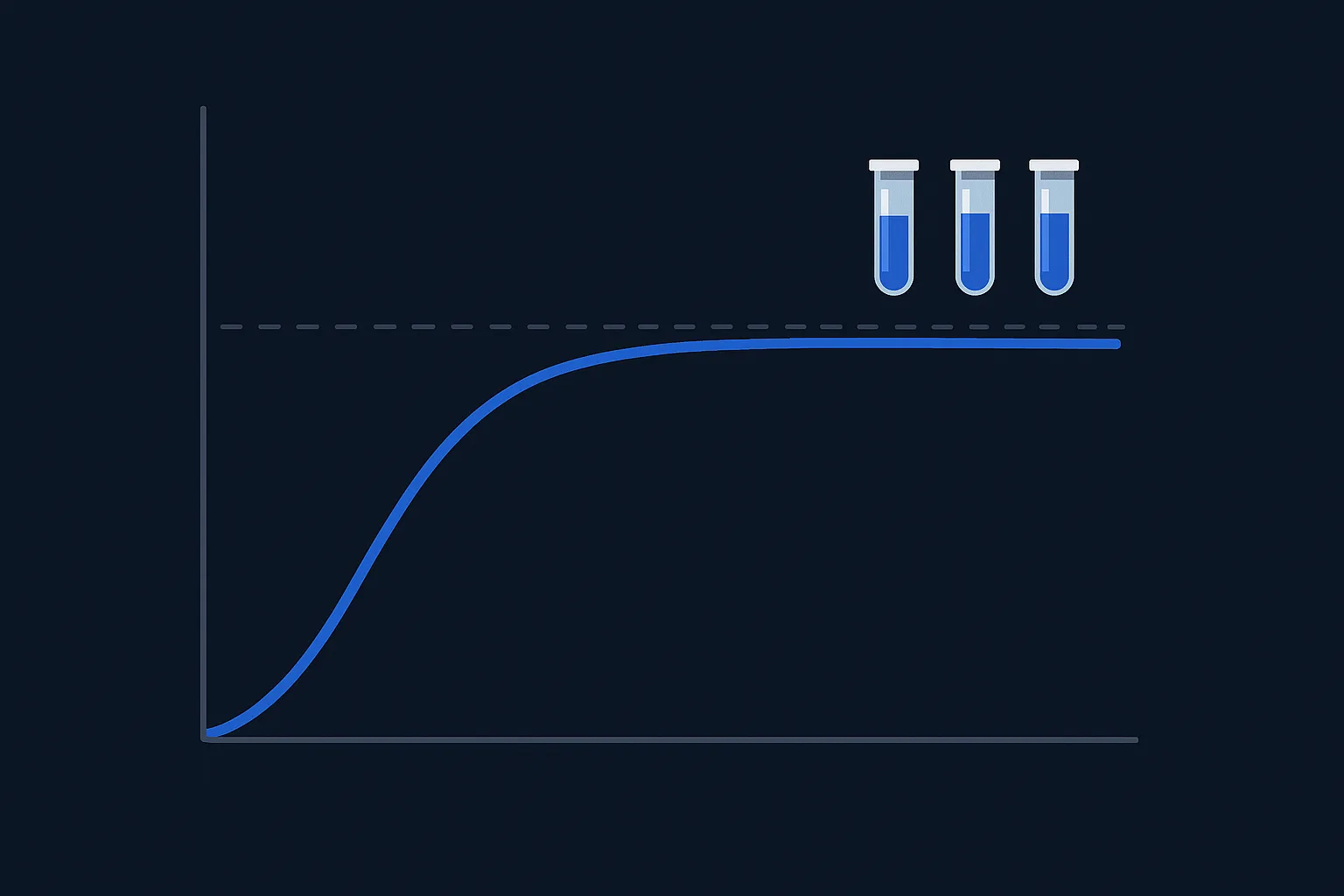
The first 12 weeks of TRT are the most informative — and the most often misread. Long-acting testosterone esters take roughly 6 weeks to reach steady state, the body's response to physiologic-replacement levels unfolds across multiple tissue systems on different timelines, and most clinical guidelines specify lab follow-up at 6-8 weeks rather than earlier. This page describes the week-by-week schedule that shows up in published clinical literature, mapped against what the TRT dosing ranges hub describes for typical starting doses. It is a reference for what experienced prescribers and major guidelines describe, not an instruction set.
If you are starting TRT or evaluating a clinic's initiation protocol, this is the timeline most prescribing literature converges on.
Starting Doses Described in Published Guidelines
The four major Anglosphere/European guidelines describe slightly different starting ranges, all in the same neighborhood:
Endocrine Society (Bhasin et al., 2018): Testosterone cypionate or enanthate 75-100 mg per week, given intramuscularly or subcutaneously, divided as needed.
AUA (Mulhall et al., 2018): Injectable testosterone titrated to maintain total testosterone in the middle tertile of the normal reference range; absolute starting dose left to clinician judgment.
EAA (Corona et al., 2020): Injectable testosterone esters at conventional starting doses with target total testosterone in the mid-normal range.
BSSM (Hackett et al., 2017): Testosterone undecanoate injection (long-acting depot) or testosterone enanthate/cypionate at standard starting doses.
In U.S. cash-pay telehealth practice, observed starting doses run somewhat higher than the Endocrine Society guideline — typically 100-160 mg per week. The week-by-week schedule below assumes a standard starting protocol within that combined 75-160 mg/week range.
The Week-by-Week Schedule
The schedule below is built around twice-weekly testosterone cypionate or enanthate at a starting dose of 100-140 mg per week, the most common pattern in U.S. clinical practice. Subcutaneous and intramuscular routes follow nearly identical timelines at this ester. Daily or every-other-day micro-dosing protocols compress the early variability but follow the same overall biological response pattern.
Week 0 — Baseline Workup
Published guidelines describe the pre-initiation workup as:
Two morning (before 10 AM) total testosterone measurements on separate days, both below the reference cutoff
PSA (in men over 40 or with prostate risk factors)
Symptom inventory (validated tools include the AMS, ADAM, qADAM)
The Endocrine Society guideline emphasizes that the diagnosis should be confirmed with two separate measurements before initiating therapy. Cash-pay clinics that skip the second confirmatory test are out of step with major guideline literature.
Week 1 — First Injection
Trial protocols and clinical experience converge on the following pattern in week 1:
First injection is given on day 1, typically Monday or Tuesday
Second injection follows on day 4, typically Thursday or Friday
Total testosterone rises rapidly over 24-72 hours after the first injection
Peak testosterone after the first dose can briefly exceed the eventual steady-state peak — this is a transient phenomenon, not a problem
Subjective effects in week 1 are usually minimal; some men report mild energy improvement, others nothing
Injection site soreness is the most commonly reported week-1 side effect, particularly for men who have not done IM injections before. Subcutaneous injection in the abdomen or thigh produces less soreness for most men.
Weeks 2-3 — Rising Levels, Early Subjective Changes
By the end of week 2, total testosterone is approaching but not yet at steady state. Trial literature and clinical experience describe the following pattern:
Trough total testosterone is typically 50-65% of its eventual steady-state value
Morning erections and libido often respond first — many men report a noticeable change in weeks 2-3
Energy and motivation may improve subtly; mood often feels marginally more stable
Sleep changes are variable — some men report deeper sleep, others mild disruption
Hematocrit has not changed measurably yet
Estradiol rises in proportion to testosterone; symptomatic estradiol issues are uncommon this early
This is not a window for dose adjustment. Levels are still climbing toward steady state, and any "this isn't working" signal in week 2-3 is premature.
Weeks 4-5 — Approaching Steady State
By week 4-5, levels are within striking distance of steady state but not there yet. The pattern published literature describes:
Trough total testosterone is typically 75-90% of eventual steady-state value
Subjective improvements that were subtle in weeks 2-3 are usually clearer
Body composition has not changed measurably; mirror checks at this point are not informative
Some men experience a transient "honeymoon" effect — disproportionate energy and well-being from the rapid rise, which moderates as levels stabilize
Acne and oily skin can appear in men with higher androgen sensitivity, particularly at upper-end starting doses
The most common error at this stage is assuming the early subjective trajectory will continue at the same slope. It usually moderates as the body normalizes to physiologic-replacement levels.
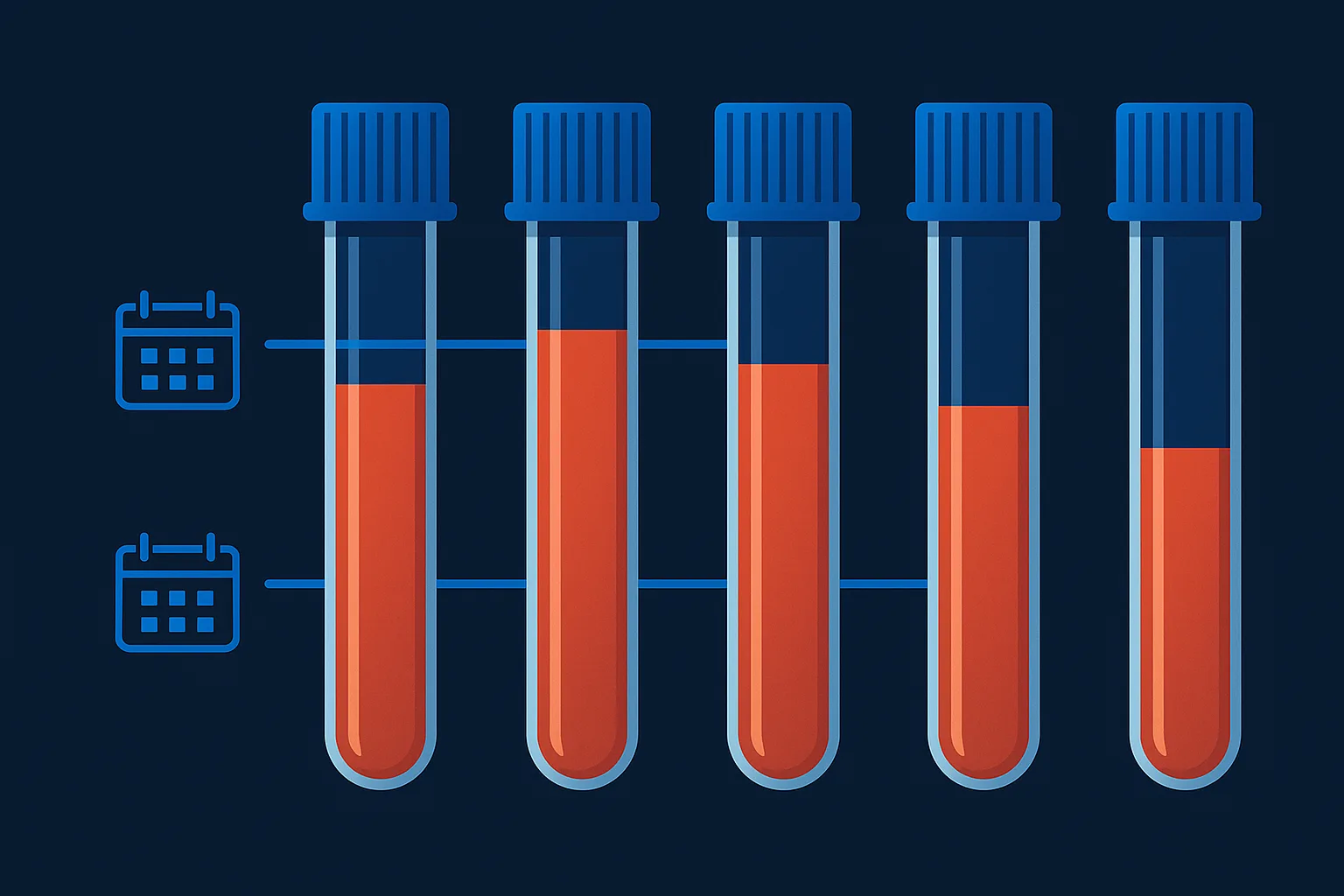
Published clinical guidelines converge on weeks 6-8 as the appropriate window for first follow-up labs. The Endocrine Society guideline specifies that long-acting injectable esters reach steady state by approximately 5 half-lives (about 6 weeks for cypionate and enanthate). Drawing labs earlier than this gives an artificially low reading because levels are still climbing.
The standard first-recheck panel described in published guidelines includes:
Total testosterone (drawn at trough — morning of next injection, before the dose)
Free testosterone or calculated free T
Estradiol (sensitive assay)
Hematocrit (CBC)
SHBG (if not already established)
What published literature describes about typical results at this point:
A 100-140 mg/week dose typically produces trough total testosterone of 600-850 ng/dL for most men
Free testosterone typically lands at 12-22 pg/mL at this dose range
Estradiol typically lands at 25-45 pg/mL
Hematocrit changes are usually modest — small upward shifts but rarely clinically significant by week 6-8
This is the data point on which dose decisions are made. The lab gap between observed and target trough levels guides the first dose adjustment.
Weeks 8-10 — First Adjustment Window
If labs at the 6-8 week mark show trough levels off-target, this is the typical window for the first dose adjustment. Published clinical practice describes:
Adjustments by 10-20 mg/week increments — small changes, repeated as needed
A trough total testosterone below 500 ng/dL with persistent symptoms typically prompts an upward adjustment
A trough total testosterone above 1000-1100 ng/dL typically prompts a downward adjustment regardless of subjective feeling
Estradiol elevation with symptoms is more often addressed by increasing injection frequency (e.g., from twice weekly to every other day) rather than by adding an aromatase inhibitor as a first step
The mechanism for adjustment matters: small increments give the body time to stabilize, while large jumps risk overshooting. The pattern described across guidelines is gradual titration, not aggressive dose escalation.
Weeks 10-12 — Stabilization Period
The 10-12 week window is a stabilization period after the first adjustment. Published literature describes:
Subjective trajectory continues — energy, libido, sleep, mood usually still trending upward
Body composition changes start to become measurable, particularly lean mass and waist circumference
Hematocrit has typically risen 1-3 percentage points from baseline by this point
Estradiol is more predictable than in early weeks; symptomatic E2 issues are easier to identify
Adverse events that emerge in this window (mood changes, sleep disruption, acne) are more likely to be dose-related than transient
This is the period when the first cycle's outcome — well-tolerated, optimized, or in need of further adjustment — becomes clear.
Week 12 — Cycle Assessment
By week 12, most prescribers and guideline-aligned clinics conduct a comprehensive reassessment:
Trough labs (full panel including hematocrit, lipids, comprehensive metabolic, CBC)
Symptom inventory comparison to baseline
Discussion of dose adjustment, frequency change, or maintenance
Plan for next lab recheck — typically 3-6 months for stabilized patients
Men who are at target trough levels with resolved symptoms and no adverse trends typically transition to maintenance. Men whose labs or symptoms suggest further titration enter another adjustment cycle, usually in 10-20 mg/week increments.
Daily and Every-Other-Day Variants of the First Cycle
Some clinics use daily subcutaneous or every-other-day injection protocols from cycle one. Published pharmacokinetic literature describes the following differences:
Time to steady state is similar — still approximately 6 weeks for cypionate or enanthate
Peak-to-trough variation is smaller — daily protocols produce nearly flat curves
Hematocrit response may be more gradual — the absence of weekly peaks reduces the polycythemia signal
Estradiol is typically lower — less aromatization peak per dose
Subjective trajectory is similar — the same week-by-week pattern of libido first, energy second, body composition last applies
The lab schedule (6-8 week first recheck, 12-week reassessment) is identical. Daily and every-other-day protocols do not allow earlier labs because they do not change the time-to-steady-state.
What Published Literature Describes About Symptom Timeline
The Endocrine Society guideline and the published trial literature converge on a rough hierarchy of symptom response timelines:
Domain
Typical First Response
Typical Stabilization
Libido and morning erections
Weeks 2-4
Weeks 8-12
Energy and motivation
Weeks 4-8
Months 3-6
Mood and well-being
Weeks 4-8
Months 3-6
Sleep quality
Weeks 4-12
Months 3-6
Body composition (lean mass, fat)
Weeks 12-16
Months 6-12
Erythrocytosis (hematocrit rise)
Weeks 6-12
Months 6-12
Lipid changes
Months 3-6
Months 6-12
Bone mineral density
Months 6-12
Years 1-2
Insulin sensitivity, glycemic control
Months 3-6
Months 6-12
Each row reflects the pattern described in trial and clinical literature, not a guarantee for any individual. Two men on identical protocols can have meaningfully different timelines within these windows.
Common Pitfalls in First-Cycle Management
Three patterns from clinical literature and prescriber experience that distinguish well-managed first cycles from poorly managed ones:
1. Drawing labs at 4 weeks instead of 6-8 weeks
Labs drawn before steady state underestimate the eventual trough by 10-25 percent. Adjusting upward based on a week-4 lab can push the eventual steady-state trough above target by week 8.
2. Aggressive dose escalation in the first month
A 50-100 mg jump within the first 4 weeks is rarely justified by data this early. Published guidelines describe small incremental titration, not pushed-through escalation. Clinics that move dose substantially within the first month typically deliver supraphysiologic levels by week 8.
3. Treating early subjective improvement as a final state
The week-3 to week-5 subjective trajectory often outpaces the eventual stable state. Men who feel exceptional in week 4 sometimes feel less so in week 10 as the body normalizes. The lab-anchored 12-week reassessment is the more reliable measure of where the cycle has landed.
If you are evaluating a clinic for first-cycle management, the question worth asking is whether they hold the line on the 6-8 week recheck and whether their initial adjustments are in 10-20 mg increments rather than larger jumps. The clinic comparison hub ranks clinics on titration discipline and lab transparency.
How the First Cycle Sets Up Long-Term Management
A well-managed first cycle produces three durable assets:
A stable trough lab dataset that anchors all future titration decisions
A documented symptom trajectory that distinguishes which complaints respond to TRT and which do not
A baseline tolerance profile — how the patient handles the dose, frequency, and ester chosen
Men whose first cycle is rushed or poorly monitored typically need 6-12 additional months to settle into a stable maintenance dose. Men whose first cycle is managed in line with published guidelines often hit a stable maintenance dose within months 3-6 and stay there for years.
Bottom Line
Published clinical guidelines and trial literature describe a TRT first-cycle schedule that is more conservative and more lab-anchored than what some cash-pay defaults look like in practice. The pattern is: start at a moderate absolute dose (75-160 mg/week of testosterone cypionate or enanthate split twice weekly), let the body reach steady state across roughly 6 weeks, draw a comprehensive trough panel at 6-8 weeks, adjust by 10-20 mg/week if labs are off-target, and reassess at 12 weeks. The first cycle is informative — but only if the lab schedule is followed and adjustments are gradual.
Bhasin S, Brito JP, Cunningham GR, et al. Testosterone Therapy in Men With Hypogonadism: An Endocrine Society Clinical Practice Guideline. J Clin Endocrinol Metab. 2018;103(5):1715-1744. PMID: 29562364
Mulhall JP, Trost LW, Brannigan RE, et al. Evaluation and Management of Testosterone Deficiency: AUA Guideline. J Urol. 2018;200(2):423-432. PMID: 29601923
Corona G, Goulis DG, Huhtaniemi I, et al. European Academy of Andrology (EAA) guidelines on investigation, treatment and monitoring of functional hypogonadism in males. Andrology. 2020;8(5):970-987. PMID: 32026626
Hackett G, Kirby M, Edwards D, et al. British Society for Sexual Medicine Guidelines on Adult Testosterone Deficiency, With Statements for UK Practice. J Sex Med. 2017;14(12):1504-1523. PMID: 29198507
Snyder PJ, Bhasin S, Cunningham GR, et al. Effects of Testosterone Treatment in Older Men. N Engl J Med. 2016;374(7):611-624. PMID: 26886521
Lincoff AM, Bhasin S, Flevaris P, et al. Cardiovascular Safety of Testosterone-Replacement Therapy. N Engl J Med. 2023;389(2):107-117. PMID: 37326322
This content is for informational purposes only and is not medical advice. Consult a qualified healthcare provider before starting any treatment.
Frequently Asked Questions
What is a typical first-cycle TRT dose?
Published clinical guidelines describe starting injectable testosterone cypionate or enanthate at 75-100 mg per week (Endocrine Society) or 100-160 mg per week (typical U.S. cash-pay telehealth defaults), divided into at least two injections. Most prescribers reassess at 6-8 weeks with trough labs.
When are first follow-up labs ordered after starting TRT?
Most published guidelines describe a first lab recheck at 6-8 weeks, when long-acting esters have reached steady state. The Endocrine Society guideline specifies follow-up at 3-6 months for clinical assessment alongside earlier lab work. Cash-pay clinics typically order labs at 6 weeks.
How long until TRT starts working?
Published trial and clinical-experience literature describes the following pattern: libido and morning erections often respond first (weeks 2-4), energy and mood improve gradually across weeks 4-8, body-composition changes become measurable by 12-16 weeks, and full benefit on insulin sensitivity, lipids, and lean mass continues to develop over 6-12 months.
Will my testosterone be at steady state in week 4?
No. Testosterone cypionate and enanthate have half-lives of approximately 8 days. Steady state — where the dose given in equals the dose cleared out — takes approximately 5 half-lives, or about 6 weeks for these esters. Lab work drawn before week 6 is informative but does not represent the eventual stable level.
Should I expect side effects in the first month?
Trial literature reports the most common early side effects as injection-site soreness, mild acne, and water retention in the first 2-4 weeks. Hematocrit changes are gradual and typically not significant before the first lab draw. Estradiol changes can become symptomatic in weeks 4-8 in some men, particularly those starting at higher doses.
Can I increase my dose at the 4-week mark?
Published guidelines do not recommend dose adjustment before steady-state labs. Adjusting at 4 weeks risks responding to a not-yet-stable level. Most prescribers wait until the 6-8 week lab and adjust by 10-20 mg/week based on the gap to target trough levels.