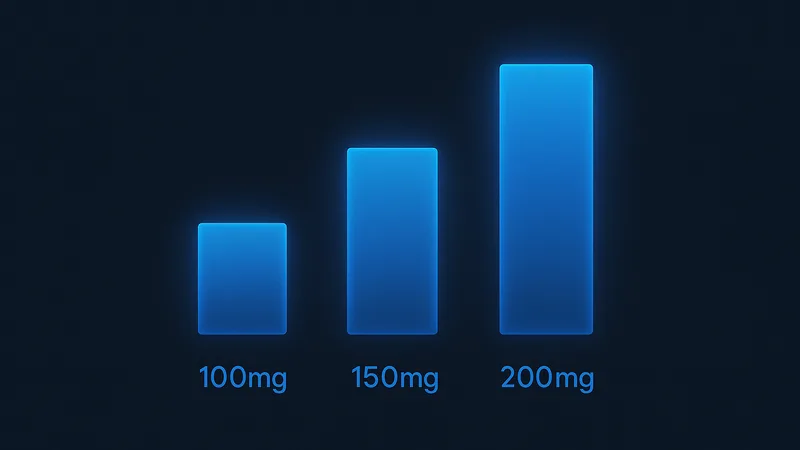
Key Takeaways: Most TRT protocols land between 80 and 200 mg per week of testosterone cypionate or enanthate. The right dose depends on your free testosterone target, SHBG, injection frequency, and how your body responds — not a universal number. Standard clinical replacement is 100-200 mg/week split twice weekly. Conservative titration starts at 25-50 mg/week and dials up only if labs and symptoms warrant it.
The TRT Dosage Chart
The chart below covers the three most common TRT dosing buckets: pure replacement, performance-oriented replacement, and body recomposition. Each tier maps to a typical weekly mg range, injection frequency, and expected free testosterone range at trough. Doses refer to testosterone cypionate or enanthate in a typical cash-pay compounded concentration (200 mg/mL).
Protocol Goal
Weekly Dose
Frequency
Target Trough Total T
Target Trough Free T
Typical Profile
Conservative titration (start-low)
25-50 mg
1-2x/week
400-600 ng/dL
10-15 pg/mL
Symptom-mild men, low SHBG, sensitive responders
Standard replacement
80-140 mg
2x/week
600-900 ng/dL
15-22 pg/mL
Most men on TRT
Performance replacement
150-200 mg
2x/week or EOD
800-1100 ng/dL
20-28 pg/mL
Active lifters, high SHBG, athletic goals
Recomposition (short cycles)
200 mg
EOD
1000-1300 ng/dL
25-35 pg/mL
Often driven by goals beyond replacement — discuss tradeoffs with a prescriber
A few things the chart does not show that matter in practice:
Your labs are the scoreboard. Two men on 140 mg/week can have trough totals of 650 and 1050 ng/dL depending on how they metabolize testosterone. Dose by lab result, not by label. Most prescribers anchor adjustments to trough-level titration drawn at the 6-8 week recheck.
Injection frequency flattens the curve. 140 mg/week given once weekly produces a peak near 1200 ng/dL on day 3 and a trough below 500 by day 7. Split that same 140 mg into two or three injections and the peak drops while the trough rises.
SHBG changes everything. Low SHBG men convert total T to free T efficiently — they need less total to hit the free T target. High SHBG men need more.
Matching Dose to Injection Frequency
Dose and frequency are the same dial in two positions. You cannot think about one without the other.
Once Weekly
Simplest schedule. Biggest peak-to-trough swing. Common outside the U.S., less common in cash-pay TRT clinics here.
100 mg once weekly: peak around 900 ng/dL day 2-3, trough near 350-450 ng/dL day 7
140 mg once weekly: peak around 1200 ng/dL, trough 450-550 ng/dL
Many men on this schedule feel great for four days then crash into day 6-7
Twice Weekly
The standard modern protocol. Better stability without much added inconvenience.
50 mg x 2/week (100 mg total): trough around 500-650 ng/dL, peak around 850 ng/dL
70 mg x 2/week (140 mg total): trough around 650-800 ng/dL, peak around 1000 ng/dL
100 mg x 2/week (200 mg total): trough around 800-1000 ng/dL, peak up to 1300 ng/dL
Every Other Day
Smoothest curve. Most needle sticks. Often used with subcutaneous injections where the volume per shot is small.
20 mg EOD (70 mg/week): steady 550-700 ng/dL
30 mg EOD (105 mg/week): steady 700-900 ng/dL
40 mg EOD (140 mg/week): steady 850-1100 ng/dL
Daily Subcutaneous
Flat. Most physiologic. Niche but growing.
10 mg daily (70 mg/week): steady 600-750 ng/dL
15 mg daily (105 mg/week): steady 750-950 ng/dL
The "Start Low" Approach
Standard TRT is often prescribed at 100-200mg/week from day one -- doses calibrated to push levels well above mid-range fast. For some users, that jump is too much: energy spikes, mood swings, aggression, sleep disruption, or simply feeling "overly pumped up" in a way that doesn't match how they want to feel on TRT.
A conservative alternative starts at 25-50mg/week (~1/4 the standard starting dose) for 4-8 weeks, then titrates up only if blood work and symptoms warrant it. Reports from community and clinician notes increasingly favor this approach for users who are sensitive to hormonal changes or want a smoother adjustment curve. Some users find they never need the full dose -- they hit target free T levels and reach their goals at the lower end of the range.
This is not a universal recommendation. Some men genuinely need 150-200mg/week to achieve symptom relief, and aggressive titration is appropriate when labs show severe hypogonadism. But if you have room to negotiate dose with your prescriber, asking for a 4-8 week "start low, titrate slowly" phase is a legitimate choice that many users report worked better for them than jumping straight to a full replacement dose.
If the goal is to fix the clinical symptoms of low testosterone — energy, libido, mood, cognition, recovery — you don't need high trough levels. You need levels that sit comfortably inside the normal reference range with free testosterone in the middle of the reference.
Start: 80-100 mg/week split 2x/week — see the TRT first cycle dosing schedule for the typical week-by-week initiation pattern
Reassess at 6-8 weeks with trough labs
Titrate by 20-30 mg increments only if symptoms persist at normal range levels
Most men land here. It is also the dose range with the cleanest safety profile — lowest hematocrit risk, smallest impact on HDL, least E2 management.
Goal 2: Athletic Replacement
Active lifters with high training volume often find they need slightly higher trough testosterone to recover the way they want. This is not a pharmacologic enhancement protocol — it's the upper end of replacement dosing with a functional justification. Weight-based dose references for heavier patients are documented in our TRT dose by body weight guide.
Start: 100-140 mg/week split 2x/week or EOD
Target trough total T 800-1000, free T 20-25 pg/mL
Expect more monitoring: hematocrit every 3 months, E2 at every lab draw
Goal 3: Body Recomposition
Doses of 200 mg/week and higher push testosterone into the supraphysiologic range. That produces stronger anabolic signal for muscle protein synthesis and fat oxidation — but also stronger side effects: hematocrit creep, lipid changes, sleep disruption, and E2 management becoming non-optional. This territory is outside standard replacement and should be discussed explicitly with your prescriber.
Dose: 200 mg/week minimum, often cycled
Frequency: EOD or daily
Monitoring: every 8-12 weeks minimum, AI often required
Reading the Chart Against Your Labs
Your 3-month labs tell you whether the chart predicted your response. Use these decision rules:
If your trough total T is below 500 and you feel symptomatic: Your dose is low or your injection frequency is too sparse. Try splitting the same weekly dose across more injections before increasing total mg/week.
If your trough total T is above 1100 and you are on a standard replacement dose: You are a fast responder or low-SHBG converter. A small dose reduction (10-20 mg/week) often restores levels to the target range without losing symptom benefits.
If free T is low despite normal total T: Look at SHBG. High SHBG binds T and reduces bioavailability. Small dose increases or frequency changes help — lifestyle factors (alcohol, low protein intake, hypothyroidism) also matter.
If hematocrit is above 52% at any dose: Stop chasing higher total T. Reduce dose or frequency, hydrate, and consider therapeutic phlebotomy if the number keeps climbing.
Who These Ranges Do Not Fit
The chart above is a starting map, not a prescription. It will not fit:
Men with untreated sleep apnea (the hematocrit response is exaggerated)
Men with very low SHBG (standard doses produce very high free T)
Men on long-acting formulations like testosterone undecanoate injections (10-12 week dosing interval)
Men using testosterone cream, gel, or pellets (absorption mechanics are different)
Fertility-preservation protocols (likely adding hCG, which changes the picture)
If any of these apply, your dosing conversation is different — lean harder on your prescriber and fewer general charts.
Comparing Clinics on Dosing Flexibility
Dosing flexibility is one of the biggest differences between clinics. Rigid clinics prescribe a fixed dose and schedule regardless of labs. Flexible clinics start conservative and titrate based on 6-8 week bloodwork.
There is no universal "right" TRT dose. There is a reasonable starting range (80-140 mg/week for most), a target free T zone (15-22 pg/mL), and a willingness to adjust based on 6-8 week labs. The clinics that do this best start low, review labs thoroughly, and change the protocol when data says to. The ones to avoid lock in a single dose on day one and never revisit it.
This content is for informational purposes only and is not medical advice. Consult a qualified healthcare provider before starting any treatment.
Frequently Asked Questions
What is a typical TRT dose per week?
Most clinics prescribe 100-200 mg per week of testosterone cypionate or enanthate, split into two injections. That range covers the vast majority of men who reach target total testosterone of 600-1000 ng/dL and free testosterone of 15-25 pg/mL at trough.
What is the lowest effective TRT dose?
Some men respond well to 25-50 mg per week, particularly if baseline SHBG is low or symptoms are mild. A conservative titration starting at 25-50 mg per week for 4-8 weeks then adjusting based on labs is increasingly common among clinicians who prioritize minimal effective dose.
Is 200 mg of testosterone per week too much?
200 mg per week sits at the upper end of replacement dosing. Some men need this to reach optimal free testosterone, especially if SHBG is elevated. Others find 200 mg pushes them into supraphysiologic range with side effects like elevated hematocrit, acne, or mood swings.
How often should I inject TRT?
Twice per week is the most common protocol. It produces stable levels with less peak-to-trough variability than once-weekly dosing. Every-other-day or daily subcutaneous injections produce the smoothest levels but require more discipline.
What free T level should I target on TRT?
Most clinicians target free testosterone of 15-25 pg/mL at trough. Men who feel best at the lower end typically have SHBG in the normal range. Men with low SHBG may feel optimal at 12-18 pg/mL because more of their total T is bioavailable.