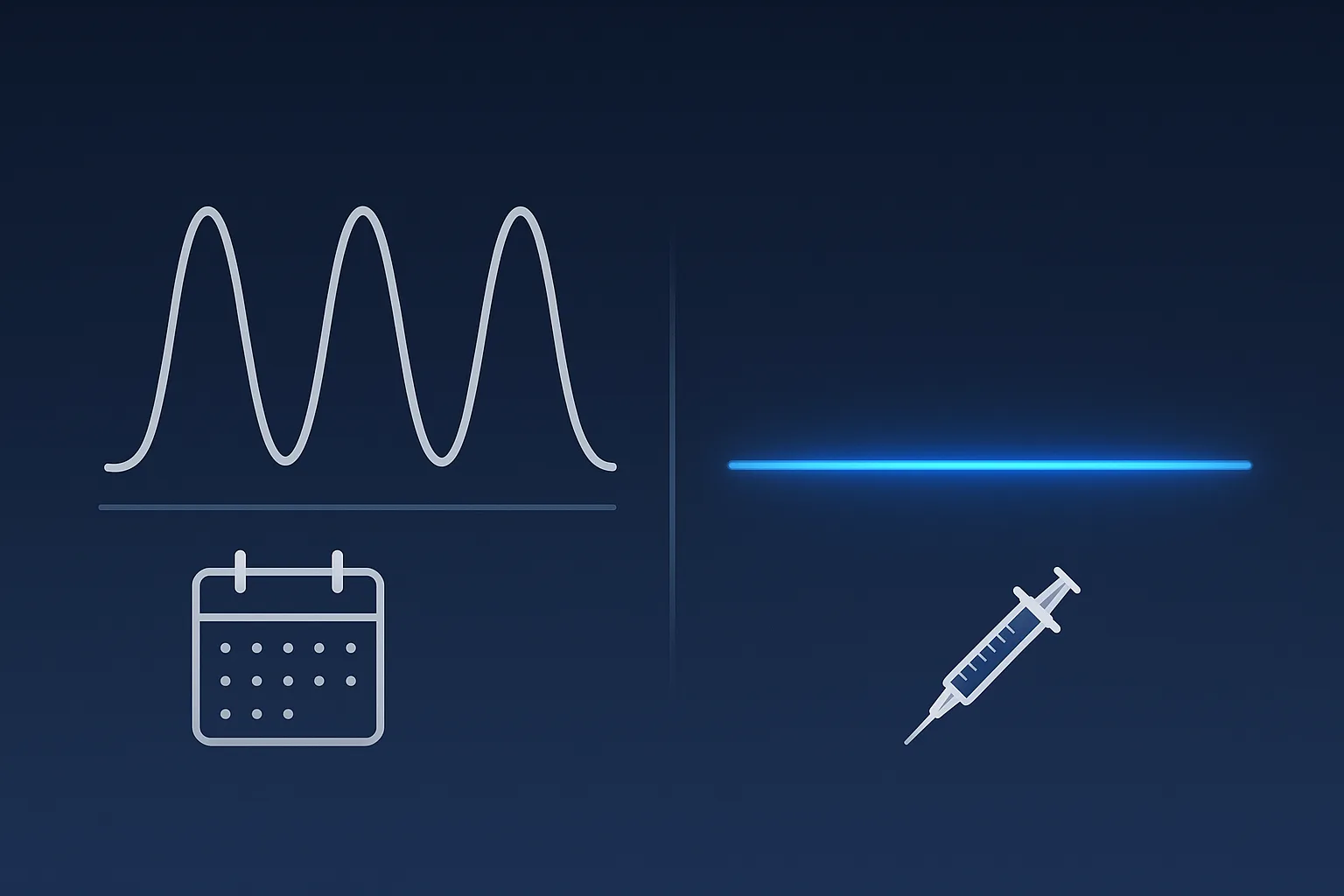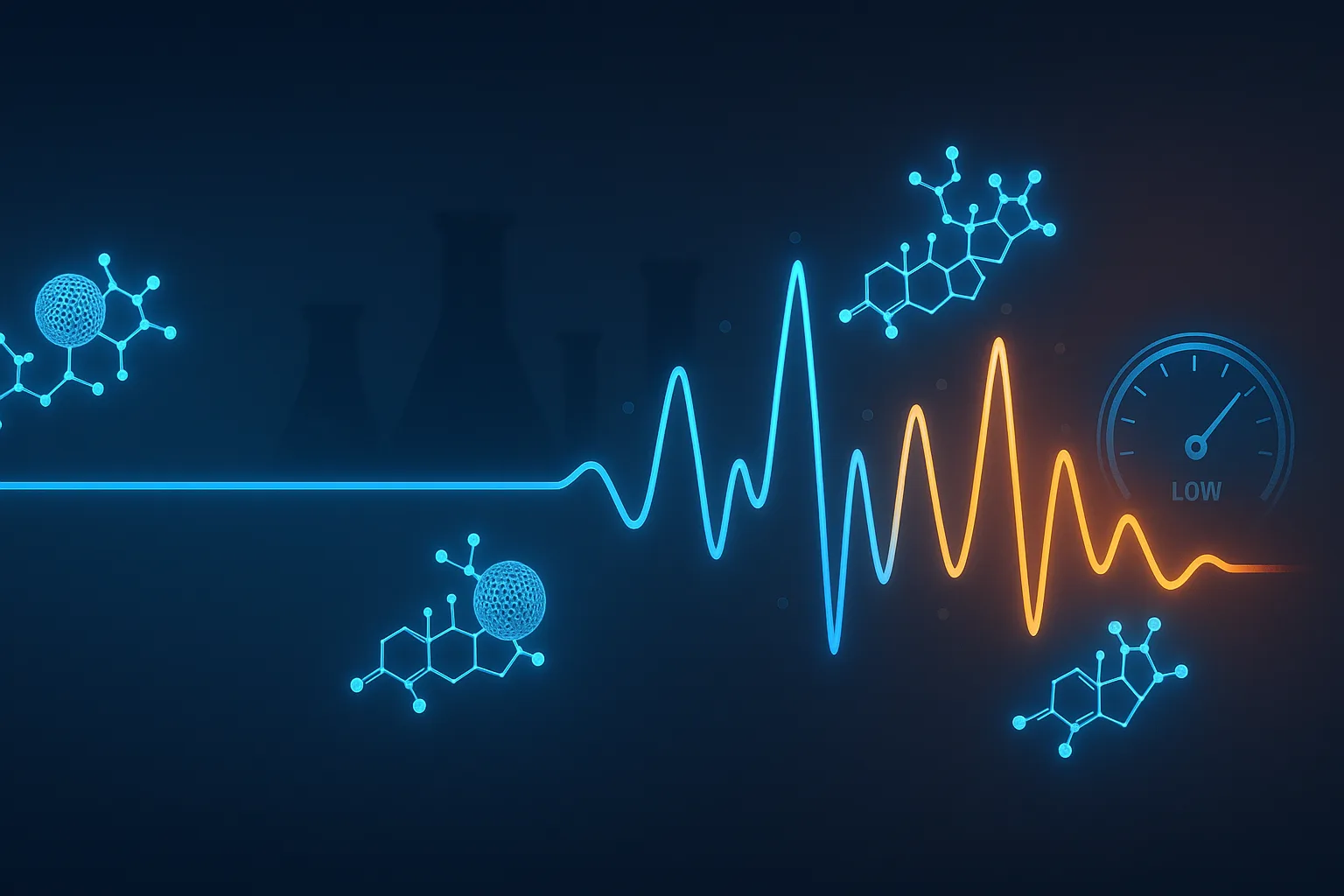
Your total testosterone is 950. Free T looks great. You should feel like a god. Instead, day three after your shot you're irritable, bloated, and your face is breaking out. By day six you're flat, tired, and questioning whether TRT is even working.
If your SHBG is sitting in the teens, this is the predictable pattern. Standard TRT protocols — 200 mg twice a week, or even 100 mg twice a week — were designed for men with average SHBG. When SHBG runs low, the same dose moves through your body differently, and the standard playbook stops working.
Key Takeaways
- SHBG below 20 nmol/L is common in men with insulin resistance, obesity, or genetic predisposition — and it changes how testosterone behaves
- Low SHBG means more free testosterone per mg of total T, but also faster clearance and bigger peak-to-trough swings
- Standard twice-weekly injections often produce side effects (high estradiol, anxiety, acne) at doses that should be modest
- Daily or every-other-day subcutaneous microdosing is the dominant fix — typically 14-20 mg/day from a 100-140 mg weekly target
- Free testosterone targets shift downward in low-SHBG men: 12-18 pg/mL often feels better than chasing 25+ pg/mL
- SHBG rarely rises on TRT alone — improving it requires fixing insulin resistance, not just adjusting hormones
What SHBG Actually Does
Sex hormone-binding globulin is a protein produced primarily by the liver. It circulates in your bloodstream and binds tightly to testosterone, dihydrotestosterone, and estradiol. Bound testosterone is biologically silent — it cannot enter cells, bind androgen receptors, or do any of the things testosterone is supposed to do.
Roughly 60-70% of total testosterone in a healthy man is SHBG-bound. About 30-40% is loosely bound to albumin (and considered bioavailable because it dissociates easily), and only 1-3% is truly free. The free fraction plus the albumin-bound fraction is what reaches tissues.
SHBG is a regulator. It buffers your hormone levels, smoothing out peaks and storing testosterone for steady release. When SHBG is normal (around 20-50 nmol/L in men), the system stays stable. When SHBG drops, the buffer disappears, and small changes in total testosterone produce big swings in free testosterone.
Why SHBG Matters More Than Total Testosterone
Total testosterone tells you how much hormone is in your blood. It does not tell you how much is active. Two men with identical total T of 800 ng/dL can have wildly different free testosterone numbers depending on SHBG. Calculated free T using the Vermeulen equation accounts for this — your provider should be using it.
Men with high SHBG often have plenty of total T but low free T, which is why some feel hypogonadal at "normal" lab numbers. Men with low SHBG have the opposite problem: free T is disproportionately high for their total, often pushing them into the side-effect zone before total T looks impressive.
The clinical implication is simple. Free testosterone, not total, is what drives symptoms. SHBG is the variable that determines the gap between the two.
What Causes Low SHBG?
SHBG is not random. It tracks closely with metabolic health and a handful of other factors.
Insulin resistance and hyperinsulinemia. Insulin directly suppresses SHBG production in the liver. The hungrier your liver is for insulin signaling, the less SHBG it produces. This is why low SHBG correlates so tightly with metabolic syndrome, type 2 diabetes, and visceral obesity. In one major NHANES analysis, men in the lowest quartile of SHBG had dramatically higher rates of metabolic syndrome than men in the highest quartile.
Obesity, particularly visceral fat. Body composition matters more than total weight. Two men at the same BMI can have very different SHBG depending on muscle mass and visceral adiposity. Lean men with high muscle mass tend to have higher SHBG than equally lean men with central fat distribution.
Genetics. Some men have low SHBG from polymorphisms in the SHBG gene, independent of any metabolic dysfunction. These men can be lean, fit, and metabolically healthy and still test in the 12-18 nmol/L range. This is harder to fix because there's nothing to "treat." Body-size considerations for these men are documented in our TRT dose by body weight reference.
Anabolic exposure. Higher doses of testosterone, oral androgens, and SHBG-suppressing compounds (some of which are misused recreationally) lower SHBG. Long-term TRT at supraphysiologic doses can keep SHBG suppressed.
Hypothyroidism and acromegaly. Less common but worth mentioning. Untreated hypothyroidism lowers SHBG. So does growth hormone excess.
Liver disease (in reverse). Cirrhosis and chronic liver disease typically raise SHBG, but early metabolic-associated fatty liver disease can lower it via the insulin resistance pathway.
If your SHBG is below 20, the first question to ask is metabolic. Get a fasting insulin, HOMA-IR, hemoglobin A1c, and lipid panel. The path to higher SHBG often runs through better insulin sensitivity, not through hormone tweaks.
Why Standard TRT Fails at Low SHBG
The default TRT prescription — 100-200 mg of testosterone cypionate split into two weekly injections — was built around an average SHBG patient. Drop SHBG to 15 and the same dose behaves completely differently.
The Peak-and-Crash Problem
Each injection produces a pharmacokinetic peak. Testosterone cypionate has a half-life of about 8 days, so injections accumulate, but the peak after each dose is real. With normal SHBG, that peak is buffered: SHBG binds the excess and parcels it out gradually.
With low SHBG, there's nothing to soak up the wave. Free testosterone spikes higher than it should, then crashes faster as the dose clears. Symptoms follow the same curve — euphoria and aggression on day two or three, depletion and apathy by day six.
Aromatization Is Worse
Aromatase converts testosterone to estradiol. The reaction depends on substrate availability. When free testosterone peaks higher in low-SHBG men, aromatization peaks too, and estradiol can spike into the 50-70 pg/mL range on doses that would keep an average-SHBG man at 25-30.
The downstream effects are familiar: water retention, moodiness, nipple sensitivity, libido suppression at the trough, and the temptation to add an aromatase inhibitor that often overshoots and crashes estradiol entirely. See our estradiol management guide for how to manage this without overcorrecting.
Hematocrit Climbs Faster
Higher peaks drive more erythropoietin stimulation. Low-SHBG men on standard biweekly protocols often hit hematocrit thresholds faster than expected. This is why injection frequency matters even before you think about dose. See high hematocrit on TRT for the full management framework.
Total T Lies
Because more testosterone is unbound and clears faster, weekly trough total T can look unimpressive even on doses that produce significant peaks. Providers who chase a higher trough total T by raising the dose just amplify the problem. The peak goes higher, the crash gets worse, and symptoms get harder to manage.
The Low-SHBG Protocol: Daily or EOD Microdosing
The single highest-leverage change for low-SHBG TRT is increasing injection frequency. The total weekly dose can stay the same or even decrease — what changes is how it's delivered.
Frequency Hierarchy
| Frequency | Per-Dose Amount (140mg/week target) | Curve Shape | Best For |
|---|---|---|---|
| Once weekly | 140 mg every 7 days | Massive peak, deep trough | Almost no one with low SHBG |
| Twice weekly | 70 mg every 3.5 days | Reduced but still volatile | Average SHBG, not low |
| Every other day | 40 mg EOD | Smooth | Many low-SHBG men |
| Daily SubQ | 20 mg/day | Flattest possible | Most low-SHBG men |
Why Subcutaneous Daily Wins for Low SHBG
Subcutaneous injection produces a slower release profile than intramuscular. Combine that with daily dosing and you get the closest pharmacokinetic match to natural diurnal testosterone production. Free testosterone fluctuates within a narrow band rather than swinging wildly.
Practical setup:
- 27-30 gauge insulin syringes, 0.5 mL volume
- Inject into abdomen, upper thigh, or love handle subcutaneous fat
- Rotate sites daily
- Same time of day works best (most men do morning)
Daily dosing also dramatically improves estradiol stability. Aromatase activity tracks the testosterone curve. Flatten the curve, flatten estradiol. Many men who needed an aromatase inhibitor on twice-weekly dosing don't need one at all on daily protocols.
Starting Doses for Low SHBG
Begin lower than standard guidelines suggest. Low-SHBG men routinely overshoot on doses that would be conservative for average SHBG.
- Initial weekly target: 80-120 mg total
- Daily breakdown: 12-18 mg per day
- EOD breakdown: 25-35 mg every other day
- Recheck labs at 6-8 weeks with timing matched to your protocol (mid-cycle for daily users)
If symptoms remain mild and bloodwork is reasonable, hold. Resist the urge to push higher just because total T is "only" 700.
Lab Timing Changes
On weekly or biweekly injections, providers typically draw labs at trough — right before the next injection. On daily microdosing, there is no trough in the traditional sense. Draw labs anywhere from 24 hours after your last dose, ideally at the same time of day each test, and interpret based on stable-state values. See titrating TRT by trough levels for how prescribers anchor adjustments to these draws across protocols.
Estradiol drawn on a sensitive (LC-MS) assay matters more than ever. Many low-SHBG men feel best with estradiol around 25-35 pg/mL on a sensitive assay, not the standard 20-30 some clinics target.