For decades, testosterone replacement therapy meant needles or messy gels. That changed when the FDA approved three oral testosterone undecanoate products between 2019 and 2022. For the first time, men with hypogonadism have a legitimate pill-based option that actually works.
This guide compares all three FDA-approved oral testosterone undecanoate products head-to-head: efficacy data, dosing protocols, cost, side effects, and who each one is best for.
Key Takeaways
Three FDA-approved oral testosterone undecanoate products are now available, each restoring normal testosterone levels in 80-88% of men
All use lymphatic absorption to bypass the liver, eliminating the hepatotoxicity seen with older oral androgens
Must be taken twice daily with a fat-containing meal for proper absorption
Monthly cost ranges from $150-400 without insurance, with significant variation between products
Best suited for needle-averse men who can commit to twice-daily dosing with meals
Why Oral Testosterone Failed Before
Oral testosterone has been available internationally for decades (as Andriol/Andriol Testocaps), but it never gained traction in the US for two reasons.
First, earlier oral androgens like methyltestosterone were hepatotoxic. They passed through the liver on first pass, causing elevated liver enzymes and, in rare cases, liver tumors. This gave oral testosterone a bad reputation that persisted for years.
Second, the older oral testosterone undecanoate formulation (Andriol) had wildly inconsistent absorption. Blood levels swung unpredictably based on meal composition, timing, and individual variation. Clinicians couldn't reliably dose it.
The three newer products solved both problems with reformulated delivery systems that improve and standardize lymphatic absorption.
See If You Qualify for Doctor-Supervised TRT
We'll match you with a licensed provider in your state — bloodwork, dosing, and ongoing telehealth follow-up.
How Oral Testosterone Undecanoate Works
Understanding the mechanism explains why these products must be taken with food and why they're safe for the liver.
Lymphatic Absorption: The Key Innovation
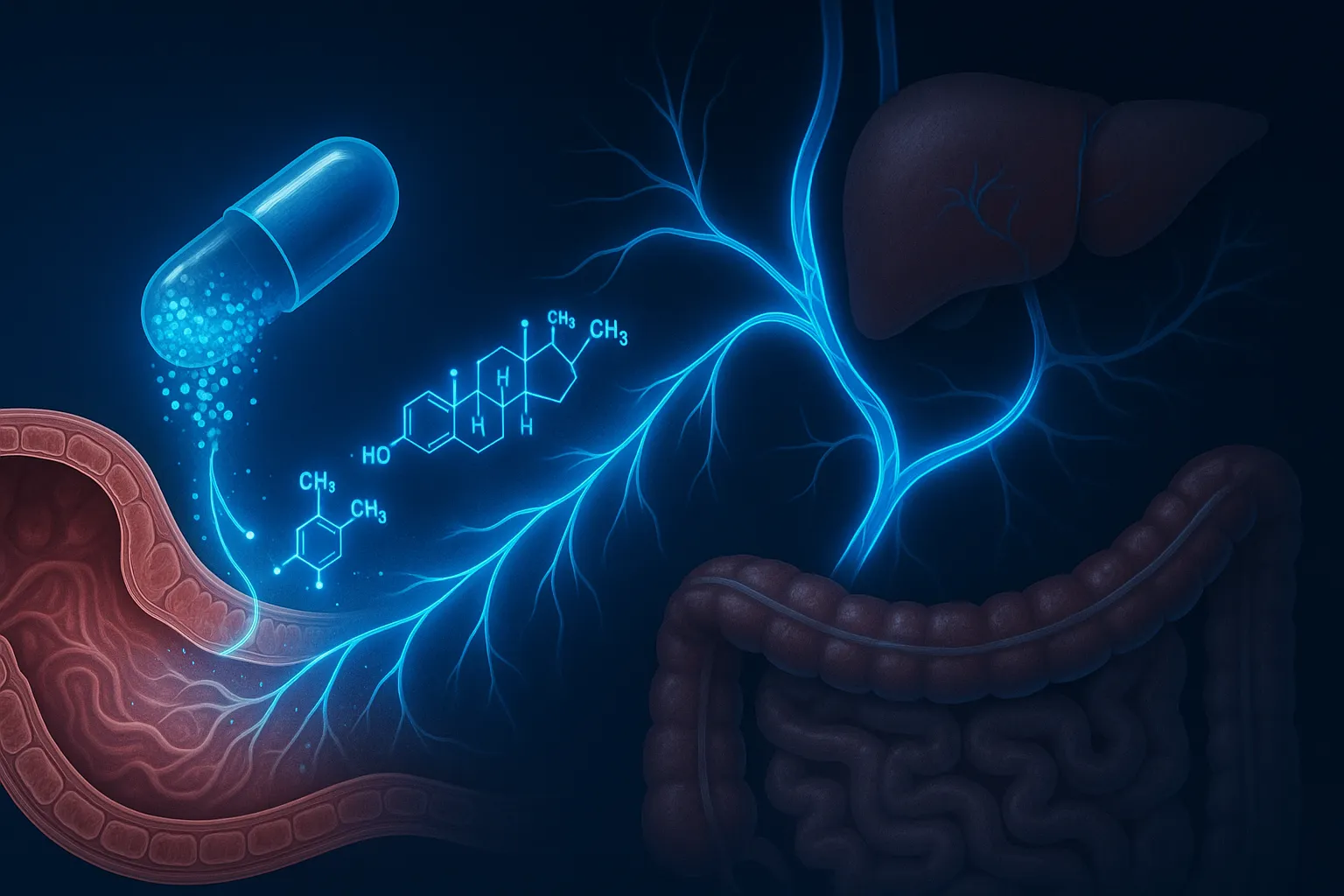
When you swallow oral testosterone undecanoate with a fat-containing meal, the drug dissolves into the dietary fat in your small intestine. Instead of being absorbed into the portal vein (which goes directly to the liver), the testosterone undecanoate is packaged into chylomicrons -- fat-carrying particles -- and absorbed into the intestinal lymphatic system.
This lymphatic route bypasses first-pass liver metabolism entirely. Research confirms that approximately 84% of systemically available testosterone from oral testosterone undecanoate comes from lymphatic transport (PMID: 966635). The testosterone undecanoate travels through the lymphatic system, enters the bloodstream via the thoracic duct, and is then hydrolyzed to active testosterone.
Why Food Matters
Without dietary fat to trigger chylomicron formation, oral testosterone undecanoate absorption drops dramatically. Studies show that fed-state absorption produces testosterone levels roughly 8-10x higher than fasting-state absorption (PMID: 12627930). This means skipping a meal or eating a low-fat meal with your dose is essentially the same as skipping a dose.
Minimum fat requirement: 15-30 grams of fat per meal. Think two eggs with avocado, a handful of nuts with yogurt, or a meal with olive oil.
The Three FDA-Approved Products Compared
All three products contain the same active ingredient -- testosterone undecanoate -- but differ in their formulation technology, dosing strategy, and titration requirements.
Product 1: First to Market (FDA Approved March 2019)
The first FDA-approved oral testosterone undecanoate in the US uses a self-emulsifying drug delivery system (SEDDS) that improves lymphatic absorption consistency.
Pivotal trial results: In a phase 3 randomized, active-controlled trial, 87% of men achieved mean testosterone concentrations within the normal range (300-1,000 ng/dL). Mean serum testosterone reached approximately 489 ng/dL (PMID: 32382745).
Dosing protocol:
Starting dose: 237 mg twice daily with food
Titration: Dose adjusted at day 21 based on serum testosterone levels
Dose range: 158 mg to 396 mg twice daily
Available capsule strengths: 158 mg, 198 mg, 237 mg
Two-year safety data: An extension study following men for 24 months showed sustained efficacy with no clinically significant liver toxicity. Testosterone-induced safety changes included a 3-6 mmHg increase in systolic blood pressure. Sexual function scores improved and were maintained throughout the study period (PMID: 36272969).
Product 2: The No-Titration Option (FDA Approved February 2022)
This product differentiates itself with a fixed-dose protocol that eliminates the need for dose titration. You take the same dose from day one -- no blood draws at 3 weeks to adjust.
Pivotal trial results: In a 24-day open-label trial of 95 hypogonadal men, 80% achieved normal testosterone concentrations on a fixed dose of 225 mg twice daily without any dose adjustment (PMID: 34994093).
Dosing protocol:
Fixed dose: 225 mg twice daily with food
No titration required
Single capsule strength: 225 mg
Why the fixed dose works: The formulation uses a different self-emulsifying system that produces more consistent absorption across patients. While the 80% eugonadal rate is slightly lower than titrated products, the simplicity of no dose adjustments is a meaningful advantage for adherence.
Product 3: The Wide-Range Option (FDA Approved October 2022)
The newest entrant offers the widest dose range of any oral testosterone product, allowing highly individualized dosing.
Pivotal trial results: In a 180-day phase 3 trial of 155 men, 87.8% achieved normal testosterone levels after titration. Among men who completed 90 days, the rate was 96.1%. Mean serum testosterone Cavg was 452 ng/dL (PMID: 38606384).
Dosing protocol:
Starting dose: 200 mg twice daily with food
Titration: Adjusted over two 28-day cycles based on blood levels
Available capsule strengths: 100 mg, 150 mg, 200 mg
Blood pressure data: A dedicated ambulatory blood pressure study showed mean systolic BP increases of only 1.7 mmHg at 120 days and 1.8 mmHg at 180 days -- clinically insignificant for most men (PMID: 34114726).
Head-to-Head Comparison Table
Feature
Product 1 (2019)
Product 2 (2022)
Product 3 (2022)
FDA Approval
March 2019
February 2022
October 2022
Active Ingredient
Testosterone undecanoate
Testosterone undecanoate
Testosterone undecanoate
Eugonadal Rate
87%
80%
87.8%
Starting Dose
237 mg BID
225 mg BID
200 mg BID
Dose Range
158-396 mg BID
225 mg fixed
100-400 mg BID
Titration Required
Yes (day 21)
No
Yes (two 28-day cycles)
Available Strengths
158, 198, 237 mg
225 mg
100, 150, 200 mg
Must Take With Food
Yes
Yes
Yes
Retail Cost (no insurance)
~$900-1,300/mo
~$400-900/mo
~$150-300/mo
Insurance Coverage
Some plans
Some plans
Self-pay model
Long-Term Data
2+ years
24 days (pivotal)
6 months
REMS Program
No
No
No
Note on pricing: Costs vary significantly by pharmacy, insurance plan, and manufacturer coupons. The figures above represent typical ranges as of early 2026. Always check current pricing with your pharmacy.
Oral TRT vs Injections: Practical Comparison
If you're considering oral testosterone, you're probably weighing it against the standard: injectable testosterone cypionate or enanthate. Here's how they actually compare.
Where Oral TRT Wins
No needles. This is the obvious one. For men with needle phobia -- or those who simply don't want to inject themselves twice a week -- oral TRT removes the barrier entirely. Patient satisfaction studies show that men who switched from injections to oral testosterone reported high satisfaction rates, with convenience being the primary driver (PMID: 36064541).
No injection site reactions. No bruising, no scar tissue buildup, no rotation of injection sites. No risk of hitting a nerve or injecting into a blood vessel.
Travel-friendly. Carrying a bottle of capsules through airport security is simpler than traveling with syringes, needles, and a vial of testosterone.
More stable levels (potentially). Twice-daily oral dosing can produce smoother testosterone levels than weekly or biweekly injections, though this depends heavily on meal consistency.
Where Injections Still Win
Cost. Injectable testosterone cypionate runs $30-80/month. Oral testosterone runs $150-1,300/month depending on the product. This gap is massive and is the single biggest barrier to oral TRT adoption.
Dose precision. With injections, you draw exactly 0.35 mL and know precisely what you're getting. Oral absorption varies with meal fat content, timing, and individual factors.
Longer track record. Testosterone cypionate has been in clinical use since the 1950s. The newest oral products have at most 2 years of post-marketing safety data.
No food dependency. You inject on your schedule regardless of meals. Oral TRT requires coordinating doses with fat-containing meals twice a day, every day.
Higher peak levels available. Men who need testosterone levels above 700-800 ng/dL may find it easier to achieve this with injectable testosterone. Oral products are designed to target mid-range eugonadal levels.
Gels are the other needle-free option. How does oral stack up?
Absorption consistency: Oral testosterone requires fat-containing meals but is otherwise straightforward. Gels require application to clean, dry skin and can be affected by sweating, showering, clothing, and skin-to-skin transfer to partners or children.
Transfer risk: This is gel's biggest weakness. Testosterone gel can transfer to women and children through skin contact, potentially causing virilization. Oral testosterone has zero transfer risk.
Efficacy: Both achieve similar eugonadal rates (80-88%). Gels tend to produce lower average testosterone levels, with more men on the lower end of the normal range.
Cost: Gel costs $200-500/month (brand name) or $30-100/month (compounded). Oral testosterone falls in the $150-1,300/month range, making it comparable to brand-name gels but more expensive than compounded options.
Convenience winner: Oral -- swallow a pill with a meal vs. applying gel daily with 5-minute dry time, site rotation, and transfer precautions.
Who Is Oral TRT Best For?
Oral testosterone undecanoate isn't for everyone. Here's who benefits most:
Ideal Candidates
Needle-averse men who would otherwise avoid TRT entirely
Men with active lifestyles where gel transfer is a concern (contact sports, young children at home)
Travelers who want hassle-free dosing without carrying injection supplies
Men who failed gel therapy due to poor absorption or skin reactions
Patients who value convenience and can commit to twice-daily dosing with meals
Poor Candidates
Budget-conscious patients -- injectable testosterone costs 5-10x less per month
Men who skip meals or eat irregular, low-fat diets -- absorption depends on it
Men needing high-dose protocols -- oral products target mid-range T levels
Men who prefer precise pharmacokinetics -- injection dosing is more predictable
Choosing Between the Three Products
Choose the no-titration product if: You want the simplest protocol. Take the same dose from day one, no early blood draws needed. Best for men who value simplicity and whose insurance covers it.
Choose the first-to-market product if: You want the longest safety track record (2+ years of data) and your provider is most familiar with this product. It's been available longest and has the most real-world prescribing experience.
Choose the wide-range product if: You want the most customizable dosing (100-400 mg BID range) or prefer the self-pay model. It's often the most affordable option without insurance.
Insurance and Cost Strategies
Insurance coverage for oral testosterone is inconsistent. Here's the current landscape:
Coverage Status (as of Early 2026)
Commercial insurance: Coverage varies widely. Many plans require prior authorization and step therapy (trying injections or gels first). Some plans cover one or two of the three products but not all.
Medicare Part D: Limited coverage. The 2026 annual out-of-pocket cap of $2,100 helps once you qualify.
Manufacturer programs: All three manufacturers offer savings cards or patient assistance programs that can reduce costs substantially.
Cost Reduction Strategies
Ask your provider to try prior authorization -- even if your plan doesn't list oral testosterone on formulary, a PA citing injection/gel failure can sometimes get coverage
Check manufacturer websites for savings cards or patient assistance programs
Compare pharmacy pricing -- costs vary significantly between retail, mail-order, and specialty pharmacies
Consider the self-pay model product -- it's designed for out-of-pocket payment and often costs less than the others without insurance
All oral testosterone products carry an FDA black box warning about blood pressure increases. In practice, the increases are modest:
Mean systolic BP increase: 1.7-5 mmHg across products
Men already on antihypertensive medications saw slightly larger increases (3.4 mmHg vs 0.7 mmHg)
Blood pressure should be monitored at baseline and periodically during treatment
A 2024 meta-analysis of 30 randomized controlled trials found that testosterone replacement therapy overall does not increase cardiovascular disease risk or all-cause mortality in hypogonadal men (PMID: 38589271).
Liver Safety
This is the most common concern, and the data is reassuring. Modern oral testosterone undecanoate formulations showed no clinically significant hepatotoxicity across all clinical trials, including 2-year extension studies. Liver function tests remained normal in the vast majority of participants. A 2024 review confirmed that elevated liver enzymes are not generally associated with newer oral testosterone undecanoate formulations (PMID: 39291780).
This is fundamentally different from older oral androgens (methyltestosterone, fluoxymesterone) that were 17-alpha-alkylated and directly hepatotoxic.
Hematocrit and Polycythemia
Like all forms of testosterone replacement, oral testosterone can increase red blood cell production. Hematocrit should be monitored per standard TRT protocols. The incidence of polycythemia in oral testosterone trials was comparable to other delivery methods.
Cardiovascular Safety (Broader Context)
The landmark TRAVERSE trial (PMID: 37326322) -- while studying testosterone gel, not oral products specifically -- found no increased risk of major adverse cardiovascular events with testosterone replacement in men with hypogonadism and pre-existing or high risk for cardiovascular disease. This provides broader reassurance about TRT cardiovascular safety.
Practical Dosing Tips
Optimizing Absorption
Always take with a meal containing at least 15-30g of fat
Consistent meal timing helps maintain stable testosterone levels -- aim for the same times daily
Don't crush or chew the capsules -- they're designed for intact swallowing
Morning and evening dosing with breakfast and dinner works for most men
If you miss a dose, take it with the next fat-containing meal -- don't double up
Month 6+: Full effects on bone density, sexual function, and metabolic parameters
Online TRT Clinics Offering Oral Testosterone
Some online TRT clinics now offer oral testosterone undecanoate as part of their protocols. Maximus is one clinic that includes oral testosterone options in their treatment offerings.
Oral testosterone undecanoate is a real option in 2026 -- not a gimmick. Three FDA-approved products deliver 80-88% eugonadal rates with favorable safety profiles and no liver toxicity. The tradeoffs are higher cost, food-dependent absorption, and less long-term data compared to injectable testosterone.
For needle-averse men who can afford it and commit to twice-daily dosing with meals, oral TRT removes the single biggest barrier to treatment. For everyone else, injectable testosterone remains the gold standard for cost, efficacy, and dose precision.
The best choice between the three products comes down to your priorities: simplicity (no-titration), track record (first-to-market), or customization (wide-range dosing). Discuss all three with your provider.
References
Gronski MA, et al. A new oral testosterone undecanoate formulation restores testosterone to normal concentrations in hypogonadal men. J Clin Endocrinol Metab. 2020. PMID: 32382745
Surampudi P, et al. Two-year analysis of a new oral testosterone undecanoate (TU) formulation in hypogonadal men: efficacy, impact on psychosexual function, and safety. J Sex Med. 2022. PMID: 36272969
Yin AY, et al. A new oral testosterone (TLANDO) treatment regimen without dose titration requirement for male hypogonadism. Andrology. 2022. PMID: 34994093
Thirumalai A, et al. A phase III, single-arm, 6-month trial of a wide-dose range oral testosterone undecanoate product. J Clin Endocrinol Metab. 2024. PMID: 38606384
Ip EJ, et al. Effects of the oral testosterone undecanoate Kyzatrex on ambulatory blood pressure in hypogonadal men. J Sex Med. 2021. PMID: 34114726
Horst HJ, et al. Lymphatic absorption and metabolism of orally administered testosterone undecanoate in man. Klin Wochenschr. 1976. PMID: 966635
Lincoff AM, et al. Cardiovascular safety of testosterone-replacement therapy. N Engl J Med. 2023. PMID: 37326322
Liu T, et al. Newer formulations of oral testosterone undecanoate: development and liver side effects. Andrology. 2024. PMID: 39291780
Oral testosterone undecanoate restores normal testosterone levels in 80-88% of men, comparable to topical gels. Injections still offer more precise dose control and slightly higher efficacy rates, but oral TRT is a legitimate alternative for needle-averse men.
Do you need to take oral testosterone with food?
Yes. All three FDA-approved oral testosterone products must be taken with a meal containing at least 15-30g of fat. Food increases absorption by up to 8x because the drug relies on lymphatic absorption triggered by dietary fat.
Is oral testosterone hard on the liver?
No. Unlike older oral androgens (methyltestosterone, oral stanozolol), modern oral testosterone undecanoate is absorbed through the lymphatic system, bypassing first-pass liver metabolism. Clinical trials up to 2 years show no clinically significant liver toxicity.
How much does oral TRT cost per month?
Without insurance: $150-400/month depending on the product. With insurance or manufacturer coupons, costs can drop significantly. Generic oral testosterone undecanoate is not yet available.
Which oral testosterone product is best?
It depends on your priorities. One product requires no dose titration (simplest protocol), another offers the widest dose range (most customizable), and the third has the longest safety track record. All three achieve similar efficacy rates of 80-88%.