Key Takeaways
- TRT raises dihydrotestosterone (DHT) 2-3x above baseline, and DHT is the primary androgen behind male-pattern hair loss
- Hair loss on TRT is genetic, not inevitable -- your androgen receptor sensitivity determines your risk, not your testosterone dose
- Five evidence-based prevention strategies exist: finasteride, dutasteride, minoxidil, topical anti-androgens, and switching to lower-DHT delivery methods
- Early intervention matters -- once a follicle miniaturizes completely, it rarely recovers
- Most men on TRT can preserve their hair with the right protocol
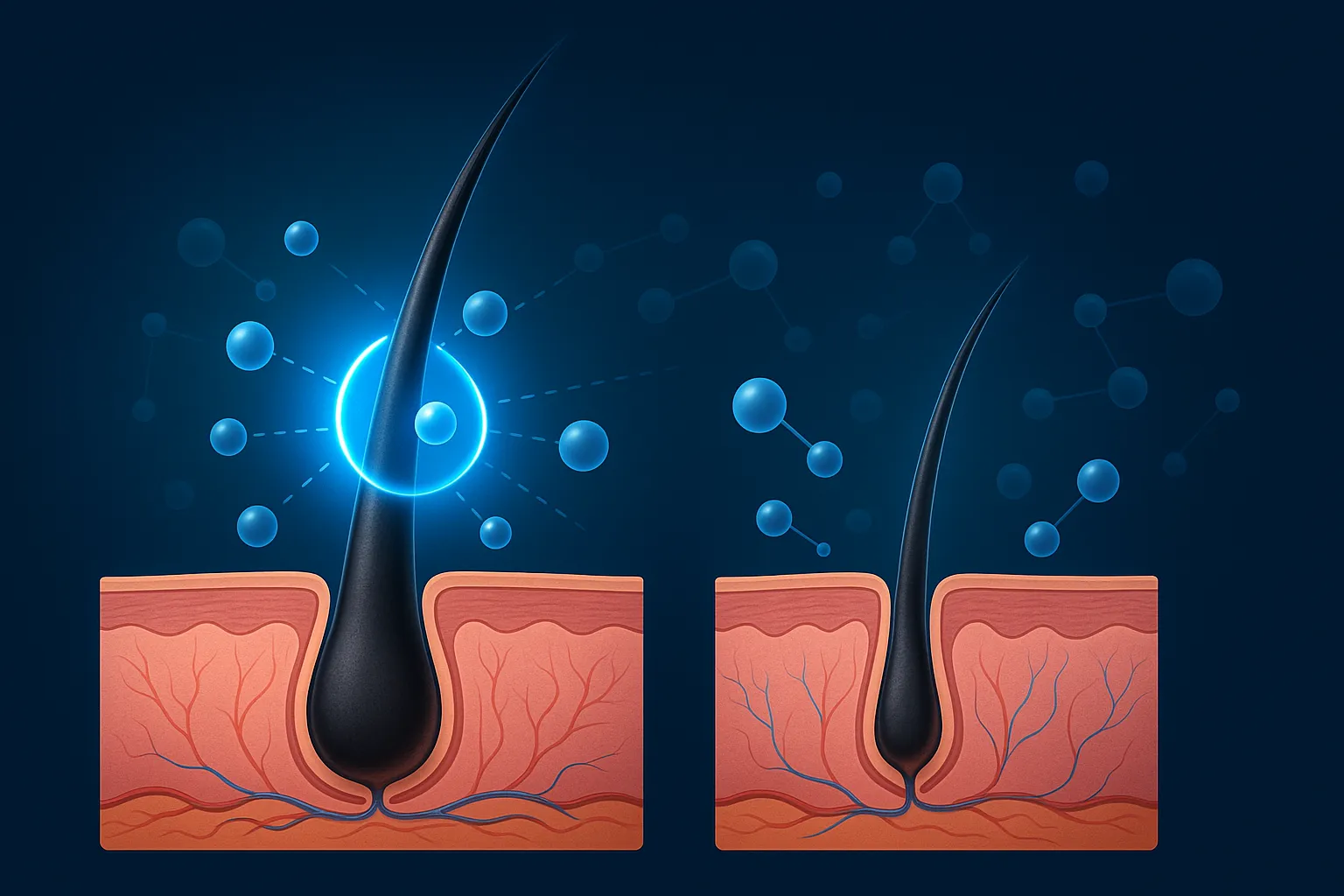
Hair loss is one of the most common fears men have before starting TRT. It's also one of the most misunderstood. The reality: testosterone itself doesn't kill hair follicles. Its metabolite DHT does -- but only if your follicles are genetically programmed to be sensitive to it.
This guide covers exactly how TRT affects your hair, who's actually at risk, and the five most effective strategies to prevent hair loss while staying on treatment.
How TRT Increases DHT
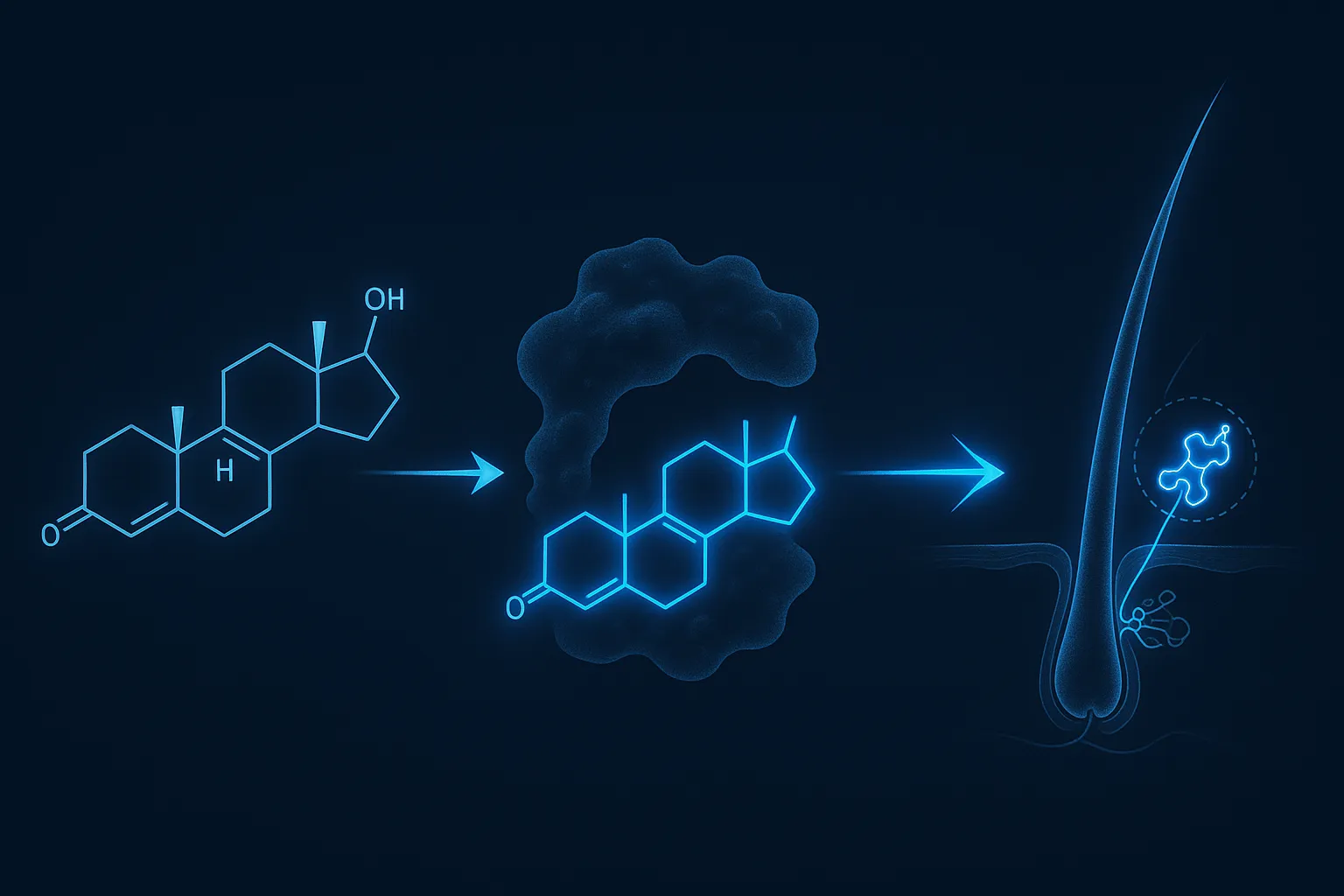
Testosterone is converted to dihydrotestosterone (DHT) by an enzyme called 5-alpha reductase. DHT is 3-5x more potent than testosterone at activating androgen receptors, and it's the primary driver of male-pattern baldness.
When you start TRT, your serum testosterone rises to the upper physiological range (typically 700-1100 ng/dL). Your body converts a percentage of that testosterone to DHT via 5-alpha reductase, which is found in skin, the prostate, and -- critically -- the scalp.
The math is straightforward: more testosterone in your system means more substrate for 5-alpha reductase to work with, which means more DHT. Studies show that TRT elevates serum DHT from a baseline of roughly 30-80 ng/dL to 50-230 ng/dL depending on the delivery method [1, 2]. That's a 2-3x increase.
Route of Administration Matters
Not all TRT methods produce the same DHT levels. This is an underappreciated factor in hair loss risk.
Transdermal (scrotal cream/patches): Scrotal skin has high concentrations of 5-alpha reductase. Testosterone cream applied to the scrotum produces supraphysiological DHT levels -- sometimes 3-5x above baseline [3]. Non-scrotal transdermal applications (shoulder, arm) also elevate DHT more than injections, though less dramatically than scrotal application.
Intramuscular injections: Testosterone cypionate and enanthate injections tend to produce lower DHT elevations relative to the testosterone increase, because the conversion happens systemically rather than through 5-alpha reductase-rich skin. For men concerned about hair loss, injections are generally the lower-DHT option.
Subcutaneous injections: Similar DHT profile to intramuscular, with slightly more stable levels when injected frequently.
If you're optimizing for hair preservation, your TRT delivery method matters. Discuss this trade-off with your prescribing clinic.
The Genetics Factor: Who's Actually at Risk
Here's the part that most TRT content gets wrong: DHT alone doesn't cause hair loss. Millions of men have high DHT and full heads of hair. The determining factor is your hair follicles' sensitivity to DHT, which is genetically encoded.
Androgen Receptor Sensitivity
The androgen receptor (AR) gene sits on the X chromosome, which you inherit from your mother. Variations in this gene -- specifically, shorter CAG repeat sequences in exon 1 -- produce androgen receptors that are more sensitive to DHT [4, 5].
When DHT binds to these hypersensitive receptors in scalp follicles, it triggers a process called follicular miniaturization. Each hair growth cycle produces a thinner, shorter, lighter hair until the follicle eventually stops producing visible hair altogether.
The pattern is predictable:
- Hairline recession at the temples (Norwood II-III)
- Crown thinning (vertex)
- Progressive connection of frontal and vertex loss (Norwood V-VII)
How to Assess Your Risk
Before starting TRT, evaluate these factors:
- Family history: Look at both sides, but maternal grandfather is the strongest single predictor (X-linked AR gene). If he was bald by 40, your risk is elevated.
- Current hair status: Are you already showing miniaturization? Thinning at the temples or crown? TRT will accelerate existing loss.
- Age of onset: If you started thinning in your 20s without TRT, you have aggressive androgen-sensitive follicles. TRT will speed this up significantly.
- Baseline DHT levels: Get a pre-TRT DHT level drawn. If it's already at the high end of range (50-80 ng/dL), adding TRT substrate will push it higher.
The bottom line: if male-pattern baldness runs in your family, assume you're at risk on TRT. If it doesn't, your hair is likely safe regardless of dose.
Normal Shedding vs. Actual Hair Loss
Not every hair that falls out after starting TRT is a sign of androgenetic alopecia. Distinguish between:
Normal shedding (telogen efflux): The body sheds 50-100 hairs daily. Hormonal changes -- including starting TRT -- can temporarily increase shedding for 2-6 weeks as hair follicles adjust to the new hormonal environment. This is self-limiting and not a sign of permanent loss.
Androgenetic alopecia acceleration: Progressive thinning that follows the classic male pattern (temples, crown). This starts 2-6 months after beginning TRT and does not reverse on its own. The earlier you intervene, the more hair you save.
How to tell the difference: Take photos of your hairline and crown under consistent lighting every month for the first six months of TRT. Compare them. Diffuse shedding that resolves by month 2-3 is adjustment. Progressive recession or thinning at the temples and crown is pattern loss.
Check your first-month TRT expectations guide for other changes to anticipate during this period.
5 Evidence-Based Prevention Strategies
If you're genetically susceptible -- or simply want to be proactive -- these are the five most effective tools for keeping your hair on TRT. They can be used individually or stacked for maximum effect.
1. Finasteride (1 mg/day oral)
Finasteride is a type II 5-alpha reductase inhibitor. It blocks the enzyme that converts testosterone to DHT, reducing serum DHT by approximately 60-70% and scalp DHT by a similar margin [6].
The evidence is strong. A landmark trial demonstrated that finasteride 1 mg/day significantly improved scalp hair at 1 and 2 years compared to placebo, with benefits sustained over 5 years of continuous use [6]. For men on TRT, finasteride essentially neutralizes the DHT increase that TRT causes.
Dosing on TRT: 1 mg/day is standard. Some men use 0.5 mg/day or even 0.25 mg/day, as clinical data shows doses as low as 0.2 mg/day demonstrate efficacy. Lower doses may reduce side effect risk while retaining most of the DHT-blocking effect.
Side effects to discuss with your doctor: Sexual side effects (decreased libido, erectile changes) occur in roughly 2-4% of users. These are usually reversible upon discontinuation. On TRT, sexual side effects may be less pronounced because testosterone levels remain high even as DHT drops.
Best for: First-line prevention. The single most effective pharmacological tool for hair preservation on TRT.
2. Dutasteride (0.5 mg/day oral)
Dutasteride inhibits both type I and type II 5-alpha reductase, reducing serum DHT by approximately 90% -- significantly more than finasteride's 60-70% [7].
A randomized controlled trial of 917 men found dutasteride 0.5 mg produced significantly greater increases in hair count compared to finasteride 1 mg at 24 weeks [7]. For men on TRT with aggressive hair loss who don't respond adequately to finasteride, dutasteride is the next step.
Important caveat: Dutasteride is not FDA-approved for hair loss in the United States (it is approved in Japan and South Korea). It's used off-label for this purpose. Its longer half-life (4-5 weeks) means it takes longer to wash out if you experience side effects.
Best for: Men who tried finasteride and still see progression, or those with aggressive early-onset pattern loss.
3. Minoxidil (topical or oral)
Minoxidil works through a completely different mechanism than DHT blockers. It's a vasodilator that prolongs the anagen (growth) phase of the hair cycle and stimulates follicular activity. It doesn't touch DHT at all -- it just helps follicles grow despite DHT exposure.
A systematic review and meta-analysis confirmed minoxidil is significantly more effective than placebo, with 5% solution producing 45% more hair regrowth than 2% solution at 48 weeks [8].
Topical: 5% minoxidil foam or solution applied to thinning areas twice daily. Results take 4-6 months to become visible.
Oral (low-dose): 2.5-5 mg/day is gaining traction as an alternative for men who don't want to deal with topical application. Oral minoxidil showed superiority over topical for vertex regrowth in a recent randomized trial. Discuss cardiac monitoring with your doctor -- minoxidil was originally a blood pressure medication.
Best for: Stacking with finasteride for maximum effect. Minoxidil + finasteride addresses both the cause (DHT) and the growth potential (follicular stimulation).
4. Topical Anti-Androgens
For men who want to block DHT at the scalp without systemic effects, topical formulations are an option.
Topical finasteride: A phase III trial showed topical finasteride spray achieved comparable hair growth to oral finasteride while producing plasma concentrations more than 100x lower. Serum DHT reduction was 34.5% (topical) versus 55.6% (oral), with significantly fewer systemic sexual side effects.
Topical dutasteride: Compounding pharmacies can formulate dutasteride in topical carriers. Less clinical data exists, but the rationale is the same -- local DHT suppression with minimal systemic absorption.
Ketoconazole shampoo (2%): Ketoconazole has mild anti-androgenic properties. Using it 2-3x per week as a maintenance shampoo is a low-risk addition to any hair preservation protocol. It won't move the needle on its own, but it complements other treatments.
Best for: Men who experience sexual side effects on oral finasteride and want localized DHT blocking.
5. Switch to Lower-DHT Delivery Methods
If you're currently on a high-DHT delivery method like scrotal cream, switching to intramuscular or subcutaneous injections can meaningfully reduce your DHT levels [2, 3].
This doesn't require adding any medication -- it's simply a delivery method change. The trade-off is that some men prefer cream for convenience or because they respond better to the higher DHT (improved libido, mood, or energy). But if hair preservation is a priority, injections produce a more favorable testosterone-to-DHT ratio.
Non-injectable options like nasal testosterone gels are also worth exploring, though data on their long-term DHT profiles is still limited.
Discuss dosing adjustments with your provider to find the balance between optimal testosterone levels and manageable DHT.