Key Takeaways: A meaningful share of men whose depression does not fully respond to antidepressants have low testosterone driving part of the picture. A 2018 JAMA Psychiatry meta-analysis of 27 randomized trials (1,890 men) found testosterone treatment produced a significant antidepressant effect versus placebo, with an odds ratio of 2.30 for a clinically meaningful response -- in the same range as standard antidepressants -- and the effect was strongest at higher doses. Small trials in men with SSRI-refractory depression and low testosterone showed rapid improvement when testosterone was added. The catch: baseline testosterone level did not cleanly predict who responded, so this is a clinical judgment built on symptoms plus labs, not a single cutoff. Testosterone is not a treatment for depression in men with normal levels, and no one should self-taper an antidepressant. But for the man stuck on an SSRI with persistent low mood, low libido, and fatigue, checking testosterone is a reasonable, often-skipped step.
The Man the Standard Algorithm Misses
There is a recognizable clinical story that plays out in primary care and psychiatry offices constantly. A man in his 40s or 50s reports low mood, no drive, poor sleep, and flat motivation. He is started on an SSRI. A few weeks later he is somewhat better but not well -- and now his libido is worse and his energy has not recovered. The dose gets raised. A second antidepressant gets added. He is labeled treatment-resistant.
What frequently never gets checked along the way is a morning testosterone level.
This matters because the symptom overlap between low testosterone and depression is almost total. Low energy, depressed mood, loss of interest, poor concentration, disrupted sleep, reduced libido, and irritability appear on both symptom lists. When a hypogonadal man presents with these complaints, the depression framing is reached for first, and the hormonal contributor goes unexamined.
The result is a subset of men carrying a "treatment-resistant depression" label whose underlying problem is at least partly endocrine -- and who never get the one test that would reveal it.
How Low Testosterone Drives Low Mood
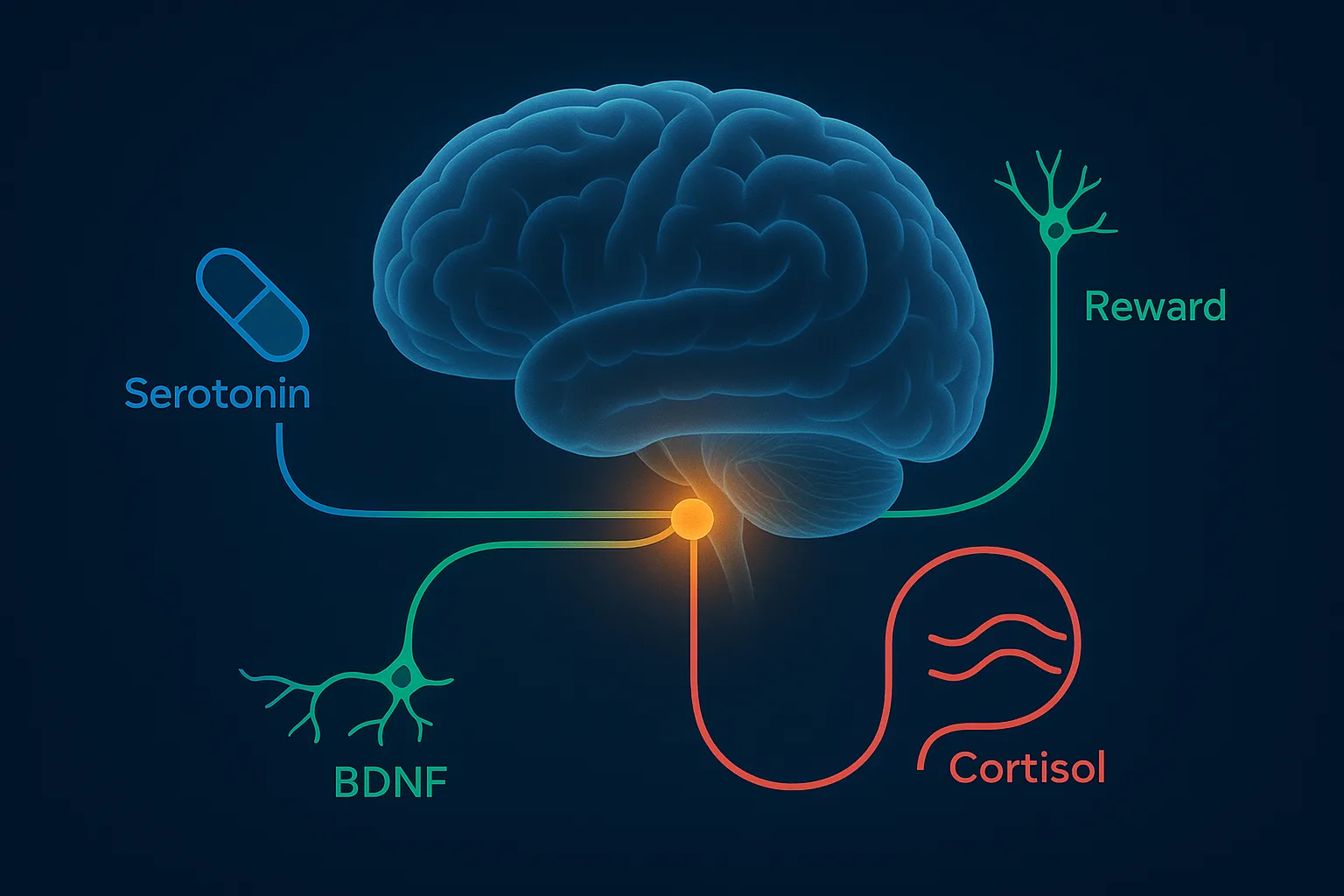
The link is not vague hand-waving. Testosterone acts on the brain through several pathways that are directly relevant to mood regulation:
- Serotonin signaling. Androgens influence serotonin receptor density and turnover, the same system SSRIs target.
- Dopamine and motivation. Testosterone supports dopaminergic signaling in reward and motivation circuits. Low dopamine drive maps onto the anhedonia and low motivation that define a large part of depression.
- BDNF and neuroplasticity. Brain-derived neurotrophic factor supports neuronal health and is implicated in both depression and antidepressant response. Low testosterone is associated with reduced BDNF.
- The HPA stress axis. Androgens exert tonic regulation over the hypothalamic-pituitary-adrenal axis. When testosterone drops, the stress axis runs hotter, with chronically elevated cortisol output -- a pattern strongly tied to depression.
Each of these is an independent line of evidence. Together they explain why a genuinely hypogonadal man can sit in a depressive state that an SSRI only partially touches: the antidepressant is working one lever while a second lever -- the hormonal one -- is still pulled the wrong way.
What the Trial Evidence Actually Shows
The strongest single piece of evidence is a 2018 meta-analysis published in JAMA Psychiatry by Walther and colleagues [1]. It pooled 27 randomized, placebo-controlled trials covering 1,890 men. The headline numbers:
- A significant antidepressant effect of testosterone versus placebo (Hedges g = 0.21).
- An odds ratio of 2.30 for achieving at least a 50% reduction in depressive symptoms -- meaning men on testosterone were more than twice as likely as those on placebo to hit a clinically meaningful response.
- A clear dose effect. Higher testosterone doses produced substantially larger mood effects; the effect at robust dosing reached Hedges g of about 0.52, which is a moderate, clinically real signal.
- Comparable acceptability to antidepressants -- dropout rates were not significantly different from placebo.
The authors put the response magnitude in the same conversation as approved antidepressants. That is a strong statement for a hormone that is rarely on the depression-treatment menu.
The SSRI-Refractory Subgroup
Beyond the broad meta-analysis, there is older but pointed evidence in the specific population that matters most here: men whose depression has not responded to antidepressants and who have low or borderline testosterone. Small randomized and open-label work has shown that adding testosterone to an existing antidepressant regimen in these men can produce rapid, substantial improvement in depression rating scores -- in some reports dropping from clearly depressed to near-remission within a few weeks [2][3].
These are small studies, and the field needs larger confirmatory trials. But they describe exactly the clinical scenario that the standard algorithm fails: the man who is already on an SSRI, still depressed, and quietly hypogonadal.
The Counterintuitive Part: No Clean Threshold
Here is the finding that complicates the simple story. The meta-analysis found that baseline testosterone level was not a reliable moderator of who responded. In other words, men who started with frankly low testosterone did not clearly out-respond men whose levels were borderline or low-normal. The authors stated plainly that there is no testosterone concentration threshold that reliably separates responders from non-responders.
This cuts two ways:
- It argues against the rigid "your level isn't low enough" gatekeeping that some men encounter. A total testosterone of 350 ng/dL is not automatically irrelevant to mood just because it clears an arbitrary lab cutoff.
- It also argues against treating testosterone as a general antidepressant for men with normal levels. The point is not that everyone benefits -- it is that a single number cannot be the sole deciding factor.
What this means in practice: this is a judgment call that belongs to a clinician who weighs the full symptom picture, free testosterone and SHBG (not just total), estradiol, and the trajectory of an antidepressant trial -- rather than a yes/no triggered by one lab value. For why total testosterone alone is misleading, see Total vs Free Testosterone and How to Read Testosterone Labs.
Can the Antidepressant Itself Be Part of the Problem?
There is a plausible bidirectional loop worth understanding. SSRIs can increase aromatization of testosterone to estradiol and influence the hypothalamic-pituitary-gonadal axis. And SSRI-associated sexual side effects -- reduced libido, erectile changes, blunted arousal -- overlap precisely with low-testosterone symptoms, which can make a man feel his hormonal situation got worse after starting treatment.
A 2024 study in Neuroscience Applied found that in men starting escitalopram, lower baseline testosterone and estradiol predicted a greater likelihood of SSRI-induced sexual dysfunction [4]. The sample was small (26 men) and the design cannot prove causation, but it supports a clinically useful idea: hormone levels may help predict who will tolerate an SSRI poorly, and the man whose libido cratered on an antidepressant is exactly the man worth checking.
This is not an argument to stop antidepressants. It is an argument to stop treating the hormonal axis as if it does not exist while medicating the same symptom cluster from one direction only.