
This article describes evidence-based timing conventions used in published clinical guidelines and routine TRT prescribing. It is not medical advice. Lab interpretation and dose decisions require a licensed prescriber.
The most common reason a testosterone lab gets misread is not the lab. It is the timing of the draw. A man tested at 4 PM after a sandwich and a workout will look like a different patient than the same man tested at 7:30 AM fasted. A man on weekly cypionate drawn 24 hours post-injection will look 30-50% better-medicated than he actually is for most of the week.
This page lays out exactly when to draw a testosterone blood test -- time of day, day of week, fasting requirements, post-injection windows by formulation, and how long to wait after starting or changing a dose. The rules are simple. The cost of breaking them is dose decisions that send your protocol in the wrong direction.
Key Takeaways
- Test between 7 and 10 AM, within two hours of waking, to capture the circadian peak
- Always draw at trough on TRT -- the morning before your next injection, never at peak
- Fasting is only required if you bundle a lipid or glucose panel; testosterone itself does not require fasting
- Wait 6-8 weeks after starting or changing any TRT protocol before drawing follow-up labs
- Avoid alcohol, intense exercise, illness, and severe sleep loss for 24-48 hours before the draw
- Transdermals, pellets, and oral testosterone each have their own draw-time rules per the product label
Time of Day: Why Morning Is Non-Negotiable
Endogenous testosterone follows a circadian pattern. Levels peak shortly after waking and fall steadily through the day, hitting their daily low in the late afternoon and evening. In a healthy young man the morning-to-evening drop is 20-30%. In an older man the rhythm flattens but a meaningful diurnal swing still exists.
The Endocrine Society 2018 guideline (Bhasin et al.) and the AUA 2018 guideline (Mulhall et al.) both specify morning total testosterone draws between 7 AM and 10 AM for the diagnosis of hypogonadism. Two morning measurements below 300 ng/dL on separate days are required before initiating therapy. An afternoon draw can run far enough below the morning value to misclassify a normal man as hypogonadal -- or, worse, miss a real deficiency because the lab was drawn at a time of day no guideline endorses.
Why the Window Is 7-10 AM Specifically
- Cortisol is dropping. Morning cortisol is high and competes for SHBG binding. By the second hour after waking, cortisol has begun its descent and total/free testosterone readings are most representative.
- Sleep effects have stabilized. Testosterone production is heavily sleep-dependent. The morning value reflects the previous night's restoration.
- Lab logistics work. Most labs and clinic phlebotomy stations open at 7 AM. The window matches when phlebotomy services are actually available.
If you are tested outside this window, the result is harder to interpret. A 9 AM total testosterone of 320 ng/dL means something different than a 4 PM total testosterone of 320 ng/dL. The first is a borderline normal morning value. The second is a severely depressed afternoon value that probably corresponds to a morning value in the 400-450 ng/dL range. Same number on the report. Different clinical reality.
For the broader interpretation framework see how to read testosterone labs.
Trough vs Peak: The Single Most Important Rule on TRT
Once you are on testosterone replacement therapy, the rules change. Time of day still matters, but the dominant variable becomes time relative to your last injection.
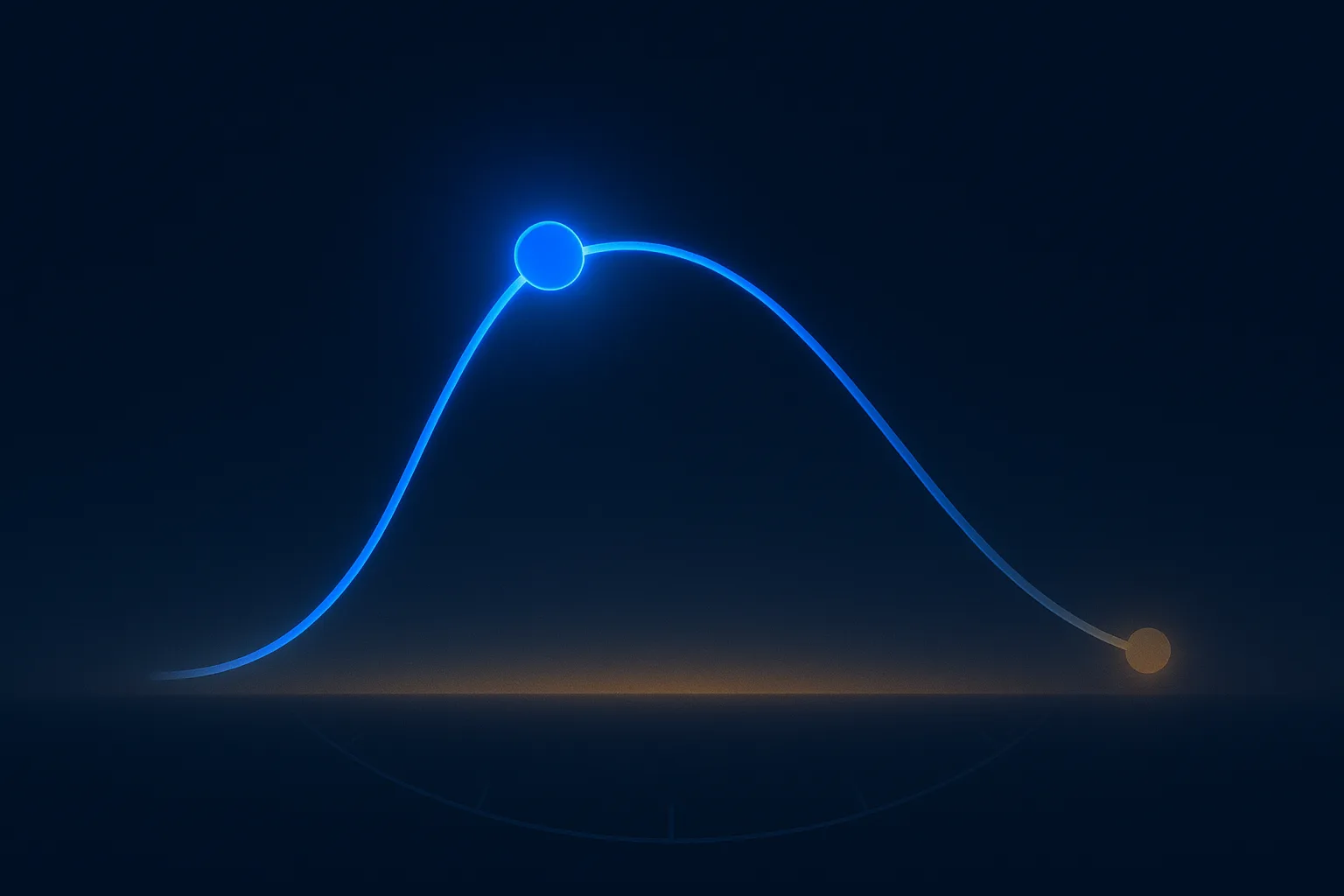
Long-acting testosterone esters -- cypionate and enanthate are the two most commonly prescribed in the U.S. -- produce a sawtooth serum pattern. A typical 140 mg weekly cypionate dose peaks around 24-72 hours post-injection at 1,200-1,500 ng/dL, then falls to a trough of 500-700 ng/dL by day 7 right before the next dose. The peak-to-trough ratio for weekly intramuscular cypionate is roughly 2:1 to 3:1.
This is why the timing of the draw decides the answer.
What Trough Means and Why It Wins
Trough is the lowest point in the dose interval. For weekly injections, that is the morning of day 7, immediately before the next dose. For twice-weekly Monday/Thursday, trough is the morning of the next scheduled injection -- Monday before Monday's dose, or Thursday before Thursday's dose.
Three reasons published guidelines anchor TRT monitoring to trough:
- Trough is reproducible. Peak depends on the exact hour relative to injection, which is hard to standardize. Trough is anchored to a single defined point: the morning before the next dose. The same man tested at trough on visit 1 and visit 2 has a comparable data point.
- Trough predicts steady-state symptom response. Your tissues see the area under the curve, not the peak. A man with a 1,400 ng/dL peak and a 500 ng/dL trough is hypogonadal for most of his week regardless of how impressive the peak looks.
- Trough drives the right dose decision. A peak draw of 1,200 might prompt a clinician to cut the dose. A trough draw on the same patient might show 450, which calls for more frequent injections, not a lower weekly milligrams. Same man, opposite decisions, depending on draw timing.
For the full lab-driven dose adjustment framework, see titrating TRT by trough levels.
Why Peak Draws Mislead So Reliably
Some clinics quietly schedule labs at convenient times -- mid-week, post-injection -- because it produces a "good number" for the chart. Others let patients pick their own draw day without coaching. The result is a generation of TRT patients whose entire dose history was set on inflated peak data.
A peak of 1,400 ng/dL with a trough of 500 ng/dL is not a man on a high dose. He is a man with a wide peak-to-trough swing on a once-weekly schedule. The fix is twice-weekly or every-other-day dosing to flatten the curve, not a dose cut. See injection frequency: weekly vs every other day for the protocol logic.
Trough Timing for Common TRT Schedules
| Schedule |
Inject Day |
Trough Draw Time |
| Weekly IM/SC |
Sunday AM |
Following Sunday AM, before next dose |
| Twice weekly |
Mon/Thu |
Monday AM before Monday dose, or Thursday AM before Thursday dose |
| Every other day |
Day 1, 3, 5... |
Morning of next scheduled dose, before injecting |
| Daily SC microdose |
Daily AM |
Morning of next dose, before injecting |
| Pellets |
Implant Q3-6 mo |
Midpoint between insertions |
Timing Rules by Formulation
Each TRT formulation produces a different serum curve. The draw-time rule changes accordingly.
Testosterone Cypionate or Enanthate (Injectable)
Long half-life esters (8 days for cypionate, 4-5 days for enanthate). Trough draw on the morning before the next scheduled injection. Steady state takes 5-6 weeks. The 6-8 week recheck rule applies to both starting therapy and any dose change.
Specifics by injection frequency are in testosterone cypionate vs enanthate and average TRT dose per week.
Testosterone Gels and Creams (Transdermal)
The FDA label for AndroGel and similar transdermals specifies drawing 2-6 hours after morning application to capture steady-state values. Transdermals produce a much flatter curve than injections -- peak-to-trough variability is roughly 20-30% rather than 100-200%. Steady state is reached within 7-14 days of consistent application.
Avoid washing the application site for at least 2 hours before the draw and avoid skin-to-skin contact at the site. Cross-contamination during phlebotomy can spike the result artifactually.
Testosterone Pellets
Pellets release testosterone over 3-6 months. Serum levels rise in weeks 1-4, plateau through months 2-4, and decline in months 4-6. The most representative draw is at the midpoint between insertions. A draw two weeks after pellet placement will overestimate steady state. A draw one week before the next planned insertion will underestimate it.
For pellet-specific dose curve details see testosterone cypionate vs pellets.
Oral Testosterone (Jatenzo, Tlando, Kyzatrex)
Oral testosterone undecanoate has a complex absorption pattern with food-dependent peaks. Each product label specifies its own draw timing -- typically a defined post-dose interval (commonly 3-6 hours after the morning dose with food). Skipping the food requirement before the draw produces uninterpretable results because absorption depends on the lipid meal.
See oral testosterone Jatenzo Tlando for the formulation-specific protocols.
HCG and Combined Protocols
HCG can spike estradiol and shift SHBG. Men on TRT plus HCG should draw labs the morning of the next HCG dose to standardize the timing of the add-on. Estradiol and SHBG are particularly sensitive to HCG dose timing. See HCG for fertility on TRT.
Aromatase Inhibitors
Anastrozole and similar AIs can dramatically suppress estradiol within 24-48 hours of a dose. Estradiol labs in men on AIs should be drawn the morning of the next AI dose, not just after one. Drawing right after a dose underestimates the average estradiol the patient lives with. See aromatase inhibitors on TRT.
Fasting: When It Matters and When It Does Not
Testosterone, free testosterone, SHBG, estradiol, prolactin, LH, FSH, and CBC do not require fasting. Most TRT panels can be drawn fed without affecting the validity of the result.
That said, three nuances are worth knowing.
High-Carb Meals Acutely Suppress Testosterone
Studies have shown that a high-glucose load acutely lowers total testosterone by 15-25% for several hours after the meal. The mechanism is poorly characterized but probably involves insulin's effect on SHBG and LH suppression. For diagnostic draws (pre-TRT), morning fasted is the cleanest default to remove this variable. For maintenance draws on TRT, fasting matters less because exogenous testosterone is the dominant contributor to the serum level.
Fasting Is Required for Bundled Panels
If your TRT bloodwork includes a lipid panel, fasting glucose, or fasting insulin, you must fast 8-12 hours regardless of the testosterone-specific rule. Most TRT clinics bundle these into the standard panel because both lipids and glucose shift on TRT and need to be tracked.
Water is fine during the fast. Black coffee is debated -- some clinicians allow it, others disallow it for fasting glucose accuracy. Skip the cream and sugar regardless.
Medications That Affect the Draw
Continue all regular TRT medications unless your prescriber explicitly instructs otherwise. Stopping testosterone, HCG, or an AI for "a clean draw" defeats the entire purpose of monitoring -- the goal is to see what your protocol is actually doing, not what your serum looks like off-protocol.
For a deeper review of which labs matter and what counts as essential vs optional, see the full TRT bloodwork schedule guide.
How Long to Wait After a Dose or Protocol Change
Six to eight weeks. This is the second most important timing rule after trough draws.
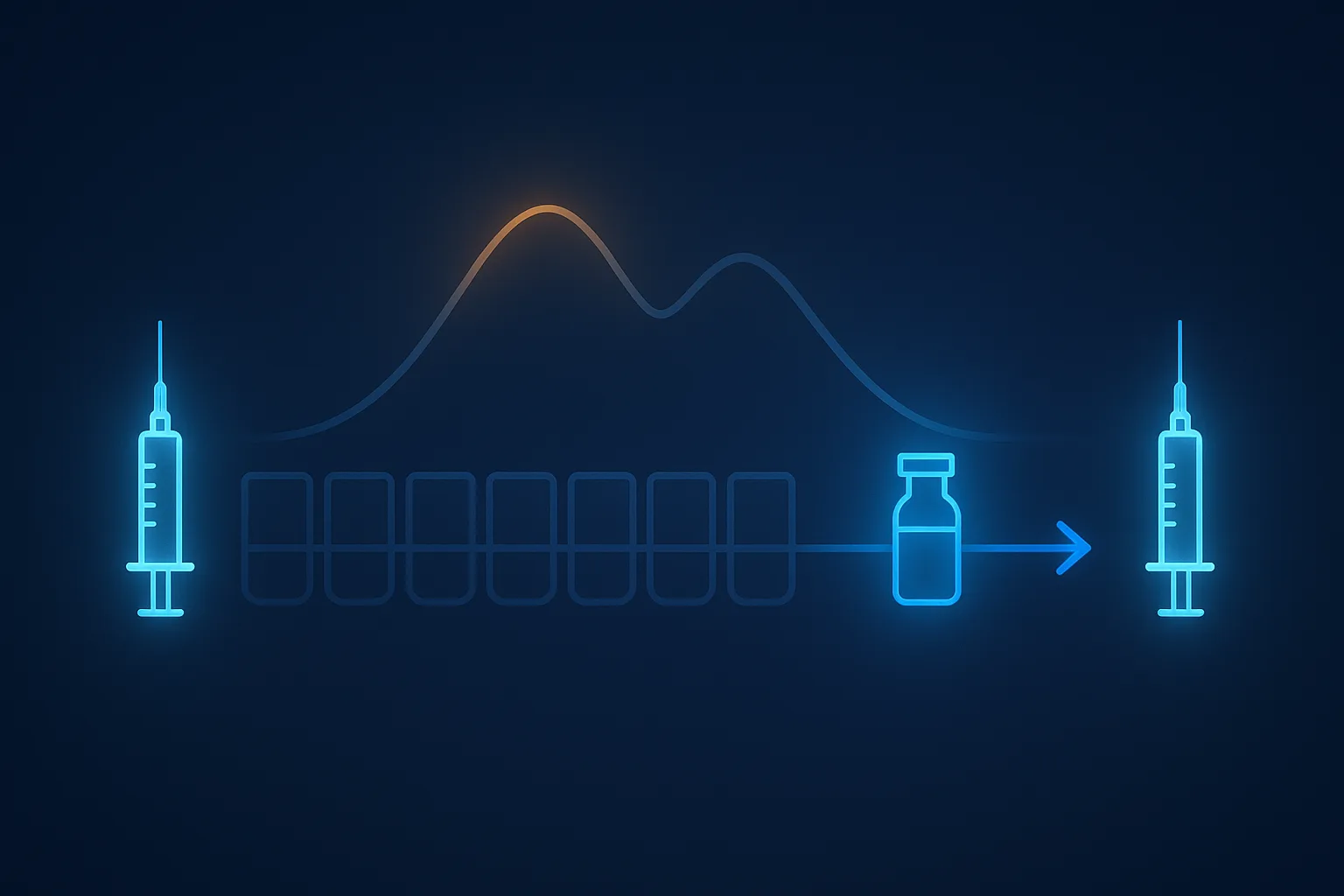
The rule is rooted in pharmacokinetics. Testosterone cypionate has a half-life of approximately 8 days. Steady state requires four to five half-lives, which is 32 to 40 days. Earlier than 6 weeks, the number is still climbing toward the new steady state. Drawing at week 3 produces a transitional value that is neither the old steady state nor the new one.
What Counts as a "Change" That Restarts the 6-8 Week Clock
- Dose change (any direction)
- Frequency change (weekly to twice weekly, twice weekly to every other day, etc.)
- Route change (IM to SC, gel to injection, etc.)
- Adding HCG to a TRT-only protocol
- Adding an aromatase inhibitor
- Stopping HCG or AI
- Switching ester (cypionate to enanthate, vice versa)
For a fresh TRT start, the same rule applies -- 6-8 weeks before the first follow-up draw. Anything earlier is a moving target, and a dose decision based on a moving target usually has to be undone at the next visit.
When Earlier Labs Make Sense
Two situations call for an earlier draw despite the steady-state rule:
- New side effect. Persistent headaches, facial flushing, vision changes, sudden mood shift, water retention, breast tenderness -- any of these warrant a targeted draw at the time of symptom onset rather than waiting for the scheduled lab.
- Suspected polycythemia. A CBC at week 4 to confirm the hematocrit trend is reasonable in men with elevated baseline hematocrit, even if the testosterone level is still moving. Hematocrit can climb on a faster timeline than testosterone reaches steady state. For the full polycythemia management framework, see TRT polycythemia and hematocrit.
Pre-Draw Checklist: What to Avoid in the 24-48 Hours Before
Even with perfect time-of-day and trough timing, several common pre-draw behaviors can distort the result.
Avoid for 24-48 Hours Before the Draw
- Intense exercise. Acute heavy resistance training causes a transient testosterone spike followed by suppression. Both directions confound interpretation.
- Alcohol. Suppresses Leydig cell function and increases SHBG transiently. Even moderate intake within 24 hours can shift readings.
- Acute illness. Any infection or systemic inflammation lowers endogenous testosterone substantially. Postpone the draw if you are sick.
- Severe sleep loss. A single night below 5 hours of sleep can drop testosterone by 10-15% the next morning.
- Unusual stress. Acute psychological stress raises cortisol, which competes for SHBG and lowers free testosterone.
- Large meal late the previous night. Heavy late dinners can alter the morning fasting state and shift insulin, which interacts with SHBG.
What Is Fine
- Routine sleep schedule. No need to sleep extra or change your normal pattern.
- Sex. No meaningful effect on next-day testosterone in either direction.
- Light walking or low-intensity activity. No effect.
- Continuing your TRT protocol. Inject your normal trough-day dose AFTER the draw, on the same morning.
Common Timing Mistakes That Wreck the Data
Even men who follow a written schedule make systematic timing errors. The most common five:
1. Drawing Mid-Week Instead of at Trough
A man on weekly Sunday cypionate who draws on Wednesday is sampling near peak. The number reads 1,150 ng/dL. He gets a dose cut. The following month his trough drops to 350 ng/dL and he feels worse. The fix was never a dose cut -- it was a draw time correction.
2. Drawing in the Afternoon
A 2 PM total testosterone of 380 ng/dL might be a 7 AM total testosterone of 480 ng/dL. The afternoon value triggers a starting-TRT decision in a man who, properly tested, would not meet the diagnostic criteria. Or it triggers an inappropriate dose increase in a man already on TRT.
3. Drawing Too Soon After a Dose Change
A man cut from 200 mg weekly to 150 mg weekly draws labs at week 3. The number still reflects the old steady state plus a partial decline. He concludes the dose cut "didn't work" and asks to go back up. The number at week 7 would have shown the actual new steady state.
4. Skipping the Morning of the Draw and Eating Breakfast First
A man with a 9 AM lab appointment eats a high-carb breakfast at 7 AM. His total testosterone reads 15-20% lower than his fasted baseline. If anything else is bundled (lipids, glucose), the panel is invalid for those markers entirely.
5. Drawing After an Unusual Workout or Drinking Episode
A man who lifted heavy the night before, slept 5 hours, and drew labs at 8 AM gets a result that reflects acute stress, not his protocol. The single visit looks alarming. The trend over time is fine.
For the broader list of TRT monitoring mistakes and how to fix them, see TRT bloodwork schedule.
What This Means for Choosing a TRT Clinic
Clinic protocols around lab timing tell you a lot about the quality of the prescribing.
A clinic that schedules labs at convenient mid-week times, lets patients draw at any hour of the day, or makes dose decisions on a single value at week 3 is a clinic running on bad data. The downstream consequence is dose history that has no relationship to the patient's actual steady-state response.
A clinic that schedules trough draws at the right time of day, waits 6-8 weeks after dose changes, and reads the trend across visits -- that is a clinic whose dose decisions you can trust. Specifically, look for these timing-related markers in any clinic you evaluate:
- Trough draw scheduling explicitly written into the patient instructions
- 6-8 week recheck windows after every change
- Use of sensitive estradiol assays (LC-MS, not standard immunoassay)
- Morning draw windows specified, not "any time during business hours"
- A documented schedule for first-year monitoring with at least 4-5 draws
For the framework on what a well-run TRT clinic looks like, see how to choose a TRT clinic and the full list of TRT clinic red flags. For independent comparison of clinics that handle monitoring properly, see our TRT clinic reviews -- monitoring quality is one of the eight scoring dimensions.
The Bottom Line
A testosterone blood test is only as useful as its timing. Drawn between 7 and 10 AM, at trough on TRT, fasted if bundled with metabolic markers, 6-8 weeks after any change, with no acute exercise or alcohol in the prior day -- the result reflects the patient. Drawn outside any of those windows, the result reflects the noise.
The two errors that produce the most wasted dose decisions are afternoon draws (for diagnosis) and peak draws (on TRT). Both are easy to fix. Both, fixed, prevent the cycle of dose adjustments that takes a year off the path to a stable protocol.
If your prescriber has not specified the time of day, the day of the week, the post-injection window, and the wait period after dose changes -- ask. The answer should be specific, not "anytime during business hours." If it isn't, you are paying for monitoring you cannot trust.
References
-
Bhasin S, Brito JP, Cunningham GR, et al. Testosterone Therapy in Men With Hypogonadism: An Endocrine Society Clinical Practice Guideline. J Clin Endocrinol Metab. 2018;103(5):1715-1744. PMID: 29562364
-
Mulhall JP, Trost LW, Brannigan RE, et al. Evaluation and Management of Testosterone Deficiency: AUA Guideline. J Urol. 2018;200(2):423-432. PMID: 29601923
-
Brambilla DJ, Matsumoto AM, Araujo AB, McKinlay JB. The effect of diurnal variation on clinical measurement of serum testosterone and other sex hormones in men. J Clin Endocrinol Metab. 2009;94(3):907-913. PMID: 19088162
-
Caronia LM, Dwyer AA, Hayden D, et al. Abrupt decrease in serum testosterone levels after an oral glucose load in men: implications for screening for hypogonadism. Clin Endocrinol (Oxf). 2013;78(2):291-296. PMID: 22804876
-
Pastuszak AW, Gittelman M, Tursi JP, et al. Pharmacokinetics of testosterone therapies in relation to diurnal variation of serum testosterone levels as men age. Andrology. 2022;10(2):209-222. PMID: 34510812
-
Welliver RC Jr, Wiser HJ, Brannigan RE, et al. Validity of midday total testosterone levels in older men with erectile dysfunction. J Urol. 2014;192(1):165-169. PMID: 24518780
-
Corona G, Goulis DG, Huhtaniemi I, et al. European Academy of Andrology (EAA) guidelines on investigation, treatment and monitoring of functional hypogonadism in males. Andrology. 2020;8(5):970-987. PMID: 32026626
-
Lincoff AM, Bhasin S, Flevaris P, et al. Cardiovascular Safety of Testosterone-Replacement Therapy. N Engl J Med. 2023;389(2):107-117. PMID: 37326322