
This article describes evidence-based clinical conventions used in TRT prescribing and gynecomastia management. It is not medical advice. Diagnosis and treatment of gynecomastia require evaluation by a licensed prescriber.
Gynecomastia is one of the most-feared side effects of testosterone replacement therapy and one of the most preventable. On a properly run protocol the rate is under 5%. On a poorly run protocol -- high dose, infrequent injections, no estradiol monitoring, ad-hoc hCG -- the rate climbs into the double digits and the window for non-surgical reversal closes faster than most patients realize.
This page covers what gyno actually is, why it happens on TRT specifically, the early signs that separate "monitor closely" from "act this week," the estradiol numbers and ratios that matter, how clinics manage suspected gyno before reaching for an aromatase inhibitor, and the point at which surgery becomes the only remaining option. The rules are not complicated. The cost of ignoring them is permanent breast tissue that no dose adjustment will undo.
Key Takeaways
- Gyno on TRT is driven by elevated estradiol relative to testosterone, not testosterone alone
- Earliest sign is nipple sensitivity or itching, often one-sided -- not a visible change
- Early-stage gyno (under 3 months) is usually reversible with estradiol normalization
- Aromatase inhibitors are not prophylactic; they are a labs-driven intervention
- Frequency changes (split dose, twice weekly) reduce aromatization without crashing estradiol
- hCG and high doses are the two most common preventable drivers of TRT-related gyno
- Surgical excision is the only definitive treatment for established fibrotic gland tissue
What Gynecomastia Actually Is
Gynecomastia is the proliferation of glandular breast tissue in men. It is not the same as pseudogynecomastia, which is fat accumulation in the chest without true gland involvement. The distinction matters because gland tissue and fat behave differently: fat responds to body composition changes, gland tissue does not regress once fibrotic.
Three components contribute to chest puffiness in men:
- Glandular tissue — true gyno, hormonally driven, palpable as a firm disc behind the nipple
- Adipose tissue — fat, distributed broadly across the chest, soft to the touch, no central lump
- Skin and connective tissue — the envelope, generally not the problem on TRT
True TRT-related gyno is a glandular phenomenon. The trigger is the local hormonal milieu in breast tissue: when the estrogen-to-androgen balance shifts toward estrogen, breast ductal cells proliferate. The same biology that drives breast tissue development in adolescent puberty is reactivated, just in the wrong direction for a man already past puberty.
Why TRT Specifically Increases Gyno Risk
Testosterone is a substrate for aromatase, the enzyme that converts androgens to estrogens. When you raise serum testosterone with exogenous administration, you also raise the substrate pool for aromatization. The resulting estradiol rise is proportional to several factors:
- Body fat percentage. Adipose tissue contains aromatase. Heavier men aromatize more.
- Insulin resistance and metabolic syndrome. These upregulate aromatase activity.
- Genetic aromatase activity. Individual variation is substantial — twofold to threefold differences are normal.
- Total testosterone load. Higher dose = more substrate.
- Peak-to-trough swings. Weekly injections produce supraphysiologic peaks that briefly drive estradiol higher than steady-state values.
- Concurrent hCG. hCG stimulates testicular aromatase directly, adding intratesticular estrogen production on top of peripheral aromatization.
A 200 mg weekly dose in a lean younger man with low body fat may keep estradiol in the 25-35 pg/mL range. The same dose in a 35% body-fat man with insulin resistance can drive estradiol into the 70-90 pg/mL range and trigger nipple symptoms within two months. The dose was the same. The substrate-to-aromatase ratio was not.
For the broader estradiol management framework see estradiol management on TRT and the testosterone-to-estradiol ratio article.
Early Signs of Gyno: What to Watch For
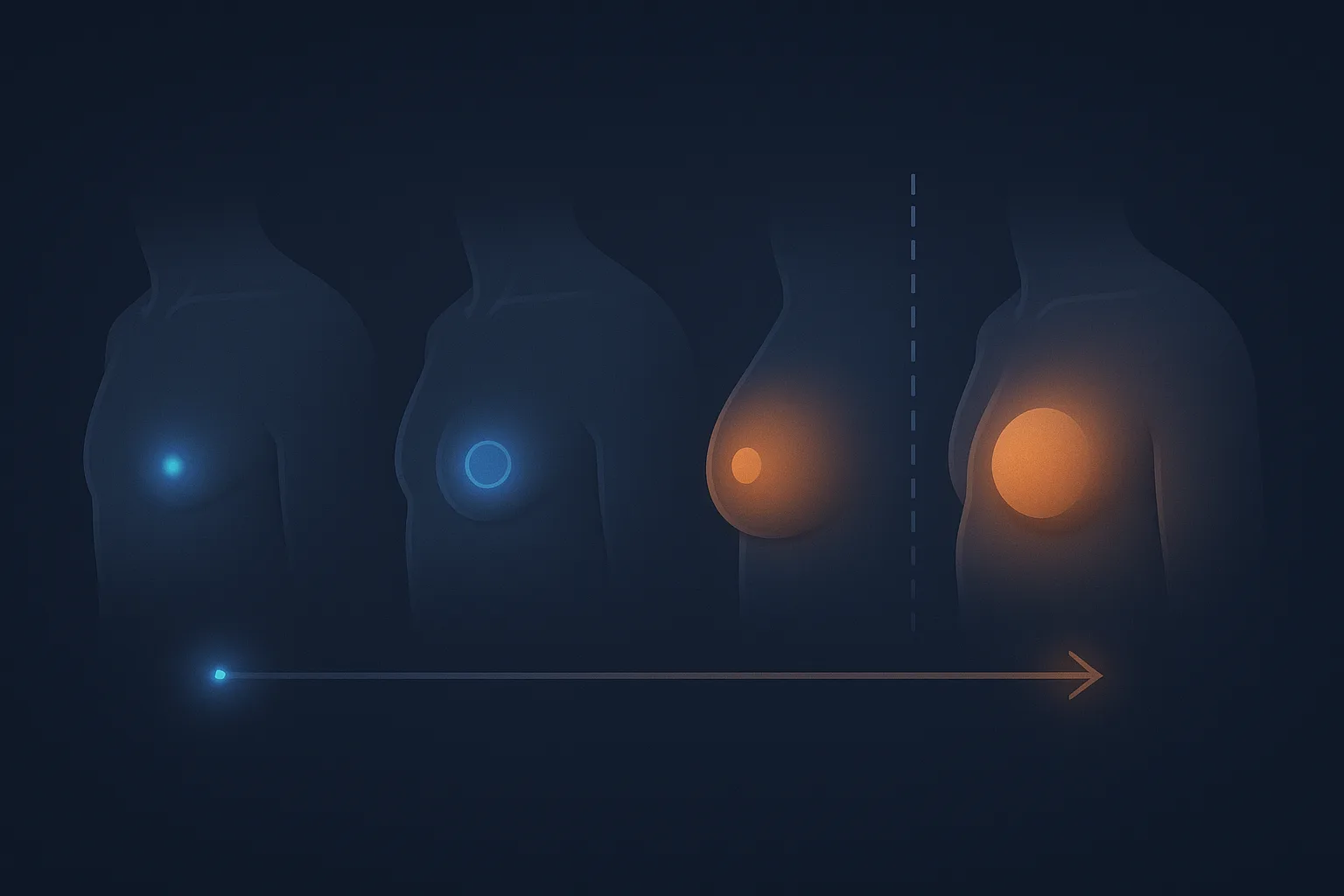
The first signs of TRT-induced gynecomastia are sensory, not visible. Most men feel something abnormal weeks before they can see anything. The pattern is consistent enough across clinical case series that prescribers treat the symptom cluster as diagnostic.
Stage 1: Nipple Sensitivity (2-6 weeks after dose start or change)
- Sharp shooting sensation in one nipple, often unilateral
- Itching that comes and goes, not relieved by topical hydrocortisone
- Heightened sensitivity to touch, fabric contact, or temperature
- Mild aching, especially in the morning
This is the early-warning stage. Hormones can be normalized and the process reversed without lasting tissue change in roughly 80% of patients who present at this stage to a clinic that responds promptly.
Stage 2: Palpable Gland (4-12 weeks)
- A small firm lump directly under the areola, pea-sized to pencil-eraser-sized
- Often unilateral first, then bilateral
- Tender to direct pressure
- Nipple may begin to look slightly raised at rest
This is the actionable stage. Reversal is still possible at this point but the window narrows. Hormone correction in the next 2-4 weeks plus possibly a SERM trial can shrink early gland tissue. Beyond this stage fibrosis sets in.
Stage 3: Visible Puffiness or Cone Shape (3-6 months)
- Areola appears puffy or domed at rest, not just when cold
- Palpable disc enlarged to a quarter or larger
- Tenderness may decrease as tissue stabilizes
- Bilateral involvement now typical
By this stage hormonal correction reduces inflammation but rarely fully resolves the gland. Surgical evaluation becomes appropriate.
Stage 4: Established Fibrotic Gyno (>6 months)
- Firm, non-tender disc of established gland tissue
- No further regression with hormonal management
- Cosmetic concerns now dominate clinical picture
- Surgical excision is the only path to resolution
The dividing line between Stage 2 and Stage 4 is roughly six months of unmanaged elevated estradiol. Patients who escalate symptoms to their prescriber within the first 8 weeks rarely cross that line. Patients who try to manage it themselves with self-prescribed AIs, or whose clinic does not act on reported sensitivity, frequently do.
How to Prevent Gyno on TRT
The strongest prevention is a protocol that does not produce supraphysiologic estradiol in the first place. Specifically:
Dose at the Lowest Effective Level
Most men reach symptom resolution at total testosterone in the 600-900 ng/dL range. There is no clinical benefit to pushing total testosterone into the 1200-1500 ng/dL range, and the higher the dose the more aromatase substrate you produce. See average TRT dose per week and TRT dose by body weight for evidence-based dose ranges.
Inject More Frequently, Not Less
Weekly injections produce a peak-trough swing of roughly 2x. That peak is the period of highest aromatization. Splitting the same weekly dose into twice-weekly or every-other-day injections flattens the curve, lowers peak estradiol, and frequently resolves nipple sensitivity without changing total dose. See injection frequency: weekly vs every other day for the evidence on frequency-driven aromatization control.
Manage Body Fat
Adipose tissue contains aromatase. Men carrying significant body fat aromatize more of any dose. A 10-15 lb fat loss can reduce estradiol enough to eliminate nipple symptoms without any TRT dose change. The GLP-1 + testosterone study in obese men covers this interaction in detail.
Monitor Estradiol on Schedule
Sensitive-assay estradiol (LC-MS, not the standard immunoassay) at week 6-8 after starting and after any dose change. The TRT bloodwork schedule and testosterone blood test timing articles cover when and how to draw correctly.
Be Cautious With hCG
hCG raises estradiol through testicular aromatase. Men adding hCG should plan an estradiol re-check at 4-6 weeks. If estradiol rises beyond the symptomatic range, lower the hCG dose before adding an AI. See hCG for fertility on TRT for hCG-specific protocol notes.
Choose a Clinic That Monitors Properly
A clinic that draws estradiol at baseline, again at week 6-8, and responds to reported symptoms with a same-week lab is doing the protocol correctly. A clinic that prescribes an AI prophylactically, never draws estradiol, or dismisses nipple sensitivity is increasing your risk. See how to choose a TRT clinic and TRT clinic red flags.
Treatment: What to Do When Symptoms Appear
The treatment ladder starts with the cheapest, lowest-risk intervention and escalates only if necessary.
Step 1: Estradiol and Testosterone Lab Draw
Same-week if possible. Sensitive-assay estradiol (LC-MS), total testosterone, and free testosterone. Calculate the testosterone-to-estradiol ratio. A T:E2 ratio in ng/dL : pg/mL of approximately 15:1 to 25:1 is target. Below 10:1 strongly suggests aromatization is the driver.
Step 2: Adjust Frequency Before Adjusting Dose
If labs confirm elevated estradiol with appropriate total testosterone, the first move is splitting the dose. A man on 160 mg weekly who develops nipple sensitivity often resolves on 80 mg twice weekly without any total-dose change. Frequency adjustments lower peak estradiol while preserving steady-state testosterone.
Step 3: Reduce Total Dose if Frequency Alone Does Not Work
If splitting the dose does not clear symptoms within 4-6 weeks, lower total dose by 20-30%. This addresses the substrate problem directly. Re-test at 6-8 weeks.
Step 4: Aromatase Inhibitor (Anastrozole) — Carefully
Only after labs confirm elevated estradiol AND symptoms persist after frequency and dose adjustments. Typical starting dose is 0.25-0.5 mg twice weekly, NOT daily. Crashing estradiol below approximately 20 pg/mL produces its own well-documented problems: joint pain, low libido, mood disturbance, accelerated bone loss, and worsened lipid profile. See aromatase inhibitors on TRT for AI dosing principles.
Step 5: SERM Trial for Established Early Gyno
For Stage 2 gyno (palpable gland tissue under 12 weeks old), a 4-12 week course of raloxifene 60 mg daily or tamoxifen 10-20 mg daily can shrink gland tissue. SERMs block estrogen at the breast tissue receptor without lowering circulating estradiol systemically. Most published series report partial regression in 50-70% of cases when started early.
Step 6: Surgical Consultation
For Stage 3+ gyno or any gyno that has not responded to the above within 4-6 months. Standard procedure is subcutaneous mastectomy via periareolar incision, often combined with liposuction for surrounding adipose tissue. Outcome is generally excellent. Recovery is 4-6 weeks.

Common Mistakes That Make Gyno Worse
Mistake 1: Starting an AI Without Labs
The most common error. A patient feels nipple sensitivity, a clinic reflexively prescribes anastrozole 1 mg twice weekly, and within a month the patient has joint pain, no libido, and depressed mood -- crashed estradiol. The original gyno may or may not have been driven by elevated estradiol; without a lab there is no way to know. AI without labs treats a guess.
Mistake 2: Self-Adjusting AI Doses Based on "Feel"
Estradiol symptoms (joint pain, low libido) overlap with low-T symptoms. Patients self-titrating AIs frequently end up either not taking enough to matter or driving estradiol into single digits. A sensitive-assay lab is the only way to know.
Mistake 3: Ignoring Early Sensitivity as "Just Sensitivity"
Nipple sensitivity is the early warning sign. Patients who treat it as a nuisance symptom and continue the same protocol unchanged frequently progress to palpable gland tissue within 6-8 weeks. Acting at Stage 1 is the difference between "fixed by frequency change" and "needs surgical evaluation."
Mistake 4: Stopping TRT Cold
Discontinuing TRT does not reverse established gyno. It also creates a hormonal trough that can transiently worsen the relative estrogen-to-androgen ratio (estradiol drops more slowly than testosterone after the last injection), sometimes accelerating gland progression. The right answer is dose and frequency adjustment, not abrupt cessation. See coming off TRT for the broader cessation framework.
Mistake 5: Adding hCG Without Re-Testing Estradiol
hCG is a major estradiol driver. Patients adding hCG for fertility or testicular volume preservation who do not re-test estradiol at 4-6 weeks frequently land in the high-estradiol zone before noticing symptoms. The pre-hCG and post-hCG estradiol delta is the single most predictive lab in fertility-stack patients.
When to Escalate: The 2-Week Rule
If you notice nipple sensitivity, itching, or a palpable lump that has been present for more than two weeks, escalate to your prescriber the same week. The clinical decision is not difficult; what kills the outcome is the time delay between symptom onset and lab draw. A clinic that responds within 7 days to a reported symptom and adjusts the protocol within 14 days has a much better gyno-resolution track record than one that treats it as a routine 12-week follow-up issue.
If your current clinic dismisses the symptom or refuses an estradiol draw, that is a clinic-quality problem, not a clinical problem. Consider switching. The TRT clinic red flags article covers what good monitoring looks like, and the main clinic comparison page shows which clinics meet the monitoring bar.
How Common Is Gyno on TRT, Really?
Population data is sparse but consistent. The TRAVERSE cardiovascular trial (Lincoff et al., NEJM 2023) reported gynecomastia in 2.8% of testosterone arm participants over 22 months — roughly 5x the rate in the placebo arm. Registry data from large telehealth TRT programs reports symptomatic gynecomastia in 3-7% of new patients depending on monitoring intensity. Older case series in untreated bodybuilders using anabolic doses report rates approaching 20-30%, but those are not relevant to TRT prescribing ranges.
The realistic number for a man on a properly dosed TRT protocol with twice-weekly to every-other-day injections, estradiol monitoring, and a responsive prescriber is probably 2-4%. For the same man on weekly injections with no estradiol monitoring and a high dose, it is closer to 8-12%. The protocol matters more than the underlying biology in most cases.
Frequently Asked: Quick Answers
Will lifting weights cause gyno on TRT?
No. Resistance training does not cause gynecomastia. Steroid abuse at supraphysiologic doses does, but that is a dose problem, not an exercise problem. See TRT exercise training guide.
Does the type of testosterone matter?
Modestly. Long-ester injectables (cypionate, enanthate) produce similar aromatization profiles. Pellets produce smoother curves and may lower peak estradiol slightly. Daily creams and gels produce the smoothest curve and the most stable estradiol. See testosterone cypionate vs enanthate and testosterone cypionate vs pellets.
What about oral testosterone?
Oral testosterone undecanoate (taken with food) bypasses some of the first-pass effect of older 17-alpha-alkylated oral agents but still aromatizes. The estradiol curve depends on the specific product and dosing schedule. See oral testosterone overview.
Can low testosterone itself cause gyno?
Yes. Untreated hypogonadism can produce a relatively elevated estrogen-to-androgen ratio because total testosterone is low while estradiol may remain in the normal range. Some men present with mild gyno before starting TRT and resolve it through proper testosterone restoration. The diagnosis-stage piece is in low testosterone symptoms.
Is breast cancer in men a concern with gyno on TRT?
Distinct condition. Gynecomastia is benign glandular proliferation. Male breast cancer is a malignant tumor and is rare. New asymmetric, hard, fixed, or non-tender lumps -- particularly with skin or nipple changes -- warrant imaging and biopsy regardless of TRT status. The TRT-cardiovascular and prostate cancer evidence is covered in the TRT cardiovascular meta-analysis 2026; the breast cancer signal in male TRT users is not elevated in current data.
Bottom Line
Gyno on TRT is not random. It is a predictable consequence of the testosterone-to-estradiol balance, modifiable by dose, frequency, body composition, and concurrent hCG use. Catching it at Stage 1 -- nipple sensitivity, two to six weeks in -- is the difference between a frequency adjustment and a surgical consultation. The early-warning system is sensory: itching, tingling, sharp sensitivity. Trust those symptoms.
The protocol moves that prevent gyno are the same moves that produce a clean TRT result generally: appropriate dose, frequent enough injections to flatten the peak, baseline plus 6-8 week sensitive-assay estradiol, and a clinic that responds to reported symptoms within a week rather than at the next quarterly visit.
If your current setup does not meet that bar, the main clinic comparison page walks through which TRT clinics monitor estradiol routinely and which do not.
Related Reading
References
- Bhasin S, Brito JP, Cunningham GR, et al. Testosterone Therapy in Men With Hypogonadism: An Endocrine Society Clinical Practice Guideline. J Clin Endocrinol Metab. 2018. PubMed
- Mulhall JP, Trost LW, Brannigan RE, et al. Evaluation and Management of Testosterone Deficiency: AUA Guideline. J Urol. 2018. PubMed
- Lincoff AM, Bhasin S, Flevaris P, et al. Cardiovascular Safety of Testosterone-Replacement Therapy (TRAVERSE). N Engl J Med. 2023. PubMed
- Cuhaci N, Polat SB, Evranos B, et al. Gynecomastia: Clinical evaluation and management. Indian J Endocrinol Metab. 2014. PubMed
- Lawrence SE, Faught KA, Vethamuthu J, Lawson ML. Beneficial effects of raloxifene and tamoxifen in the treatment of pubertal gynecomastia. J Pediatr. 2004. PubMed
- de Ronde W, de Jong FH. Aromatase inhibitors in men: effects and therapeutic options. Reprod Biol Endocrinol. 2011. PubMed
- Rambhatla A, Mills JN, Rajfer J. The Role of Estrogen Modulators in Male Hypogonadism and Infertility. Rev Urol. 2016. PubMed
- Narula HS, Carlson HE. Gynaecomastia — pathophysiology, diagnosis and treatment. Nat Rev Endocrinol. 2014. PubMed