How TRT changes your training capacity, recovery, and results. Evidence-based protocols for resistance training, cardio, and nutrition on testosterone.
Starting TRT changes the equation. Your body can now build and repair muscle tissue the way it was designed to -- something it couldn't do efficiently when testosterone was low. But TRT is not a shortcut. It's the removal of a bottleneck. You still need to train smart, eat right, and recover properly to get results.
This guide covers exactly how testosterone replacement therapy changes your training capacity, what that means for programming, and how to avoid the most common mistakes men make once they start feeling better in the gym.
Key Takeaways
TRT increases muscle protein synthesis by up to 56% in hypogonadal men, enabling faster recovery and greater training volume
Progressive overload and compound movements remain the foundation -- TRT amplifies good training, it doesn't replace it
Most men can handle 15-20 hard sets per muscle group per week on TRT, compared to 10-14 with low testosterone
Protein intake of 0.7-1.0 g per pound of bodyweight supports the increased protein synthesis rate
Cardiovascular training remains essential -- TRT alone does not improve aerobic capacity
The biggest mistake is overtraining in the first 8 weeks before TRT has fully taken effect
How TRT Changes Your Recovery and Training Capacity
Low testosterone cripples your ability to recover from training. When your levels sit below 300 ng/dL, muscle protein synthesis is suppressed, cortisol runs relatively unchecked, and the repair process that should happen between sessions slows to a crawl. Men with low T often describe feeling perpetually sore, struggling to add weight to the bar, and losing motivation to train -- all of which have a direct physiological basis.
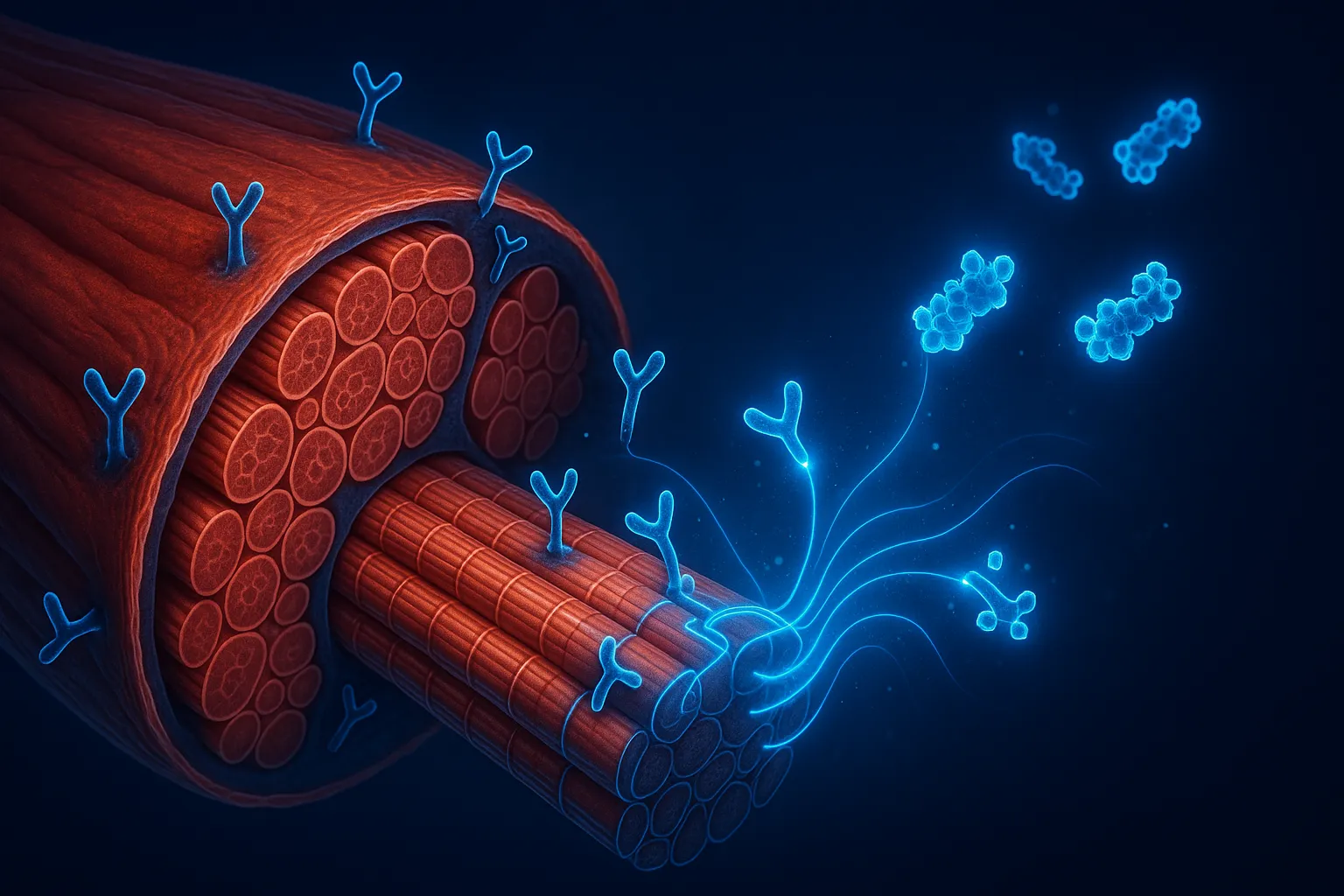
TRT reverses this. A landmark study on hypogonadal men found that testosterone replacement increased the fractional synthesis rate of mixed skeletal muscle proteins by 56% [1]. That's not a subtle change. It means your muscles are literally rebuilding faster after each session.
Here's what changes in practical terms:
Faster between-session recovery: Where you once needed 72+ hours before hitting a muscle group again, you may now recover in 48 hours
Greater volume tolerance: You can handle more total sets per muscle group before overreaching
Improved mind-muscle connection: Testosterone affects neuromuscular signaling, which improves motor unit recruitment
Reduced muscle breakdown: Testosterone has direct anti-catabolic effects, inhibiting protein degradation during and after training [2]
Better body composition partitioning: Calories are more likely to support muscle tissue rather than fat storage
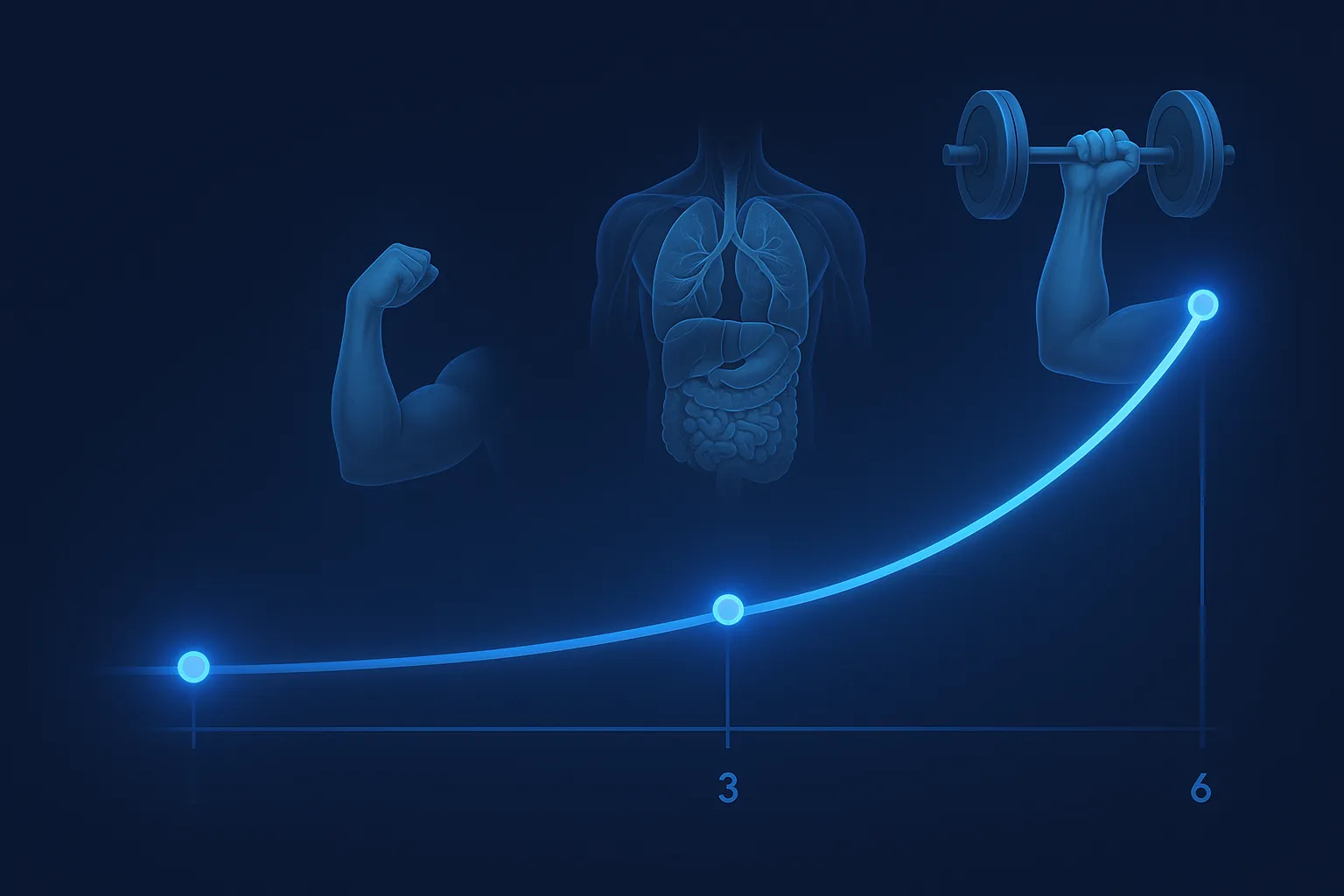
These changes don't happen overnight. Protein synthesis improvements begin within 2-4 weeks of starting TRT, but the full training capacity increase takes 3-6 months to materialize as testosterone levels stabilize and androgen receptors upregulate.
Resistance Training Principles on TRT
The fundamentals of hypertrophy training don't change on TRT. What changes is the dose you can tolerate and recover from. Think of it like upgrading your engine -- you still need to drive the same roads, but you can push harder and recover between efforts faster.
Progressive Overload Is Still King
No amount of testosterone will build muscle without a progressive stimulus. Your training must systematically increase in difficulty over time through one or more of these variables:
Load: Adding weight to the bar (the most straightforward driver)
Volume: Adding sets or reps at a given load
Frequency: Training a muscle group more often per week
Intensity techniques: Drop sets, rest-pause, slow eccentrics (use sparingly)
Track your workouts. If you aren't lifting more weight or doing more reps than you were 4 weeks ago, TRT isn't going to magically produce results.
Volume Recommendations
Research suggests that trained individuals need approximately 10-20 hard sets per muscle group per week for optimal hypertrophy [3]. Where you fall in that range depends on training age, recovery capacity, and testosterone levels.
For men on stable TRT with levels in the 500-900 ng/dL range:
Training Experience
Sets Per Muscle Group/Week
Frequency
Beginner (0-1 year)
10-14 sets
2-3x per week
Intermediate (1-3 years)
14-18 sets
3-4x per week
Advanced (3+ years)
16-22 sets
3-5x per week
Compare this to the same lifter with low testosterone, who might stall at 10-14 sets before recovery becomes the limiting factor.
Exercise Selection
Build your program around compound movements that load multiple joints and muscle groups:
Primary movements (do these every week):
Squat variation (back squat, front squat, leg press)
Hip hinge (deadlift, Romanian deadlift, hip thrust)
Secondary movements (rotate based on weak points):
Lunges, split squats, leg curls, leg extensions
Dumbbell flyes, dips, lateral raises, face pulls
Bicep curls, tricep extensions, calf raises
A 4-day upper/lower split or push/pull/legs rotation works well for most men on TRT because it allows adequate frequency (hitting each muscle 2x per week) with enough recovery between sessions.
Rep Ranges
Don't get locked into one rep range. Testosterone improves performance across the strength-hypertrophy spectrum:
Heavy work (3-6 reps): 2-3 sets of compound lifts, builds strength and neural efficiency
Moderate work (8-12 reps): The hypertrophy sweet spot, 3-4 sets per exercise
Higher reps (15-20 reps): 2-3 sets for metabolic stress, joint-friendly loading, and isolation work
Your training response on TRT follows the same timeline as your hormonal stabilization. Expecting too much too soon is the single biggest programming mistake.
Weeks 1-4: The Adjustment Phase
Testosterone levels are still fluctuating. You may feel better mentally (improved mood, motivation, reduced brain fog), but the structural changes in muscle tissue haven't started yet.
What to do: Keep training as you were. Don't add volume or intensity. Focus on consistency and dialing in your form on compound movements. This is the time to establish your baseline.
Weeks 4-8: Early Adaptation
Protein synthesis rates are increasing. Recovery between sessions improves noticeably. You may start setting small PRs and notice improved pumps during training.
What to do: Begin adding 1-2 sets per muscle group per week. Increase training frequency if recovery allows -- if you were training each muscle once per week, move to twice. Start pushing harder on your working sets.
Weeks 8-16: The Growth Phase
This is where visible changes start. Lean mass is increasing, body fat is shifting, and strength gains accelerate. A study of men on testosterone therapy combined with exercise showed significant increases in fat-free mass and reductions in body fat within this window [4].
What to do: Push volume toward the higher end of your experience-appropriate range. This is the time to be aggressive with progressive overload. Your body can handle it now.
Months 4-12: Full Optimization
Androgen receptor density has upregulated. Satellite cell number has increased -- a key driver of long-term muscle growth [5]. Body composition changes are clearly visible. Most men gain 3-8 lbs of lean mass and lose a comparable amount of fat in the first year, depending on training quality and nutrition.
What to do: Periodize your training. Alternate between accumulation phases (higher volume, moderate intensity) and intensification phases (lower volume, heavier loads). This prevents plateaus and manages fatigue.
For a complete breakdown of what to expect month by month, see our TRT results timeline.
Cardio on TRT: Why You Can't Skip It
Here's an uncomfortable truth: TRT alone does not improve aerobic capacity. A 12-week randomized trial found that exercise increased VO2max by 2.5-3.2 mL/kg/min regardless of testosterone status, while testosterone treatment without exercise produced no change in aerobic fitness [6].
TRT increases red blood cell production (erythrocytosis), which can actually become a cardiovascular risk factor if hematocrit rises above 54%. Regular cardio helps manage hematocrit levels and provides cardiovascular protection that testosterone alone cannot.
Cardio Recommendations on TRT
Minimum effective dose:
150 minutes per week of moderate-intensity cardio (brisk walking, cycling, swimming)
Or 75 minutes per week of vigorous-intensity cardio (running, rowing, HIIT)
Optimal approach for body composition:
2-3 sessions of 20-30 minutes of moderate-intensity steady-state (MISS) cardio
1-2 sessions of 15-20 minutes of high-intensity interval training (HIIT)
Daily walking (8,000-10,000 steps) as a non-negotiable baseline
What to avoid:
Excessive endurance training (marathon-level mileage) can elevate cortisol and blunt some of TRT's anabolic effects
Doing all your cardio on leg day -- spread it out to avoid competing recovery demands
Skipping cardio entirely because "I'm on TRT and just want to lift" -- your cardiovascular health matters more than your bicep peak
Nutrition: Fueling the Machine
TRT increases your body's capacity to build muscle, but it can't create tissue from nothing. Nutrition becomes more important, not less, when your protein synthesis machinery is running at full capacity.
Protein: The Non-Negotiable
Testosterone replacement increases the muscle protein synthesis rate [1], but that elevated synthesis requires amino acids as raw material. Without adequate protein, you're running a factory with no supplies.
Target: 0.7-1.0 g of protein per pound of bodyweight per day (1.6-2.2 g/kg)
For a 200 lb man, that's 140-200 g of protein daily. Research on high-protein diets shows that intakes up to 3.4 g/kg/day don't suppress testosterone, though there's no additional muscle-building benefit beyond ~1.0 g/lb [7].
Distribution matters: Spread protein across 3-5 meals with at least 30-40 g per meal to maximize the muscle protein synthesis response at each feeding.
Calories: Match to Your Goal
Building muscle: Eat at a slight surplus (200-400 calories above maintenance). TRT improves nutrient partitioning, so a smaller surplus is needed compared to low-T states.
Losing fat: A moderate deficit (300-500 calories below maintenance) works. TRT helps preserve lean mass during dieting -- one study showed that men on testosterone lost almost exclusively fat, while the placebo group lost both fat and muscle [4].
Recomposition: Eating at maintenance while training hard works better on TRT than off it, particularly in the first 6-12 months. The elevated protein synthesis rate and improved nutrient partitioning create a window where simultaneous muscle gain and fat loss is realistic.
Micronutrients That Matter
Vitamin D: 2,000-5,000 IU daily. Supports testosterone function and bone health.
Magnesium: 200-400 mg daily (glycinate or threonate form). Involved in hundreds of enzymatic reactions including muscle contraction and recovery.
Zinc: 15-30 mg daily. Essential for testosterone metabolism and immune function.
Omega-3s: 2-3 g EPA/DHA daily. Anti-inflammatory, supports cardiovascular health -- important given TRT's effect on hematocrit.
TRT Is Not Steroids: Setting Realistic Expectations
This needs to be stated clearly because the internet distorts expectations. TRT brings your testosterone to normal physiological levels -- typically 500-900 ng/dL. Steroid cycles use doses that produce levels of 2,000-5,000+ ng/dL, often with multiple compounds stacked together.
The Bhasin study that became famous for showing "testosterone builds muscle even without exercise" used 600 mg/week of testosterone enanthate -- producing supraphysiological levels far beyond what TRT provides [3]. The men in that study who received testosterone without exercise gained 3.2 kg of fat-free mass in 10 weeks. That result does not apply to TRT doses.
What you can realistically expect in year one of TRT combined with proper training:
Lean mass gain: 3-8 lbs (highly dependent on training quality and nutrition)
Fat loss: 3-10 lbs (especially visceral fat, even without aggressive dieting)
Strength increase: 15-30% on major compound lifts over 12 months
Recovery improvement: Noticeably faster by week 6-8
Body composition shift: Visible recomposition even if scale weight doesn't change dramatically
These are meaningful results. They're just not bodybuilder-on-a-cycle results. For a visual reference of what's achievable, see our TRT before and after body composition guide.
Common Mistakes to Avoid
1. Overtraining in the Honeymoon Phase
The most common mistake. You start feeling better at week 3-4, so you double your training volume overnight. Your tendons, ligaments, and connective tissue haven't caught up to your new recovery rate. Result: joint pain, tendinitis, or injury that sidelines you for weeks.
Fix: Increase volume by no more than 10-15% per week. Let connective tissue adapt alongside muscle tissue.
2. Neglecting Deload Weeks
TRT improves recovery, but it doesn't eliminate fatigue accumulation. Every 4-6 weeks, reduce training volume by 40-50% for one week. This allows your joints, nervous system, and connective tissue to catch up.
3. Chasing the Pump Instead of Progressive Overload
Higher testosterone gives you better pumps. That feels productive. But pump-focused training without progressive overload produces minimal long-term growth. Track your numbers and ensure weights are going up over time.
4. Ignoring Bloodwork
Training hard on TRT increases metabolic demand. Monitor these markers every 3-6 months:
Hematocrit: Should stay below 54%. Donate blood if it creeps up.
Estradiol: Hard training can increase aromatization. Watch for symptoms.
Lipids: Heavy resistance training generally improves lipid profiles, but monitor regardless.
PSA: Baseline and annual monitoring per standard TRT protocol.
5. Copying Steroid-User Programs
Programs designed for enhanced athletes (professional bodybuilders, competitive powerlifters on gear) use volumes that will destroy a natural or TRT-level trainee. Stick to evidence-based programming designed for physiological hormone levels.
Putting It Together: A Sample Week
Here's what a well-structured training week looks like for an intermediate lifter on stable TRT:
Day
Focus
Duration
Monday
Upper body (push emphasis)
60-75 min
Tuesday
Lower body (squat emphasis)
60-75 min
Wednesday
Cardio (MISS 30 min) + mobility
45 min
Thursday
Upper body (pull emphasis)
60-75 min
Friday
Lower body (hinge emphasis)
60-75 min
Saturday
HIIT (20 min) + walking
45-60 min
Sunday
Rest or light walking
--
Total: 4 resistance sessions, 2 dedicated cardio sessions, daily walking. This provides adequate stimulus and recovery for most men on TRT.
The Bottom Line
TRT removes the hormonal bottleneck that was limiting your training results. It doesn't change the rules of muscle building -- it just lets you play the game at full capacity. Train with progressive overload, eat enough protein, do your cardio, and be patient. The results will come, and they'll be sustainable because they're built on a foundation of normalized physiology, not pharmaceutical excess.
For tracking your progress against expected timelines, check our guides on 3-month TRT results and 6-month TRT results. When you're ready to optimize your protocol, find a clinic that takes training and body composition goals seriously.
References
Brodsky IG, Balagopal P, Nair KS. Effects of testosterone replacement on muscle mass and muscle protein synthesis in hypogonadal men -- a clinical research center study. J Clin Endocrinol Metab. 1996;81(10):3469-3475. PMID: 8855787
Kraemer WJ, Ratamess NA, Nindl BC. Recovery responses of testosterone, growth hormone, and IGF-1 after resistance exercise. J Appl Physiol. 2017;122(3):549-558. Testosterone physiology in resistance exercise and training. Sports Med. 2010;40(12):1037-1053. PMID: 21058750
Bhasin S, Storer TW, Berman N, et al. The effects of supraphysiologic doses of testosterone on muscle size and strength in normal men. N Engl J Med. 1996;335(1):1-7. PMID: 8637535
Ng Tang Fui M, Prendergast LA, Dupuis P, et al. Effects of testosterone treatment on body fat and lean mass in obese men on a hypocaloric diet: a randomised controlled trial. BMC Med. 2016;14(1):153. PMID: 27716209
Sinha-Hikim I, Roth SM, Lee MI, Bhasin S. Testosterone-induced muscle hypertrophy is associated with an increase in satellite cell number in healthy, young men. Am J Physiol Endocrinol Metab. 2003;285(1):E197-E205. PMID: 12670837
Huang G, Basaria S, Travison TG, et al. Testosterone and exercise: effects on fitness, body composition, and strength in middle-to-older aged men with low-normal serum testosterone levels. Am J Physiol Endocrinol Metab. 2021;320(4):E733-E742. PMID: 33739155
Whittaker J, Harris M. High-protein diets and testosterone. Nutr Health. 2022;28(4):185-191. PMID: 36266956
Frequently Asked Questions
How soon after starting TRT can I increase training volume?
Most men notice improved recovery within 3-6 weeks. Increase volume gradually -- add one set per muscle group per week rather than doubling overnight.
Will TRT let me build muscle like someone on steroids?
No. TRT restores testosterone to normal physiological levels (500-900 ng/dL). Steroid cycles use 2-10x that amount. TRT removes a deficit; it does not create a superhuman advantage.
Should I train differently on TRT versus natural?
The principles stay the same -- progressive overload, compound movements, adequate recovery. TRT lets you recover faster and handle slightly more volume, but the fundamentals don't change.
How much protein do I need on TRT?
Aim for 0.7-1.0 g per pound of bodyweight daily (1.6-2.2 g/kg). TRT increases protein synthesis rates, but you still need adequate protein intake to fuel that process.