BMS 2026 Progestogen Rules: Higher Estrogen Needs More
5/17/2026
5 min read
By The TRT Catalog
British Menopause Society updated its progestogen guidance May 2026. Higher estrogen needs higher progesterone for endometrial protection — here's how.
Key Takeaways: The British Menopause Society released an updated Tool for Clinicians on progestogens and endometrial protection in May 2026. The central change reflects the new reality after the FDA removed the black-box warning from menopausal hormone therapy — more women are on higher estrogen doses, and the standard 200 mg sequential / 100 mg continuous micronized progesterone regimens were not designed for that. The BMS now recommends that women on higher estrogen consider 300 mg sequential or 200 mg continuous oral micronized progesterone, or the 52 mg levonorgestrel IUD for up to 5 years inside an HRT regimen. Compounded transdermal progesterone creams still fail to provide adequate endometrial protection at any dose. This is a dosing-precision update, not a safety scare — but if you are on a higher estrogen patch or gel, your progesterone dose probably needs to be re-checked.
What Changed in May 2026
The British Menopause Society publishes a series of clinician-facing summary documents called "Tools for Clinicians." The progestogens and endometrial protection tool was last refreshed in 2023. The May 2026 update [1] is the first major revision since the FDA's November 2025 decision to remove the black-box warning from menopausal hormone therapy products — a decision that has triggered a sharp increase in both the number of women on HRT and the typical estrogen dose they are taking [2].
The clinical question this update answers is simple: if women are taking more estrogen than the 200 mg sequential / 100 mg continuous progesterone regimens were originally validated against, are those progesterone doses still enough?
The answer, per BMS: probably not, for women on the higher end of estrogen dosing. The principle is "proportionate opposition" — the progestogen dose should rise with the estrogen dose.
The Standard Doses (And Why They Still Work for Most Women)
For women on standard-dose estradiol — a 50-microgram patch twice weekly, 1-2 pumps of gel daily, or 1-2 mg oral estradiol — the existing dose schedule remains adequate per systematic review evidence [1]:
Sequential HRT (women still cycling or recently postmenopausal): oral micronized progesterone 200 mg/day for 12-14 days per month
Continuous combined HRT (women more than 12 months postmenopausal): oral micronized progesterone 100 mg/day taken daily
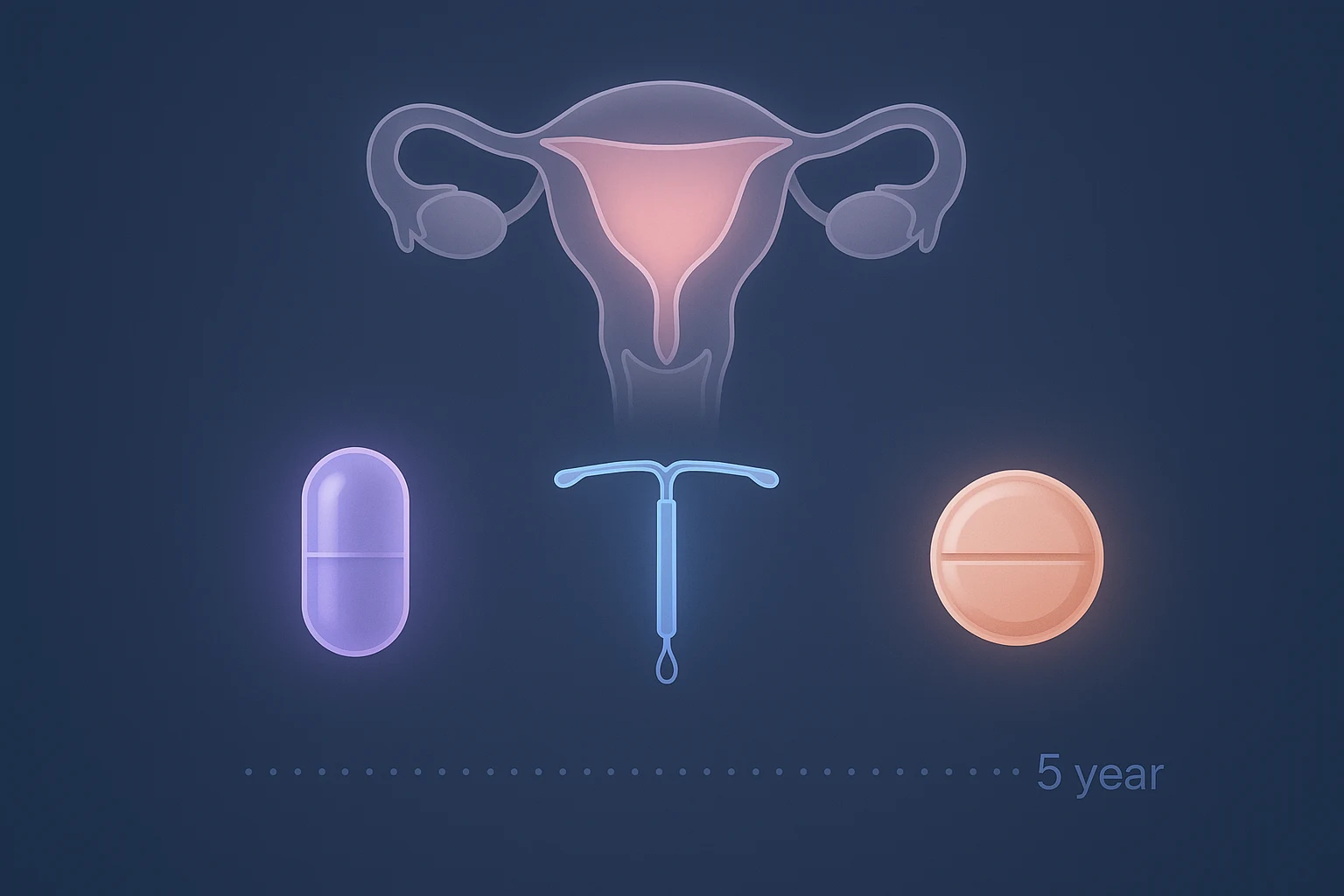
Levonorgestrel IUD (52 mg): adequate endometrial protection for up to 5 years inside an HRT regimen, regardless of estrogen dose
These doses provide adequate endometrial protection for up to five years per the underlying systematic review evidence [3]. For the majority of women on HRT — those on a standard 50-microgram estradiol patch or equivalent — the standard progestogen dose is fine.
The change in May 2026 is what to do when estrogen exceeds standard dose.
The New Higher-Estrogen Recommendations
The BMS now recommends:
Sequential HRT on higher estrogen: consider increasing oral micronized progesterone from 200 mg to 300 mg for 12 days per month
Continuous combined HRT on higher estrogen: consider increasing oral micronized progesterone from 100 mg to 200 mg daily
"Higher estrogen" in clinical practice means:
Transdermal estradiol patch 75-100 micrograms twice weekly or higher
Estradiol gel 3-4 pumps daily or higher
Oral estradiol above 2 mg daily
This pattern is increasingly common. After the FDA's November 2025 decision, prescriptions for higher-dose estradiol patches have surged [2]. Women who were previously stuck on a 25-microgram patch because of fear of "too much estrogen" are now being titrated to symptom control — often at 75-100 micrograms — without a corresponding bump in progesterone. The BMS update is a correction for that gap.
The 300 mg dose and the 200 mg continuous dose are technically off-label per UK licensing, and the guidance is explicit that patients should be informed of that off-label status [1]. In US practice, the same off-label situation applies, but oral micronized progesterone has decades of clinical experience at the 300 mg dose for sleep and mood indications, so most prescribers consider it within standard practice.
Women's HRT — Menopause-First Telehealth
Bioidentical estradiol, progesterone, and low-dose testosterone — all 50 states, unlimited physician access.
The 52 mg levonorgestrel intrauterine system — sold in the US as Mirena, Liletta, and a few generics — is one of the most underutilized progestogen options in HRT. The BMS May 2026 update reaffirms three points about it [1]:
It provides adequate endometrial protection within HRT regimens for up to 5 years, even though the UK contraceptive license is 4 years. The 5-year HRT duration is off-label but is established clinical practice.
Local delivery means minimal systemic progestogen exposure, which makes it particularly valuable for women with progesterone intolerance — the mood, breast tenderness, fatigue, and bloating cluster that some women develop on oral progestogens.
It works at any estrogen dose, including the higher transdermal doses now being prescribed post-black-box-removal. Because the progestogen is delivered locally to the endometrium, the systemic estrogen dose does not change the protection equation.
Many midlife-focused HRT telehealth practices now offer Mirena placement as part of the HRT initiation workflow, either through partnered local OB-GYN clinics or in-house. If you have a uterus, persistent breakthrough bleeding, or progesterone intolerance, this is worth asking about.
What About Compounded Bioidentical Progesterone Creams?
This is the single most dangerous gap in the compounded-bioidentical hormone market, and the BMS update is unambiguous on it: compounded transdermal progesterone creams do not provide adequate endometrial protection against systemic estrogen [1].
The reason is pharmacokinetic. Oral micronized progesterone delivers progesterone through the portal circulation, reaches the endometrium at adequate concentrations, and produces the expected secretory transformation. A transdermal cream delivers progesterone primarily to the skin and subcutaneous tissue, with serum levels that are erratic and well below the threshold needed to oppose estrogen at the endometrium.
This is consistent with positions from the Menopause Society, the FDA, the European Menopause and Andropause Society, and now the May 2026 BMS update. If you are taking systemic estrogen and you have a uterus, the acceptable progestogen options are:
Oral micronized progesterone (Prometrium, Utrogestan, or compounded oral capsules from a reputable pharmacy)
The 52 mg levonorgestrel IUD
A licensed synthetic progestin (norethisterone, dydrogesterone, medroxyprogesterone acetate)
That is the entire list. Topical creams, even at 100-200 mg/day applied to the skin, do not belong on it.
Breakthrough Bleeding: When to Worry, When to Adjust
Unscheduled bleeding is the most common reason women on HRT come back to their prescriber. The BMS update reinforces three management principles [1]:
First 3-6 Months: Usually Settles
New irregular bleeding in the first 3-6 months of HRT is expected and usually self-resolves. The endometrium is adapting to a new hormonal environment. Reassurance and a 6-month review is standard.
Persistent or New-Onset Bleeding After 6 Months: Investigate
Persistent unscheduled bleeding beyond 6 months, or new bleeding after a period of amenorrhea on continuous combined HRT, requires investigation:
Transvaginal ultrasound to measure endometrial thickness (< 4 mm is reassuring; > 4 mm warrants further evaluation)
Hysteroscopy and endometrial biopsy if the lining is thickened or imaging is inconclusive
Review of the progestogen dose and duration in parallel
Most Cases Are Fixed By Adjusting the Progestogen
The BMS notes that the majority of unscheduled bleeding cases that prove non-pathological respond to one of [1]:
Increasing the progestogen dose (the 200 → 300 mg sequential or 100 → 200 mg continuous bump described above)
Extending the duration of progestogen in sequential regimens (from 12 days to 14 days per month)
Switching from cyclical to continuous regimens in women more than 12 months postmenopausal
Switching to the Mirena IUD
Many women are told their bleeding is "just normal" and left on inadequate progestogen for years. That is the failure mode the May 2026 update is trying to close.
How to Tell If You Need a Dose Review
You probably need to revisit your progestogen dose with your prescriber if any of the following apply:
You are on a transdermal estradiol patch of 75 micrograms twice weekly or higher
You are on estradiol gel at 3+ pumps daily, or oral estradiol above 2 mg daily
You are on a sequential regimen with only 200 mg micronized progesterone for 12 days, despite the higher estrogen dose
You are on a continuous combined regimen with only 100 mg micronized progesterone despite the higher estrogen dose
You have new or worsening unscheduled bleeding more than 6 months into HRT
You are using a compounded transdermal progesterone cream for endometrial protection with systemic estrogen — this should be changed, not adjusted
The fix is rarely dramatic — a bump from 200 mg to 300 mg sequential, or a switch to a Mirena IUD, resolves most of the relevant cases. The cost of not addressing it is endometrial hyperplasia and, eventually, endometrial cancer.
Quick-Reference Dosing Table
Estrogen Regimen
Sequential Progesterone
Continuous Progesterone
Mirena IUD
Transdermal patch 25-50 mcg twice weekly
Micronized progesterone 200 mg × 12-14 days/month
Micronized progesterone 100 mg daily
Adequate
Transdermal patch 75-100 mcg twice weekly
Micronized progesterone 300 mg × 12 days/month
Micronized progesterone 200 mg daily
Adequate
Estradiol gel 1-2 pumps daily
200 mg × 12-14 days/month
100 mg daily
Adequate
Estradiol gel 3-4+ pumps daily
300 mg × 12 days/month
200 mg daily
Adequate
Oral estradiol 1-2 mg/day
200 mg × 12-14 days/month
100 mg daily
Adequate
Oral estradiol > 2 mg/day
300 mg × 12 days/month
200 mg daily
Adequate
The bolded rows are the new May 2026 recommendations. The non-bolded rows reflect the previous (and still adequate) standard-dose protocols.
What This Does Not Change
The May 2026 update is a dose-precision refinement, not a safety reversal. It does not change:
The overall safety profile of HRT, which the FDA black-box removal already affirmed
The recommendation to initiate HRT within 10 years of menopause onset or before age 60 for systemic indications
The acceptability of vaginal estrogen at any age without systemic progestogen (vaginal estrogen does not require endometrial protection, as covered in our vaginal estrogen GSM guide)
The role of testosterone in women's HRT — testosterone is not a progestogen, does not provide endometrial protection, and is dosed independently per our testosterone for women dosage guide
If you are on standard-dose estrogen and standard-dose progestogen with no bleeding issues, nothing has changed for you. The update is specifically for the subset of women whose estrogen dose has crept up — and whose progesterone may not have kept pace.
Finding a Provider Who Adjusts Both Doses Together
A common failure mode in HRT prescribing is to adjust the estrogen dose for symptom control without revisiting the progestogen dose. Most general primary care providers will increase a patch from 50 to 75 micrograms when hot flashes return and never touch the progesterone capsule.
You want a provider who will:
Calibrate the estrogen dose to symptom control AND serum estradiol level
Re-check the progestogen dose every time the estrogen dose changes
Offer the Mirena IUD as a default option, not a last resort
Investigate persistent unscheduled bleeding rather than dismiss it
Avoid compounded transdermal progesterone creams as monotherapy for endometrial protection in women with a uterus
For the broader picture of how progesterone and testosterone interact in women's HRT — a separate topic from endometrial protection but a common companion question — see our progesterone and testosterone in women's HRT guide. For context on the regulatory backdrop driving the higher-estrogen prescribing pattern, see our FDA black box warning removal article.
The Bottom Line
The May 2026 BMS update is the first major HRT dosing refresh of the post-black-box era. The reason it matters is not that the previous regimens were unsafe — they were validated against the lower estrogen doses that were common when fear of HRT dominated prescribing. It matters because estrogen doses are now higher across the board, and the progestogen has to scale with them.
The fix is concrete:
If you are on a higher-dose transdermal patch, gel, or oral estradiol, ask your prescriber if your progestogen dose needs to be increased to 300 mg sequential or 200 mg continuous.
The Mirena IUD remains the most consistent option across all estrogen doses, with a 5-year HRT duration that is off-label but widely accepted.
Compounded transdermal progesterone creams are not adequate for endometrial protection in any woman taking systemic estrogen with a uterus. If this is your current setup, it needs to be changed, not titrated.
Persistent unscheduled bleeding more than 6 months into HRT is a dose-adjustment signal, not background noise.
Vaginal estrogen does not require systemic progestogen, regardless of dose.
If your provider has never revisited your progesterone dose since you started HRT — and you have been bumped up on the estrogen side — the May 2026 BMS update is a strong reason to ask. The fix is small. The protection it provides is not.
References:
British Menopause Society. Tools for Clinicians: Progestogens and Endometrial Protection (May 2026 Update). Marlow, UK: BMS, 2026. PDF
US Food and Drug Administration. FDA Approves Labeling Changes to Menopausal Hormone Therapy Products. November 2025. FDA press announcement
Stute P, Neulen J, Wildt L. The impact of micronized progesterone on the endometrium: a systematic review. Climacteric. 2016;19(4):316-328. PMID: 27277331
Hamoda H, Panay N, Pedder H, Arya R, Savvas M. The British Menopause Society & Women's Health Concern recommendations on the management of women with premature ovarian insufficiency. Post Reprod Health. 2017;23(1):22-35. PMID: 28381102
Furness S, Roberts H, Marjoribanks J, Lethaby A. Hormone therapy in postmenopausal women and risk of endometrial hyperplasia. Cochrane Database Syst Rev. 2012;(8):CD000402. PMID: 22895916
The Menopause Society. The 2022 hormone therapy position statement of The North American Menopause Society. Menopause. 2022;29(7):767-794. PMID: 35797481
Frequently Asked Questions
What did the British Menopause Society update in May 2026?
The British Menopause Society released a refreshed Tool for Clinicians on progestogens and endometrial protection in May 2026. The headline change: the dose of progestogen should be proportionate to the dose of estrogen. Women on higher estrogen — increasingly common after the FDA removed the black-box warning on menopausal hormone therapy — should consider 300 mg of oral micronized progesterone for 12 days per month in sequential regimens, or 200 mg daily in continuous combined regimens, instead of the standard 200 mg sequential or 100 mg continuous doses. The guidance also reaffirms that the 52 mg levonorgestrel IUD provides adequate endometrial protection for up to 5 years inside an HRT regimen, though that is technically off-label in the UK where the licensed duration is 4 years.
What is the standard micronized progesterone dose for endometrial protection?
Standard dosing is 200 mg/day for 12-14 days each month in sequential regimens, or 100 mg/day continuously in continuous combined regimens. Systematic review evidence supports adequate endometrial protection at these doses for up to five years when paired with standard-dose estradiol. The May 2026 BMS update emphasizes that these doses assume standard-dose estrogen — if you are on a higher transdermal patch (100 microgram twice weekly or higher) or a higher gel dose, the progestogen often needs to be increased.
Why does higher estrogen require higher progesterone?
Estrogen stimulates the endometrial lining. Progesterone (or any progestogen) opposes that growth signal. If estrogen exposure is increased without proportionally increasing the progestogen, the endometrium can over-proliferate, raising the risk of breakthrough bleeding, endometrial hyperplasia, and eventually endometrial cancer. The May 2026 BMS guidance acknowledges that direct trial data on optimal progesterone dosing with high-dose estrogen is limited, but the principle — proportionate opposition — drives the recommendation to go from 200 mg to 300 mg sequential, or from 100 mg to 200 mg continuous, when estrogen doses are elevated.
Can the Mirena IUD replace oral progesterone in HRT?
Yes. The 52 mg levonorgestrel IUD provides effective endometrial protection within HRT regimens. The BMS guidance recognizes it as adequate for up to five years in this off-label use, even though the UK contraceptive license is four years. The IUD has the advantage of delivering progestogen locally to the endometrium with minimal systemic exposure, which is particularly useful for women with progesterone intolerance — mood symptoms, breast tenderness, bloating, or fatigue on oral progestogens. Many midlife-focused HRT clinics now offer Mirena placement as part of the HRT initiation pathway.
What about breakthrough bleeding on HRT?
Breakthrough bleeding in the first 3-6 months of HRT is common and usually settles. Persistent unscheduled bleeding after 6 months, or new bleeding after a period of amenorrhea, warrants investigation — typically transvaginal ultrasound to measure endometrial thickness, followed by hysteroscopy and endometrial biopsy if the lining is thickened. The May 2026 BMS update emphasizes that modifying the progestogen — increasing the dose, extending the duration, or switching to an IUD — controls bleeding in most cases. Many women on too-low-progesterone regimens are misdiagnosed with 'just normal perimenopausal bleeding' when the actual fix is a dose adjustment.
Are bioidentical compounded progesterone creams adequate for endometrial protection?
No. The BMS, the Menopause Society, and the FDA are all consistent on this point: compounded transdermal progesterone creams have never been shown to deliver adequate serum or tissue progesterone to protect the endometrium against estrogen-driven proliferation. If you are taking systemic estrogen and you have a uterus, the only progestogen options with adequate evidence are oral micronized progesterone, the 52 mg levonorgestrel IUD, or licensed synthetic progestins. This is the single most common dangerous gap in the compounded-bioidentical HRT market.