Key Takeaways: Over 52% of postmenopausal women develop female pattern hair loss. The mechanism is not low estrogen alone — it is the shift in the estrogen-to-androgen ratio, combined with follicular DHT sensitivity. HRT slows progression in most women within 3 to 6 months, but visible regrowth typically requires adding topical or low-dose oral minoxidil. Spironolactone is reserved for hyperandrogenic or resistant cases. Testosterone therapy can cause hair loss in a genetically susceptible minority, but paradoxically helps most women by restoring follicular energy metabolism. The single biggest mistake is waiting too long — miniaturized follicles eventually die.
Hair Loss Is a Menopause Symptom No One Talks About
Hot flashes get headlines. Hair loss gets silence.
A 2022 cross-sectional study of 178 postmenopausal women aged 50 to 65 found that 52.2% had clinically diagnosable female pattern hair loss [1]. Among those affected, most were mild (Ludwig grade I, 73%), but nearly a quarter had moderate thinning and a small group had progressed to advanced loss. Most had never discussed it with a doctor.
The women who notice it first describe the same things:
A wider part line in the mirror
More scalp visible under overhead light
Ponytail diameter cut in half
Hair that will not hold a style
Shedding that never stops — not the seasonal shed that resolves in a month
This is not in your head. This is a neuroendocrine event that happens to roughly half of women after the menopause transition, and it is treatable if you catch it early.
Why Menopause Triggers Hair Loss
The folk explanation — "estrogen drops and hair falls out" — is too simple. The real mechanism has four moving parts.
1. Estrogen Keeps Hair in the Growth Phase
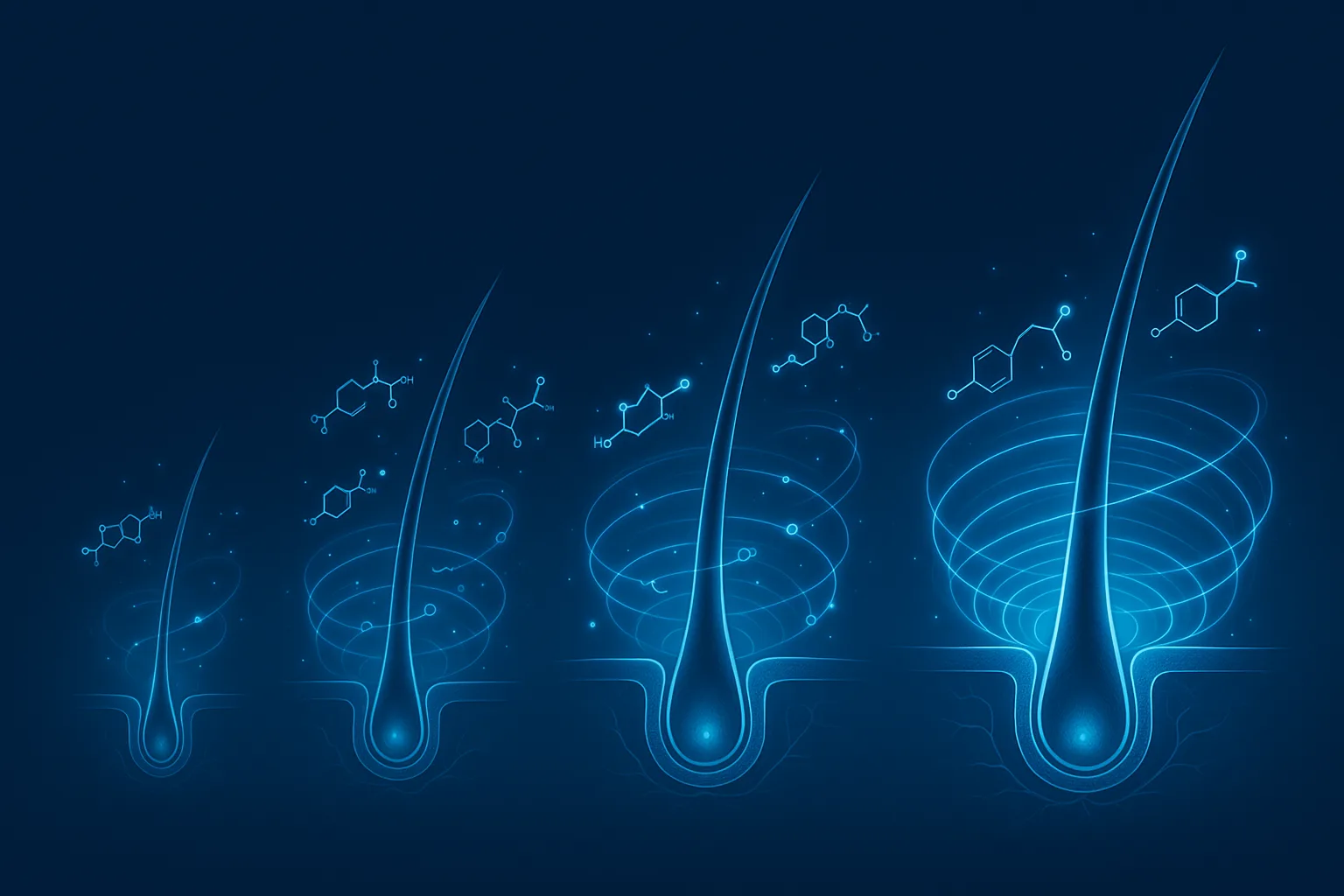
Scalp hair cycles through three phases: anagen (growth, 2 to 7 years), catagen (transition, weeks), and telogen (rest and shed, 3 months). Estrogen prolongs anagen. It binds to estrogen receptors expressed in the hair follicle dermal papilla, extends the growth phase, and delays the switch into telogen.
When estradiol drops from premenopausal levels of 100 to 400 pg/mL down to postmenopausal levels under 20 pg/mL, follicles spend proportionally more time in telogen. Shedding increases. Regrowth shortens.
2. The Androgen Ratio Shifts
Testosterone does not crash at menopause the way estrogen does. Total testosterone in women declines gradually from the 20s, not precipitously at 50. Meanwhile SHBG (sex hormone binding globulin) often drops as estrogen falls.
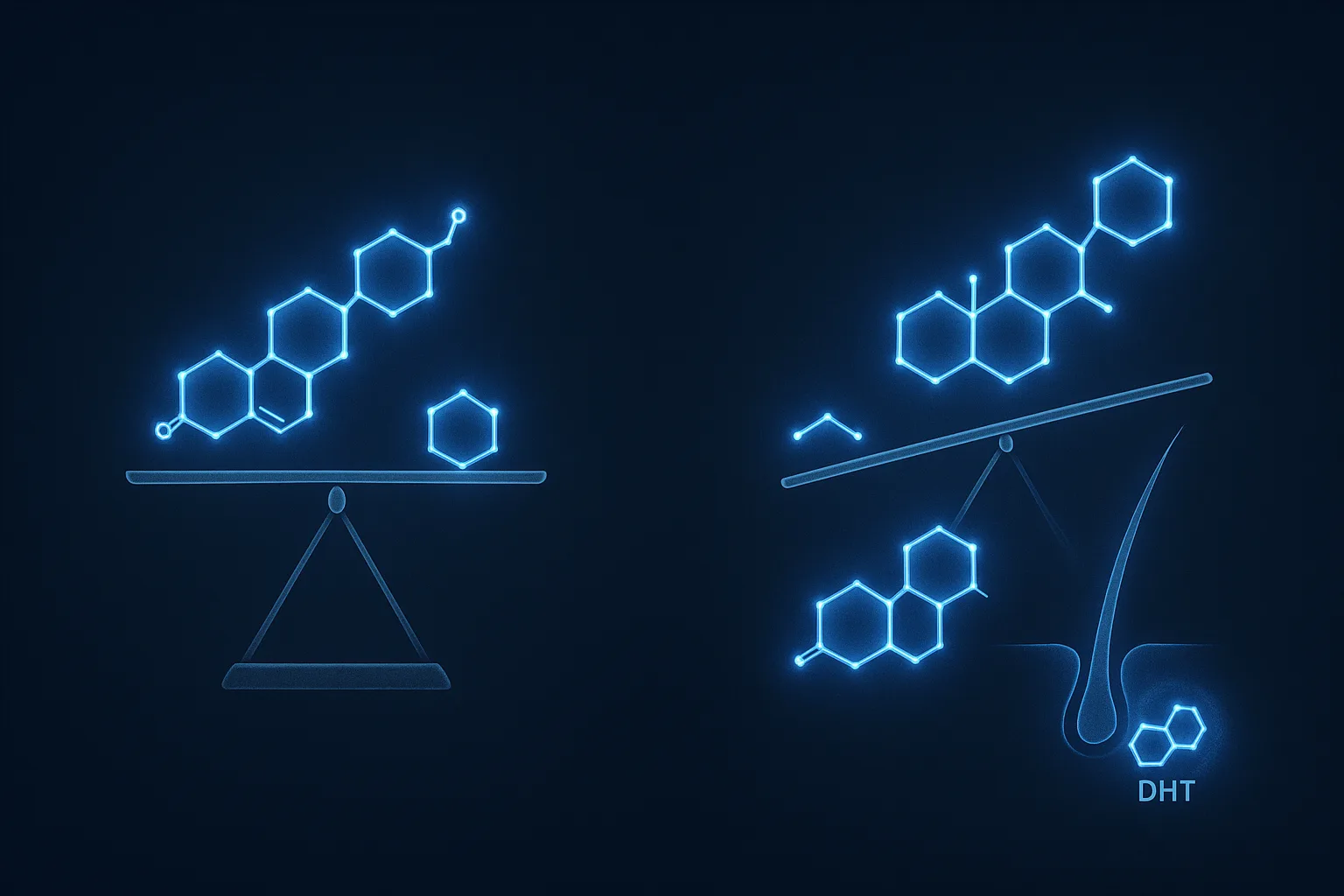
The result: free (bioavailable) testosterone can actually rise relative to estrogen during and after menopause. This is not hyperandrogenism — it is a shift in the ratio. In genetically susceptible follicles, that ratio shift is enough to trigger miniaturization.
3. DHT Does Local Damage
Within the scalp follicle, testosterone is converted by 5-alpha reductase to dihydrotestosterone (DHT). DHT binds androgen receptors in susceptible follicles, shortens anagen, and progressively shrinks the follicle across cycles — a process called miniaturization. A terminal hair becomes a vellus hair. A vellus hair eventually disappears.
This is the same mechanism as male pattern baldness, but the distribution in women is diffuse across the top of the scalp rather than the temple and crown pattern men get. The hairline usually stays intact.
4. Progesterone Loss Removes a 5-Alpha Reductase Brake
Progesterone weakly inhibits 5-alpha reductase. When progesterone declines in perimenopause — often years before estrogen drops — that brake on DHT conversion is released. This is one reason some women notice shedding in their early to mid-40s, well before classic menopause symptoms appear.
The net effect: lower estrogen, relatively higher free androgens, more local DHT, less progesterone restraint. Follicles start to miniaturize.
What HRT Actually Does for Hair
Systemic HRT is not a hair loss drug. But it addresses the upstream hormonal driver, and for most women that matters more than any topical alone.
Stops the Shedding
Within 2 to 3 months of starting optimized HRT, most women notice that diffuse shedding slows. This is because:
Stable hormone levels reduce the telogen effluvium that hormonal chaos causes
The shed-per-day count — often 200+ hairs in active menopause hair loss — drops back toward the normal 50 to 100 range.
Slows Miniaturization
HRT does not reliably reverse miniaturization that has already happened, but it slows the progression. A follicle that was about to shrink from terminal to vellus may hold its ground. Follicles that have already gone dormant rarely come back from HRT alone.
This is why timing matters. Women who start HRT within 2 to 3 years of noticing thinning get more benefit than women who wait a decade.
Creates the Conditions for Regrowth
Topical minoxidil and oral minoxidil work much better when the hormonal environment is optimized. HRT is the substrate. Minoxidil is the amplifier.
What HRT Does Not Do
HRT will not:
Regrow hair in scars or areas where follicles are dead
Outpace severe miniaturization without adjunctive therapy
Replace minoxidil for women with established Ludwig grade II or III pattern loss
Fix hair loss that is primarily thyroid, iron, or nutritional
HRT is necessary but not always sufficient.
The Testosterone Paradox
This is where most internet advice goes wrong.
Women read that testosterone causes hair loss and panic. In reality, the relationship is bimodal.
For most women, low-dose transdermal testosterone — targeting free T in the upper quartile of the female reference range — improves hair quality by:
Restoring follicular energy metabolism
Supporting sebum production (dry, brittle hair is a low-androgen sign)
Improving scalp circulation
Restoring the density and shine that crashes in postmenopausal women
For a minority of women with genetic 5-alpha reductase sensitivity, testosterone increases scalp DHT enough to accelerate miniaturization. These women typically have:
A family history of female pattern hair loss (mother or maternal grandmother)
Existing Ludwig grade I or II thinning before starting testosterone
Concurrent PCOS or other hyperandrogenic history
The solution for these women is not to skip testosterone — it is to pair it with either topical anti-androgen therapy, low-dose spironolactone, or topical/oral minoxidil. For the full testosterone dosing framework, review the testosterone for women dosage guide and testosterone women side effects article.
Blanket avoidance of testosterone in menopausal women because "it causes hair loss" abandons the majority who would benefit, to avoid a problem that is manageable in the minority who are susceptible.
Women's HRT — Menopause-First Telehealth
Bioidentical estradiol, progesterone, and low-dose testosterone — all 50 states, unlimited physician access.
The stack below is what experienced women's HRT clinicians actually prescribe. It is not a single pill — it is a layered protocol.
Layer 1: Optimized HRT
Transdermal estradiol, 0.05 to 0.075 mg/day patch or 1 mg/day gel, targeting serum estradiol of 60 to 80 pg/mL.
Oral micronized progesterone, 100 to 200 mg at bedtime if you have a uterus. Progesterone has the added benefit of weak 5-alpha reductase inhibition and supports sleep, which matters because cortisol-driven sleep loss worsens shedding.
Low-dose transdermal testosterone (optional but usually beneficial), 0.5 to 1 mg/day, targeting the upper quartile of the female free T range. Skip or defer only if you have strong family history of female pattern hair loss and existing visible thinning.
Layer 2: Topical or Low-Dose Oral Minoxidil
Minoxidil is first-line evidence-based therapy for female pattern hair loss [2]. Two options:
Topical 5% minoxidil foam, once daily to the affected scalp. Evidence supports 5% over 2% for efficacy, with similar side effect profile [3].
Low-dose oral minoxidil (LDOM), 0.25 to 1.25 mg daily. A study of 148 women found 85% showed improvement at 6 months, with minimal side effects [4]. This is increasingly preferred over topical for adherence and results.
Minoxidil produces an initial shed ("minoxidil shed") in the first 4 to 8 weeks as follicles synchronize into a new growth phase. Do not stop — this is the sign it is working. Visible density improvement takes 4 to 6 months.
Layer 3: Anti-Androgens (If Indicated)
Add if there is clear hyperandrogenic driver — elevated free testosterone, elevated DHEAS, PCOS history, or progression despite HRT and minoxidil.
Spironolactone, 50 to 200 mg/day oral. Blocks androgen receptors and modestly inhibits adrenal androgen production. Evidence supports efficacy in female pattern hair loss, especially when combined with minoxidil [5]. Requires potassium monitoring if dosed above 100 mg/day.
Topical anti-androgen options (compounded topical spironolactone, topical finasteride) are an emerging alternative for women who cannot tolerate systemic spironolactone.
Layer 4: Foundational Nutrition
Before adding drugs, make sure the basics are covered. Hair loss that looks hormonal is sometimes nutritional:
Protein intake. Minimum 1 g per pound of goal body weight. Hair follicles are among the most metabolically active tissues in the body.
Thyroid. TSH under 2.5. Both hypo- and hyperthyroid cause diffuse shedding.
If ferritin is 25 or thyroid is borderline, fix those first. HRT will not overcome iron deficiency.
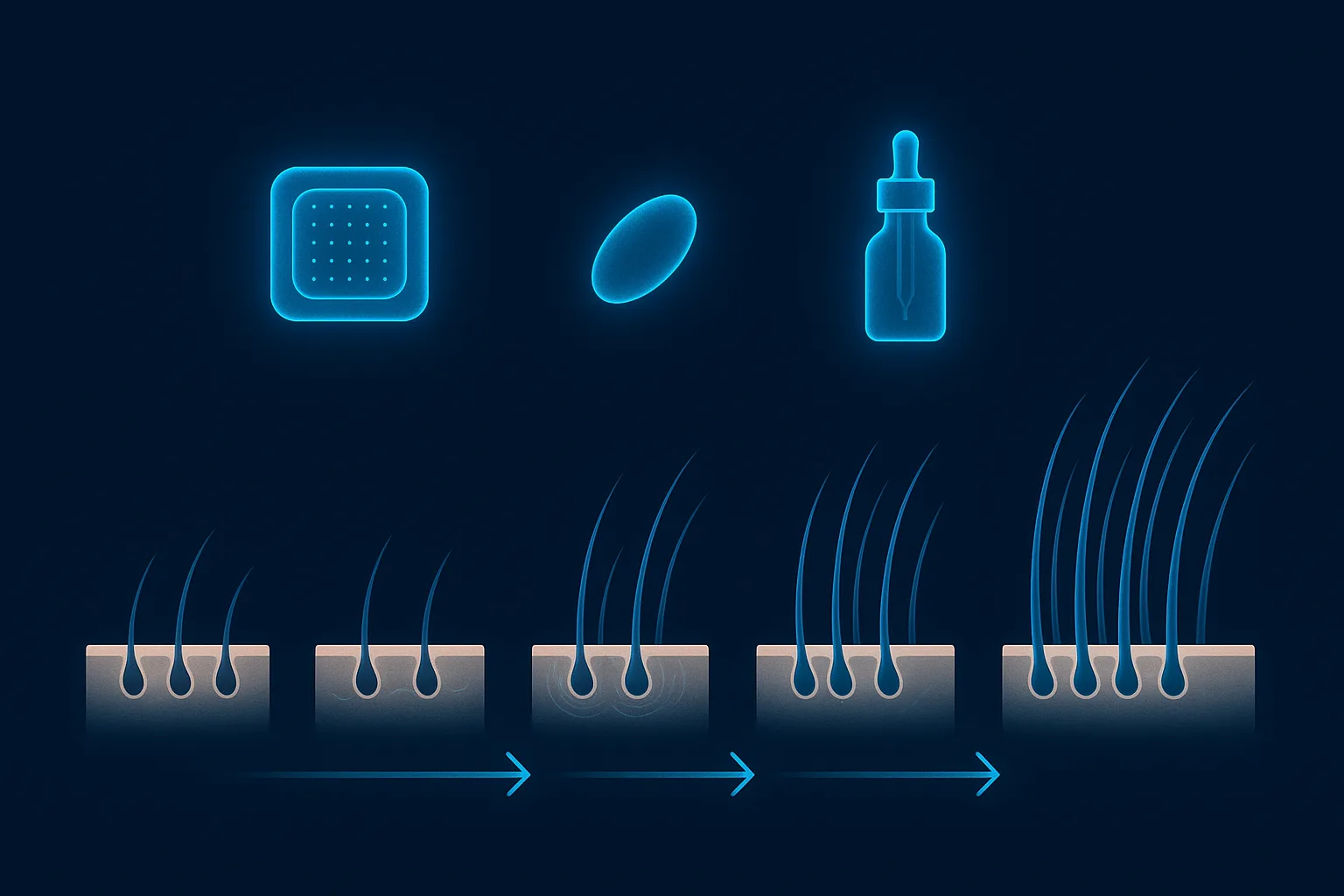
Typical Timeline on a Full Protocol
Month 1 to 2
Shedding may initially worsen (minoxidil shed, HRT adjustment shed)
Subjective scalp "itch" or tingling as follicles activate
Sleep, mood, and vasomotor symptoms improve from HRT
Month 3 to 4
Shedding normalizes to 50 to 100 hairs/day
Baby hairs ("regrowth") visible at temples, hairline, and part line
Existing hair feels slightly thicker
Month 6
Visible density change at the part line
Photos from month 0 vs month 6 show measurable difference (take reference photos at start)
Baby hairs lengthening into 2 to 4 inches
Month 12
Full response evident
If response is partial, this is the time to add or increase spironolactone, or step up minoxidil dose
Continue the protocol indefinitely. Stopping reverses gains within 6 to 12 months.
Delivery Methods: Which HRT Is Best for Hair
Delivery
Effect on Hair
Notes
Transdermal estradiol patch
Preferred. Steady levels, no SHBG spike.
Best for androgen-driven loss.
Oral estradiol
Mixed. Raises SHBG, lowers free T.
Helpful if hair loss is primarily androgen-driven, less helpful if low estrogen is the issue.
Estradiol pellets
Not recommended. Supraphysiologic estradiol early, low later. Destabilizes.
Hair response is inconsistent.
Compounded bi-est cream
Acceptable but variable absorption.
Requires serum monitoring.
Testosterone cream
Usually helpful, rarely harmful in the right dose.
Skip or pair with anti-androgen if genetic risk.
Testosterone pellets
Too much, too fast for most hair-loss-prone women.
Peaks can trigger miniaturization in susceptible follicles.
Oral micronized progesterone
Weak 5-alpha reductase inhibition. Helpful.
Bedtime dosing.
Medroxyprogesterone (MPA)
Androgenic progestin. Can worsen hair loss.
Use micronized progesterone instead.
The combination most experienced HRT clinicians prescribe for hair-conscious women: transdermal estradiol + oral micronized progesterone + low-dose transdermal testosterone (skipped or delayed in genetically susceptible women), paired with topical or low-dose oral minoxidil.
Mistakes to Avoid
Waiting Too Long
Every cycle a follicle miniaturizes, it becomes harder to revive. Women who wait 5 to 10 years after first noticing thinning rarely recover full density. The window matters.
Relying on HRT Alone
HRT slows progression. Minoxidil causes regrowth. Expecting HRT to regrow hair without minoxidil is the most common protocol failure.
Using Biotin Instead of Addressing Hormones
Biotin supplements do nothing for hormonal hair loss unless you are actually deficient (rare). They also interfere with thyroid and troponin lab tests. Skip biotin, fix hormones.
Taking Too Little Estrogen for Symptom Control
Women who are dosed at a 0.025 mg patch "just to take the edge off" often continue to lose hair. If the goal is symptom relief and tissue protection including hair, aim for a serum estradiol of 60 to 80 pg/mL, not 20.
Avoiding Testosterone Out of Fear
Most women do not lose hair on low-dose testosterone. Many improve. The blanket "testosterone causes hair loss" advice costs women the mood, libido, muscle, and bone benefits of the hormone, to avoid a side effect that has manageable mitigation.
Not Taking Baseline Photos
Hair changes slowly. Without baseline photos at a consistent angle and lighting (part line, crown, temples), you cannot tell if a protocol is working at month 4. Take photos day one.
Finding the Right Provider
Most primary care physicians will not prescribe the full protocol. Standard gynecologists often prescribe HRT but decline to address hair loss directly. Dermatologists may prescribe minoxidil and spironolactone but do not handle HRT.
You need one of:
A women's HRT-focused telehealth clinic that will coordinate HRT, minoxidil, and sometimes spironolactone
A menopause specialist (NAMS certified) who treats hair loss
A dermatologist who co-manages with your HRT prescriber
For comparisons of women's HRT clinics that will address hair loss alongside hormones, review the best online HRT clinic for women.
Menopause hair loss is a hormonal event that affects roughly half of postmenopausal women. The mechanism is the shift in the estrogen-to-androgen ratio, local DHT miniaturization of susceptible follicles, and loss of the estrogen-driven anagen-prolongation effect.
HRT alone is usually not enough to regrow hair, but it is the necessary foundation. The evidence-based protocol is:
Optimize HRT. Transdermal estradiol to a serum level of 60 to 80 pg/mL, oral micronized progesterone, and usually low-dose testosterone (skip or defer in genetically susceptible women).
Add minoxidil. Topical 5% foam daily or low-dose oral minoxidil 0.25 to 1.25 mg daily.
Add spironolactone if indicated. Hyperandrogenic signs, PCOS history, or partial response at 6 months.
Take photos, be patient. Full response is at month 12, not month 2.
Do not quit. Stopping the protocol reverses gains within 6 to 12 months.
The biggest mistake is waiting. Follicles that have miniaturized past vellus are usually gone for good. Women who catch it in the shedding phase and treat aggressively keep most of their hair. Women who wait a decade rarely do.
If you are shedding more than you used to and your part line is widening, this is not vanity — it is a hormonal symptom with a treatment protocol. Find a clinic that will treat it seriously.
References:
Ramos PM, Brianezi G, Martins ACP, da Silva MG, Marques MEA, Miot HA. Prevalence of female pattern hair loss in postmenopausal women: a cross-sectional study. Menopause. 2022;29(4):419-423. PMID: 35357365
van Zuuren EJ, Fedorowicz Z, Schoones J. Interventions for female pattern hair loss. Cochrane Database Syst Rev. 2016;(5):CD007628. PMID: 27225981
Lucky AW, Piacquadio DJ, Ditre CM, et al. A randomized, placebo-controlled trial of 5% and 2% topical minoxidil solutions in the treatment of female pattern hair loss. J Am Acad Dermatol. 2004;50(4):541-553. PMID: 15034503
Ramos PM, Sinclair RD, Kasprzak M, Miot HA. Low-Dose Oral Minoxidil for Female Pattern Hair Loss: A Unicenter Descriptive Study of 148 Women. Skin Appendage Disord. 2020;6(4):245-251. PMID: 32656239
Famenini S, Slaught C, Duan L, Goh C. Demographics of women with female pattern hair loss and the effectiveness of spironolactone therapy. J Am Acad Dermatol. 2015;73(4):705-706. PMID: 26190239
Carmina E, Azziz R, Bergfeld W, et al. Female Pattern Hair Loss and Androgen Excess: A Report From the Multidisciplinary Androgen Excess and PCOS Committee. J Clin Endocrinol Metab. 2019;104(7):2875-2891. PMID: 30785999
Frequently Asked Questions
Does HRT reverse menopause hair loss?
Partially. Systemic estradiol and progesterone slow or stop the thinning in most women within 3 to 6 months, but visible regrowth usually requires adding topical minoxidil and, in some cases, an anti-androgen like spironolactone. HRT alone is rarely enough to restore density if miniaturization has already progressed past Ludwig grade I.
Can testosterone therapy cause hair loss in women?
It can, but it is less common than the internet suggests. Low-dose transdermal testosterone (targeting the upper quartile of the female reference range) causes scalp hair thinning in roughly 3 to 8% of women, almost always those with a family history of female pattern hair loss and an underlying genetic sensitivity to DHT. The same women often improve on testosterone paired with a 5-alpha reductase inhibitor or topical anti-androgen.
How long does it take to see regrowth on HRT?
Shedding usually slows within 8 to 12 weeks of starting optimized HRT. Visible regrowth — thicker part lines, fewer visible scalp zones, returning baby hairs at the temples — takes 6 to 12 months. Hair follicles cycle slowly. Anyone promising 4-week regrowth is selling something.
Is minoxidil safe to use with HRT?
Yes. Topical 5% minoxidil and low-dose oral minoxidil (0.25 to 1.25 mg) are both compatible with systemic HRT and are the first-line evidence-based treatment for female pattern hair loss. They address the follicular miniaturization that HRT alone cannot fully reverse.
Which HRT delivery method is best for hair?
Transdermal estradiol (patch or gel) paired with oral micronized progesterone is preferred. Oral estradiol raises SHBG, which can lower free testosterone — a double-edged sword. In women whose hair loss is driven primarily by low estrogen rather than high androgens, raising SHBG via oral estradiol can actually help. In androgen-driven patterns, transdermal is better.