Aviva AVA-291: Aromatization-Resistant Testosterone for Women
5/18/2026
5 min read
By The TRT Catalog
Aviva Bio's AVA-291 is a deuterium-modified testosterone designed to resist aromatization and lower breast-cancer-cell-proliferation signal by approximately 1,000-fold.
The single biggest reason there is no FDA-approved testosterone for women is not efficacy. The efficacy data, particularly for hypoactive sexual desire disorder, has been robust for two decades. The barrier has been theoretical breast cancer risk from testosterone's conversion to estradiol in breast tissue. Aviva Bio's AVA-291 is the first serious attempt to engineer that risk out of the molecule itself.
In late April 2026 at the American Association for Cancer Research Annual Meeting, Aviva presented preclinical data showing AVA-291 has roughly 1,000-fold less potential to stimulate breast cancer cell proliferation than conventional testosterone. Earlier in 2026, the FDA had provided Type B meeting guidance on the development pathway for AVA-291 as a women's testosterone therapy. Phase 1 trials are slated to begin in 2026.
Key Takeaways
AVA-291 (d3-T) is a deuterium-substituted testosterone designed to resist aromatization
In vitro data shows ~1,000-fold lower breast cancer cell proliferation potential vs conventional testosterone
FDA provided Type B meeting guidance on the development pathway for women's testosterone therapy
AACR April 2026 presentation marked the first major preclinical disclosure for the molecule
Phase 1 trials planned for 2026; earliest realistic U.S. availability is 2031 to 2033
Off-label compounded testosterone is the current standard for women — see women's HRT clinics for prescribers today
What AVA-291 Actually Is
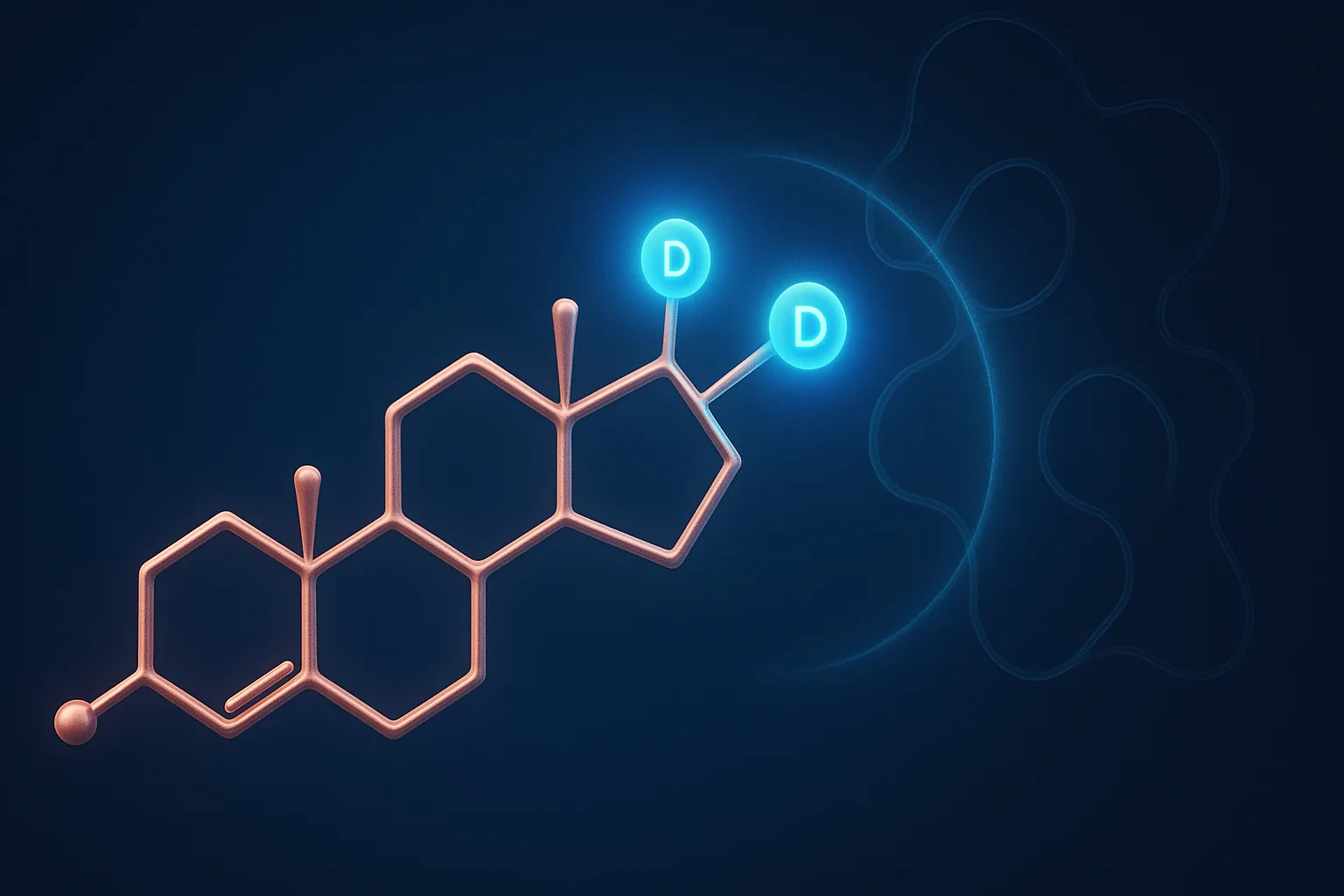
AVA-291 is a deuterated isotopologue of testosterone. The active molecule is identical to testosterone in almost every way: same androgen receptor binding, same metabolic pathways through 5-alpha-reductase to dihydrotestosterone, same downstream effects on muscle, brain, and libido. The only structural difference is three hydrogen atoms have been replaced with deuterium, a stable hydrogen isotope with an extra neutron.
The deuterium substitution is positioned at the site where aromatase, the enzyme that converts testosterone to estradiol, removes a hydrogen during its catalytic cycle. The carbon-deuterium bond is stronger than a carbon-hydrogen bond. Aromatase has more difficulty breaking the deuterium bond, so the enzymatic conversion to estradiol is slowed or blocked.
The strategy is borrowed from established deuterated drugs in other categories. Deutetrabenazine, used for Huntington's chorea and tardive dyskinesia, is a deuterated version of tetrabenazine. The deuteration slows the drug's breakdown by liver enzymes, extending half-life. Deucravacitinib is a deuterated TYK2 inhibitor for psoriasis. Both are FDA-approved. The deuterium chemistry strategy has regulatory precedent.
What is novel about AVA-291 is the target. Rather than slowing the drug's own breakdown, deuteration is positioned to block one specific metabolic conversion (testosterone to estradiol) while leaving androgen receptor binding and other testosterone activities unchanged.
Why Aromatization Has Blocked Women's Testosterone Approval
To understand AVA-291's potential, it helps to understand why the conventional women's testosterone story has stalled.
Testosterone in women circulates at much lower levels than in men — roughly one-tenth — but is biologically significant. Female testosterone declines steadily through the 30s and 40s and contributes to libido, mood, muscle, and bone. Replacement at physiological female doses (1 to 5 mg/day topical, versus 100 to 200 mg/week for men) has documented benefit for hypoactive sexual desire disorder.
The problem is what happens to that testosterone once it enters the body. Aromatase enzyme in breast tissue, adipose tissue, and bone converts a fraction of testosterone to estradiol. For women already at low estradiol (postmenopausal), this can be desirable. For women at higher estradiol, it can mean unwanted breast tissue stimulation.
Regulators have treated this conversion as a hard safety question. Long-term breast cancer outcome data on women using testosterone is limited. Procter and Gamble's Intrinsa patch, approved in Europe in 2007, was rejected by the FDA largely on breast cancer surveillance grounds. BioSante's LibiGel attempted long-term outcome trials in the 2010s but failed Phase 3 on efficacy. The result is that off-label compounded testosterone is widely used but no product has earned FDA approval.
AVA-291's pitch is that if the molecule cannot become estradiol locally, the breast cancer concern theoretically dissolves. The FDA's January 2026 Type B meeting feedback acknowledged this rationale and outlined what preclinical and clinical data would be required to advance.
The AACR 2026 Data, Translated
The April 2026 American Association for Cancer Research presentation was the first major mechanistic disclosure on AVA-291. The headline number was a ~1,000-fold reduction in breast cancer cell proliferation potential compared with conventional testosterone in in vitro assays.
What that number means in practice depends on the assay design, which Aviva has described in regulatory and conference materials.
The assay. Estrogen-receptor-positive breast cancer cell lines (commonly MCF-7) are exposed to testosterone, AVA-291, or vehicle control across a concentration range. Cell proliferation is measured by standard methods (e.g., MTT assay, BrdU incorporation, or direct cell counting) at 24 to 72 hours.
What testosterone does in this assay. Conventional testosterone causes a dose-dependent increase in ER+ breast cancer cell proliferation because intracellular aromatase converts a fraction of the testosterone to estradiol, which then binds estrogen receptors and drives cell division. This is a well-characterized mechanism and is one reason oncologists are cautious about systemic testosterone in women with a history of ER+ breast cancer.
What AVA-291 does in this assay. Because the deuterium substitution blocks the aromatase conversion step, far less estradiol is produced intracellularly, and proliferation signal drops. The ~1,000-fold reduction means the dose-response curve shifts to the right by three orders of magnitude. To produce the same proliferation increase as a given dose of testosterone, you would need roughly 1,000 times more AVA-291.
What this does not prove. In vitro cell line data does not directly predict human breast cancer outcomes. Issues include:
Cell lines do not capture the complexity of human breast tissue with stromal interactions, immune cells, and variable aromatase expression
The assay does not measure systemic estrogen effects from peripheral aromatization in adipose tissue
Long-term cancer incidence requires clinical follow-up of thousands of patient-years
The ~1,000-fold figure is best read as evidence that the mechanistic strategy is working. It establishes the bar for what Phase 1 and Phase 2 trials need to confirm.
How This Compares to Acrux's Phase 3 Program
AVA-291 is not the only women's testosterone in development. Acrux's Female Testosterone product, which uses a metered-dose transdermal applicator delivering conventional testosterone, advanced to Phase 3 on April 30, 2026. The two programs reflect fundamentally different strategies.
Dimension
Acrux Female Testosterone
Aviva AVA-291
Active molecule
Conventional testosterone
Deuterated testosterone (d3-T)
Aromatization
Normal (~3-5% conversion)
Engineered to be much lower
Delivery system
Patchless patch (MDTS spray)
Not yet disclosed (likely transdermal)
Development phase (May 2026)
Phase 3
Phase 1 planned 2026
Earliest U.S. launch
2030 to 2032
2031 to 2033
Primary indication target
HSDD in peri/postmenopausal women
TBD (likely HSDD initial)
Differentiation pitch
Dose precision + clean topical
Aromatization resistance
These are complementary rather than competing. Acrux's product is closer to market and addresses dose precision, which has been a real-world problem with compounded creams. AVA-291 is earlier-stage but addresses the regulatory safety concern that has historically blocked broader prescribing. If both succeed, the women's testosterone market would have a precision-delivery option for general HSDD and an aromatization-resistant option for women with breast cancer risk concerns or active hormone-sensitive cancer history.
Women's HRT — Menopause-First Telehealth
Bioidentical estradiol, progesterone, and low-dose testosterone — all 50 states, unlimited physician access.
A Type B meeting is a structured pre-submission interaction between a drug sponsor and the FDA, typically requested to discuss specific development questions before committing to expensive trials. Aviva announced in January 2026 that the FDA had provided formal feedback on the development pathway for AVA-291 as a women's testosterone therapy.
What this typically means in practice:
The FDA has reviewed the preclinical package and the proposed clinical development plan
The agency has identified what additional studies it considers necessary before Phase 1
The agency has clarified what safety endpoints, particularly around breast cancer surveillance, it expects to see in Phase 2 and Phase 3
The agency has not committed to approval but has confirmed the regulatory path is viable
For a women's testosterone candidate, the FDA's willingness to engage at this level is meaningful. Prior women's testosterone applications (Intrinsa, LibiGel) faced uncertain pathways with shifting safety requirements. Aviva entering Phase 1 with documented FDA agreement on the trial design substantially reduces regulatory risk for the program.
The FDA's engagement also signals broader receptivity to women's testosterone. The April 2026 FDA action expanding low libido as a potential testosterone indication for men with idiopathic hypogonadism, the Acrux Phase 3 advancement, and the AVA-291 Type B meeting all sit within the same regulatory window. The pattern suggests the agency is treating low desire and androgen deficiency as legitimate therapeutic targets after decades of skepticism.
Realistic Timeline for AVA-291
For women considering whether to plan around AVA-291's eventual approval, here is the realistic timeline.
Milestone
Estimated Date
Phase 1 first patient enrolled
Late 2026 to early 2027
Phase 1 readout
2028
Phase 2 trials
2028 to 2030
Phase 3 trials
2030 to 2032
FDA submission
2032 to 2033
Standard FDA review
10 to 12 months
Earliest U.S. launch
2033 to 2034
Priority Review (if granted)
Shifts launch up ~6 months
Seven to eight years is a long time. Women experiencing symptoms of testosterone deficiency now should evaluate off-label treatment rather than waiting for AVA-291.
What Is Available Today
For women considering testosterone treatment in 2026, the landscape is unchanged by AVA-291's news. The off-label pathway remains the standard.
Compounded Testosterone Cream
The dominant option. Specialized providers prescribe compounded testosterone cream at 1 to 5 mg/day applied to the inner forearm or thigh. Cost is typically $40 to $100/month plus consultation and labs. See testosterone cream for women for protocol details.
Testosterone Pellets
Subcutaneous pellets inserted in the hip release testosterone over 3 to 4 months. Cost is $300 to $500 per insertion. Pellets produce steady levels but commit to high cumulative dose. Read testosterone pellets for women.
Off-Label Use With Anastrozole
For women specifically concerned about estrogen conversion (such as those with breast cancer history under specialist supervision), some clinicians add a low-dose aromatase inhibitor like anastrozole to suppress testosterone-to-estradiol conversion. This is a workaround for what AVA-291 is engineered to solve at the molecular level. It requires careful monitoring of estradiol, bone mineral density, and lipids because systemic aromatase inhibition has its own consequences.
Off-Label Male Topicals
Some providers prescribe a fraction of a male AndroGel packet (typically 1/10th to 1/8th daily). Cheapest option but worst dose precision. Most women on this protocol over- or under-shoot the female physiological range.
If AVA-291 reaches approval, it would matter most for two patient groups.
Women with Personal or Family History of Breast Cancer
Conventional testosterone is generally avoided in women with active or recent ER+ breast cancer due to the aromatization concern. Many specialists also hesitate to prescribe to women with strong family history (BRCA carriers, multiple first-degree relatives). An aromatization-resistant testosterone could open testosterone treatment to these populations where it is currently off-limits.
Women on Aromatase Inhibitor Therapy for Breast Cancer
Women taking anastrozole or letrozole as adjuvant therapy for ER+ breast cancer routinely experience androgen-deficiency symptoms: low libido, muscle loss, fatigue, cognitive complaints. Conventional testosterone supplementation is rarely offered because of the underlying cancer biology. AVA-291 could theoretically restore testosterone function in this population without restoring estrogen exposure, though this is speculative until clinical data exists.
Women in Late Perimenopause and Postmenopause
For the larger general population of women with HSDD or symptoms of low testosterone, AVA-291 would offer a "cleaner" option compared with conventional testosterone. The clinical benefit may be modest if Acrux's product is already available, but for women whose providers refuse to prescribe conventional testosterone due to long-term concerns, AVA-291 may lower the prescribing threshold.
What This Means for the Field
Beyond the immediate Aviva story, the AVA-291 program signals two broader shifts.
First, women's testosterone is finally a real R&D category. A decade ago, no major or mid-size pharma had a serious women's testosterone program. Acrux and Aviva represent two distinct technical approaches reaching meaningful development milestones in the same calendar quarter. The regulatory environment has shifted enough that biotech investors are willing to fund these programs.
Second, the breast cancer concern is being engineered around rather than ignored. Prior failed attempts (Intrinsa, LibiGel) tried to manage the conversion problem through dose titration and long-term surveillance. Aviva is attempting to remove the problem at the molecular level. If the strategy works clinically, it changes how the field thinks about systemic hormone replacement: rather than accepting a metabolic tradeoff, deuteration and other molecular engineering approaches could selectively preserve desired effects while blocking unwanted ones.
The practical takeaway for women considering testosterone now is unchanged. Off-label compounded testosterone remains the standard, the supporting evidence is strong, and the Menopause Society endorses it for HSDD. AVA-291 is a long-term horizon story, not a near-term option.
While AVA-291 timelines stretch into 2033 and beyond, the established 1-5mg compounded protocol is what current prescribers use now — and what off-label and Acrux-era pricing will continue to anchor.
References
Aviva Bio. Aviva Bio Announces FDA Guidance on Development Pathway for Women's Testosterone Therapy and New Evidence of a Reduced Risk of Breast Cancer Cell Proliferation for AVA-291. Press Release, January 26, 2026.
Aviva Biopharm Inc. Unveils Groundbreaking Pre-Clinical Data on d3-T, a First-in-Class Testosterone Therapy for Women at ENDO 2025. BioSpace, 2025.
American Association for Cancer Research. Aviva Bio AVA-291 Mechanistic Data Presentation. AACR Annual Meeting, April 2026.
Davis SR, et al. Safety and Efficacy of Testosterone for Women: A Systematic Review and Meta-Analysis of Randomised Controlled Trial Data. Lancet Diabetes Endocrinol. 2019;7(10):754-766.
The Menopause Society. The Use of Testosterone Therapy in Women: 2023 Position Statement. Menopause. 2023;30(7):700-711.
Parish SJ, et al. International Society for the Study of Women's Sexual Health Clinical Practice Guideline for the Use of Systemic Testosterone for HSDD in Women. J Sex Med. 2021;18(5):849-867.
Shifren JL, et al. Testosterone Patch for the Treatment of Hypoactive Sexual Desire Disorder in Naturally Menopausal Women. Menopause. 2006;13(5):770-779.
Cancer Network. FDA Type B Meeting Elucidates Testosterone-Associated Breast Cancer Risks. 2026.
Frequently Asked Questions
What is AVA-291?
AVA-291, also called d3-T or d3-testosterone, is a novel testosterone analog developed by Aviva Bio. It is structurally identical to testosterone except that three hydrogen atoms have been replaced with deuterium, a heavier stable isotope of hydrogen. The deuterium substitution is positioned to block the aromatase enzyme from converting testosterone to estradiol while preserving androgen receptor binding. The goal is a testosterone that acts like testosterone in muscle, brain, and libido pathways but does not feed estrogen-driven tissues such as breast.
Why does aromatization matter for women's testosterone?
Aromatase converts testosterone to estradiol locally in tissues including breast, fat, and bone. For women, this is the main reason no systemic testosterone has been FDA-approved despite decades of clinical evidence supporting efficacy for HSDD. Regulators have repeatedly cited theoretical breast cancer risk from local estradiol elevation as a barrier. An aromatization-resistant testosterone would, in principle, deliver androgenic benefit without raising breast estradiol exposure.
What did the AACR 2026 data show?
At the American Association for Cancer Research Annual Meeting in April 2026, Aviva presented in vitro data showing AVA-291 has approximately 1,000-fold lower potential to stimulate breast cancer cell proliferation compared with conventional testosterone. The mechanistic interpretation is that because AVA-291 cannot be converted to estradiol locally, it does not activate estrogen-receptor-positive breast cancer cell growth pathways. This is preclinical evidence and does not predict human clinical outcomes.
When will AVA-291 be available?
AVA-291 is preclinical as of May 2026, with Aviva planning to initiate Phase 1 trials in 2026. Phase 1 establishes safety and pharmacokinetics in healthy volunteers (typically 12 to 24 months). Phase 2 efficacy trials and Phase 3 confirmatory trials would follow. Realistic earliest U.S. availability is 2031 to 2033, assuming each phase succeeds. The FDA has provided guidance on the development pathway via a Type B meeting but has not committed to approval.
Is AVA-291 the only women's testosterone in development?
No. Acrux's Female Testosterone product, which uses a metered dose transdermal applicator, advanced to Phase 3 in April 2026 and is the closest women's testosterone product to U.S. market. AVA-291 is earlier-stage but represents a different scientific approach—engineering the molecule itself rather than the delivery system. The two programs are not competitors; they could both succeed for different patient subgroups.
Can I get aromatization-resistant testosterone today?
Not in the form Aviva is developing. Some clinicians prescribe a low-dose aromatase inhibitor (anastrozole or letrozole) alongside off-label compounded testosterone to suppress conversion to estradiol. This is functionally different from AVA-291: the molecule itself is unchanged, but a second drug blocks aromatase systemically. The off-label combination has been used in select cases of treatment-related virilization or unwanted estrogen elevation in women on testosterone.