Low-dose testosterone injections for women: typical doses (5-20 mg/week), virilization risks, injection technique, and how they compare to cream and gel.
Key Takeaways: Injectable testosterone is not first-line therapy for women, but some clinicians prescribe low-dose injections (5-20 mg/week) when topical options fail or are impractical. The primary risks are supraphysiologic hormone spikes and virilization. Subcutaneous injection with an insulin syringe offers better dose control than intramuscular. Frequent monitoring is essential.
Why Injections Are Not First-Line for Women
Every major clinical guideline on testosterone therapy for women recommends transdermal delivery -- cream, gel, or patch -- as the starting point. The 2019 Global Consensus Position Statement is explicit: injectable testosterone formulations are not recommended for women because they produce supraphysiologic levels that increase virilization risk [1].
The reasoning is straightforward. Women need roughly one-tenth the testosterone dose that men do. The target range for most women on TRT is a total testosterone of 30-70 ng/dL, compared to 500-900 ng/dL for men. At these tiny doses, the pharmacokinetics of injectable testosterone work against you:
Peak-and-trough cycling. Even low-dose injections create a spike in the first 24-48 hours followed by a decline. At female physiologic doses, these swings can push levels into the supraphysiologic range at the peak and below therapeutic range at the trough.
Dosing precision. A 5 mg dose of testosterone cypionate 200 mg/mL is 0.025 mL -- a volume that is difficult to measure accurately even with an insulin syringe.
No approved product. There is no FDA-approved injectable testosterone product dosed for women. All injectable use is off-label with male formulations.
Transdermal testosterone (cream or gel) avoids these problems. It delivers small, consistent amounts through the skin, producing stable blood levels without dramatic peaks [2]. This is why the Endocrine Society, the ISSWSH, and the International Menopause Society all recommend transdermal routes first [3][4].
When Clinicians Prescribe Injections Anyway
Despite the guidelines, some clinicians do prescribe low-dose injectable testosterone for women. Common scenarios include:
Topical Failure or Intolerance
Some women absorb transdermal testosterone poorly due to skin type, sweating, or the formulation itself. If blood work shows persistently low testosterone levels despite proper cream or gel use and dose escalation, a switch to injectable delivery may be warranted.
Transfer Concerns
Women with young children or partners who are pregnant face real risks of testosterone transfer through skin contact. Injections eliminate this concern entirely because the testosterone enters the bloodstream directly.
Access and Cost
Compounded testosterone cream can cost $30-80/month depending on the pharmacy and insurance coverage. A single 10 mL vial of testosterone cypionate 200 mg/mL costs $30-70 and lasts months at female doses, making injections the least expensive option by a wide margin.
Patient Preference
Some women prefer the certainty of a measured injection over the variability of topical absorption. Knowing exactly how many milligrams entered the body appeals to patients who want tight control.
Compounding Pharmacy Unavailability
Not all regions have compounding pharmacies that produce low-concentration testosterone cream for women. Standard commercially available testosterone products are dosed for men. Injectable testosterone from a standard pharmacy is universally available.
Typical Doses for Women
Female injectable testosterone doses are dramatically lower than male doses. Here is what the clinical literature and prescribing practice support:
Parameter
Female dose
Male dose (comparison)
Weekly dose
5-20 mg
100-200 mg
Concentration used
200 mg/mL (same vial)
200 mg/mL
Injection volume
0.025-0.1 mL
0.5-1.0 mL
Target total T
30-70 ng/dL
500-900 ng/dL
Injection frequency
1-2x per week
1-2x per week
Typical ester
Cypionate or enanthate
Cypionate or enanthate
Starting Protocol
Most clinicians who prescribe injectable testosterone for women follow this approach:
Start low: 5 mg per week (0.025 mL of 200 mg/mL)
Lab check at 4-6 weeks: Total testosterone, free testosterone, SHBG, estradiol, CBC
Draw labs at trough: The morning of the next injection, before injecting
Titrate slowly: Increase by 2.5-5 mg increments if levels remain below target and symptoms persist
Ceiling: Most women should not exceed 20 mg/week. Doses above this almost always produce supraphysiologic levels
Some clinicians prescribe even lower starting doses of 2-4 mg per week, particularly for smaller women or those who have shown sensitivity to androgens.
Split Dosing
Because of the peak-and-trough problem, many clinicians recommend splitting the weekly dose into two injections. A woman prescribed 10 mg/week would inject 5 mg every 3.5 days. This produces more stable blood levels and reduces the peak, lowering virilization risk.
The "Start Low" Approach
Even within the already-conservative female range, many women do best starting at the very bottom of the curve. Standard prescribing for women is often 10-20mg/week from day one. For some women, that's too much: acne, oily skin, irritability, sleep disruption, or a subtle "pumped up" edge that doesn't match how they want to feel on testosterone.
A more conservative alternative starts at 3-5mg/week (~1/4 the standard starting dose) for 4-8 weeks, then titrates up only if blood work and symptoms warrant it. With a 200mg/mL vial, that's 0.015-0.025mL -- which is why compounded lower-concentration vials (50mg/mL) make this protocol far easier to measure. Reports from community and clinician notes increasingly favor this approach for women who are sensitive to hormonal changes or want a smoother adjustment curve. Some women find they never need more -- they hit target free T levels and reach their goals at the very bottom of the range.
This is not a universal recommendation. Some women genuinely need 15-20mg/week to achieve symptom relief, and slightly faster titration is appropriate when labs show severe androgen deficiency. But if you have room to negotiate dose with your prescriber, asking for a 4-8 week "start low, titrate slowly" phase is a legitimate choice -- and given how narrow the window is between therapeutic and virilizing doses in women, it's often the safer default.
Injection Technique for Women
Women using injectable testosterone typically use subcutaneous (SubQ) injection rather than intramuscular (IM). Research confirms that subcutaneous testosterone delivery is effective and produces comparable blood levels to IM injection, with less pain and easier self-administration [5].
Equipment
Syringe: Insulin syringe (0.5 mL or 1 mL) with a 27-30 gauge needle
Needle length: 1/2 inch (sufficient for subcutaneous injection)
Alcohol swabs for site cleaning
The insulin syringe is critical. Standard 3 mL syringes cannot accurately measure the tiny volumes women need. A 0.5 mL insulin syringe with 50-unit markings allows you to measure 0.025 mL (2.5 units) with reasonable precision.
Injection Sites
Abdomen: 1-2 inches from the navel, alternating sides. Pinch a fold of skin and inject at a 45-degree angle.
Outer thigh: Upper outer quadrant. Same pinch-and-inject technique.
Back of the upper arm: If someone else can administer the injection.
Rotate sites to prevent lipohypertrophy (thickening of fat tissue at the injection site).
Step-by-Step Process
Wash hands thoroughly
Draw the prescribed volume from the vial using the insulin syringe
Clean the injection site with an alcohol swab and let it dry
Pinch a fold of skin at the site
Insert the needle at a 45-degree angle
Inject slowly and steadily
Release the skin fold, withdraw the needle, and apply light pressure with a cotton ball
Women's HRT — Menopause-First Telehealth
Bioidentical estradiol, progesterone, and low-dose testosterone — all 50 states, unlimited physician access.
Virilization is the development of male physical characteristics. It is the primary safety concern with testosterone therapy in women, and injectable delivery carries the highest risk among all routes because of the supraphysiologic peaks it creates [6].
Signs of Virilization (In Order of Onset)
Sign
Typically appears
Reversible?
Acne
Weeks 2-6
Yes, with dose reduction
Oily skin
Weeks 2-6
Yes
Increased body hair
Months 1-3
Partially (slows but may not fully reverse)
Facial hair (chin, upper lip)
Months 2-6
Partially
Scalp hair thinning
Months 3-12
Variable
Voice deepening
Months 3-12
Often irreversible
Clitoral enlargement
Months 6+
Often irreversible
The early signs (acne, oily skin) are warning signals. If they appear, check blood work immediately. Any dose producing a total testosterone above 70 ng/dL at trough should be reduced. If voice changes or clitoral enlargement develop, discontinue injectable testosterone and consider switching to a lower-dose transdermal formulation.
Why Injections Carry More Risk
A woman injecting 10 mg of testosterone cypionate may see her levels spike to 80-120 ng/dL within 24-48 hours, then decline to 30-40 ng/dL by day 7. Those peak levels are supraphysiologic for a woman and drive androgenic side effects, even though the trough levels look normal.
Cream or gel, by contrast, produces a much flatter curve. A woman applying 5 mg of testosterone cream daily typically sees levels in the 40-60 ng/dL range with minimal fluctuation. This is why topical delivery has a better safety profile at equivalent weekly doses.
Risk Reduction Strategies
Split doses into 2 injections per week to flatten peaks
Use the lowest effective dose -- start at 5 mg/week and titrate slowly
Monitor aggressively -- blood work at 4-6 weeks, then every 3 months for the first year
Check trough AND peak -- draw labs at trough (pre-injection) and 24-48 hours post-injection to capture the full picture
Keep a symptom journal tracking skin changes, hair, voice, and mood
Set a hard ceiling -- most clinicians will not exceed 20 mg/week regardless of symptoms
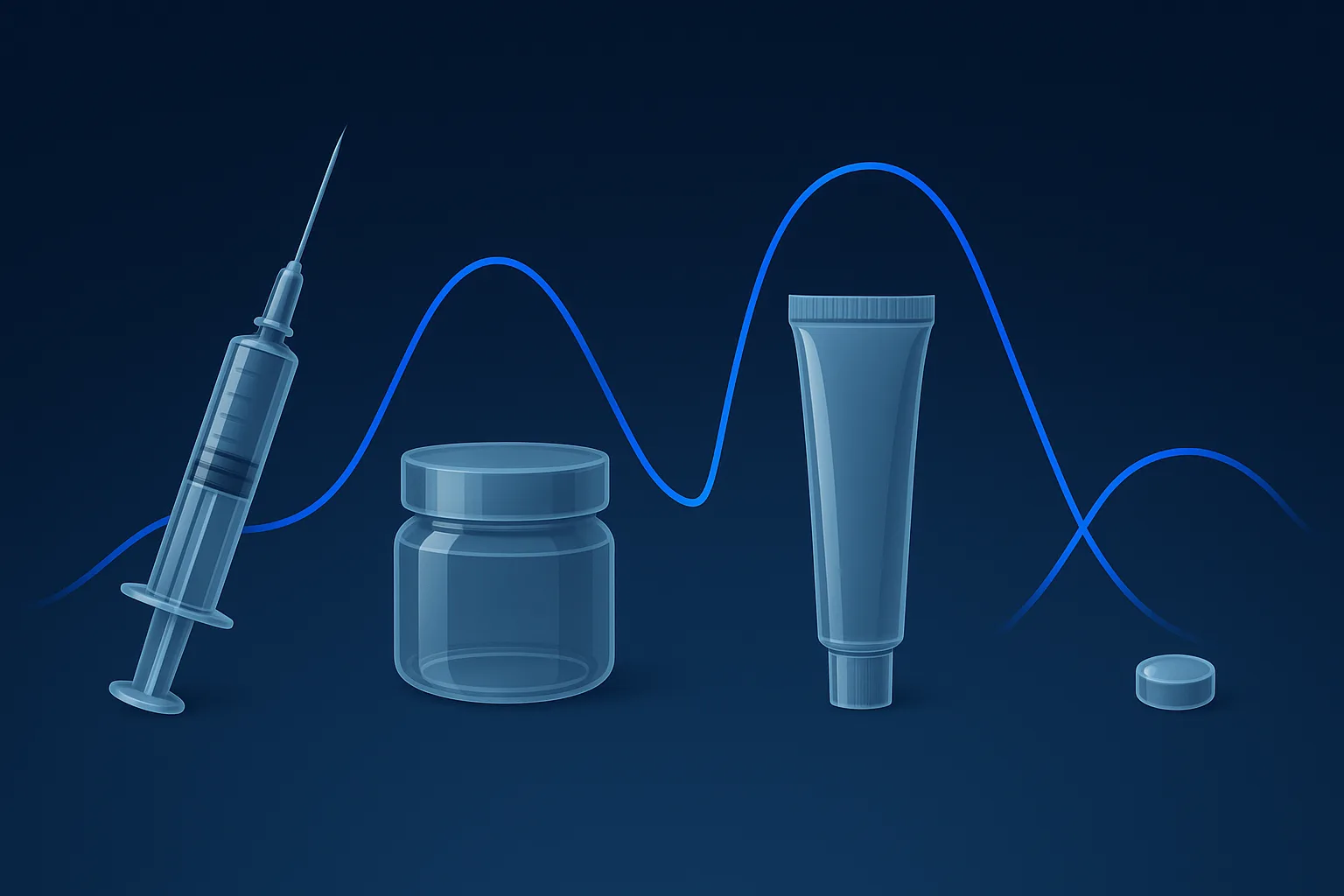
Injections vs Cream vs Gel vs Pellets
This comparison focuses specifically on how each delivery method performs for women. The considerations are different from men because the margin between therapeutic and supraphysiologic dosing is much narrower.
Factor
Injections
Cream
Gel
Pellets
Dose control
Moderate -- precise volume but peak/trough
Excellent -- daily titration
Excellent -- daily titration
Poor -- fixed once inserted
Blood level stability
Low -- peaks and troughs
High -- steady levels
High -- steady levels
High initially, then declining
Virilization risk
Higher (peaks)
Lower
Lower
Moderate (cannot reduce once placed)
Reversibility
Stop injecting
Stop applying
Stop applying
Must wait 3-4 months to clear
Transfer risk
None
Moderate
Moderate
None
Convenience
1-2x/week injection
Daily application
Daily application
Every 3-4 months
Cost (monthly)
$5-15
$30-80
$30-80
$75-170 (amortized)
Access
Any pharmacy
Compounding pharmacy
Compounding or commercial
Specialized clinic
Self-administrable
Yes (SubQ)
Yes
Yes
No (office procedure)
Guideline recommended
No -- off-label
Yes -- first-line
Yes -- first-line
Not specifically
Bottom Line
Testosterone cream remains the best starting point for most women. It offers the finest dose control, the most stable blood levels, and the easiest path to dose adjustment if side effects emerge. Testosterone gel is a close alternative with faster drying time. Pellets suit women who want a hands-off approach and have already established their optimal dose with a titratable method. Injections are a reasonable fallback when topical delivery fails, but they require more vigilant monitoring.
Monitoring is more intensive for injectable testosterone than for topical formulations. Because of the peak-and-trough pattern, a single blood draw does not tell the whole story.
Baseline Labs (Before Starting)
Total testosterone and free testosterone
SHBG (sex hormone-binding globulin)
Estradiol
DHEA-S
CBC (complete blood count) -- testosterone can increase hemoglobin and hematocrit
Lipid panel
Liver function (ALT, AST)
First Follow-Up (4-6 Weeks)
Total and free testosterone at trough (morning of injection day, before injecting)
Optionally: total testosterone at peak (24-48 hours after injection) to assess the swing
Women with a history of androgen sensitivity (severe acne during puberty, hirsutism, or PCOS-like symptoms) should avoid injections and use the lowest-dose transdermal option if testosterone therapy is pursued.
Practical Considerations
Compounding for Lower Concentrations
Some compounding pharmacies will prepare testosterone cypionate at lower concentrations (e.g., 50 mg/mL or 100 mg/mL) specifically for women. This makes dosing easier and more accurate:
5 mg dose from 50 mg/mL = 0.1 mL (much easier to measure than 0.025 mL from 200 mg/mL)
10 mg dose from 100 mg/mL = 0.1 mL
If your clinician prescribes injectable testosterone, ask about compounded lower-concentration options.
Storage and Handling
Store testosterone cypionate at room temperature (68-77 F)
The oil may crystallize in cold temperatures -- warm the vial in your hands for a few minutes before drawing
Multi-dose vials are typically good for 28 days after first puncture (check the label)
A 10 mL vial of 200 mg/mL contains 2,000 mg total -- at 10 mg/week, this lasts approximately 200 weeks (nearly 4 years), well beyond the expiration date. A 1 mL vial is more practical for women.
Insurance and Prescriptions
Injectable testosterone for women is entirely off-label. Some insurance plans will cover testosterone cypionate with a diagnosis code for hypoactive sexual desire disorder (F52.0) or other hormone deficiency. Others will not. The out-of-pocket cost is low enough ($30-70 for a vial lasting many months) that insurance denial is usually not a financial barrier.
When to Consider Switching Off Injections
Even women who start on injections successfully may benefit from transitioning to transdermal delivery once their optimal dose is established. Consider switching if:
Virilization signs appear despite dose reduction
Blood work shows persistent peak-trough swings greater than 2x
The convenience advantage diminishes (many women find daily cream application becomes routine)
A compounding pharmacy becomes accessible
The reverse transition -- from topical to injectable -- is appropriate when topical delivery consistently fails to achieve therapeutic levels despite proper application technique and adequate dosing.
Davis SR, Baber R, Panay N, et al. Global Consensus Position Statement on the Use of Testosterone Therapy for Women. J Clin Endocrinol Metab. 2019;104(10):4660-4666. PMID: 31488288
Fooladi E, Reuter SE, Bell RJ, Robinson PJ, Davis SR. Pharmacokinetics of a transdermal testosterone cream in healthy postmenopausal women. Menopause. 2015;22(1):44-49. PMID: 24845394
Wierman ME, Arlt W, Basson R, et al. Androgen therapy in women: a reappraisal: an Endocrine Society clinical practice guideline. J Clin Endocrinol Metab. 2014;99(10):3489-3510. PMID: 25279570
Parish SJ, Simon JA, Davis SR, et al. International Society for the Study of Women's Sexual Health Clinical Practice Guideline for the Use of Systemic Testosterone for Hypoactive Sexual Desire Disorder in Women. Climacteric. 2021;24(6):533-550. PMID: 33792440
Spratt DI, Stewart II, Engel S, et al. Subcutaneous Injection of Testosterone Is an Effective and Preferred Alternative to Intramuscular Injection: Demonstration in Female-to-Male Transgender Patients. J Clin Endocrinol Metab. 2017;102(7):2349-2355. PMID: 28379417
Islam RM, Bell RJ, Green S, Page MJ, Davis SR. Safety and efficacy of testosterone for women: a systematic review and meta-analysis of randomised controlled trial data. Lancet Diabetes Endocrinol. 2019;7(10):754-766. PMID: 31353194
Bachmann G, Bancroft J, Braunstein G, et al. Testosterone therapy in women: a review. Int J Impot Res. 2005;17(5):399-408. PMID: 15889125
Frequently Asked Questions
What is a typical testosterone injection dose for women?
Most women are prescribed 5-20 mg of testosterone cypionate per week, usually administered subcutaneously. This is roughly one-tenth the standard male TRT dose. Some clinicians start as low as 2-4 mg per week and titrate upward based on lab results.
Why aren't injections the first choice for women's TRT?
Injections cause peak-and-trough hormone fluctuations that are harder to control at the very low doses women need. Transdermal cream or gel allows finer dose adjustments and produces more stable blood levels, reducing virilization risk.
Can women use the same testosterone vial as men?
Yes, women typically use the same testosterone cypionate 200 mg/mL vials but inject a much smaller volume. A 5 mg dose requires only 0.025 mL, which demands an insulin syringe for accuracy.
How do you monitor for virilization on injectable testosterone?
Check total and free testosterone, SHBG, and DHEA-S at 4-6 weeks after starting. Watch for acne, facial hair growth, voice deepening, or clitoral changes. Any virilization sign warrants an immediate dose reduction or switch to transdermal delivery.