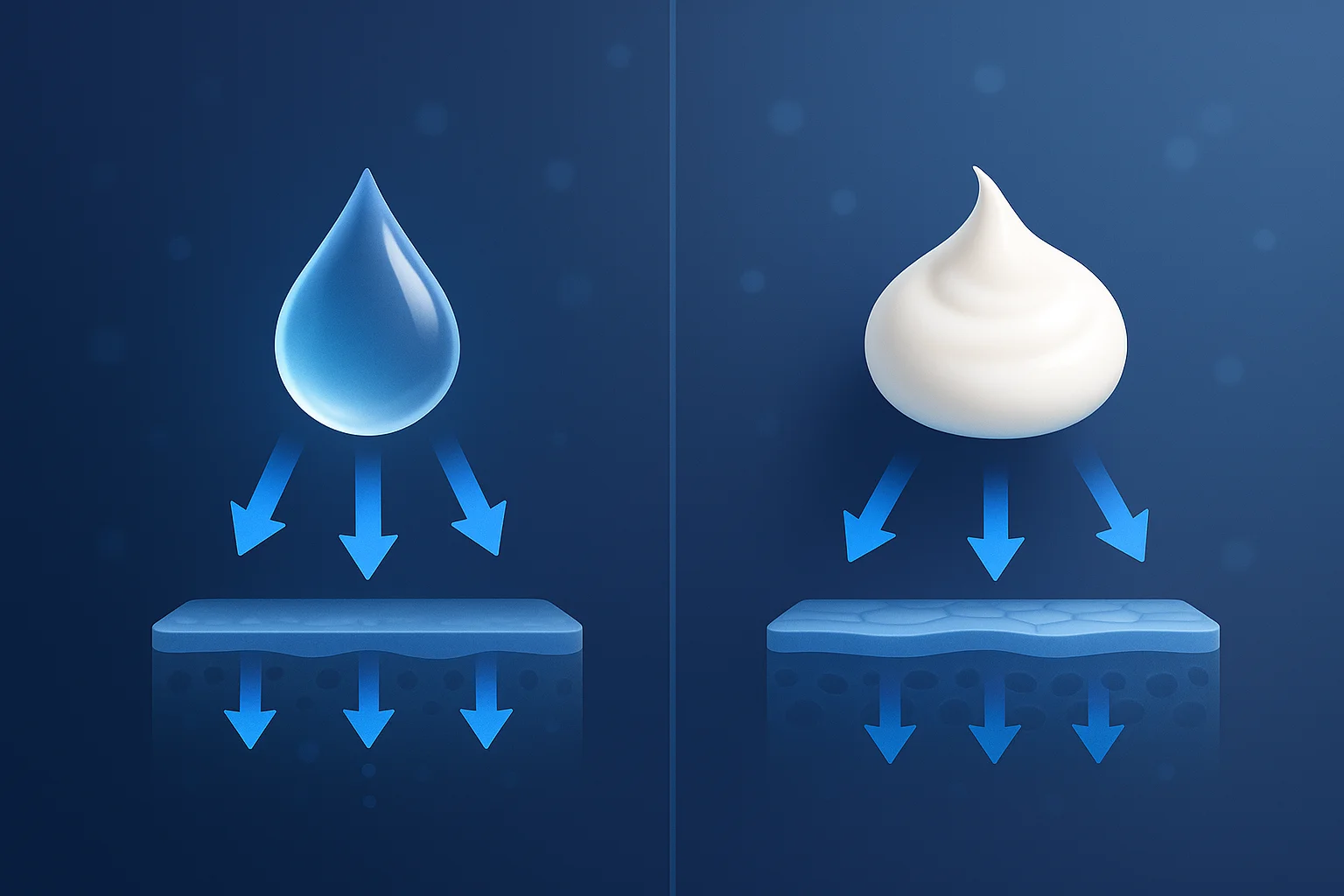
Key Takeaways: Testosterone gel is a viable alternative to cream for women's TRT, offering faster drying time and similar efficacy. Gels use an alcohol base for rapid absorption while creams use an emollient base. Both deliver effective testosterone levels at doses of 1-10 mg/day. The choice between gel and cream often comes down to personal preference and skin sensitivity.
Gel vs Cream: Understanding the Difference
The terms "gel" and "cream" are often used interchangeably, but they are distinct formulations with different properties.
Testosterone gel uses an alcohol or hydroalcoholic base. The alcohol acts as a penetration enhancer, carrying testosterone through the skin quickly before evaporating. This results in rapid drying and fast initial absorption.
Testosterone cream uses a lipid or emollient base. The cream sits on the skin longer, providing sustained absorption over a longer period. It feels moisturizing rather than drying.
Key Differences at a Glance
Property
Gel
Cream
Base
Alcohol/hydroalcoholic
Lipid/emollient
Drying time
3-5 minutes
10-15 minutes
Skin feel
Drying, may cause tightness
Moisturizing, smooth
Absorption speed
Rapid initial peak
Slower, more sustained
Skin irritation
More common (alcohol content)
Less common
Application volume
Often smaller
May require more volume
Availability
Compounded or commercial
Primarily compounded
Transfer risk
Similar
Similar
See If You Qualify for Doctor-Supervised HRT
We'll match you with a licensed menopause-trained provider in your state — bioidentical estradiol, progesterone, and low-dose testosterone protocols.
Available Formulations
Compounded Gel
Most women's testosterone gel is compounded, just like cream. Compounding pharmacies can formulate gel in the low concentrations women need (0.5-2%). Common gel bases include:
Pentravan -- a widely used transdermal gel base with proven absorption
Atrevis Hydro -- a newer hydrogel base designed for hormone delivery
VersaPro Gel -- versatile gel base with consistent penetration
Commercial Products (Off-Label)
No testosterone gel is FDA-approved for women. However, some clinicians prescribe commercial male products at reduced doses:
1% testosterone gel (generic) -- the smallest available dose per pump may deliver 10-12.5 mg, which is at the high end for women. Some providers instruct women to use a half-pump or quarter-pump.
1.62% testosterone gel -- even more concentrated, making accurate dosing for women difficult
The challenge with commercial products is precision. When a single pump delivers 20 mg and a woman needs 5 mg, measuring a quarter-pump accurately is difficult. This is why compounded formulations are generally preferred. A provider experienced in women's hormone therapy will prescribe the right formulation -- find one through our clinic reviews.
Application and Dosing
Recommended Sites
Inner forearm/wrist -- thin skin, good absorption, quick drying
Inner thigh -- easily covered by clothing, reduces transfer risk
Shoulders/upper arms -- option if other sites are irritated
Abdomen -- some clinicians recommend this site for gel specifically
Dosing Protocol
Starting dose: 2.5-5 mg/day
Maintenance dose: 5-10 mg/day
Application time: Morning, to align with natural circadian testosterone rhythm
Apply to clean, dry skin. Do not apply to broken or irritated skin. Allow 3-5 minutes to dry completely before dressing. Wash hands thoroughly after application.
Titration Schedule
Weeks 1-6: Start at the low end of dosing
Week 6-8: Check blood work (total T, free T, SHBG)
Adjust in 2.5 mg increments every 4-6 weeks until symptoms resolve and blood levels reach target (50-70 ng/dL total testosterone)
Pros and Cons of Gel
Advantages
Quick drying -- 3-5 minutes versus 10-15 for cream, making it more convenient for morning routines
Consistent absorption -- alcohol-based penetration enhancers provide reliable transdermal delivery
Less residue -- does not leave the oily film that some creams do
Good for active women -- faster absorption means less risk of rubbing off during exercise
Disadvantages
Skin irritation -- the alcohol base can cause dryness, redness, or burning in sensitive skin
Not moisturizing -- unlike cream, gel does not condition the skin
Transfer risk -- same concern as cream regarding skin-to-skin contact
Limited compounding options -- fewer pharmacies compound gels versus creams
Odor -- some alcohol-based gels have a noticeable medicinal smell that dissipates as they dry
Who Should Choose Gel Over Cream
Gel may be the better choice if you:
Have oily skin that does not absorb cream well
Want the fastest possible drying time
Prefer minimal skin residue
Are active in the morning and need quick absorption before exercise
Cream may be the better choice if you:
Have dry or sensitive skin
Experience irritation from alcohol-based products
Prefer the moisturizing properties of a cream base
Want slightly more sustained testosterone release throughout the day
Addressing Transfer Risk
Like cream, testosterone gel can transfer to others through skin contact. The alcohol base means gel absorbs faster, which theoretically reduces the transfer window -- but do not rely on this.
Standard precautions:
Apply to an area covered by clothing
Wash hands immediately with soap and water
Wait at least 2 hours before close skin-to-skin contact
If contact occurs, the other person should wash the area with soap and water
Be particularly cautious around children, who are more sensitive to testosterone exposure
Gel in Combination with Other Hormones
For perimenopausal and postmenopausal women, testosterone gel is often part of a broader hormone replacement regimen. It can be used alongside:
Estradiol patches or cream -- for vasomotor symptoms, bone protection, and cardiovascular health
Oral or vaginal progesterone -- for endometrial protection in women with a uterus
DHEA -- some clinicians add DHEA for adrenal support, though this is controversial if testosterone is already being replaced
The advantage of using gel for testosterone when other hormones are delivered by different methods is clear separation -- you know exactly what each product is delivering and can adjust them independently.
Insurance rarely covers any form of testosterone for women. Plan for out-of-pocket costs regardless of which delivery method you choose. Some online TRT clinics offer women's hormone therapy with all-inclusive pricing that simplifies budgeting.
Making the Switch: Gel to Cream or Vice Versa
Switching between gel and cream is straightforward. The key considerations:
Dose equivalence -- 5 mg of testosterone in gel and 5 mg in cream deliver similar blood levels, but absorption varies by base. Check blood work 6 weeks after switching.
No washout needed -- you can switch from one to the other on consecutive days
Symptom tracking -- keep a journal through the transition to identify any differences in how you feel
What is the difference between testosterone gel and cream for women?
Gels are alcohol-based, dry quickly, and absorb faster. Creams are emollient-based, feel smoother, and may provide slightly more sustained absorption. Clinically, both achieve similar testosterone levels at equivalent doses.
Can women use male testosterone gel products?
Some clinicians prescribe low doses of commercial gel products like 1% testosterone gel, but dosing must be carefully managed. The smallest pump of most male products delivers 10-12.5 mg, which is at the upper end of female dosing.
Does testosterone gel dry quickly?
Yes. Alcohol-based gels typically dry within 3-5 minutes. This is faster than cream, which can take 10-15 minutes to fully absorb.