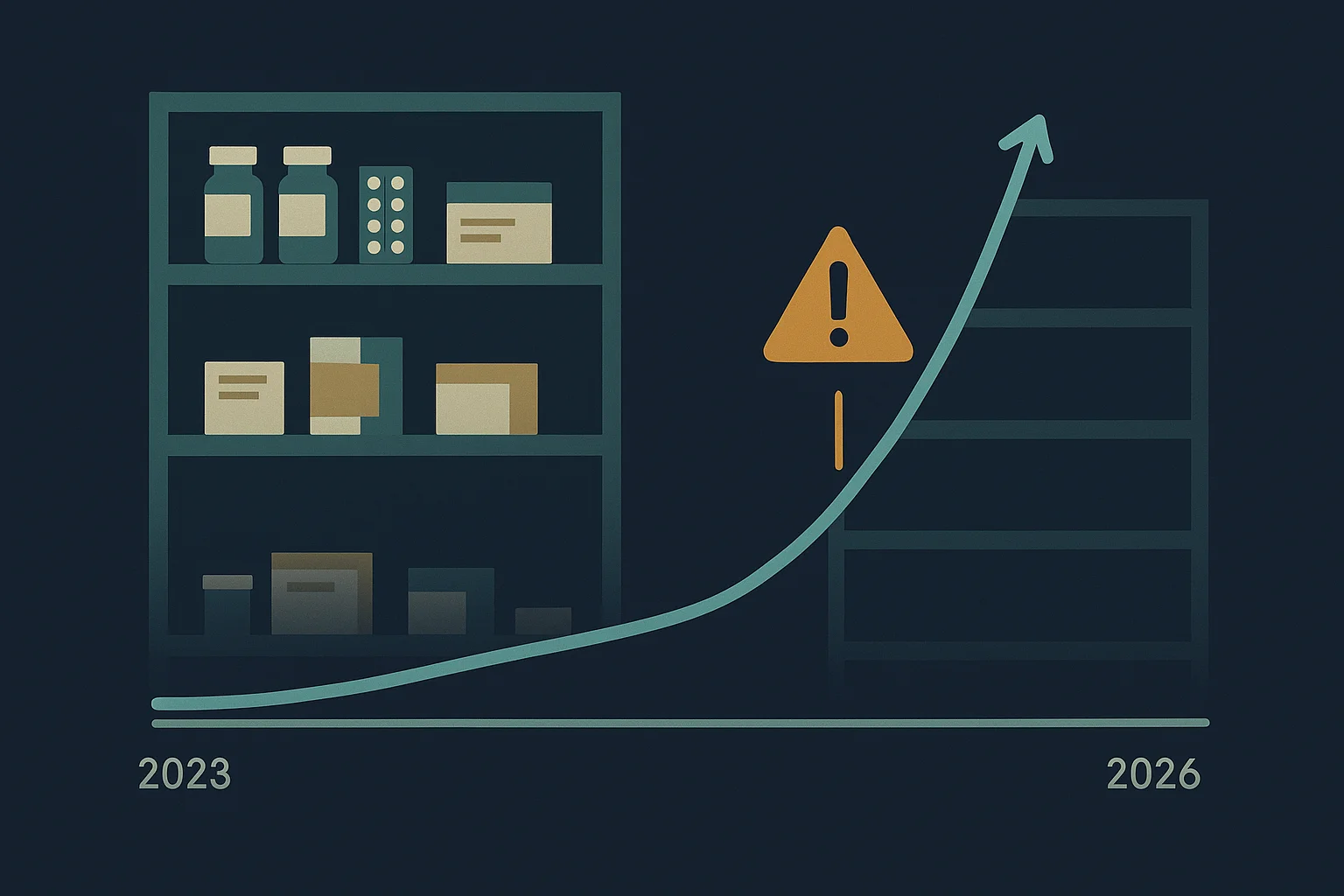
Key Takeaways: Every major estradiol patch brand is backordered in 2026 after demand surged 72% following the FDA's black box warning removal. The shortage will likely persist through late 2026. Five alternatives deliver estradiol without patches: transdermal gel, spray, vaginal ring, oral tablets, and compounded cream. Gel and spray are the closest substitutes because they bypass the liver the same way patches do.
Why Every Pharmacy Is Out of Estrogen Patches
If you have called three pharmacies and heard "backordered" each time, you are not alone. The estradiol patch shortage is the largest HRT supply disruption in over a decade, and it is hitting women across the country.
Here is what happened: In November 2025, the FDA removed the black box warning from menopausal hormone therapy products. Prescriptions surged almost immediately. By February 2026, about 1 in 20 women aged 45 to 54 had an active estrogen-based HRT prescription -- roughly double the rate from 2023.
The patch market could not absorb that demand. Only five manufacturers produce estradiol patches in the US: Amneal (Lyllana), Noven (Vivelle-Dot), Sandoz, Mylan, and Zydus. When demand doubles but production capacity stays flat, shortages are inevitable.
Add tariff pressures on overseas raw materials, and you get a shortage that NBC News reports could last through late 2026 -- or up to three years by some industry estimates.
Which Patches Are Affected
The short answer: nearly all of them.
Brand/Generic
Manufacturer
Status (April 2026)
Dotti
Noven/Novavax
Backordered nationally
Lyllana
Amneal
Limited/backordered
Vivelle-Dot
Noven
Intermittent availability
Climara
Bayer
Intermittent availability
Minivelle
Noven
Limited supply
Sandoz generic
Sandoz
Backordered
Mylan generic
Mylan/Viatris
Limited supply
Alora
AbbVie
Permanently discontinued
Regional availability varies day to day. A pharmacy in one city may have Climara while every pharmacy 50 miles away is out. This unpredictability is what makes the shortage so disruptive for women who depend on consistent estradiol delivery.
What NOT to Do During the Shortage
Before covering alternatives, a critical warning: do not ration your current patches.
It is tempting to wear a patch longer than prescribed or cut it in half. Both approaches are harmful:
Wearing a patch past its lifespan means the adhesive matrix is depleted. You are getting less estradiol each day the patch ages beyond its rated duration.
Cutting a patch breaks the delivery system. Some patches use reservoir technology where cutting allows the estradiol to leak or distribute unevenly. You cannot predict what dose you are actually getting.
Either approach risks a return of hot flashes, night sweats, mood instability, and other menopause symptoms you worked hard to control. The better move is to switch to a different delivery method with your provider's guidance.
5 Alternatives to Estrogen Patches
Each of these delivers estradiol through a different mechanism. They are listed in order of how closely they replicate the pharmacokinetics of a patch.
Women's HRT — Menopause-First Telehealth
Bioidentical estradiol, progesterone, and low-dose testosterone — all 50 states, unlimited physician access.
How it works: Estradiol gel is applied to the skin daily, typically on the upper arm or thigh. Like patches, it delivers estradiol transdermally -- bypassing the liver and maintaining steady blood levels.
Available products:
EstroGel (0.06% gel, metered pump)
Divigel (single-dose packets in 0.25, 0.5, and 1.0 mg)
Elestrin (0.06% gel, metered pump)
Why it is the top alternative: Gel uses the exact same transdermal absorption pathway as patches. Your provider can calculate a bioequivalent dose without guesswork. The supply chain for gels has not been hit as hard because different manufacturers and raw materials are involved.
Downsides: Daily application instead of twice-weekly patch changes. Transfer risk if someone touches the application site before it dries (allow 5 minutes).
Approximate cost: $30-80/month with GoodRx; varies with insurance.
2. Estradiol Spray
How it works: A metered-dose spray applied to the inner forearm once daily. Transdermal absorption similar to gel and patches.
Available products:
Evamist (1.53 mg/spray)
Why it works: Same transdermal route, liver bypass, and steady delivery. Spray dries faster than gel (about 2 minutes) and the dosing is highly consistent.
Downsides: Only one product on the market (Evamist), which makes it vulnerable to its own supply issues if demand shifts. Currently available but worth securing a prescription sooner rather than later.
Approximate cost: $50-120/month depending on dose and insurance.
3. Estradiol Vaginal Ring (Systemic)
How it works: A flexible ring inserted vaginally that releases estradiol continuously for 90 days. The systemic version (Femring) delivers estradiol into the bloodstream at levels comparable to a patch.
Available products:
Femring (0.05 mg/day or 0.1 mg/day)
Important distinction: Femring is a systemic estrogen -- it treats hot flashes, bone loss, and other systemic menopause symptoms. The lower-dose Estring only treats vaginal symptoms. Make sure your provider prescribes the right one.
Why it works: Set-it-and-forget-it for 3 months. No daily application. Bypasses the liver. Extremely consistent delivery.
Downsides: Some women are uncomfortable with vaginal insertion. It requires a fitting to ensure the correct ring size. Fewer dose options than gel.
Approximate cost: $200-400 per ring (lasts 3 months), so $67-133/month effective.
4. Oral Estradiol Tablets
How it works: A daily pill (usually 0.5 mg, 1 mg, or 2 mg estradiol) swallowed and absorbed through the GI tract.
Why it is an option: Oral estradiol has the most robust supply chain of any estrogen formulation. Multiple manufacturers produce generic tablets, and pharmacies almost always have it in stock. It is also the least expensive option.
Important caveat: Oral estradiol undergoes first-pass liver metabolism. This means:
It increases hepatic production of clotting factors (slightly higher blood clot risk vs. transdermal)
It raises sex hormone-binding globulin (SHBG), which can reduce free testosterone
It may increase triglycerides
If your provider originally chose a patch specifically to avoid these liver effects -- for example, if you have a history of blood clots, migraines with aura, or high triglycerides -- oral may not be appropriate. Discuss this with your provider before switching.
Approximate cost: $5-20/month (generic). One of the cheapest HRT options available.
5. Compounded Estradiol Cream
How it works: A compounding pharmacy prepares a custom estradiol cream at a dose specified by your provider. Applied to the skin daily.
Available from: Any PCAB-accredited compounding pharmacy. Many online HRT clinics also prescribe compounded estradiol.
Why it works: Transdermal delivery with customizable dosing. Compounding pharmacies are not affected by the same supply constraints as patch manufacturers because they source raw estradiol powder from different suppliers.
Important caveat: Compounded products are not FDA-tested for dose uniformity. Quality varies between pharmacies. Choose one that is PCAB-accredited (Pharmacy Compounding Accreditation Board) for the highest quality standards.
Approximate cost: $30-80/month depending on pharmacy and dose.
Dose Conversion Guide
Switching formulations requires adjusting the dose. These are approximate bioequivalent conversions -- your provider will fine-tune based on your symptoms and blood levels.
Patch Dose
Gel Equivalent
Spray Equivalent
Oral Equivalent
Notes
0.025 mg/day
0.25 mg Divigel
1 spray Evamist
0.5 mg oral
Lowest standard dose
0.0375 mg/day
0.375-0.5 mg Divigel
1 spray Evamist
0.5-1 mg oral
Between standard dose points
0.05 mg/day
0.5 mg Divigel or 1 pump EstroGel
1-2 sprays Evamist
1 mg oral
Most common starting dose
0.075 mg/day
0.75-1.0 mg Divigel
2 sprays Evamist
1-2 mg oral
Moderate dose
0.1 mg/day
1.0 mg Divigel or 2 pumps EstroGel
2-3 sprays Evamist
2 mg oral
Higher dose
These conversions are starting points, not exact equivalencies. Transdermal-to-transdermal switches (patch to gel or spray) are more predictable than transdermal-to-oral because the absorption route stays the same.
After switching, monitor for symptom return over 2 to 4 weeks. If hot flashes or other symptoms recur, your provider may need to adjust the dose upward.
How to Navigate the Shortage: Step by Step
Step 1: Call Multiple Pharmacies
Availability changes daily. Call at least 5 pharmacies in your area, including independent pharmacies (they sometimes have stock that chains do not). Ask specifically which brands they have and whether they can order from their distributor.
Step 2: Ask Your Provider for a Therapeutic Switch
Bring the alternatives table from this article to your next appointment. If your provider is not a menopause specialist, consider seeing one who has experience with multiple estradiol formulations. The North American Menopause Society provider directory can help you find a certified menopause practitioner.
Step 3: Consider an Online HRT Clinic
Online HRT clinics that use compounding pharmacies have been less affected by the shortage because they source estradiol independently. Many can prescribe compounded estradiol cream or gel and ship directly to your door within days.
This is particularly useful if your local pharmacy options are exhausted and your provider is slow to switch formulations.
Step 4: Do Not Stockpile
It is understandable to want a safety net, but filling multiple prescriptions early or at different pharmacies worsens the shortage for everyone. Fill your normal 30 or 90-day supply and switch to an available alternative for ongoing treatment.
When Will the Shortage End?
The honest answer: not soon.
Estradiol patches are generic drugs with thin profit margins. Manufacturers have little financial incentive to invest hundreds of millions in new production lines for a product that generates modest returns. Building new manufacturing capacity for transdermal patches takes 2 to 3 years from investment to output.
NBC News and industry analysts project the acute shortage will persist through late 2026, with intermittent supply constraints potentially lasting into 2027 or 2028.
The practical takeaway: if you are currently on an estrogen patch, having a backup plan with your provider now -- before your current supply runs out -- is essential. Do not wait until your pharmacy says "backordered" to start exploring alternatives.
References
NBC News. "Estrogen patch shortages are getting worse and could last for years." April 2026.
NPR. "Why the 'mad scramble' to fill hormone therapy prescriptions for menopause." March 2026.
CNN. "Estrogen patch shortage as demand for menopause hormone therapy grows." February 2026.
Truveta. "Estrogen HRT use is rising: Real-world trends." 2026.
HHS.gov. "HHS Advances Women's Health, Removes Misleading FDA Warnings on Hormone Replacement Therapy." November 2025.
The 19th. "Impacted by the estrogen patch shortage? Here are your options." February 2026.
Frequently Asked Questions
How long will the estrogen patch shortage last?
Most pharmacies and manufacturers expect the shortage to persist through late 2026. Only a handful of companies produce estradiol patches in the US, and a 72% demand surge after the FDA removed black box warnings in November 2025 has overwhelmed supply chains that were already strained.
Which estrogen patches are affected by the shortage?
Nearly all brands and generics are affected: Dotti, Lyllana, Vivelle-Dot, Climara, Minivelle, Sandoz, and Mylan generics. AbbVie has discontinued Alora entirely. Availability varies by pharmacy and region, but no patch brand has reliable nationwide stock.
Is estradiol gel as effective as the patch?
Yes. Estradiol gel delivers the same hormone through the same transdermal route. Both bypass the liver (unlike oral estradiol), maintain steady blood levels, and carry similar safety profiles. The main difference is application method -- gel is rubbed into the skin daily rather than worn as a patch changed once or twice weekly.
Can I cut my estrogen patch in half to make it last?
No. Cutting a patch alters the delivery system and reduces your estradiol dose by an unpredictable amount. This can cause menopause symptoms to return and provides inconsistent hormone levels. Talk to your provider about switching to an available alternative instead.
Should I switch to oral estradiol during the shortage?
Oral estradiol is an option, but it works differently. Oral forms undergo first-pass liver metabolism, which increases clotting proteins and may elevate blood clot risk slightly compared to transdermal options. If you were on a patch specifically because of clot risk factors, discuss gel, spray, or cream alternatives with your provider first.
Can a compounding pharmacy make estrogen patches?
Compounding pharmacies cannot make patches, but they can compound estradiol creams and gels. One concern is that compounded products do not undergo the same FDA testing for dose consistency as manufactured products. If you use a compounding pharmacy, choose one that is PCAB-accredited.