
Key Takeaways: Light unscheduled bleeding in the first 3 to 6 months of HRT is common and usually settles on its own. The British Menopause Society's 2024 joint guideline treats early bleeding as expected, not alarming, in women without risk factors. The real red flag is bleeding that starts after you have been stable and bleed-free for more than 6 months, or bleeding that persists. Most breakthrough bleeding is fixed by adjusting the progestogen dose, route, or type, not by stopping HRT. The job of a good provider is to rule out the rare serious causes while keeping you on the therapy that is working.
The Bleed That Sends You Into a Spiral
You finally started HRT. The hot flashes are easing, you are sleeping again, and then one morning there is blood. You were not expecting it. You are postmenopausal, or close to it, and you were told the bleeding was supposed to be over.
Your mind goes straight to the worst place. You read that any bleeding after menopause means cancer. You consider stopping HRT entirely.
Stop. Breathe. Unscheduled bleeding on HRT is one of the most common reasons women abandon hormone therapy, and in the large majority of cases it is benign, expected, and fixable. The key is knowing which kind of bleeding you have, when it warrants investigation, and how it gets corrected without throwing away the therapy that is helping you.
What "Unscheduled" Actually Means
The word matters. Not all bleeding on HRT is "unscheduled."
- Scheduled (expected) bleeding happens on sequential HRT (also called cyclical HRT), the regimen typically used in perimenopause and early menopause. You take estrogen continuously and add progestogen for part of the month, which produces a predictable monthly withdrawal bleed, like a lighter, more regular period. This is by design and not a concern.
- Unscheduled (breakthrough) bleeding is any bleeding that is not expected: spotting or bleeding on continuous combined HRT (estrogen and progestogen every day, used in postmenopause, where the goal is no bleeding at all), bleeding at the wrong time on sequential HRT, or bleeding that returns after you have been settled and bleed-free.
The clinical concern is essentially limited to unscheduled bleeding. That is the category this article is about.
What Is Normal in the First Few Months
Here is the single most reassuring fact: when you start continuous combined HRT, or change your dose or preparation, your endometrium needs time to adapt.
Estrogen builds the uterine lining. Progestogen thins it and keeps it stable. When you begin continuous progestogen, the lining transitions from a cyclically shedding tissue to a thin, quiet one. During that transition, the lining can shed erratically and unpredictably for several months before it settles into the bleed-free state that continuous HRT aims for.
The British Menopause Society's 2024 joint guideline, written with the Royal College of Obstetricians and Gynaecologists and several other bodies, draws the line clearly: in women without risk factors for endometrial cancer, unscheduled bleeding within the first 6 months of starting continuous combined HRT, or persisting up to 3 months after a dose or preparation change, is expected. The recommended approach is to adjust the progestogen or preparation and give it time, not to rush to invasive testing [1].
So if you started HRT eight weeks ago and you are spotting, you are most likely in the normal adjustment window. It is annoying. It is not, by itself, a danger sign.
When Bleeding Is a Red Flag
Now the other side. There are specific patterns where bleeding does need prompt evaluation, because the point of all this is to rule out endometrial hyperplasia (overgrowth of the lining) or, rarely, endometrial cancer.
Seek evaluation if you have any of the following:
- Bleeding that starts after you have been stable and bleed-free on continuous HRT for more than 6 months. This is the classic red-flag pattern. A new bleed after a long quiet period is the one that gets investigated.
- Bleeding that persists beyond the 6-month adjustment window despite progestogen adjustments.
- Heavy bleeding, or bleeding with clots, rather than light spotting.
- Bleeding that returns after stopping HRT.
- Bleeding with pelvic pain, unusual discharge, or bleeding after sex, which can point to a cervical, infective, or structural cause.
Some women should be referred faster, on a 2-week pathway rather than the standard 6 weeks, because their baseline risk of endometrial problems is higher. Risk factors include a high BMI (excess adipose tissue produces extra estrogen that drives lining growth), type 2 diabetes, polycystic ovary syndrome, a prior history of endometrial hyperplasia, tamoxifen use, and a strong family history of certain cancers [1].
This is the honest part of the message: postmenopausal bleeding is taken seriously precisely because it is the cardinal symptom of endometrial cancer, and that cancer is highly curable when caught early. The reassurance is that the large majority of women who get investigated for HRT bleeding turn out to have a benign cause. But the evaluation is not optional when you fit a red-flag pattern.
How Bleeding Gets Investigated
If your bleeding warrants a workup, here is what to expect, so it feels less frightening.
- History and risk review. Your provider maps your bleeding pattern, your exact HRT preparation and how you take it, and your personal risk factors.
- Examination. An abdominal and pelvic exam, a check that your cervical screening is current, and swabs if infection is suspected.
- Transvaginal ultrasound. This measures endometrial thickness. A thin lining is reassuring. A thickened or irregular lining prompts the next step.
- Endometrial sampling (biopsy) and/or hysteroscopy. A small tissue sample, or a thin camera passed into the uterus to look directly at the lining and remove polyps. Hysteroscopy can be done in clinic and is well tolerated by most women.
The whole pathway is built to catch the rare serious cause early while reassuring the many women whose bleeding is benign. Polyps and fibroids, both very common and usually harmless, are among the most frequent structural findings.
The Hormonal Causes a Provider Can Actually Fix
Most breakthrough bleeding on HRT is a regimen problem, not a disease. These are the levers an experienced provider pulls.
Too Little Progestogen for the Estrogen Dose
If your estrogen dose is relatively high and your progestogen is too low, the lining is not being adequately opposed and it can build up and shed. The fix is to increase or change the progestogen so the lining stays thin and stable. This is the single most common adjustable cause.
Missed or Poorly Absorbed Doses
HRT bleeding control depends on consistency. Skipping doses of progestogen, or applying estrogen gel and progesterone inconsistently, lets the lining destabilize. Oral micronized progesterone also depends on gut absorption, which varies between women. Tightening up adherence is the first, free intervention.
Wrong Route of Progesterone
This is underappreciated. Oral micronized progesterone used vaginally produces much higher local concentrations at the endometrium than the same dose swallowed, and it can resolve breakthrough bleeding in women who spot on the oral route. Switching the route, not just the dose, often does the job.
Transitioning From Sequential to Continuous Too Early
A common cause of "I keep bleeding on continuous HRT" is starting continuous combined HRT while you are still in late perimenopause and your own ovaries are still producing fluctuating estrogen. The guideline suggests women on sequential HRT over 45 switch to continuous after about 5 years of use or by age 54, whichever comes first [1]. Switch too early and your residual ovarian activity fights the continuous regimen, producing erratic bleeds. The fix may be to go back to a sequential regimen for a while.
The Levonorgestrel IUS: The Most Reliable Bleeding Control
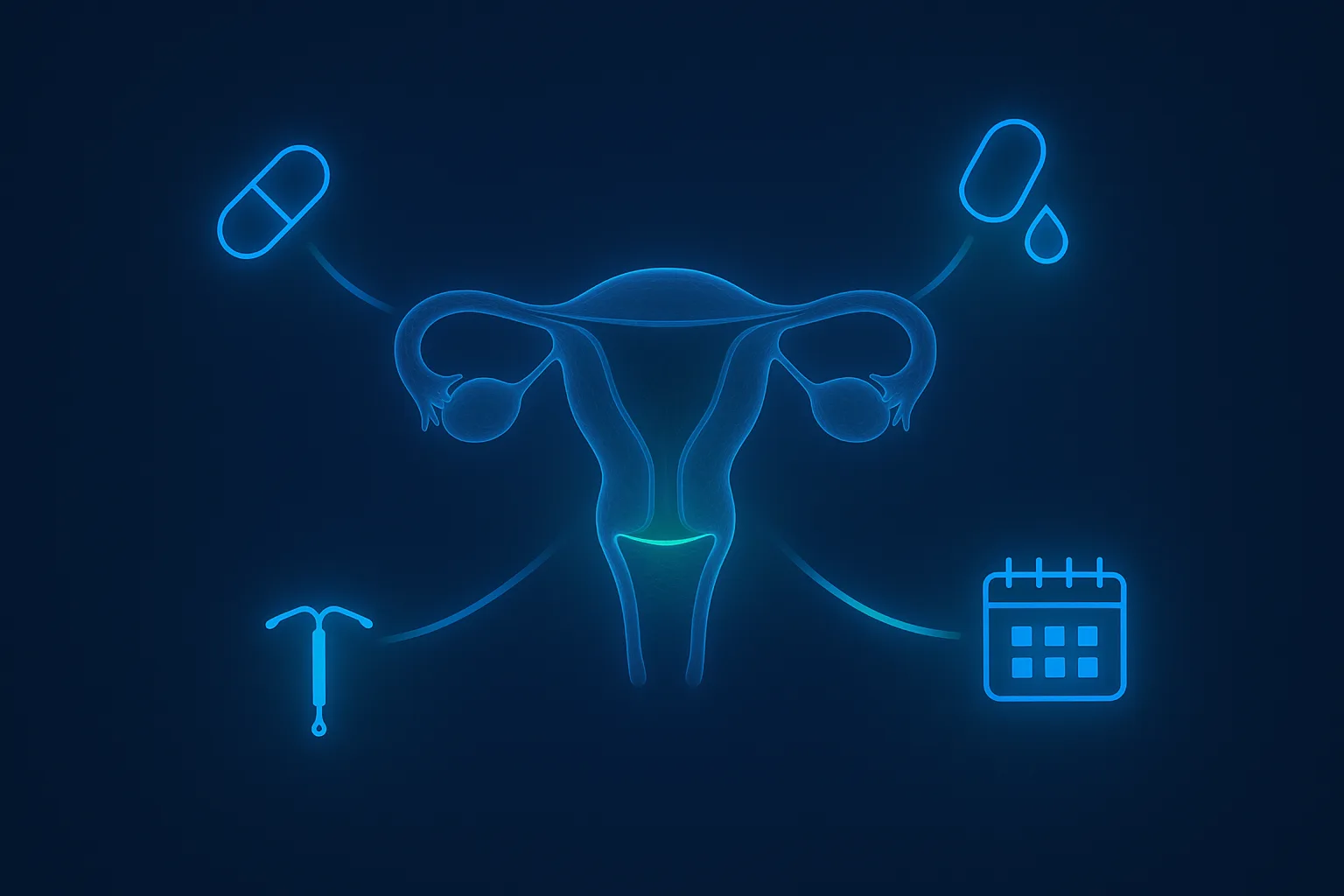
A levonorgestrel-releasing intrauterine system delivers progestogen directly to the endometrium, which gives the most consistent lining suppression of any progestogen option. For women who keep bleeding despite oral or transdermal progestogen adjustments, the IUS is often the definitive solution, and it doubles as the progestogen arm of HRT, contraception in perimenopause, and heavy-period control. It is one of the most useful tools in midlife women's health.
Where Testosterone Fits In
Testosterone is increasingly part of comprehensive women's HRT for libido, energy, mood, and muscle. A common question is whether it causes breakthrough bleeding.
In the low, physiological doses used for women, testosterone is not a significant driver of endometrial bleeding. It is not an estrogen, and at female-physiological doses it does not meaningfully thicken the uterine lining. If you are bleeding on a regimen that includes low-dose testosterone, the cause is almost always the estrogen-progestogen balance, not the testosterone. That said, any new bleeding should still be evaluated against the red-flag patterns above rather than assumed to be from any single hormone. If you are weighing testosterone as part of your regimen, the testosterone for women dosage guide covers physiological dosing, and the progesterone and testosterone in women's HRT article explains how the hormones work together.
A Practical Decision Framework
Use this to orient yourself, then take it to a provider.
| Your situation |
Likely meaning |
Reasonable next step |
| Started HRT under 6 months ago, light spotting |
Normal adjustment |
Confirm adherence, give it time, review at 3 to 6 months |
| Changed dose under 3 months ago, spotting |
Expected post-change |
Allow the lining to restabilize |
| Bleed-free over 6 months, then new bleeding |
Red flag |
Prompt evaluation, ultrasound +/- biopsy |
| Persistent bleeding past 6 months on continuous HRT |
Needs a fix and possibly a workup |
Adjust progestogen route/type, investigate if it continues |
| Any bleeding plus high BMI, diabetes, PCOS, tamoxifen |
Faster-track |
Referral, often within 2 weeks |
| Heavy bleeding, pain, discharge, post-coital bleeding |
Needs assessment regardless of timing |
See a provider |
This table is a guide, not a substitute for a clinician who knows your history.
Why the Right Provider Matters So Much Here
Breakthrough bleeding is exactly the kind of problem where provider experience changes the outcome. A clinician who is not confident with HRT will often do one of two unhelpful things: panic and tell you to stop hormones entirely, or dismiss you and tell you to "wait and see" past the point where investigation is warranted.
What you want is a provider who:
- Knows the 6-month adjustment window and does not over-investigate normal early bleeding
- Recognizes the red-flag patterns and refers promptly when they appear
- Adjusts the progestogen dose, route, and type before considering invasive steps
- Is comfortable using vaginal micronized progesterone and the levonorgestrel IUS
- Will keep you on HRT while sorting out the bleeding rather than abandoning treatment
This level of comfort with HRT nuance is far more common in dedicated menopause and women's hormone telehealth practices than in a rushed general appointment. Compare options in our best online HRT clinic for women review, and if you want a broader comparison of providers and pricing, see the full clinic comparison.
The Bottom Line
Unscheduled bleeding on HRT is common, frightening, and usually fixable. The mental model is simple:
- Early bleeding (first 3 to 6 months) is usually normal adjustment. Confirm you are taking everything correctly and give it time.
- Bleeding after a long bleed-free period is the red flag. That, plus heavy or persistent bleeding or bleeding with pain, gets evaluated.
- Most fixes are regimen changes, especially adjusting the progestogen dose, route, or type, with the levonorgestrel IUS as the most reliable bleeding-control option.
- You rarely have to stop HRT. The goal is to keep the benefits and fix the bleeding.
- The right provider is the whole game here, because the same symptom can be safely watched or urgently investigated depending on your pattern and risk.
If you are bleeding on HRT and your provider's only answer is "stop the hormones," get a second opinion from someone who actually specializes in this. Start with the best online HRT clinic for women and bring the decision framework above to your consultation.
For related reading on getting your regimen right, see progesterone and testosterone in women's HRT, the estradiol patch dosing guide for women, and HRT cost for women to understand what an optimized regimen should run.
References:
- Manley K, Hillard T, Clark J, et al. Management of unscheduled bleeding on hormone replacement therapy (HRT): A joint guideline on behalf of the British Menopause Society, Royal College of Obstetricians and Gynaecologists, British Gynaecological Cancer Society, and others. Post Reproductive Health. 2024;30(2):117-138. PMID: 38743767
- Women's Health Concern. Management of unscheduled bleeding on HRT (Factsheet). British Menopause Society; 2026. Women's Health Concern factsheet
- British Menopause Society. Management of unscheduled bleeding on hormone replacement therapy (HRT). BMS guideline
