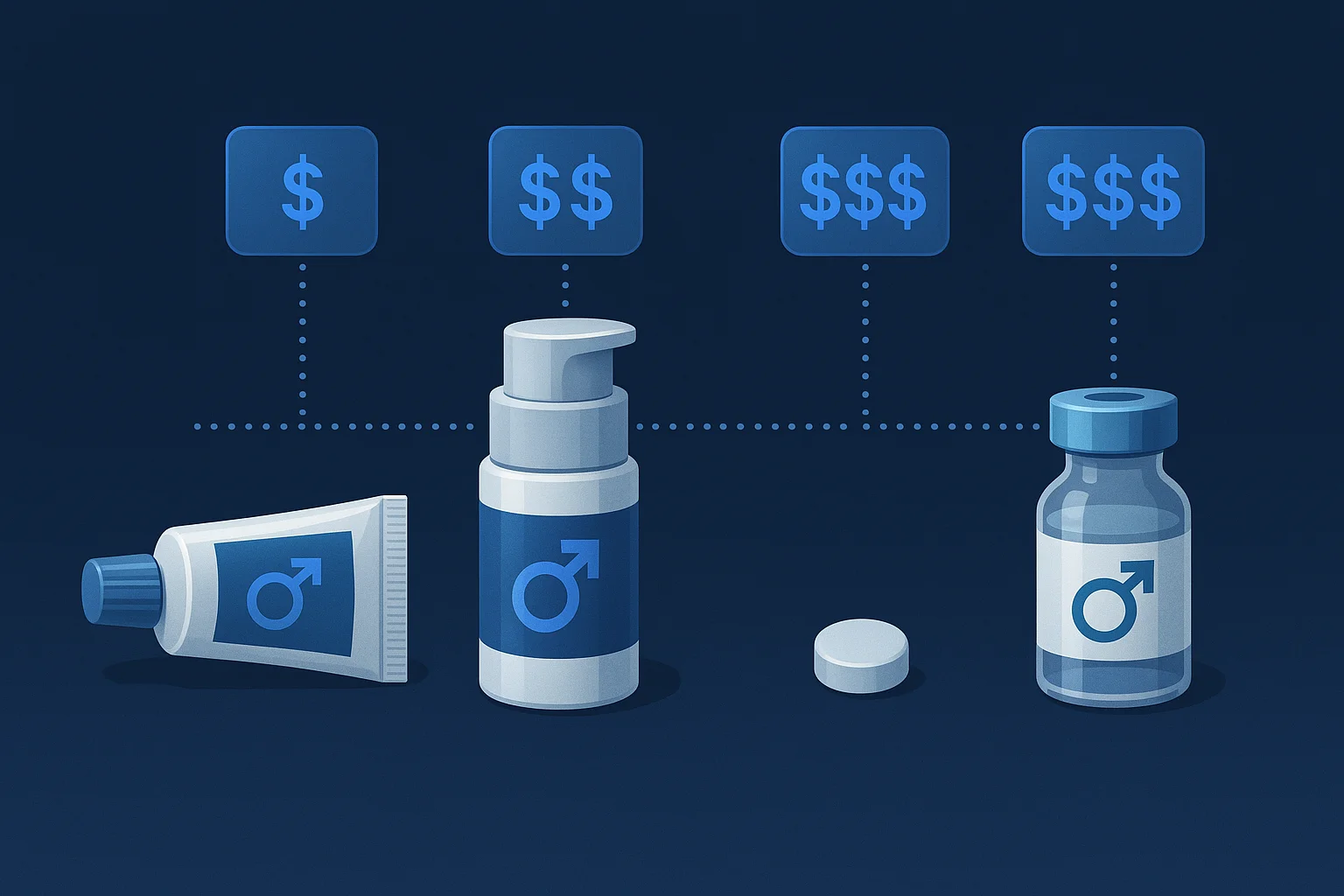
Online HRT runs $79-300/month depending on what's included. One clinic bundles labs, meds, and shipping at $79/mo. Full cost breakdown by treatment type.
Key Takeaways: Women's HRT costs $40-500/month depending on the provider, delivery method, and what is included. The biggest cost variable is whether labs and testosterone are bundled or billed separately. Winona is a menopause-first telehealth clinic built specifically for women with unlimited physician access and follow-ups included in the base subscription, plus medications billed separately ($25-60/month for estradiol/progesterone, +$15-25/month if adding testosterone). Peter MD is the lowest all-inclusive option at $79/month. Insurance covers estrogen and progesterone but almost never covers compounded testosterone for women.
HRT Costs Vary Wildly -- Here Is Why
Ask five women what they pay for HRT and you will get five different numbers. One pays $79/month. Another pays $350. A third pays $200 but does not realize she is missing testosterone entirely.
The variation is not random. It comes down to three things: what hormones are included, whether labs are bundled, and which provider model you choose. Understanding these variables is the difference between overpaying by thousands of dollars per year and getting comprehensive treatment at a fair price.
The Cost Breakdown
Here is what HRT actually costs across the major provider types in 2026:
Provider Type
Monthly Cost
Labs Included
Testosterone Included
Annual Total
Menopause-first specialist (Winona)
Subscription + meds billed separately ($25-60/mo for E2/P4, +$15-25/mo if T added)
Varies
Available
Lower effective cost when meds are primary spend
Online all-inclusive (Peter MD)
$79/mo
Yes
Yes
$948/yr
Online a la carte (Thrivelab)
$129-199/mo
Varies
Available
$1,548-2,388/yr + meds
Online premium (Midi Health)
$149-249/mo
No
Varies by state
$1,788-2,988/yr + labs
Online concierge (Defy Medical)
$200-300/mo effective
No
Yes
$2,400-3,600/yr
Local endocrinologist
$200-500/mo effective
No
Varies
$2,400-6,000/yr
Compounding pharmacy direct
$75-200/mo (meds only)
N/A
Yes
$900-2,400/yr + provider fees
Annual totals include consultations, labs, medications, and shipping where applicable.
The "effective monthly cost" for a la carte providers includes the subscription or consultation fee plus the average monthly lab and medication expenses over a year.
What Is Included in HRT Cost
HRT is not one line item. It is a bundle of expenses that clinics package differently:
Provider Consultations
The fee for access to your prescribing clinician. This covers initial evaluation, follow-up visits, dose adjustments, and ongoing management.
All-inclusive clinics: bundled in monthly fee
A la carte clinics: $150-300 initial, $75-150 per follow-up
Local providers: $150-400 per visit, partially covered by some insurance
Lab Work
Blood panels are essential for safe HRT management. You need comprehensive labs before starting and follow-up panels every 3-6 months.
Comprehensive hormone panel: $200-500 out of pocket
Labs are the hidden cost that makes "affordable" clinics expensive. A clinic charging $99/month that requires separate labs at $200-400 per panel costs $1,800-2,800/year -- more than an all-inclusive option like Peter MD at $948/year with labs included, or a menopause-first specialist like Winona where unlimited physician access and follow-ups are included in the base subscription and you pay only for the medications you actually use.
Medications
The hormones themselves vary in cost by type:
Hormone
Form
Monthly Cost
Insurance Coverage
Estradiol
Patch (Vivelle-Dot)
$30-80
Usually covered
Estradiol
Cream/gel
$20-60
Usually covered
Progesterone
Oral micronized
$15-40
Usually covered
Testosterone
Compounded cream
$30-80
Rarely covered
Testosterone
Compounded gel
$40-100
Rarely covered
Testosterone
Pellets
$75-167/mo effective
Rarely covered
DHEA
Oral or vaginal
$10-30
Rarely covered
For women on comprehensive HRT (estrogen + progesterone + testosterone), medication costs alone run $75-200/month. The testosterone component is the most expensive because it must be compounded.
Shipping
Telehealth clinics ship medications to your door. Some include shipping in the monthly fee. Others charge $10-25 per shipment, adding $60-300/year.
Why Testosterone Adds to the Cost
This is the single biggest reason women's HRT costs more than most expect.
There is no FDA-approved testosterone product for women in the United States. Every testosterone prescription for a woman must be filled by a compounding pharmacy, which creates a custom formulation at the concentration women need (typically 0.5-2% cream delivering 5-10 mg/day).
Compounded medications are almost never covered by insurance. There is no generic to fall back on. No GoodRx coupon applies. You pay cash.
This is not a niche issue. The 2019 Global Consensus Position Statement endorsed testosterone therapy for postmenopausal women, and researchers estimate that up to 50% of women could benefit from testosterone as part of HRT. Yet the regulatory gap means women bear the full cost of the hormone that often matters most for their quality of life.
Winona is a menopause-first telehealth clinic built specifically for women and licensed in all 50 states. It prescribes bioidentical estradiol, progesterone, and low-dose testosterone.
What is included in the subscription:
Unlimited physician access and follow-ups
Ongoing dose adjustments and monitoring
Menopause-literate clinicians (not generalists)
Billed separately:
Bioidentical estradiol + progesterone combo: typically $25-60/month
Low-dose testosterone (if added): +$15-25/month
Lab work when ordered
The structural difference matters. Most women end up paying less than the all-inclusive bundles because you only pay for the medications you actually use, and the provider relationship is unlimited rather than capped at a few visits per year.
At $79/month, Peter MD offers the lowest all-inclusive bundled price for women's HRT that includes testosterone.
What $79/month covers:
Estrogen, progesterone, and testosterone
All lab work (no separate charges)
Compounded medications shipped to your door
Telehealth consultations with hormone-specialized providers
Ongoing monitoring and dose adjustments
Annual cost: $948
Compare that to the typical a la carte path: $149/month subscription + $800/year in labs + $100/month in separate medication charges = $3,388/year. The all-inclusive model saves most women $1,500-2,500 annually.
Generic oral progesterone -- micronized progesterone (generic Prometrium). Usually covered with a low copay.
Basic hormone labs -- FSH, estradiol, TSH. Often covered as part of a standard panel.
Provider visits -- if you see an in-network OB/GYN or endocrinologist, the consultation is typically covered.
What Insurance Almost Never Covers
Compounded testosterone -- no FDA-approved product for women means no coverage pathway. Cash-pay nearly always.
Telehealth clinic subscriptions -- these are service fees, not medical claims.
Comprehensive hormone panels -- free testosterone by equilibrium dialysis, SHBG, and DHEA-S are frequently denied or require prior authorization.
Testosterone pellet insertions -- considered elective for women by most plans.
The Practical Reality
If you only need estrogen and progesterone, insurance can meaningfully reduce your costs. You might pay $30-60/month total with insurance covering the rest.
If you need testosterone as part of your HRT -- and if you are reading this, you probably do or are considering it -- plan to pay out of pocket for that component. The testosterone cream alone runs $30-80/month through a compounding pharmacy.
This is exactly why all-inclusive telehealth clinics have gained ground. When insurance does not cover the most impactful part of treatment, a bundled price that includes everything is often cheaper and simpler than navigating insurance for partial coverage and paying cash for the rest.
Cost-Saving Tips
Choose a provider structured for predictable costs
Two structures work well. Either bundle everything (all-inclusive) or use a menopause-first specialist where physician access is included and you pay only for the actual medications. Peter MD at $79/month all-inclusive is the current bundled benchmark. Winona is the menopause-first alternative — unlimited physician access and follow-ups in the base subscription, with medications billed separately at $25-60/month for estradiol/progesterone and +$15-25/month if adding testosterone. Either structure beats an a la carte subscription where labs and every refill are separate line items.
Use GoodRx for separate prescriptions
If your provider writes prescriptions you fill at a local pharmacy (rather than shipping from their own), use GoodRx for estradiol and progesterone. Generic micronized progesterone drops to $8-15/month with coupons. Estradiol patches are $20-40 with GoodRx versus $80+ retail.
Compare compounding pharmacy prices
Testosterone cream prices vary significantly between compounding pharmacies. If your clinic allows you to choose your pharmacy, get quotes from 2-3 options. The same formulation can cost $35 at one pharmacy and $80 at another.
Opt for cream over pellets
Testosterone cream ($30-80/month) is significantly cheaper than pellets ($75-167/month effective). Cream requires daily application, but the cost savings of $500-1,000/year adds up. Pellets make sense if convenience is your top priority and budget is not a concern.
Skip clinic-branded supplements
Some HRT clinics push proprietary vitamin and supplement packages at $60-100/month. Vitamin D, magnesium, and omega-3 are reasonable supplements -- but you can buy identical formulations at any pharmacy for $10-20/month. Do not pay a 5x markup for a clinic label.
Use FSA/HSA funds
HRT prescribed by a licensed provider is a qualified medical expense for FSA and HSA accounts. This effectively reduces your cost by your marginal tax rate (22-37% for most women considering HRT). A $79/month clinic fee becomes $49-62/month in after-tax dollars.
What Is Fair to Pay
Based on the current market, here is a framework for evaluating whether you are getting a good deal:
Monthly Cost
What to Expect
Under $100
All-inclusive with labs and all three hormones (Peter MD territory), or menopause-first specialist where meds are billed separately (Winona territory)
$100-175
Either all-inclusive basic or subscription + some extras separate
$175-250
Mid-range with experienced providers, may or may not include labs
$250-350
Premium concierge care with comprehensive protocols
$350+
Should include full optimization: all hormones, frequent monitoring, on-demand access
If you are paying over $200/month and labs are not included, compare your annual total to an all-inclusive option. Many women are surprised to find they are paying 2-3x more than necessary for equivalent care.
Frequently Asked Questions
How much does HRT cost per month without insurance?
Without insurance, online HRT clinics run $40-300/month all in. Winona is a menopause-first telehealth clinic with unlimited physician access and follow-ups included in the base subscription; medications are billed separately and typically run $25-60/month for the estradiol/progesterone combo, +$15-25/month if adding testosterone. Peter MD offers an all-inclusive $79/month option with labs, medication, and shipping. Concierge clinics like Midi and Defy run $150-300/month. Local endocrinologists plus pharmacy costs can total $200-500/month.
Does insurance cover HRT for women?
Insurance typically covers FDA-approved estrogen and progesterone products. However, compounded testosterone for women is rarely covered since there is no FDA-approved testosterone product for women in the US. Most women pay cash for the testosterone component.
What is the cheapest way to get HRT?
Online telehealth clinics offer the best value. Winona is a menopause-first specialist with unlimited physician access and follow-ups included in the base subscription, and medications billed separately ($25-60/month for estradiol/progesterone, +$15-25/month if adding testosterone). Peter MD at $79/month all-inclusive is the lowest-cost bundled option that includes testosterone. Some clinics charge less but do not include labs or testosterone, which adds up quickly.
Are testosterone pellets more expensive than cream for women?
Yes. Testosterone pellets cost $300-500 per insertion every 3-4 months ($75-167/month effective). Testosterone cream runs $30-80/month. Pellets are more convenient but significantly more expensive.
This content is for informational purposes only and is not medical advice. Consult a qualified healthcare provider before starting any treatment.
Frequently Asked Questions
How much does HRT cost per month without insurance?
Without insurance, online HRT clinics run $40-300/month all in. Winona is a menopause-first telehealth clinic with unlimited physician access and follow-ups included in the base subscription; medications are billed separately and typically run $25-60/month for the estradiol and progesterone combo, plus $15-25/month if adding testosterone. Peter MD offers an all-inclusive $79/month option. Concierge clinics like Midi and Defy run $150-300/month. Local endocrinologists plus pharmacy costs can total $200-500/month.
Does insurance cover HRT for women?
Insurance typically covers FDA-approved estrogen and progesterone products. However, compounded testosterone for women is rarely covered since there is no FDA-approved testosterone product for women in the US. Most women pay cash for the testosterone component.
What is the cheapest way to get HRT?
Online telehealth clinics offer the best value. Winona is a menopause-first specialist with unlimited physician access and follow-ups included in the base subscription, and medications billed separately ($25-60/month for estradiol/progesterone, +$15-25/month if adding testosterone). Peter MD at $79/month all-inclusive remains the lowest-cost bundled option that includes testosterone. Some clinics charge less but don't include labs or testosterone, which adds up quickly.
Are testosterone pellets more expensive than cream for women?
Yes. Testosterone pellets cost $300-500 per insertion every 3-4 months ($75-167/month effective). Testosterone cream runs $30-80/month. Pellets are more convenient but significantly more expensive.