TRT and Fertility: Protect Your Sperm on TRT

4/4/2026
5 min read
By The TRT Catalog

How TRT suppresses sperm production and 5 proven strategies to preserve fertility. HCG, enclomiphene, FSH, and sperm banking protocols.

TRT and Fertility: How to Protect Your Sperm on TRT

Starting TRT without a fertility plan is one of the most expensive mistakes men make -- not in dollars, but in options. Exogenous testosterone shuts down the hormonal signals that drive sperm production, and for roughly 40% of men, the result is zero viable sperm within months.

The good news: this is a solved problem. Multiple proven strategies exist to preserve fertility while on TRT, recover sperm production after suppression, or protect your options before you ever start treatment. The key is making these decisions before they become emergencies.

This guide covers every fertility preservation strategy available to men on TRT -- from the biology of why suppression happens to the specific protocols clinicians use to prevent it.

Key Takeaways

  • TRT suppresses sperm production in ~90% of men, with ~40% reaching complete azoospermia within 3-6 months
  • HCG (500 IU, 2-3x weekly) concurrent with TRT is the frontline fertility preservation strategy
  • Enclomiphene is an alternative that raises testosterone while preserving natural sperm production
  • FSH combined with HCG recovers spermatogenesis in ~74% of men after testosterone-induced suppression
  • Sperm banking before TRT is the only guaranteed insurance policy
  • Recovery after stopping TRT takes 6-24 months, with 67-90% of men eventually recovering

How TRT Suppresses Fertility: The HPG Axis

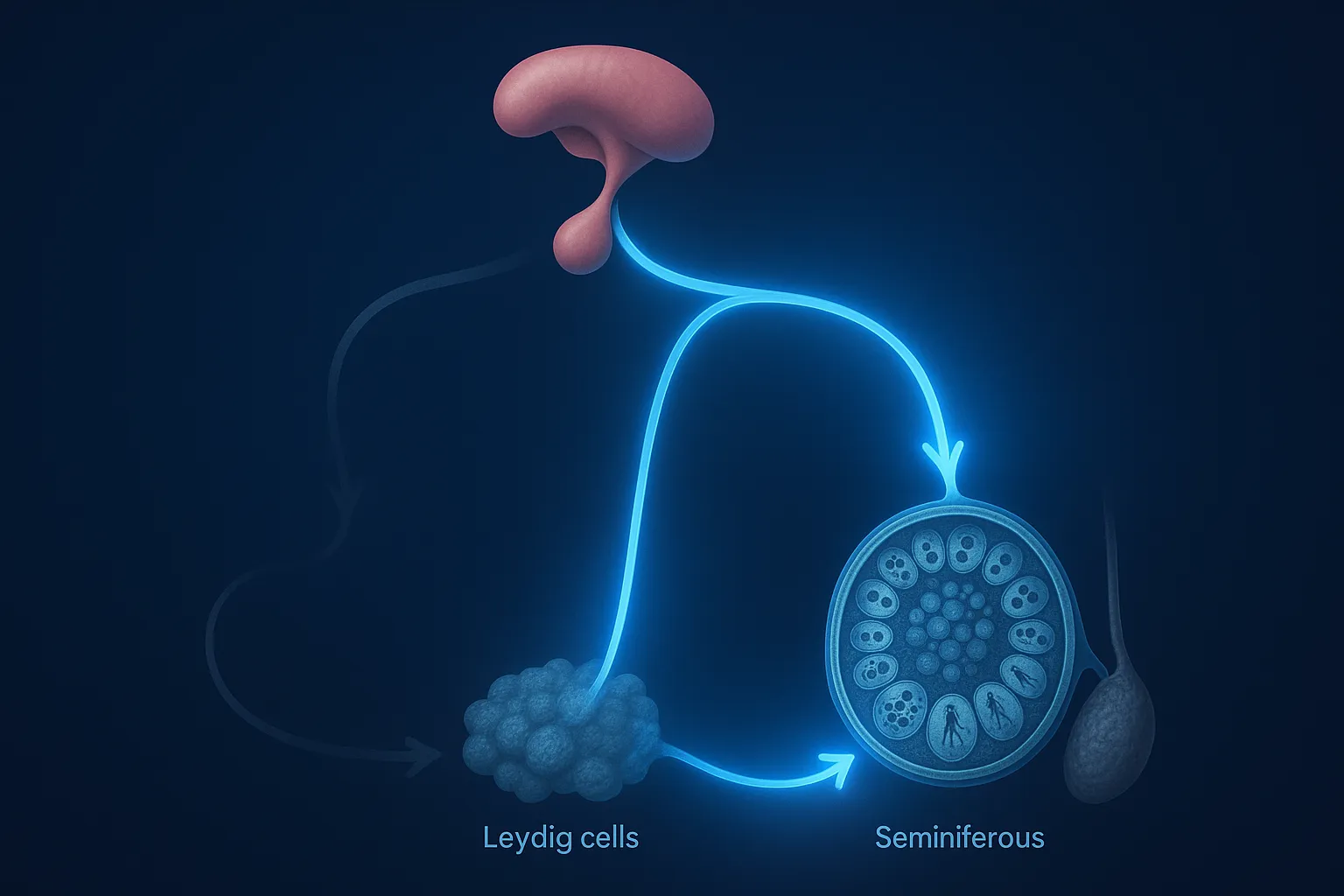
Your reproductive system runs on a feedback loop called the hypothalamic-pituitary-gonadal (HPG) axis. Understanding this loop is essential to understanding why TRT suppresses fertility and how every preservation strategy works.

Here's the chain of command:

  1. Hypothalamus releases gonadotropin-releasing hormone (GnRH) in pulses
  2. Pituitary gland responds by secreting luteinizing hormone (LH) and follicle-stimulating hormone (FSH)
  3. LH tells Leydig cells in the testes to produce testosterone
  4. FSH drives Sertoli cells to support spermatogenesis (sperm production)
  5. Rising testosterone and estradiol signal the hypothalamus to slow GnRH release -- completing the feedback loop

When you inject exogenous testosterone, your blood levels rise well above what the hypothalamus expects. It detects the surplus and slams the brakes -- GnRH output drops to near zero. Without GnRH, the pituitary stops producing LH and FSH. Without LH and FSH, your testes lose both signals: the signal to produce testosterone internally and the signal to produce sperm.

The critical detail most men miss: spermatogenesis requires intratesticular testosterone (ITT) concentrations 50-100x higher than what circulates in the bloodstream. On TRT, ITT drops by 90-95% because the Leydig cells are no longer being stimulated. Even though your blood testosterone is high, your testicular testosterone collapses -- and that's what sperm production depends on [1].

This isn't a side effect or a complication. It's the predictable pharmacology of exogenous testosterone.

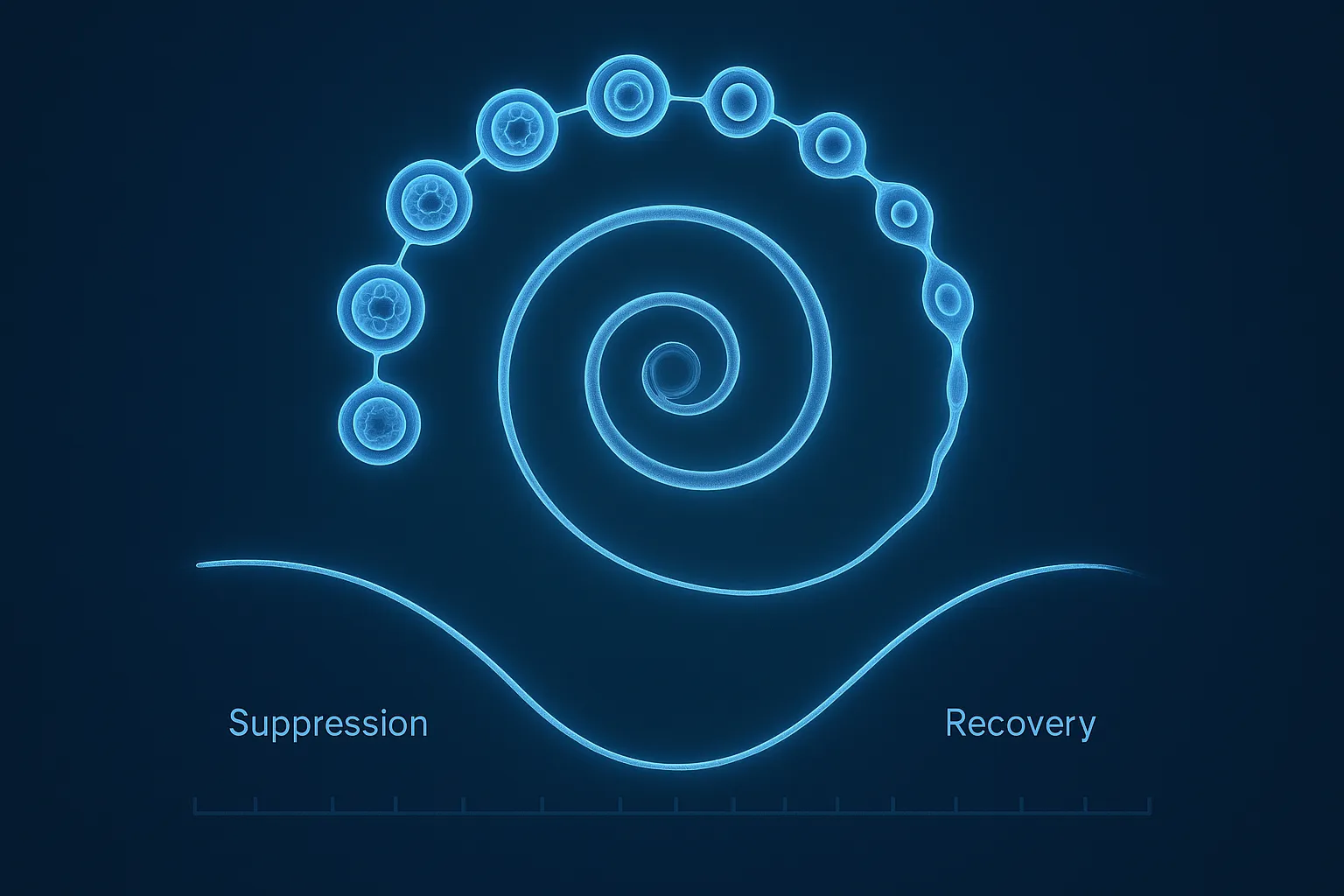
Timeline: How Fast Does Sperm Production Decline?

The suppression isn't instant, but it's faster than most men expect:

Timeframe What's Happening
Weeks 1-4 LH and FSH begin declining. Intratesticular testosterone drops. No visible change in semen analysis yet.
Months 1-3 Sperm concentration starts falling. Some men already show oligospermia (<15 million/mL). Testicular volume begins decreasing.
Months 3-6 Most men reach severely oligospermic or azoospermic levels. About 40% have zero sperm on semen analysis.
Months 6-12 Suppression deepens in late responders. Testicular volume may decrease 10-20% from baseline.
Year 1+ Continued azoospermia or severe oligospermia in the majority of men not using fertility adjuncts.

The 2018 Endocrine Society Clinical Practice Guideline explicitly warns that TRT should not be initiated in men actively trying to conceive, and recommends discussing fertility preservation before starting any testosterone therapy [7].

Important: the degree of suppression varies between individuals. Some men retain minimal sperm production on TRT -- enough to occasionally achieve pregnancy -- while others become completely azoospermic within weeks. You cannot predict which category you'll fall into, which is why planning matters.
How TRT affects sperm production over time

Strategy 1: HCG Concurrent With TRT

HCG (human chorionic gonadotropin) is the primary tool for preserving fertility while on TRT. It's been the standard of care in fertility-aware TRT clinics for over a decade, and the evidence base is solid.

How It Works

HCG is structurally similar to LH. It binds to the same receptors on Leydig cells and sends the same "produce testosterone" signal. The critical advantage: HCG comes from outside the pituitary, so it works even when your natural LH production is suppressed by exogenous testosterone.

By maintaining stimulation of the Leydig cells, HCG keeps intratesticular testosterone elevated at roughly 25-50% of baseline -- enough to sustain spermatogenesis in most men. A landmark 2005 study demonstrated that even low-dose HCG (250 IU every other day) maintained ITT at 25% of baseline in men whose gonadotropins were completely suppressed by exogenous testosterone [3].

Dosing Protocols

Maintenance protocol (not actively trying to conceive):

  • 500 IU subcutaneously, 2-3x per week
  • Evenly spaced (Monday/Wednesday/Friday or Monday/Thursday)
  • Continue as long as you're on TRT and fertility matters

Active fertility protocol (trying to conceive now):

  • 1,000-1,500 IU subcutaneously, every other day
  • Combined with FSH if sperm counts remain low after 3 months
  • Continue until semen analysis confirms adequate counts

A 2013 study by Coviello et al. confirmed that concomitant intramuscular HCG preserves spermatogenesis in men undergoing TRT, with men maintaining measurable sperm production when HCG was added from the start of testosterone therapy [2].

What to Expect

Most men on concurrent HCG + TRT maintain:

  • Measurable sperm counts (though typically lower than pre-TRT baseline)
  • 80-90% of baseline testicular volume
  • Preserved Leydig cell function for easier future recovery

HCG is not a guarantee of full fertility preservation. Some men still experience significant sperm count reductions even with concurrent HCG. But the difference between "severely reduced" and "zero" is the difference between natural conception being difficult versus impossible.

For a deep dive on HCG protocols, dosing, and monitoring, see our complete HCG fertility guide.

Strategy 2: Enclomiphene Instead of TRT

For men who prioritize fertility above all else, enclomiphene citrate offers a fundamentally different approach: raising testosterone without suppressing the HPG axis.

How It Works

Enclomiphene is the active trans-isomer of clomiphene citrate. It blocks estrogen receptors at the hypothalamus and pituitary, tricking the brain into thinking estrogen is low. The brain responds by increasing GnRH, which raises LH and FSH. Your testes do all the work -- producing both testosterone and sperm through the natural pathway.

Because the HPG axis stays active, spermatogenesis is preserved or even enhanced. A 2015 study showed that enclomiphene raised testosterone levels while simultaneously increasing sperm counts -- something TRT cannot do [6].

Who Should Consider Enclomiphene

Enclomiphene is the better choice when:

  • You're under 40 with secondary hypogonadism (the pituitary is the bottleneck, not the testes)
  • Fertility is a near-term priority (planning children within 1-5 years)
  • Your testosterone deficit is mild to moderate (baseline 200-400 ng/dL)
  • You want to avoid the commitment of lifelong TRT

The tradeoff: enclomiphene typically raises testosterone by 200-400 ng/dL over baseline, which is meaningful but less predictable and lower-ceiling than TRT. A man at 250 ng/dL might reach 500-650 ng/dL. If you need 800+ ng/dL for symptom resolution, enclomiphene alone likely won't get you there.

Maximus is one clinic that leads with enclomiphene-first protocols, particularly for younger men where fertility preservation is a priority. For a detailed comparison, see our enclomiphene vs. TRT breakdown.

Strategy 3: FSH Protocols for Recovery

When HCG alone isn't enough -- particularly for men recovering from prolonged TRT without any fertility adjuncts -- adding recombinant FSH can make the difference.

Why FSH Matters

HCG replaces the LH signal but does nothing for FSH. While LH (via HCG) maintains intratesticular testosterone, FSH directly stimulates the Sertoli cells that nurture developing sperm. In men with severely suppressed spermatogenesis, the FSH signal is often the missing piece.

A 2024 study found that combined HCG + FSH therapy recovered spermatogenesis in 74% of men with testosterone-induced infertility. The average time to recovery was 4.6 months, with a mean first sperm density of 22.6 million/mL [5].

Typical FSH Protocol

  • Medication: Recombinant FSH (follitropin alfa or beta)
  • Dose: 75 IU subcutaneously, 3x per week
  • Combined with: HCG 1,000-3,000 IU every other day
  • Duration: 3-6 months minimum, guided by semen analysis
  • Monitoring: Semen analysis every 6-8 weeks; FSH, LH, and testosterone labs monthly

FSH is significantly more expensive than HCG -- typically $200-500 per month depending on the formulation. But for men who've been azoospermic on TRT for years and need to recover fertility, the combination protocol has the highest success rate documented in the literature.

When to Escalate to FSH

Consider adding FSH to HCG if:

  • HCG monotherapy for 3+ months hasn't improved semen analysis
  • You've been on TRT for >2 years without any fertility preservation
  • You need to conceive within a specific timeframe and can't afford to wait
Strategy 4: Sperm Banking Before TRT

Sperm cryopreservation before starting TRT is the only strategy that provides an absolute guarantee. Every other approach -- HCG, enclomiphene, FSH -- works for most men but not all. Banking sperm eliminates the uncertainty entirely.

How It Works

You provide one or more semen samples to a fertility clinic or sperm bank. The samples are analyzed, processed, and frozen in liquid nitrogen at -196 degrees Celsius. Properly stored sperm remains viable for decades.

Practical Details

Factor Details
Cost (initial collection) $300-1,000 per sample (varies by location)
Annual storage $200-500 per year
Number of samples recommended 2-3 collections, spaced 2-3 days apart
How it's used Intrauterine insemination (IUI) or in vitro fertilization (IVF)
Viability Decades with proper storage; no meaningful degradation over time

Who Should Bank Sperm

  • Every man starting TRT who wants biological children -- regardless of age or current plans
  • Men with borderline sperm parameters who can't afford further decline
  • Men planning high-dose testosterone or adding other suppressive compounds
  • Men with a single functioning testicle or other baseline fertility concerns

The cost of banking sperm is trivial compared to the cost of fertility treatment if you later develop prolonged azoospermia. IVF with surgical sperm extraction runs $15,000-30,000 per cycle. Banking costs a few hundred dollars.

Don't rely on "I'll just come off TRT when I want kids." Recovery isn't guaranteed, it takes months, and you'll feel terrible during the process. Bank your sperm, then start TRT with zero anxiety about the fertility question.

Recovery After Stopping TRT

If you didn't preserve fertility during TRT and now need to recover sperm production, here's what the evidence shows.

Recovery Rates

A systematic review of spermatogenesis recovery after testosterone/AAS cessation found that 67-90% of men eventually recover sperm production [8]. However, the timeline is highly variable:

  • Median time to recovery: 6-12 months
  • Range: 3-24+ months
  • Factors that slow recovery: Longer duration of TRT use, older age at cessation, higher doses, concurrent use of other suppressive compounds

About 10% of men in published cohorts did not recover adequate spermatogenesis within the study follow-up period. Whether this represents permanent damage or simply a longer recovery window remains debated.

Recovery Protocols

Most fertility specialists use a stepwise approach:

Phase 1: HCG restart (weeks 1-8)

  • HCG 1,500-3,000 IU every other day
  • Restores intratesticular testosterone
  • Semen analysis at 8 weeks to assess response

Phase 2: Add FSH if needed (weeks 8-24)

  • If sperm counts haven't improved on HCG alone
  • Recombinant FSH 75 IU 3x/week alongside HCG
  • 74% of men respond to this combination [5]

Phase 3: SERM bridge (optional)

  • Enclomiphene 12.5-25mg daily or clomiphene 25-50mg every other day
  • Stimulates the pituitary to restart natural LH/FSH production
  • Often used as a bridge to full natural recovery after discontinuing HCG

A 2015 study documented a 95.9% rate of sperm return in men using HCG-based combination therapy after testosterone-induced azoospermia, with an average recovery time of 4.6 months [4].

For complete PCT and recovery protocols, see our guide to coming off TRT.

Fertility recovery timeline after stopping TRT

Combined Protocols: The Real-World Approach

In practice, most men don't use a single strategy in isolation. Here's how fertility-aware TRT clinics typically approach this:

For Men Starting TRT Who May Want Children Later

  1. Bank sperm before first injection (2-3 samples)
  2. Start HCG 500 IU 3x/week concurrent with TRT from day one
  3. Monitor semen analysis at 3 and 6 months to confirm preservation
  4. Adjust HCG dose up to 1,500 IU total weekly if counts drop below acceptable levels

For Men on TRT Who Now Want to Conceive

  1. Semen analysis to assess current status
  2. Add HCG 1,000-1,500 IU every other day (if not already on it)
  3. Add FSH 75 IU 3x/week if no improvement after 3 months
  4. Consider temporarily reducing TRT dose to lighten suppressive load
  5. Monthly labs and semen analysis every 6-8 weeks

For Men Choosing Between TRT and Enclomiphene

If your testosterone is mildly to moderately low (250-450 ng/dL) and fertility is a priority within the next few years:

  • Start with enclomiphene 12.5-25mg daily
  • Recheck labs at 6-8 weeks
  • If testosterone reaches an adequate level and symptoms improve, continue
  • If response is insufficient, transition to TRT + HCG with sperm banking as backup

Many men find that exploring clinic options helps them access these combination protocols. Clinics like Maximus offer enclomiphene-first approaches, while others provide comprehensive TRT + HCG programs.

Monitoring Your Fertility on TRT

Whatever strategy you choose, you need objective data -- not assumptions.

Essential Tests

Test Frequency What It Tells You
Semen analysis Every 3-6 months Sperm count, motility, and morphology -- the direct measure of fertility
FSH Every 3-6 months Whether the pituitary signal for spermatogenesis is present
LH Every 3-6 months Suppressed on TRT (expected); should rise on HCG or enclomiphene
Testosterone (total + free) Every 3-6 months Confirms TRT dosing; relevant for enclomiphene response
Estradiol (sensitive) Every 3-6 months HCG increases estradiol conversion; monitor for excess

Red Flags That Require Action

  • Semen analysis showing azoospermia while on HCG -- dose increase or FSH addition needed
  • Testicular volume shrinking despite HCG use -- possible underdosing
  • Estradiol climbing above 50-60 pg/mL on HCG -- may need dose adjustment (not an aromatase inhibitor as first response)
  • No sperm recovery after 6 months of combination HCG + FSH -- referral to reproductive endocrinologist

The Bottom Line

TRT and fertility aren't mutually exclusive -- but they require deliberate planning. The men who run into trouble are the ones who start testosterone without thinking about sperm production, then scramble to recover it years later.

Here's the decision framework:

  • Want kids someday but not now? Bank sperm + concurrent HCG with TRT
  • Want kids soon? Enclomiphene first, or TRT + aggressive HCG/FSH protocol with close semen monitoring
  • Already on TRT with no fertility plan? Get a semen analysis now. If counts are present, add HCG immediately. If azoospermic, start HCG + FSH recovery protocol
  • Done having kids permanently? TRT without fertility adjuncts is fine -- but "permanently" means permanently

The earlier you address fertility in your TRT journey, the more options you have. Don't wait until you're trying to conceive to discover your sperm count is zero.

References

  1. Patel AS, Leong JY, Ramasamy R. Understanding and managing the suppression of spermatogenesis caused by testosterone replacement therapy (TRT) and anabolic-androgenic steroids (AAS). Ther Adv Urol. 2022. PMID: 35783920

  2. Coviello AD, Matsumoto AM, Bremner WJ, et al. Concomitant intramuscular human chorionic gonadotropin preserves spermatogenesis in men undergoing testosterone replacement therapy. J Urol. 2013;189(2):647-650. PMID: 23260550

  3. Coviello AD, Matsumoto AM, Bremner WJ, et al. Low-dose human chorionic gonadotropin maintains intratesticular testosterone in normal men with testosterone-induced gonadotropin suppression. J Clin Endocrinol Metab. 2005;90(5):2595-2602. PMID: 15713727

  4. Wenker EP, Dupree JM, Langille GM, et al. The use of HCG-based combination therapy for recovery of spermatogenesis after testosterone use. J Sex Med. 2015;12(6):1334-1337. PMID: 25904023

  5. Pham C, Fayaz D, Golan R, et al. Optimal restoration of spermatogenesis after testosterone therapy using human chorionic gonadotropin and follicle-stimulating hormone. Fertil Steril. 2024. PMID: 39442683

  6. Kim ED, McCullough A, Kaminetsky J. Oral enclomiphene citrate raises testosterone and preserves sperm counts in obese hypogonadal men, unlike topical testosterone: restoration instead of replacement. BJU Int. 2016;117(4):677-685. PMID: 26496621

  7. Bhasin S, Brito JP, Cunningham GR, et al. Testosterone therapy in men with hypogonadism: an Endocrine Society clinical practice guideline. J Clin Endocrinol Metab. 2018;103(5):1715-1744. PMID: 29562364

  8. Rahnema CD, Lipshultz LI, Crosnoe LE, et al. Recovery of spermatogenesis following testosterone replacement therapy or anabolic-androgenic steroid use. Asian J Androl. 2016;18(3):373-380. PMID: 26908067

Frequently Asked Questions

Can you get someone pregnant while on TRT?

It's possible but unlikely without fertility preservation. TRT suppresses sperm production in about 90% of men, and roughly 40% become completely azoospermic (zero sperm). Adding HCG or enclomiphene dramatically improves your odds.

How long does TRT take to affect fertility?

Sperm counts begin declining within weeks of starting TRT. Most men reach oligospermic or azoospermic levels within 3-6 months. The suppression is dose-dependent and varies by individual.

Is TRT-induced infertility permanent?

In most cases, no. Studies show 67-90% of men recover spermatogenesis after stopping TRT, though recovery can take 6-24 months. However, some men -- particularly those on TRT for many years -- may not fully recover.

Can you take HCG and testosterone at the same time?

Yes. Concurrent HCG (500 IU 2-3x per week) with TRT is the most common fertility preservation strategy. HCG bypasses the suppressed pituitary and directly stimulates the testes to maintain sperm production.

Is enclomiphene better than TRT for fertility?

Enclomiphene preserves fertility by working through the natural HPG axis, making it ideal for men who prioritize fertility. However, it typically raises testosterone less than TRT (200-400 ng/dL increase vs. reaching 600-1100 ng/dL on TRT).

Should I bank sperm before starting TRT?

Yes, especially if you want biological children in the future. Sperm banking before TRT is the only guaranteed fertility insurance and costs $300-1,000 for initial collection plus $200-500 per year for storage.