Key Takeaways: Bladder leakage affects roughly half of postmenopausal women and is driven in large part by estrogen loss in the urethra, bladder, and pelvic floor — not just aging or childbirth. But the type of hormone therapy is decisive. Low-dose vaginal estrogen improves urgency, frequency, nocturia, and both stress and urge incontinence. Systemic HRT does not treat incontinence, and oral systemic estrogen was associated with new and worsening leakage in large trials. The 2025 AUA/SUFU/AUGS guideline reflects this split. Best results layer vaginal estrogen with pelvic floor muscle training, behavioral strategies, and weight management. Effect builds over 8 to 12 weeks and reverses when treatment stops.
How Common Is Bladder Leakage After Menopause
Urinary incontinence is one of the most prevalent — and least discussed — symptoms of the menopausal transition. By age 60, an estimated 38 to 55% of women experience some degree of involuntary urine leakage. Among postmenopausal women specifically, prevalence estimates for any incontinence run from 40% to over 50%, with many women experiencing daily or near-daily symptoms.
Despite being this common, bladder leakage is chronically underreported. Surveys consistently find that most affected women never raise it with a clinician, often assuming it is an unavoidable part of aging or childbirth. It is neither inevitable nor untreatable — and a meaningful share of it is hormonally driven.
Urge incontinence (overactive bladder) — a sudden, intense urge to urinate followed by leakage before reaching the toilet. Driven by involuntary bladder muscle contractions.
Mixed incontinence — features of both, which is the most common pattern in menopausal women.
Why Estrogen Loss Drives Bladder Leakage
The lower urinary tract is one of the most estrogen-sensitive systems in the female body. The urethra, the bladder trigone (the triangular base of the bladder), the pelvic floor connective tissue, and the vaginal wall all share a common embryological origin and are densely populated with estrogen receptors.
Before menopause, estrogen maintains:
A thick, well-vascularized urethral lining that creates a watertight mucosal seal
Submucosal blood flow that contributes a substantial fraction of resting urethral closure pressure
Collagen content and elasticity in the connective tissue that supports the bladder neck and urethra
A healthy bladder trigone urothelium that is less prone to irritation and overactivity
After menopause, estradiol falls and these tissues atrophy. The urethral lining thins and loses its seal, closure pressure drops, supporting collagen degrades, and the bladder trigone becomes more irritable. The result is leakage with exertion (stress component) and heightened urgency and frequency (urge component) at the same time — which is exactly why so many menopausal women have mixed symptoms.
This urogenital atrophy is part of the broader genitourinary syndrome of menopause (GSM), which also includes vaginal dryness, painful intercourse, and recurrent urinary tract infections. Bladder symptoms are one of GSM's most consequential — and most treatable — manifestations.
The Critical Distinction: Vaginal vs Systemic Hormone Therapy
Here is the single most important and most misunderstood point about hormones and bladder leakage: vaginal estrogen and systemic HRT have opposite effects on continence.
Low-Dose Vaginal Estrogen Helps
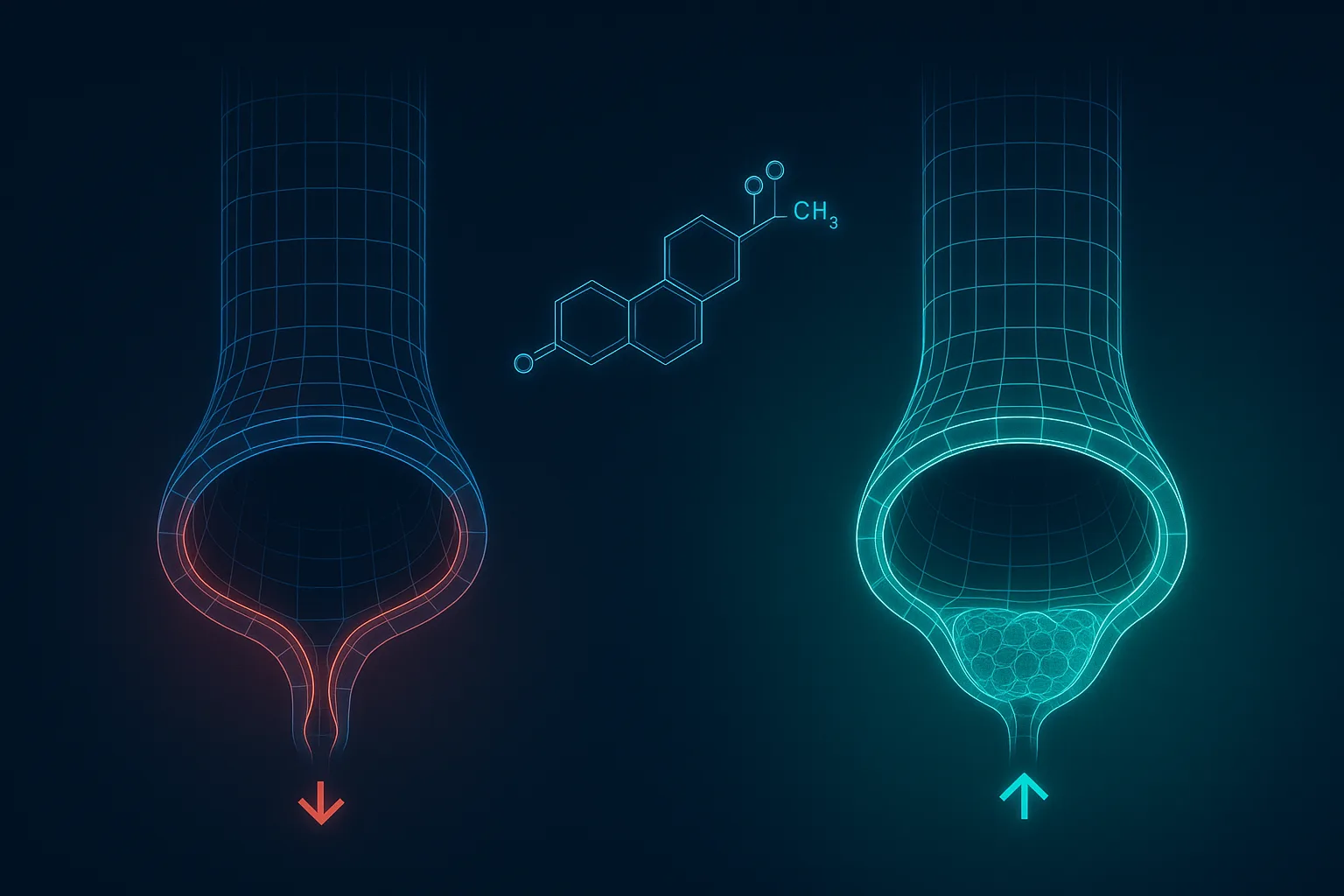
Local vaginal estrogen — cream, tablet, or ring applied directly to the vaginal and periurethral tissue — restores the urethral lining, submucosal blood flow, collagen, and closure pressure, and calms the irritable bladder trigone. Across studies it improves:
Urinary urgency
Frequency and nocturia (nighttime urination)
Stress incontinence severity
Urge incontinence severity
Recurrent UTIs (a frequent companion of incontinence in this population)
Because the dose is low and the absorption minimal, this benefit comes without meaningful systemic estrogen exposure.
Systemic HRT Does Not — and Oral Estrogen Can Worsen It
Systemic HRT — oral or transdermal estrogen taken at doses meant to treat whole-body symptoms like hot flashes — is a different exposure entirely, and the continence data are sobering:
In the Women's Health Initiative, women taking oral conjugated equine estrogen (alone or with a progestin) had a higher incidence of new urinary incontinence and worsening of existing incontinence compared with placebo, with the largest effect on stress incontinence among women who were continent at baseline.
In the HERS trial, oral estrogen plus progestin was associated with worsening incontinence over follow-up.
Pooled analyses have estimated meaningfully increased odds of stress and urge incontinence with systemic oral estrogen.
The likely mechanism is that oral estrogen passes through the liver and alters circulating proteins and connective-tissue metabolism in ways that reduce urethral support — the opposite of what locally applied estrogen does at the tissue. Transdermal systemic estrogen appears more neutral than oral, but neither systemic route is a treatment for incontinence.
The takeaway: if your primary goal is bladder control, the answer is local vaginal estrogen, not a systemic patch or pill. If you are on systemic HRT for hot flashes and also have leakage, you can — and often should — add vaginal estrogen on top of it. The two are not mutually exclusive, and the vaginal product is what addresses the bladder.
Women's HRT — Menopause-First Telehealth
Bioidentical estradiol, progesterone, and low-dose testosterone — all 50 states, unlimited physician access.
In 2025 the American Urological Association, the Society of Urodynamics, Female Pelvic Medicine & Urogenital Reconstruction (SUFU), and the American Urogynecologic Society (AUGS) jointly published the first comprehensive guideline on genitourinary syndrome of menopause [1].
For the urinary components of GSM, the guideline supports offering low-dose vaginal estrogen to perimenopausal and postmenopausal women with bothersome genitourinary symptoms, including urinary urgency, frequency, and recurrent UTI. At the same time, it draws the line clearly: systemic hormone therapy is not a treatment for urinary incontinence, consistent with the trial evidence that oral systemic estrogen can worsen it.
The guideline also emphasizes a multimodal approach — vaginal estrogen restores the tissue, but pelvic floor muscle training, behavioral therapy, and where appropriate referral to a pelvic floor physical therapist or urogynecologist address the mechanical and neurological components that estrogen alone cannot fix.
This is the modern framing every menopausal woman with bladder leakage should know: it is a treatable, partly hormonal condition, and the right hormone is the local one.
How Vaginal Estrogen Works on the Bladder and Urethra
The mechanism is well-characterized and acts at several points in the lower urinary tract.
Urethral Lining and Seal
Estradiol restores the thickness and vascularity of the urethral epithelium. A plump, well-perfused lining creates a better mucosal seal — a significant contributor to resting urethral closure pressure and therefore to continence during exertion.
Submucosal Blood Flow and Closure Pressure
A substantial fraction of urethral closure pressure comes from the vascular cushion in the submucosa. Estrogen increases periurethral blood flow, raising that pressure and improving the urethra's ability to stay sealed against sudden increases in abdominal pressure (the stress-incontinence trigger).
Connective Tissue and Bladder Neck Support
Estrogen supports collagen synthesis and quality in the pelvic connective tissue that holds the bladder neck and urethra in position. Better support means less hypermobility of the bladder neck, which is a driver of stress leakage.
Bladder Trigone and Urgency
Estrogen receptors are dense in the bladder trigone and urothelium. Local estrogen improves the urothelial barrier and reduces the sensory irritability that drives urgency and frequency. This is why vaginal estrogen helps the urge component, not just the stress component.
Restored Vaginal Microbiome (and Fewer UTIs)
By restoring vaginal pH and lactobacilli, vaginal estrogen also cuts recurrent UTIs, which themselves cause urgency, frequency, and leakage. Removing that recurring irritant further stabilizes bladder symptoms. For the full UTI protocol, see Recurrent UTIs After Menopause: Vaginal Estrogen Protocol.
The Three Vaginal Estrogen Formulations
All three low-dose forms improve urinary symptoms; choice comes down to adherence, cost, and preference.
Vaginal Estradiol Cream
Estradiol 0.01% (100 mcg/g) cream
Loading: a small daily dose for about 2 weeks, then 2 to 3 times weekly
Allows targeted application to the vaginal opening and periurethral area, which some clinicians prefer when bladder symptoms dominate
Inexpensive as a generic; can be slightly messy
Vaginal Estradiol Tablets/Inserts
10 mcg estradiol (current low-dose standard)
Loading: once daily for about 2 weeks, then twice weekly
Clean, measured, strong adherence profile
Estradiol-Releasing Vaginal Ring
Releases roughly 7.5 mcg estradiol per day
Inserted by the patient, replaced every 90 days
Best adherence — no daily or weekly dosing burden
Ideal for women who struggle with consistency on creams or tablets
Realistic expectations matter — vaginal estrogen is not an overnight fix.
Week
What Improves
2 to 4
Vaginal dryness and burning; early tissue changes
4 to 6
Urgency and frequency begin to ease; mucosa thickens
8 to 12
Stress and urge leakage episodes decline; vaginal pH normalizes
3 to 6 months
Stable steady-state improvement in bladder symptoms
Urgency and frequency tend to respond first; leakage episodes follow. Most trials measure outcomes at 12 weeks to 6 months. Because the effect depends on maintaining estrogenized tissue, discontinuation returns symptoms within weeks — this is a maintenance therapy.
Beyond Hormones: What Actually Moves the Needle
Vaginal estrogen restores the tissue substrate, but the best outcomes layer it with non-hormonal strategies that address the mechanical and behavioral drivers.
Pelvic Floor Muscle Training (First-Line for Stress Incontinence)
Strengthening the pelvic floor improves urethral support and closure during exertion. Pelvic floor muscle training has strong evidence for stress incontinence and is recommended first-line. A pelvic floor physical therapist substantially improves results over self-directed Kegels — many women perform Kegels incorrectly. Combining pelvic floor training with vaginal estrogen produces better results than either alone.
Bladder Training (For Urge Incontinence)
Scheduled, timed voiding with gradual lengthening of intervals retrains an overactive bladder and reduces urgency and urge leakage. Urge-suppression techniques (pausing, contracting the pelvic floor, distracting until the urge passes) are part of the protocol.
Weight Management
Excess intra-abdominal pressure worsens stress incontinence. Even modest weight loss measurably reduces leakage episodes — one reason bladder symptoms sometimes improve on GLP-1 therapy or after intentional weight loss.
Bladder Irritant Reduction
Caffeine, alcohol, carbonated drinks, and artificial sweeteners can aggravate urgency. Reducing them helps the urge component for many women.
Treat Constipation
Chronic constipation increases pelvic pressure and shares anatomy with the bladder — managing it improves both urgency and stress symptoms.
Escalation When Needed
For urge incontinence not controlled by behavioral measures, bladder-directed medications and office procedures exist. For stress incontinence, devices (pessaries) and surgical options are effective when conservative measures fall short. A urogynecologist manages the full ladder.
A Practical Starting Protocol
A reasonable framework for a postmenopausal woman with bothersome bladder leakage and signs of urogenital atrophy:
Step 1 — Characterize the Leakage
Distinguish stress vs urge vs mixed (a 3-day bladder diary helps)
Note triggers, frequency, nocturia, and any UTI history
A clinician should document GSM on exam (vaginal pH, mucosal thinning) and rule out structural causes (post-void residual, prolapse, infection)
Step 2 — Start Low-Dose Vaginal Estrogen
Estradiol 10 mcg tablet/insert, OR estradiol cream, OR the vaginal ring
Daily for about 2 weeks (loading), then 2 to 3 times weekly
No progestogen required at low dose
This is the hormonal foundation — not a systemic pill or patch
Step 3 — Add Pelvic Floor and Behavioral Therapy
Referral to a pelvic floor physical therapist for guided training (especially for stress symptoms)
Bladder training and timed voiding for urge symptoms
Reduce caffeine and bladder irritants; address constipation; target gradual weight loss if relevant
Step 4 — Reassess at 3 Months
Re-count leakage episodes against the baseline diary
If urge symptoms persist, consider escalation to overactive-bladder therapy
If stress symptoms persist, consider a pessary or urogynecology referral
Confirm adherence before concluding a therapy "failed"
Step 5 — Continue Vaginal Estrogen Indefinitely
The benefit is maintenance-dependent; stopping returns symptoms within weeks
Annual review of indication and adherence is sufficient at low dose
For a clinician who can manage this protocol via telehealth — labs, prescription, and follow-up — Compare All Clinics lists clinics scored on diagnostic depth and physician quality. The clinics focused on women's hormonal care are reviewed at Best Online HRT Clinics for Women.
The Testosterone and DHEA Angle
The lower urinary tract and pelvic floor carry androgen receptors as well as estrogen receptors, and female testosterone deficiency is increasingly recognized as part of the broader genitourinary syndrome of menopause. Systemic testosterone in women — dosed at roughly one-tenth the male dose — is used primarily for libido, energy, and lean mass rather than incontinence specifically, but it is a reasonable layered consideration in women with broad hormonal symptom burden.
Vaginal DHEA (prasterone) is FDA-approved for genitourinary symptoms and converts locally to both estrogen and androgen with minimal systemic effect; some women who do not fully respond to vaginal estrogen alone improve when it is added. For dosing logistics, see Testosterone Women Dosage Guide, and for the safety picture, see Testosterone in Women: Cardiovascular Safety Review.
What This Means for the Woman Who Was Told "It's Just Age"
The story most women hear about bladder leakage — that it is an inevitable consequence of getting older or having children, manageable only with pads — misses the hormonal half of the picture. A large share of postmenopausal incontinence is driven by estrogen loss in the urethra, bladder, and pelvic connective tissue, and that part is treatable.
The crucial nuance is that the type of hormone matters. Local vaginal estrogen helps; systemic oral estrogen can hurt. Paired with pelvic floor therapy and behavioral strategies, vaginal estrogen restores tissue that pads and panty liners only manage around.
If your clinician dismisses bladder leakage as untreatable, or reaches for a systemic pill to fix it, options include a board-certified menopause specialist, a urogynecologist, or a telehealth menopause clinic current with the 2025 guidelines — see Best Online HRT Clinics for Women. The condition is treatable. The main barrier is access to a clinician who treats it correctly.
The AUA/SUFU/AUGS Guideline on Genitourinary Syndrome of Menopause. Journal of Urology. 2025. PMID: 40298120
Hendrix SL, Cochrane BB, Nygaard IE, et al. Effects of estrogen with and without progestin on urinary incontinence (Women's Health Initiative). JAMA. 2005;293(8):935-948. PMID: 15728164
Grady D, Brown JS, Vittinghoff E, et al. Postmenopausal hormones and incontinence: the Heart and Estrogen/Progestin Replacement Study (HERS). Obstet Gynecol. 2001;97(1):116-120. PMID: 11152919
Cody JD, Jacobs ML, Richardson K, Moehrer B, Hextall A. Oestrogen therapy for urinary incontinence in post-menopausal women. Cochrane Database Syst Rev. 2012;10:CD001405. PMID: 23076892
The North American Menopause Society. The 2022 Hormone Therapy Position Statement. Menopause. 2022;29(7):767-794. PMID: 35797481
Dumoulin C, Cacciari LP, Hay-Smith EJC. Pelvic floor muscle training versus no treatment for urinary incontinence in women. Cochrane Database Syst Rev. 2018;10:CD005654. PMID: 30288727
Frequently Asked Questions
Does HRT help bladder leakage in menopause?
It depends on the type. Low-dose vaginal estrogen — cream, tablet, or ring applied locally — improves bladder symptoms including urgency, frequency, nocturia, and both stress and urge incontinence by restoring the estrogen-dependent tissue of the urethra, bladder trigone, and vaginal wall. Systemic HRT (oral or transdermal estrogen taken for whole-body symptoms like hot flashes) does NOT improve incontinence and, in the case of oral estrogen, was associated with a higher risk of new and worsening urinary incontinence in large trials. The 2025 AUA/SUFU/AUGS guideline reflects this split: it recommends local vaginal estrogen for genitourinary symptoms and cautions that systemic therapy is not a treatment for incontinence.
Why does oral HRT make incontinence worse but vaginal estrogen makes it better?
The route and dose are completely different exposures. Low-dose vaginal estrogen acts directly on the estrogen-rich tissues of the lower urinary tract — restoring urethral epithelial thickness, submucosal blood flow, collagen, and closure pressure — with minimal systemic absorption. Oral systemic estrogen, by contrast, passes through the liver and alters circulating proteins and connective tissue metabolism in ways that appear to reduce urethral support and increase stress incontinence. In the Women's Health Initiative and HERS trials, oral estrogen (alone or with a progestin) increased the incidence of stress, urge, and mixed incontinence among women who were continent at baseline. The lesson is that 'estrogen' is not one thing — local and systemic estrogen have opposite effects on continence.
What is the difference between stress and urge incontinence?
Stress incontinence is leakage triggered by physical pressure on the bladder — coughing, sneezing, laughing, lifting, or exercise — and reflects a weakened urethral closure mechanism and pelvic floor support. Urge incontinence (overactive bladder) is a sudden, intense need to urinate followed by involuntary leakage before reaching the toilet, driven by overactive bladder muscle contractions. Many menopausal women have mixed incontinence with features of both. Estrogen loss contributes to both types: it thins the urethral lining (worsening stress leakage) and irritates the bladder lining and trigone (worsening urgency). This is why local estrogen helps across the spectrum, while pelvic floor therapy targets the stress component specifically.
How long does vaginal estrogen take to improve bladder symptoms?
Tissue changes begin within 2 to 4 weeks, but the full effect on urinary symptoms takes 8 to 12 weeks. Urgency and frequency often improve first, followed by reductions in leakage episodes. Most clinical trials measure outcomes at 12 weeks to 6 months. Vaginal estrogen is a maintenance therapy — symptoms return within weeks of stopping because the tissue re-atrophies. Combining it with pelvic floor muscle training accelerates and amplifies improvement in stress incontinence specifically.
Is vaginal estrogen safe for the bladder long-term?
Yes. Low-dose vaginal estrogen produces minimal systemic absorption — serum estradiol stays in the early postmenopausal range. Large observational datasets reviewed in the 2025 AUA/SUFU/AUGS genitourinary syndrome of menopause guideline found no increased risk of breast cancer, stroke, blood clots, or endometrial cancer at standard low doses, and a progestogen is not required for endometrial protection. The FDA is in the process of removing the black box warning from low-dose vaginal estrogen products to reflect this safety profile. Treatment is generally indefinite because the benefit reverses when therapy stops.
Can I do anything besides hormones for menopause bladder leakage?
Yes, and the best results come from layering. Pelvic floor muscle training (Kegels, ideally guided by a pelvic floor physical therapist) is first-line for stress incontinence and has strong evidence. Bladder training and timed voiding help urge incontinence. Weight loss reduces intra-abdominal pressure and improves stress leakage. Reducing bladder irritants (caffeine, alcohol, artificial sweeteners) and treating constipation both help. For urge incontinence not controlled by behavioral measures, medications and procedures exist. Vaginal estrogen complements all of these by restoring the tissue substrate — it is not either/or.
Does testosterone play any role in bladder symptoms for women?
There are androgen receptors throughout the lower urinary tract and pelvic floor, and female testosterone deficiency is increasingly recognized as a contributor to the broader genitourinary syndrome of menopause — particularly the vulvar, sexual, and pelvic-floor components. Systemic testosterone in women is dosed at roughly one-tenth the male dose and is used primarily for libido, energy, and lean mass rather than incontinence specifically. Vaginal DHEA, which converts locally to both estrogen and androgen, is FDA-approved for genitourinary symptoms and helps some women who do not fully respond to vaginal estrogen alone. Testosterone is a layered consideration in women with broad hormonal symptom burden, not a first-line incontinence treatment.