Up to 40% of menopausal women develop burning mouth syndrome. Here's the estrogen-nerve mechanism, what HRT actually does, and the treatments that work.
Key Takeaways: Burning mouth syndrome (BMS), a scalding or tingling sensation in the tongue and mouth with no visible cause, is overwhelmingly a condition of midlife and postmenopausal women, affecting an estimated 18 to 40 percent of menopausal women. Estrogen receptors populate the oral mucosa, salivary glands, and the small sensory nerve fibers of the tongue; when estradiol falls, saliva drops, the mucosa thins, and the trigeminal sensory pathways appear to become dysregulated. Because the mouth looks completely normal, BMS is repeatedly dismissed or misdiagnosed. The HRT evidence is genuinely mixed: estrogen may help when burning is caught early and clearly tied to recent estrogen loss, but established BMS often does not respond, because the nerve pathways have already remodeled. The strongest BMS-specific treatments are topical clonazepam, alpha-lipoic acid, and capsaicin. BMS must be diagnosed by exclusion, because iron, B12, zinc, and thyroid deficiencies, candida, and reflux all mimic it.
The Burning Nobody Could See
You are 54. For months your tongue has felt scalded, as if you burned it on coffee that never cooled down. It is barely there when you wake up, then builds all afternoon until, by evening, the tip and sides of your tongue feel raw and tingling. There is a strange metallic taste, and your mouth feels dry even though you are not.
Your dentist looked, found nothing, and said your teeth and gums were fine. Your doctor looked, found nothing, and wondered if it was stress. Nobody connected it to the fact that your periods stopped two years ago.
This is burning mouth syndrome, and the dismissal is almost universal. The condition produces real, often relentless pain in a mouth that looks completely healthy, which is exactly why women are so often told it is anxiety, or nothing at all. BMS is strongly linked to the menopause transition: it is primarily a condition of women aged 50 to 70, and estimates of its prevalence in menopausal women range from roughly 18 percent up to 40 percent depending on how it is defined [1][2].
This guide explains why falling estrogen affects the nerves of your mouth, what the 2026 evidence actually says about hormone therapy for BMS, and which treatments have the best track record, so you can get properly worked up rather than told to live with it.
What Burning Mouth Syndrome Actually Is
Burning mouth syndrome is a chronic pain condition, not a dental or gum problem. The defining feature is a burning, scalding, or tingling sensation, most often on the tip and sides of the tongue, but sometimes spreading to the lips, gums, palate, or the whole mouth, that occurs without any visible abnormality on examination.
Clinicians divide it into two forms, and the distinction matters:
Primary (idiopathic) BMS is the form with no identifiable local or systemic cause. This is the type most closely tied to menopause and is increasingly understood as a small-fiber neuropathy, a dysfunction of the tiny sensory nerves in the mouth.
Secondary BMS is burning caused by an identifiable problem, such as iron or B12 deficiency, oral thrush, dry mouth from medication, reflux, or diabetes. Treating the cause resolves the burning.
The single most important step is sorting which one you have, because the treatments are completely different.
The Classic Symptom Pattern
Several features distinguish primary BMS from other causes of a sore mouth:
An evening crescendo. The burning is mildest on waking and intensifies through the day, peaking at night. This daily rhythm is highly characteristic.
A normal-looking mouth. No ulcers, redness, or lesions, which is what frustrates so many sufferers and clinicians.
Relief while eating. Unlike most mouth pain, BMS often eases during meals and worsens between them.
Taste changes and phantom dryness. A metallic or bitter taste and a feeling of dry mouth are common even when saliva measures normal.
Women's HRT — Menopause-First Telehealth
Bioidentical estradiol, progesterone, and low-dose testosterone — all 50 states, unlimited physician access.
The link between BMS and menopause is not a coincidence of timing. Estrogen acts directly on the tissues and nerves of the mouth.
Estrogen Receptors in Oral Tissue
Estrogen receptors are present throughout the oral mucosa, the salivary glands, and the sensory nerve endings of the tongue [3]. Estrogen helps maintain:
Salivary flow and quality, keeping the mucosa lubricated and protected
The thickness and integrity of the oral mucosa, so the surface is not thinned and vulnerable
The health and signaling of small sensory nerve fibers that carry taste and touch from the tongue
When estradiol declines at menopause, saliva production falls, the mucosa thins, and the protective environment of the mouth degrades. But the more important driver in primary BMS is what happens in the nerves themselves.
The Neuropathic, Two-Stage Mechanism
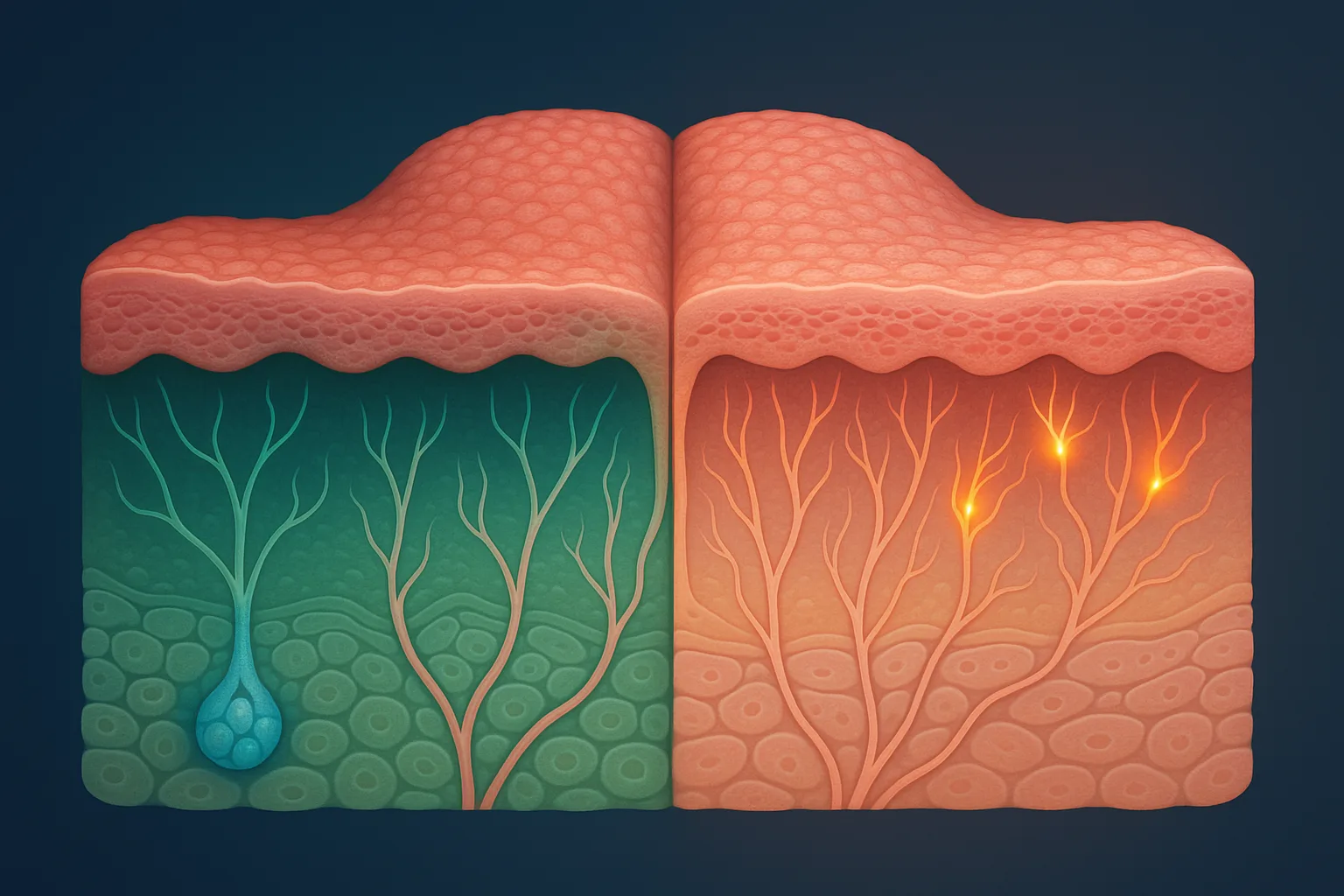
The most compelling current model is that BMS is a small-fiber neuropathy with a hormonal trigger. Estrogen modulates the trigeminal sensory pathways and the brain's pain-processing centers. Researchers describe a non-linear, two-stage relationship: when estrogen is present and stable, it tends to be protective; when it withdraws, the small sensory fibers and central pain pathways become dysregulated and start generating burning signals with no external stimulus [4].
This is why BMS behaves like a phantom pain. The burning is real, but it originates in misfiring nerves, not in damaged tissue, which is exactly why the mouth looks normal. It also explains the most important and counterintuitive fact about treatment: restoring estrogen does not always fix it.
The Evidence: Does HRT Help Burning Mouth Syndrome?
This is where honesty matters, because the data genuinely conflict and several clinics overstate the case.
The Case For
There is biological plausibility and some supportive clinical observation. Because estrogen receptors line the oral tissues and estrogen supports salivary flow and mucosal health, replacing it can relieve the dryness and mucosal-thinning component of burning. Case series and some observational reports describe improvement when HRT is started early, in women whose burning began close to the onset of estrogen loss and who have not had the symptom for years [3].
The Case Against, and the Caveats
A substantial body of research has found that HRT does not consistently resolve established burning mouth syndrome in postmenopausal women [1][3]. The leading explanation is the neuropathic mechanism above: once years of hormonal fluctuation have remodeled the sensory nerve pathways, the pain becomes self-sustaining, and simply replacing the hormone no longer switches it off. In other words, estrogen may help prevent or treat early, dryness-driven burning, but it is a poor tool for the entrenched, neuropathic form.
The honest synthesis: HRT is most reasonable when BMS appears alongside other menopausal symptoms that already justify hormone therapy, particularly when burning is recent and accompanied by genuine dry mouth. It is not a reliable stand-alone cure for established BMS, the evidence quality is modest, and HRT should not be prescribed for burning mouth syndrome alone. If you want to understand whether hormone therapy fits your overall picture, a clinician at an online HRT clinic can review your full symptom profile and risk factors rather than treating the mouth in isolation.
The Workup: Ruling Out Everything Else First
Primary burning mouth syndrome is a diagnosis of exclusion. Before any clinician attributes burning to hormones, the secondary causes, several of them common in midlife women, must be ruled out, because many are completely reversible.
Blood and nutritional tests:
Ferritin and full iron studies, because iron deficiency is one of the most common reversible causes of oral burning
Vitamin B12 and folate
Zinc
Thyroid function (TSH and free T4), since both over- and under-active thyroid produce oral symptoms
Fasting glucose and HbA1c, because diabetes drives oral neuropathy and dryness
FSH and estradiol to characterize where you are in the transition
Oral and local assessment:
Examination for oral thrush (candida), which causes burning and is easily missed
Check for geographic tongue, lichen planus, and other mucosal conditions
Assessment of dentures, dental work, and any allergic or galvanic reactions
Salivary flow assessment if dry mouth is reported
Medication and reflux review:
ACE inhibitors (blood-pressure drugs) are a recognized cause of oral burning
Review of any drug that causes dry mouth
Screening for acid reflux, which can produce a burning, sour mouth
If you need the comprehensive nutritional and hormone panel as part of this workup, an online HRT clinic can order the full set and connect you with a clinician who understands the menopausal context, rather than leaving you to coordinate testing across separate offices.
Treatments That Actually Work for BMS
Because HRT is unreliable for established BMS, the BMS-specific treatments matter most. Recent reviews consistently identify a small group of options with the best evidence [5][6].
Topical Clonazepam
The single most studied and most effective option. A clonazepam tablet is sucked or held against the painful area and then spat out, delivering the medication locally to the sensory nerves with minimal systemic absorption. It produces the most consistent reduction in burning of any intervention, though it is best used for acute management rather than indefinitely, and it requires a prescription and clinician oversight.
Alpha-Lipoic Acid
An antioxidant taken orally, alpha-lipoic acid is well tolerated and widely tried. As a sole treatment its effect is modest, but it appears to improve over longer use and is often more useful in combination than alone. It is one of the few options available without prescription.
Capsaicin
Derived from chili peppers, topical or rinse-based capsaicin desensitizes the overactive sensory nerve endings over time. It has shown benefit over placebo, though the initial burning it causes limits tolerability for some.
Other Options and the Combination Principle
Low-dose tricyclic antidepressants (such as amitriptyline) and certain anticonvulsants target the neuropathic component, and cognitive behavioral therapy reduces the distress and attention that amplify the pain. The clear theme in the 2025 to 2026 literature is that individualized combinations outperform any single agent, and that managing sleep, anxiety, and mood is part of the treatment, not separate from it.
How HRT Fits Into a Combined Approach
When BMS appears alongside other menopausal symptoms, hormone therapy can play a supporting role even though it is rarely curative on its own.
Restoring Saliva and Mucosal Health
Transdermal estradiol supports salivary flow and mucosal integrity, which addresses the dryness-driven component of burning, particularly in women whose symptoms are recent.
Stabilizing the Estrogen Signal
Because the sensory nerves react to estrogen fluctuation, steady-state delivery is preferred. Transdermal routes (patch, gel, or spray) avoid the daily peaks and troughs of oral estrogen and provide a more stable hormonal environment.
Improving Sleep and Lowering Distress
Much of BMS suffering is driven by the nervous system's attention to the pain, which rises with fatigue, anxiety, and poor sleep. By improving sleep, especially with bedtime micronized progesterone, and easing mood symptoms, HRT can meaningfully reduce how intrusive the burning feels even when the nerve signal changes little. For the endometrial-protection side of this, see our guide on progesterone with testosterone in women's HRT.
Optional Low-Dose Testosterone
For women with persistent fatigue, low mood, or poor sleep despite adequate estradiol, low-dose transdermal testosterone may improve energy and wellbeing, lowering the bandwidth the brain devotes to monitoring pain. The effect on the burning itself is indirect.
What to Expect: Timeline
Timeframe
Expected Changes
Week 1-2
Secondary causes (iron, B12, thrush) corrected if found; topical clonazepam may reduce acute burning quickly
Week 3-4
Better sleep and lower anxiety on HRT reduce evening intensity; alpha-lipoic acid still building
Week 6-8
Salivary and mucosal improvement on estradiol; dryness-driven burning often softens
Month 3
Best point to judge the combined approach; alpha-lipoic acid and capsaicin reach fuller effect
Month 6
Stable maintenance; neuropathic burning that persists is managed with the BMS-specific toolkit, not hormones alone
If a reversible deficiency was the cause, correcting it can resolve the burning entirely within weeks. If burning persists after deficiencies are corrected and HRT is optimized, the condition is primary neuropathic BMS, and the focus shifts to the targeted treatments above.
When Burning Is NOT Hormonal
HRT will not fix burning that has another driver. Seek a proper workup, not a hormone prescription, when burning is accompanied by:
Visible white patches, ulcers, or redness, which point to thrush, lichen planus, or other mucosal disease
Known iron, B12, or thyroid abnormality, which should be corrected first
A new ACE inhibitor or dry-mouth medication, which may be the cause
Reflux symptoms, suggesting an acid-related rather than hormonal source
Numbness or burning beyond the mouth, which warrants a wider neurological assessment
A competent clinician rules these out before attributing burning to menopause. If your provider dismissed your symptom without nutritional bloods or a hormone review, a specialist in women's hormone health can provide a more thorough assessment.
Lifestyle Measures That Help
While you pursue diagnosis and treatment, several measures reduce the burning or at least keep it from worsening:
Sip water frequently and stay hydrated. Keeping the mouth moist eases the dryness component.
Avoid triggers. Acidic, spicy, and very hot foods, alcohol, and tobacco all aggravate the burning. Many women find cinnamon and mint flavorings (including in toothpaste) make it worse; a mild, SLS-free toothpaste often helps.
Chew sugar-free gum. Stimulating saliva can relieve symptoms during the day.
Protect your sleep. Fatigue magnifies neuropathic pain. Treating night sweats and using bedtime progesterone where appropriate both help.
Manage stress and anxiety. The nervous system sets the volume on BMS. Breathing practices, exercise, and CBT measurably lower distress.
Limit caffeine and alcohol. Both worsen the autonomic instability of perimenopause and can amplify the burning.
Finding the Right Clinician
Burning mouth syndrome falls awkwardly between specialties. Dentists and oral medicine specialists assess the mouth and prescribe topical agents. Gynecologists and HRT clinicians manage the hormones. The ideal evaluator understands that a normal-looking mouth does not rule out a real pain condition, that nutritional deficiencies must be excluded first, and that a hormone review belongs in the workup of new burning during the menopause transition.
Online HRT clinics that focus on perimenopausal and menopausal hormone therapy are often the most efficient route to the nutritional panel and the hormone side of the picture. They can order the comprehensive bloods, judge whether HRT is appropriate given your overall symptoms and risk factors, and prescribe transdermal estradiol with proper monitoring, while you arrange oral-medicine treatment in parallel.
References
Dahiya P, et al. "Burning mouth syndrome and menopause." International Journal of Preventive Medicine. 2013;4(1):15-20.
Wardrop RW, et al. "Oral discomfort at menopause." Oral Surgery, Oral Medicine, Oral Pathology; and related prevalence surveys in menopausal cohorts.
Woda A, et al. "Burning mouth syndrome at menopause: elusive etiology." Journal of Mid-life Health. 2012;3(1):3-8.
"Estrogen-mediated neural mechanisms of sex differences in burning mouth syndrome." Review of estrogen modulation of trigeminal sensory pathways. 2025.
Mazdeyasnan L, Shabbir Z, Ibarra F. "What's hot, what's not: review of pharmacological options for managing burning mouth syndrome." Annals of Pharmacotherapy. 2025.
"Management strategies for burning mouth syndrome: a comprehensive review." 2025; and systematic reviews of clonazepam, alpha-lipoic acid, and capsaicin.
Yes. Burning mouth syndrome (BMS) is strongly tied to the menopause transition. It is primarily a condition of women aged 50 to 70, and estimates suggest it affects somewhere between 18 and 40 percent of menopausal women depending on the definition used. Estrogen receptors line the oral mucosa, salivary glands, and the small sensory nerve fibers of the tongue. When estradiol falls, salivary flow drops, the mucosa thins, and the trigeminal nerve fibers that carry taste and sensation appear to become dysregulated, generating a scalding or burning sensation with no visible cause. Because the mouth looks completely normal on examination, BMS is frequently missed or dismissed.
Does HRT cure burning mouth syndrome?
Not reliably, and this is where many clinics overstate the case. The evidence is genuinely conflicting. Some studies and case series report that estrogen replacement improves burning when it is started early and BMS is clearly tied to recent estrogen loss. But several controlled studies show HRT does not consistently resolve established BMS, likely because years of hormonal fluctuation appear to remodel the sensory nerve pathways, so simply restoring estrogen no longer reverses the pain. HRT is most reasonable when BMS appears alongside other menopausal symptoms that warrant hormone therapy, and it is not a stand-alone cure. The most evidence-backed BMS-specific treatments are topical clonazepam, alpha-lipoic acid, and capsaicin rinses.
What does burning mouth syndrome feel like?
Most women describe a scalding, tingling, or numb sensation, as if they had sipped a too-hot drink, most often on the tip and sides of the tongue, but sometimes on the lips, gums, or roof of the mouth. The classic pattern is that the burning is mild or absent on waking, builds through the day, and peaks in the evening. Many women also report a metallic or bitter taste, a sensation of dry mouth even when saliva is normal, and relief while eating or drinking. The mouth looks entirely healthy, which is part of what makes the condition so frustrating to have diagnosed.
How is burning mouth syndrome diagnosed?
BMS is a diagnosis of exclusion, meaning other causes of oral burning have to be ruled out first. A clinician should check for oral thrush (candida), geographic tongue, lichen planus, ill-fitting dentures, and acid reflux, and order blood tests for iron, ferritin, vitamin B12, folate, zinc, and thyroid function, because deficiencies in any of these produce identical burning. Diabetes and certain blood-pressure medications (ACE inhibitors) are also checked. Only when the mouth is clinically normal and these secondary causes are excluded is the burning labeled primary, or idiopathic, burning mouth syndrome, the form most closely linked to menopause.
Why does my burning mouth get worse as the day goes on?
This evening crescendo pattern is one of the hallmark features of primary burning mouth syndrome and helps distinguish it from other oral problems. The burning is typically least intense on waking, then steadily intensifies through the afternoon and evening. The leading explanation involves the nervous-system and hormonal component rather than anything structural in the mouth: as the day progresses, distraction falls, fatigue rises, and the dysregulated small-fiber nerve pathways become more symptomatic. Stress, anxiety, and the sleep disruption common in perimenopause all amplify the perception, which is why BMS so often travels with mood and sleep symptoms.
Can low testosterone in women contribute to burning mouth?
The direct evidence is thin, but there is an indirect link worth understanding. Burning mouth syndrome is partly a neuropathic, small-fiber pain condition, and how much it bothers a person is heavily modulated by sleep, mood, and anxiety, all of which are influenced by testosterone in midlife women. Low testosterone correlates with poor sleep, fatigue, and low mood, the same factors that turn up the volume on neuropathic pain. Some clinicians include low-dose transdermal testosterone within comprehensive HRT for women who have persistent fatigue and mood symptoms, which can reduce how distressing the burning feels even if it does not change the nerve signal itself.