Key Takeaways: A new cross-sectional study, Beyond Estrogen: Distribution and Hormonal Correlates of Serum Testosterone Among Postmenopausal U.S. Women (Journal of Clinical Medicine, May 8, 2026), used the nationally representative NHANES 2011-2016 and 2021-2023 cycles to map how testosterone is actually distributed across postmenopausal American women. The practical message is not a new "low-T number." It is the opposite: testosterone in postmenopausal women spans a wide range, SHBG was the most consistent hormonal correlate (higher SHBG strongly lowered the odds of testing "low"), and there is still no blood level that reliably defines deficiency or predicts symptoms. This matters because direct-to-consumer marketing increasingly sells testosterone to women on the basis of a single "low" number. This study reinforces why that number, in isolation, is close to meaningless -- and why SHBG and free testosterone, not total testosterone alone, are what make a reading interpretable.
What the Study Did
The National Health and Nutrition Examination Survey (NHANES) is the large, nationally representative health survey the CDC runs to characterize the US population. Because it draws a representative sample and measures hormones with standardized assays, it is one of the few datasets that can answer a deceptively simple question: across all postmenopausal American women, what does testosterone actually look like?
The investigators behind Beyond Estrogen pooled women meeting criteria for physiologic (natural) menopause from the 2011-2016 and 2021-2023 NHANES cycles and described the distribution of serum total testosterone, then evaluated which demographic and hormonal factors correlated with it. The paper was published in the Journal of Clinical Medicine on May 8, 2026.
This is, deliberately, a descriptive study. It is not a trial of testosterone therapy, and it does not claim that women at the low end would benefit from treatment. Its job is to map the terrain -- and the terrain turns out to be the whole story.
The Finding That Matters: There Is No Clean Cutoff
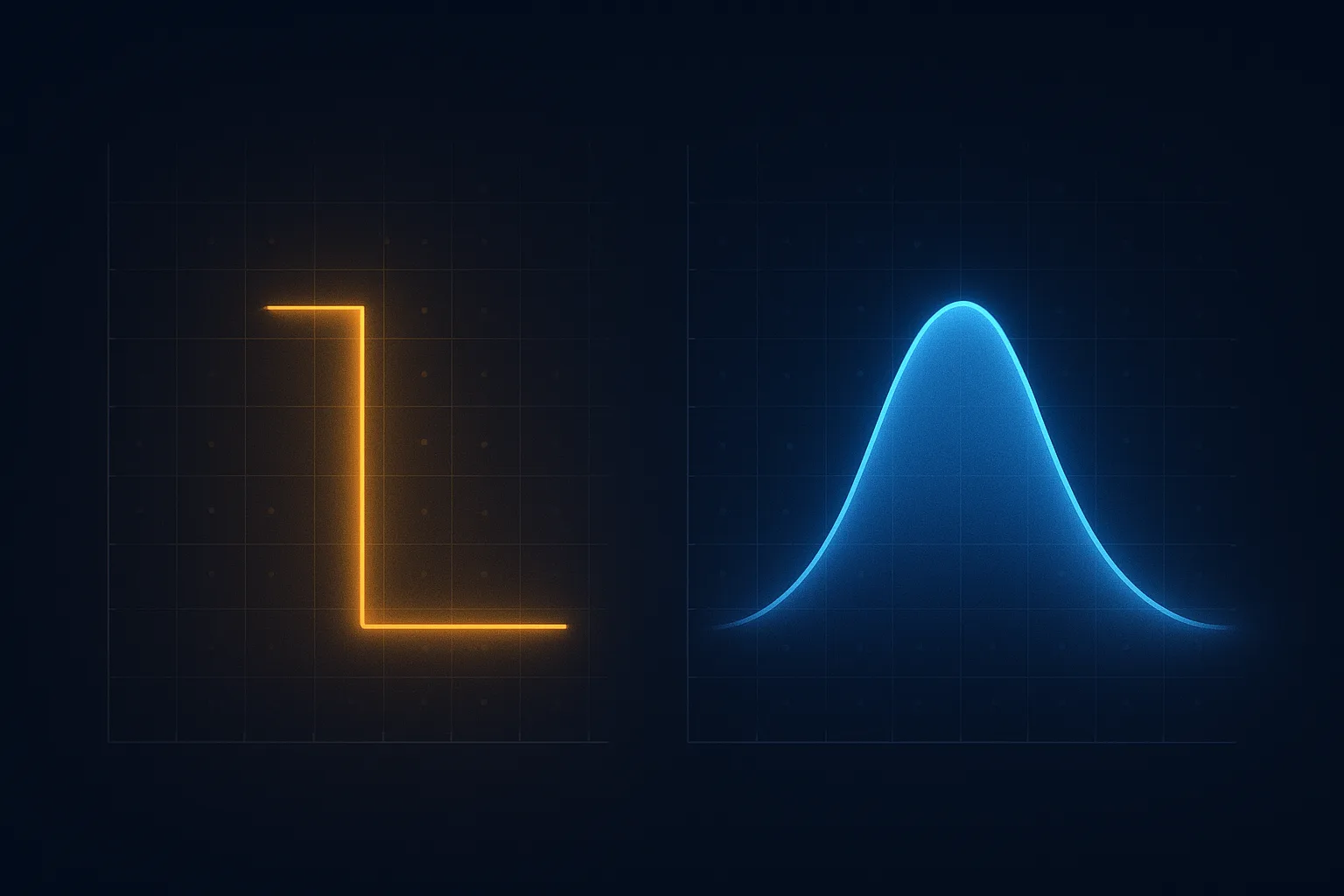
Here is the uncomfortable truth this kind of data keeps surfacing. In men, "low testosterone" has a workable definition: a morning total testosterone below roughly 300 ng/dL, confirmed on a second test, paired with symptoms. The number and the syndrome line up reasonably well.
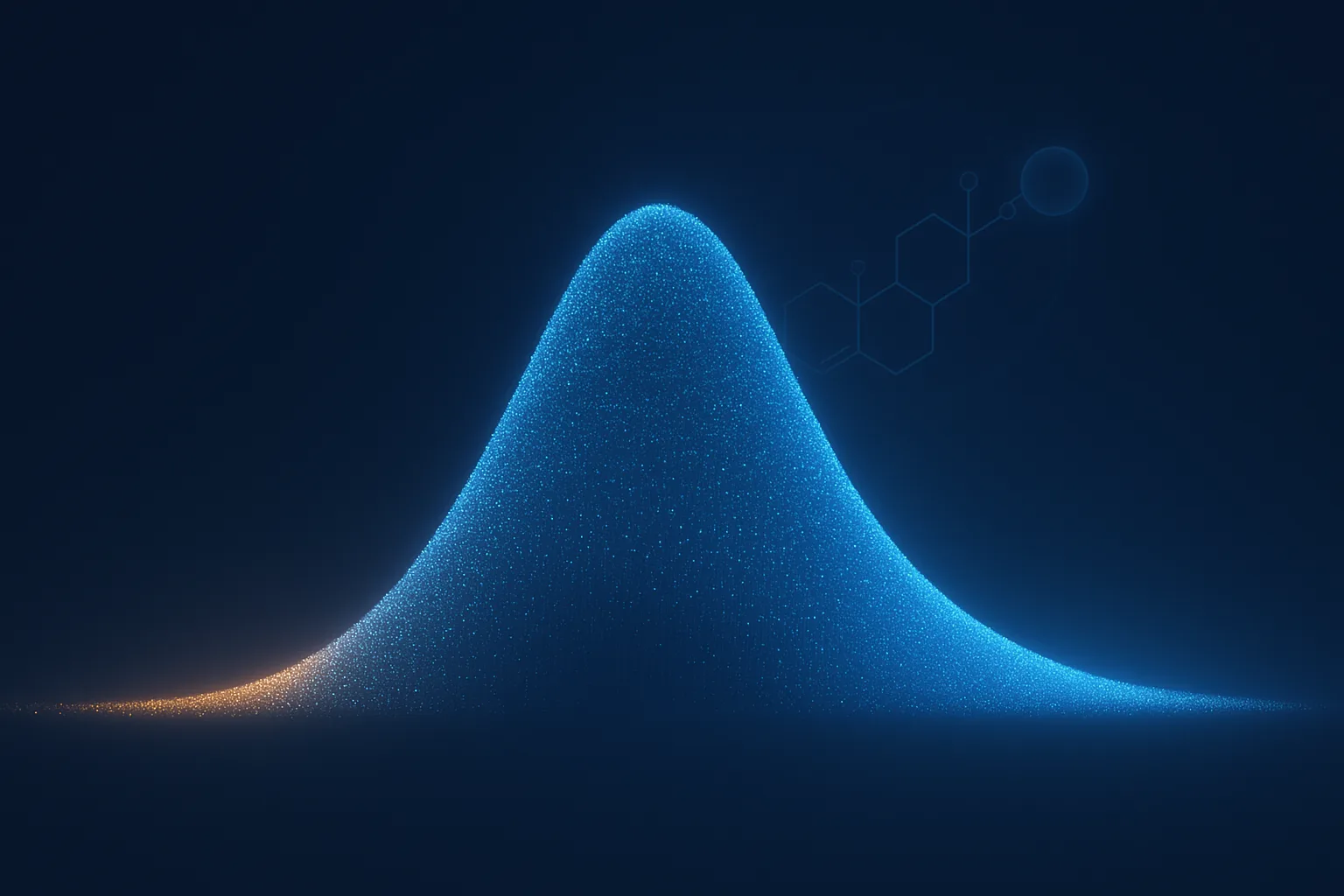
In women, they do not. Testosterone concentrations in postmenopausal women form a wide, continuous distribution with no natural break separating "deficient" from "normal." Researchers can draw an operational threshold to estimate how many women sit at the bottom of the range -- and this study does -- but that line is a statistical convenience, not a biological boundary. Below it, women are not reliably symptomatic. Above it, they are not reliably symptom-free.
This is consistent with what the field's leading researchers have said repeatedly: there is no such thing as a defined "testosterone insufficiency syndrome" in women, and no blood level below which symptoms predictably emerge. Our deeper write-up of why testosterone in women is justified only for HSDD covers that position in full. The new NHANES distribution data is the population-level picture underneath that clinical conclusion: if there were a clean deficiency state, you would expect to see it in a distribution this large. You do not.
SHBG Is the Hidden Variable
The single most clinically useful correlate in the study was sex hormone-binding globulin (SHBG). Higher SHBG was consistently associated with lower odds of a woman's total testosterone falling below the operational low threshold.
To understand why that matters, you have to understand what SHBG does. SHBG is the protein that carries testosterone through the bloodstream. Testosterone bound to SHBG is held in reserve and is not biologically active; only the small free fraction can actually act on tissues. So SHBG cuts both ways:
It props up your total testosterone number. More SHBG means more bound testosterone riding along in the blood, which is why higher-SHBG women were less likely to read "low" on total testosterone.
It can starve your tissues of usable hormone. That same high SHBG can mean less free testosterone available to do anything, even when the total looks healthy.
Women's HRT — Menopause-First Telehealth
Bioidentical estradiol, progesterone, and low-dose testosterone — all 50 states, unlimited physician access.
This is exactly why a total testosterone value alone is one of the most misleading lab numbers in women's health. A woman on oral estrogen therapy (which sharply raises SHBG) can show a "normal" or even high total testosterone while being functionally low on free testosterone. A woman with insulin resistance or obesity (which lowers SHBG) can read "low" on total while having adequate free hormone. The total number, by itself, tells you very little.
The fix is not complicated, but it is non-negotiable: any serious evaluation measures total testosterone, SHBG, and a calculated free testosterone together. Our total vs. free testosterone explainer and the free testosterone calculator walk through exactly how the bound and free fractions interact and why the calculation matters more than any single value. For women specifically, see testosterone blood testing in women, where assay sensitivity is its own pitfall.
The Assay Problem Nobody Mentions
There is a second reason a single testosterone number can mislead a woman, and it sits underneath the entire conversation: most labs cannot measure female testosterone accurately.
Women's testosterone runs roughly a tenth to a twentieth of male levels. The standard immunoassays that hospitals and many telehealth platforms use were designed and validated for male-range concentrations, and they become unreliable at the much lower levels seen in women. The gold standard at female concentrations is liquid chromatography-tandem mass spectrometry (LC-MS/MS) -- the same method serious menopause research uses.
So when a clinic hands a woman a "low testosterone" result and a prescription in the same visit, two things may be wrong at once: the number may not define a real deficiency state (because no such cutoff exists), and the number itself may be inaccurate (because the assay was not built for female levels). Both failure modes push in the same commercial direction -- toward treating a woman who may not need treatment.
What This Means for Women Considering Testosterone
None of this says testosterone is useless for women. Androgens genuinely contribute to sexual function, bone density, muscle mass, and mood, and the ovaries and adrenals keep producing testosterone well after menopause. The physiology is real. What the data keeps showing is that the number is a poor decision tool on its own.
Put practically:
Do not start testosterone to fix a lab value. A "low" total testosterone, especially without SHBG and free testosterone alongside it, is not a reason to treat. The evidence-based indication is distressing low sexual desire (HSDD), not a number on a page.
If you test, test correctly. Total testosterone by a sensitive assay (LC-MS/MS), SHBG, and calculated free testosterone -- ideally interpreted by a clinician who treats women specifically and understands the assay limits. A single total testosterone from a standard panel is not enough to act on.
Use levels to stay safe, not to justify starting. When testosterone therapy is appropriate (HSDD), labs matter for keeping you in the physiologic female range and catching excess -- acne, hair changes, voice effects -- not for proving you were deficient in the first place. Our women's testosterone dosage guide and side effects guide cover physiologic dosing and monitoring.
Be skeptical of "your testosterone is low" marketing. Given that there is no symptom-defining threshold and that most assays misread female levels, "low" is doing a lot of unearned work in direct-to-consumer messaging. The same caution our influencer marketing analysis raises for men applies, arguably more sharply, to women.
How to Choose Care That Gets This Right
The practical lesson is less about whether to consider testosterone and more about how a clinic evaluates you. Three signals separate evidence-aligned care from number-chasing:
Does it run the full androgen panel? Total testosterone alone is a red flag. A clinic that measures SHBG and calculates free testosterone -- ideally by a sensitive assay -- is doing the work this study shows actually matters.
Does it treat a diagnosis or a value? A trustworthy prescriber frames testosterone for women around HSDD and shared decision-making, and is honest that bone, muscle, mood, and metabolic benefits are plausible but not yet proven. A clinic that prescribes off a single "low" reading is running ahead of the evidence.
Does it dose physiologically and monitor? Female testosterone therapy targets the upper end of the normal female range, not male levels, with follow-up labs to catch excess. A program that hands out a fixed dose with no follow-up is not managing the real risks.
The Bottom Line
Beyond Estrogen does a quietly important thing: it shows, in a large nationally representative US sample, that postmenopausal women's testosterone is a smooth, wide distribution with no natural deficiency cutoff -- and that SHBG, not total testosterone, is the variable that most shapes whether a woman reads "low." The takeaway is not "more women need testosterone." It is that a single testosterone number, the exact thing being used to sell testosterone to women, is one of the least reliable tools in the room. Test the full picture, treat the diagnosis, and judge a clinic by whether it does the same.
Compare HRT and TRT Clinics
If you are weighing testosterone or broader hormone therapy, the standard a clinic holds itself to -- a full androgen panel with SHBG and free testosterone, sensitive assays, diagnosis-based prescribing, physiologic dosing, and follow-up labs -- matters more than the marketing. See independent reviews of leading clinics, scored on diagnostic rigor, physician oversight, lab monitoring, pricing transparency, and guideline-aligned care.
Beyond Estrogen: Distribution and Hormonal Correlates of Serum Testosterone Among Postmenopausal U.S. Women, NHANES 2011-2016 and 2021-2023. Journal of Clinical Medicine. 2026;15(10):3607. Published May 8, 2026.
National Health and Nutrition Examination Survey (NHANES), Centers for Disease Control and Prevention. Survey cycles 2011-2016 and 2021-2023.
Davis SR, Wang Y, et al. "Testosterone and pre-androgens by age and menopausal stage at midlife: findings from a cross-sectional study." eBioMedicine (The Lancet), 2025.
Global Consensus Position Statement on the Use of Testosterone Therapy for Women. J Clin Endocrinol Metab and partner journals, 2019.
Vermeulen A, Verdonck L, Kaufman JM. "A critical evaluation of simple methods for the estimation of free testosterone in serum." J Clin Endocrinol Metab. 1999;84(10):3666-3672.
Frequently Asked Questions
What did the new NHANES testosterone study actually find?
A cross-sectional study titled 'Beyond Estrogen: Distribution and Hormonal Correlates of Serum Testosterone Among Postmenopausal U.S. Women,' published in the Journal of Clinical Medicine on May 8, 2026, analyzed testosterone in postmenopausal women from the NHANES 2011-2016 and 2021-2023 cycles -- the large, nationally representative US health survey. The goal was to describe the actual population distribution of serum total testosterone in postmenopausal American women and identify what correlates with it. The headline finding for practical purposes: testosterone in postmenopausal women spans a wide range, and sex hormone-binding globulin (SHBG) was consistently the strongest hormonal correlate -- higher SHBG meant much lower odds of falling below the low-testosterone threshold. The study maps the landscape; it does not establish a symptom-based deficiency cutoff, because one does not reliably exist.
Is there a defined 'low testosterone' number for women?
Not in the way there is for men. The study used an operational threshold to estimate how many women fall at the low end, but the authors and the broader field are clear that no testosterone blood level reliably predicts symptoms in women. Unlike estrogen, which drops sharply at menopause and produces a defined symptom cluster, testosterone in women declines gradually with age and does not have a clean cliff. Many women with low measured testosterone feel fine, and many women with normal levels have the symptoms often blamed on low testosterone. This is why guidelines do not endorse treating a number -- they endorse treating a specific diagnosis (hypoactive sexual desire disorder) with labs used mainly to keep levels physiologic, not to justify starting.
Why does SHBG matter so much for my testosterone reading?
SHBG (sex hormone-binding globulin) is the protein that carries testosterone in the blood. Only the fraction not bound to SHBG is biologically active. The NHANES analysis found higher SHBG was consistently linked to lower odds of low total testosterone -- but high SHBG can simultaneously mean less free, usable testosterone, because more of it is bound up. This is the central trap of testosterone testing in women: a total testosterone number alone can mislead you in either direction. SHBG is raised by oral estrogen, thyroid hormone, and aging, and lowered by insulin resistance and obesity. Any honest evaluation in a woman measures total testosterone, SHBG, and calculates free testosterone together -- never total alone.
Does this study mean more women should be on testosterone?
No -- it is a mapping study, not a treatment recommendation. It describes how testosterone is distributed across postmenopausal US women and what associates with it. It does not show that women below any cutoff benefit from treatment, and it does not change the evidence base. The only indication for testosterone in women that medical societies currently endorse is hypoactive sexual desire disorder (HSDD) in postmenopausal women, treated at physiologic doses. The value of population data like this is context: it tells a clinician where a given woman sits relative to her peers, which is useful for interpretation, but a lab value is a starting point for a conversation, not a prescription trigger.
Should I get my testosterone tested if I'm in menopause?
It depends on why. Routine testosterone screening in menopausal women with no specific concern is not recommended, because there is no level that defines deficiency and no symptom that maps cleanly to the number. Testing is appropriate when there is a focused question -- most commonly distressing low sexual desire (HSDD) being considered for testosterone therapy, where baseline and follow-up labs keep dosing physiologic and rule out excess. If you are testing, do it correctly: total testosterone by a sensitive assay (LC-MS/MS is the gold standard at female concentrations), plus SHBG, with free testosterone calculated. Standard immunoassays are unreliable at the low levels seen in women.
What is testosterone actually doing in postmenopausal women?
Physiologically, androgens in women contribute to sexual function, bone density, muscle mass, mood, and overall well-being, and the ovaries and adrenal glands keep producing testosterone after menopause -- it does not switch off the way estrogen production largely does. That biological role is real and is why the topic gets so much attention. But a physiologic role is not the same as proof that supplementing testosterone improves those outcomes. The randomized evidence currently supports only sexual desire (HSDD). For bone, muscle, mood, and metabolic outcomes, testosterone's contribution is biologically plausible and actively studied, but not established enough to treat for. Mapping the population, as this study does, is a step toward the trials that could answer those questions.