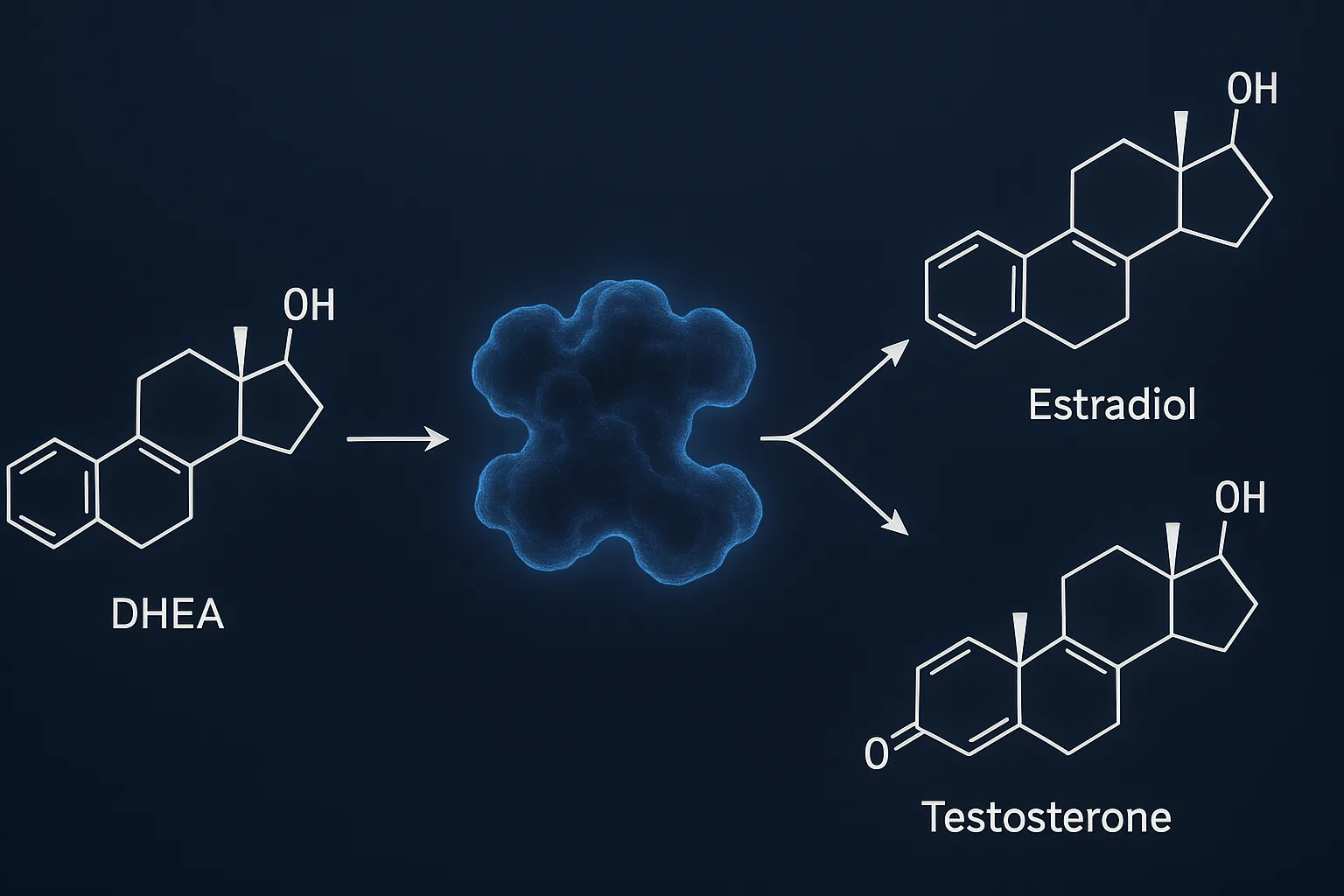
Key Takeaways: DHEA is a precursor hormone that your body converts into both testosterone and estradiol -- but how much of each you get is unpredictable. Direct testosterone therapy delivers a known dose with measurable results. DHEA costs $5-20/month over the counter; prescription testosterone cream runs $30-90/month through a clinic. For mild symptoms, DHEA is a reasonable starting point. For women who need reliable hormone levels, prescription testosterone wins.
The OTC-to-Prescription Pipeline
Most women who end up on testosterone therapy tried DHEA first. It makes sense -- DHEA is available without a prescription, costs less than a co-pay, and the marketing promises are appealing. "Natural hormone support" sounds better than "prescription hormone therapy."
But here is what the marketing does not tell you: DHEA is not testosterone. It is a raw material your body may or may not convert into testosterone, and even when it does, you have no control over how much testosterone you get versus how much estradiol you get.
This article breaks down exactly how DHEA works, why results vary so dramatically between women, and when it makes sense to skip the OTC aisle and go straight to prescription testosterone.
What DHEA Actually Is
Dehydroepiandrosterone (DHEA) is the most abundant circulating steroid hormone in the human body. Your adrenal glands produce it in large quantities during your 20s, after which levels decline steadily -- roughly 2-3% per year. By menopause, most women have lost 60-80% of their peak DHEA levels.
DHEA itself has minimal direct hormonal activity. It functions as a precursor -- a building block that your cells convert into active hormones through a process called intracrinology. The enzymes in your peripheral tissues (skin, bone, brain, fat, muscle) take DHEA and transform it into testosterone, dihydrotestosterone (DHT), estradiol, and other active steroids locally within each tissue.
This is where the problem starts. The conversion happens at the cellular level, governed by enzyme activity that varies significantly between individuals and between different tissues in the same person. Your neighbor taking the same 50 mg DHEA capsule might produce twice as much testosterone and half as much estradiol as you do.
The Conversion Problem: Why DHEA Results Are Unpredictable
When you swallow a DHEA capsule, your body runs it through a cascade of enzymatic conversions. The two primary pathways are:
Which pathway dominates depends on your individual enzyme expression, which is influenced by genetics, age, body composition, and existing hormone levels. A 2020 meta-analysis of randomized controlled trials found that oral DHEA at 50 mg/day increased testosterone by an average of 17-28 ng/dL in women -- but individual responses ranged from negligible change to levels exceeding the normal female reference range.
The estradiol side is equally unpredictable. A dose-response meta-analysis of DHEA's effect on estradiol levels in women found significant increases at doses of 50 mg/day and above, particularly in postmenopausal women. For women already on estrogen therapy, this uncontrolled estradiol increase can throw off a carefully balanced HRT protocol.
Labcorp founder Fernand Labrie's pioneering work on intracrinology demonstrated that serum levels of testosterone and estradiol are actually poor indicators of what is happening at the tissue level with DHEA supplementation. Your blood work might look normal while your tissues are getting too much or too little of each hormone.
What This Means in Practice
You take 50 mg of DHEA daily for 8 weeks. You get blood work. Three scenarios:
Testosterone rose adequately, estradiol stayed stable. You are one of the lucky ones. DHEA is working as intended.
Testosterone barely moved, estradiol increased. Your enzyme profile favors the estrogenic pathway. You got the opposite of what you wanted.
Both hormones increased significantly. You cannot selectively reduce one without stopping DHEA entirely.
With direct testosterone therapy, none of these scenarios occur. You apply 5 mg of testosterone cream and your testosterone goes up by a predictable, dose-dependent amount. Your estradiol is not affected unless you are converting testosterone via aromatase, which can be monitored and managed.
What Direct Testosterone Therapy Looks Like
Prescription testosterone for women is almost exclusively delivered as a compounded topical cream or gel. The standard protocol uses testosterone cream at 0.5-2% concentration, delivering 5-10 mg per day applied to the inner thigh, wrist, or vulvar tissue.
The key advantages over DHEA:
Dose precision. You know exactly how many milligrams of testosterone you are delivering. If 5 mg/day is not enough, your provider increases to 7.5 mg. There is no enzymatic lottery.
Predictable blood levels. Testosterone cream produces steady-state blood levels within 2-3 weeks. Blood work at 6-8 weeks confirms whether levels are in the target range (typically 30-70 ng/dL for women).
No estradiol interference. Testosterone cream does not increase estradiol through uncontrolled conversion pathways. Some testosterone converts to estradiol via aromatase, but this is a small, predictable amount -- not the large, variable increases seen with DHEA.
Titration control. If side effects appear (acne, hair changes, irritability), the dose can be reduced by fractions of a milliliter. With DHEA, your only options are to continue at the same dose or stop entirely.
The 2019 Global Consensus Position Statement on Testosterone Therapy for Women -- endorsed by multiple international medical societies -- recommended transdermal testosterone as the preferred treatment for postmenopausal women with hypoactive sexual desire disorder. DHEA was not included in this recommendation for systemic hormone therapy.
The evidence gap is significant. A Lancet systematic review and meta-analysis of 36 randomized controlled trials found that transdermal testosterone significantly improved sexual desire, arousal, orgasm, and satisfaction in postmenopausal women. The evidence for oral DHEA improving sexual function is far less consistent, with a Cochrane review finding insufficient evidence to support DHEA for perimenopausal and postmenopausal women's sexual function.
Women's HRT — Menopause-First Telehealth
Bioidentical estradiol, progesterone, and low-dose testosterone — all 50 states, unlimited physician access.
DHEA is not useless. There are specific situations where it is the better choice or a reasonable starting point.
Vaginal/Vulvar Health (Intravaginal DHEA)
Intravaginal DHEA (prasterone) is FDA-approved for moderate to severe dyspareunia caused by vulvovaginal atrophy of menopause. At the 6.5 mg daily vaginal insert dose, DHEA acts locally within vaginal tissue without raising systemic hormone levels. This is a legitimate, evidence-based use case where DHEA outperforms systemic testosterone therapy because the goal is local tissue repair, not systemic hormone replacement.
Mild Symptoms, Low Urgency
If your symptoms are mild -- slight energy dip, minor libido decrease, general "not feeling like yourself" -- a trial of 25-50 mg oral DHEA with blood work at 8 weeks is reasonable. If your enzyme profile happens to favor testosterone production, you may get meaningful relief at minimal cost and without needing a prescription.
Adrenal Insufficiency
Women with adrenal insufficiency (Addison's disease or surgical adrenal removal) have near-zero DHEA levels. In this population, DHEA supplementation at 25-50 mg/day has shown improvements in well-being and sexual function, because the baseline is so low that even modest conversion produces meaningful hormone levels.
Cost as a Barrier
If the cost of a telehealth clinic and compounded testosterone is not feasible right now, DHEA at $5-20/month is better than nothing. Just get blood work to confirm it is actually doing something. See women's HRT costs for a full cost breakdown.
When to Skip DHEA and Go Straight to Testosterone
Several situations warrant bypassing DHEA entirely and starting with prescription testosterone therapy:
Moderate to severe symptoms. If low libido, fatigue, brain fog, or mood changes are significantly affecting your quality of life, the 8-12 weeks needed to evaluate DHEA is wasted time. Testosterone cream for women produces measurable improvements within 4-6 weeks.
Already on estrogen therapy. If you are taking estradiol as part of an HRT protocol, adding DHEA introduces an uncontrolled variable. DHEA's conversion to additional estradiol can destabilize your existing protocol. Direct testosterone avoids this problem entirely.
Previous DHEA failure. If you have tried DHEA for 8+ weeks with blood work showing inadequate testosterone response, your enzyme profile likely does not favor androgenic conversion. Continuing DHEA at higher doses primarily increases estradiol, not testosterone.
Hormone-sensitive history. Women with a history of estrogen-receptor-positive breast cancer or endometriosis need precise hormone control. The unpredictable estradiol increases from DHEA make it a poor choice. Testosterone cream with regular monitoring is far safer in this context.
You want clinical oversight. Prescription testosterone comes with a provider relationship -- someone monitoring your blood work, adjusting doses, and watching for side effects. OTC DHEA puts that responsibility entirely on you.
Here is a practical framework that accounts for both cost and outcomes:
Step 1: Baseline Blood Work
Before starting anything, get tested. At minimum: total testosterone, free testosterone, DHEA-S, estradiol, and SHBG. This establishes your starting point and tells you whether your DHEA levels are actually low.
Step 2: DHEA Trial (Optional)
If symptoms are mild and DHEA-S is low, try 25-50 mg oral DHEA daily for 8-12 weeks. This is your screening phase.
Step 3: Follow-Up Blood Work
Retest the same panel at 8 weeks. Three outcomes:
Testosterone in range, symptoms improved -- continue DHEA, retest in 6 months
Testosterone inadequate, symptoms unchanged -- transition to prescription testosterone
If DHEA did not deliver, this is where prescription testosterone therapy takes over. A telehealth HRT clinic can prescribe compounded testosterone cream shipped to your door. Most women find their dose within 2-3 adjustments over the first 3 months.
Stacking DHEA With Testosterone
Some HRT protocols include both DHEA and testosterone. This is most common when:
A woman has very low DHEA-S levels (below 100 mcg/dL) alongside low testosterone
The provider wants to support local tissue health (vaginal DHEA) while using systemic testosterone for whole-body effects
Adrenal function is compromised and DHEA replacement addresses more than just sex hormones
If your provider suggests both, make sure blood work includes estradiol monitoring at 6-8 weeks. The combined estrogenic output from DHEA conversion plus any aromatization of testosterone needs to be tracked.
What the Evidence Actually Shows
The research landscape for these two approaches is not equal.
Testosterone therapy for women has a robust evidence base. The 2019 Lancet meta-analysis -- the largest systematic review on the topic -- analyzed 36 randomized controlled trials and found that testosterone therapy significantly improved sexual function across multiple domains. The Global Consensus Position Statement endorsed transdermal testosterone for postmenopausal women with hypoactive sexual desire disorder.
Oral DHEA for systemic effects has weaker, more inconsistent evidence. A Cochrane systematic review concluded there was insufficient evidence to support DHEA supplementation for improving sexual function in peri- and postmenopausal women. Individual trials show positive results, but the variability in response rates undermines the consistency needed for strong clinical recommendations.
Intravaginal DHEA is the exception. Multiple phase III clinical trials demonstrated significant improvements in vulvovaginal atrophy symptoms, and prasterone earned FDA approval in 2016 on the strength of this evidence.
The takeaway: if your primary goal is improving libido, energy, and overall well-being, testosterone therapy has the stronger evidence base. If your primary goal is vaginal health, intravaginal DHEA has dedicated FDA-approved evidence.
Cost Comparison
Item
DHEA (Self-Managed)
Testosterone (Clinic-Managed)
Initial consultation
$0
$99-199
Monthly hormone cost
$5-20
$30-90 (compounded cream)
Blood work (per panel)
$50-150 (self-ordered)
Often included in clinic fee
Provider follow-ups
$0
$0-50/month (membership)
Year 1 total
$160-540
$600-1,800
Ongoing annual
$60-240
$360-1,080
The cost gap is real but narrows when you factor in the blood work that responsible DHEA use requires. Two lab panels per year at $100-150 each adds $200-300 to the DHEA column. Many telehealth clinics include blood work in their membership fee, which closes the gap further.
DHEA is a reasonable first step for women with mild symptoms and confirmed low DHEA-S levels. It is cheap, accessible, and occasionally effective. But it is a gamble -- your body's enzymatic machinery determines the outcome, not the dose on the bottle.
Prescription testosterone therapy removes the gamble. You get a known dose, predictable blood levels, clinical oversight, and the strongest evidence base available for improving women's sexual function and well-being.
If DHEA has not worked for you after 8-12 weeks, or if your symptoms are more than mild, the path forward is clear: find a qualified HRT provider and start testosterone cream at an appropriate dose.
References
Davis SR, et al. Global Consensus Position Statement on the Use of Testosterone Therapy for Women. J Sex Med. 2019;16(9):1331-1337. PMID: 31488288
Islam RM, et al. Safety and efficacy of testosterone for women: a systematic review and meta-analysis of randomised controlled trial data. Lancet Diabetes Endocrinol. 2019;7(10):754-766. PMID: 31353194
Peixoto C, et al. Impact of dehydroepiandrosterone (DHEA) supplementation on testosterone concentrations and BMI in elderly women: A meta-analysis of randomized controlled trials. Exp Gerontol. 2020;141:111110. PMID: 33220453
Labrie F. DHEA and its transformation into androgens and estrogens in peripheral target tissues: intracrinology. Front Neuroendocrinol. 2001;22(3):185-212. PMID: 11456468
Elraiyah T, et al. The effect of DHEA supplementation on estradiol levels in women: A dose-response and meta-analysis of randomized clinical trials. J Steroid Biochem Mol Biol. 2021;214:105972. PMID: 34246664
Pinkerton JV, et al. Prescribing testosterone and DHEA: The role of androgens in women. Maturitas. 2021;144:54-63. PMID: 33384313
Labrie F, et al. Efficacy of intravaginal dehydroepiandrosterone (DHEA) on moderate to severe dyspareunia and vaginal dryness, symptoms of vulvovaginal atrophy. Menopause. 2016;23(3):243-256. PMID: 26731686
Elraiyah T, et al. Dehydroepiandrosterone for women in the peri- or postmenopausal phase. Cochrane Database Syst Rev. 2015;(1):CD011066. PMID: 25879093
Frequently Asked Questions
Can DHEA replace testosterone therapy for women?
Not reliably. DHEA is a precursor hormone that converts to both testosterone and estradiol at rates that vary dramatically between women. Some women get adequate testosterone levels from DHEA, but many do not. Direct testosterone therapy provides predictable, titratable dosing that DHEA cannot match.
How much testosterone does DHEA actually produce in women?
A meta-analysis of randomized trials found 50 mg/day of oral DHEA increases testosterone by an average of 17-28 ng/dL in women. However, individual responses range from almost no change to levels above the normal female range, making outcomes unpredictable without blood work.
Is DHEA safe to take without a doctor?
DHEA is sold over the counter in the US and is generally well-tolerated at 25-50 mg/day. However, it can raise both testosterone and estradiol unpredictably, which matters for women with hormone-sensitive conditions like breast cancer. Blood work at 6-8 weeks is recommended even with OTC use.
Should I try DHEA before testosterone therapy?
Many women do, and it is a reasonable first step if symptoms are mild. If DHEA does not resolve symptoms after 8-12 weeks with confirmed blood work showing inadequate testosterone levels, transitioning to prescription testosterone therapy is the logical next step.