Key Takeaways: Yes, you can donate blood on TRT — it is a prescribed medication, not a disqualifier. Whole-blood donation is capped at once every 56 days, and for most men with mildly elevated hematocrit, three to four donations a year holds the number steady. If hematocrit is genuinely high, therapeutic phlebotomy ordered by your doctor is the right tool, not donating more often than allowed. The hidden cost is iron: each draw removes 200-250 mg of iron and TRT already drains your stores, so check ferritin alongside your CBC. And never donate right before bloodwork — it masks your true set point.
The Question Every TRT Patient Eventually Asks
Your hematocrit is creeping up. Your doctor mentioned blood donation as the fix, or you read it on a forum, and now you are standing in a donation center wondering whether to mention the testosterone at all. Or you want to keep donating the way you always have and you are not sure TRT changes the rules.
Here is the short version: testosterone replacement therapy does not disqualify you from donating blood. At the American Red Cross and most U.S. blood centers, TRT is treated like any other prescription. The longer version — how often you should actually donate, the difference between donating and a medical phlebotomy, and the iron problem nobody warns you about — is where men get this wrong.
This matters because elevated hematocrit is the single most common lab abnormality on TRT. Drawing off red blood cells is the most direct way to bring it down. But "just donate blood" is incomplete advice that, done carelessly, trades one problem (thick blood) for another (an empty iron tank). Let's get the whole picture right.
Can You Donate Blood on TRT? The Eligibility Reality
Yes. There is no blanket deferral for men on testosterone therapy at standard whole-blood donation centers. The screening questionnaire asks what medications you take and why, but a testosterone prescription for hypogonadism is not a reason to turn you away.
What can actually stop you from donating are the universal criteria everyone faces:
Hemoglobin in range: Men need hemoglobin of at least 13.0 g/dL to donate. Ironically, TRT usually pushes you well above this, so it is rarely the limiting factor for testosterone patients.
Weight and age minimums: At least 110 lbs and generally 17+ (16 with consent in some states).
Feeling well that day: No active infection, fever, or recent illness.
Deferral windows: Recent tattoos or piercings, certain travel, recent surgery, or some medications trigger temporary deferrals — none of these are TRT-specific.
One nuance worth knowing: some men using compounded or non-FDA-approved preparations occasionally get extra questions. Be honest. A prescribed testosterone protocol from a legitimate clinic is routine, and donation staff see it constantly. If you want to understand how a reputable provider documents your protocol — which makes these conversations frictionless — our independent clinic comparison lays out which clinics handle monitoring and paperwork properly.
How Often Should You Actually Donate?
This is where most advice falls apart. The legal cap on whole-blood donation in the U.S. is once every 56 days — eight weeks, about six times a year. That is the maximum. It is not a target.
A single whole-blood donation removes roughly 450-500 mL of blood and lowers hematocrit by approximately 3 percentage points. For a man whose hematocrit drifts from 48% to 52% over a few months, two to four donations a year is usually enough to keep it parked in a safe zone. Donating the full six times a year is rarely necessary and often counterproductive.
The trap is treating donation as the primary fix when hematocrit is climbing aggressively. If you are hitting the 56-day cap and your number still won't stay down, donation is not solving the problem — your protocol is the problem. The real levers are upstream:
Injection frequency: Splitting the same weekly dose into smaller, more frequent injections lowers the supraphysiologic peaks that drive red cell production. This often does more for hematocrit than donation does. See our breakdown of weekly versus every-other-day injection frequency.
Dose reduction: More testosterone means more erythropoiesis. A modest dose cut frequently brings hematocrit down without sacrificing how you feel.
Route of administration: Injections drive hematocrit harder than transdermal gels. Some men with stubborn polycythemia do better switching modalities.
Donation is a downstream patch. If you need to donate aggressively just to stay safe, the smarter move is fixing the protocol so your hematocrit set point is lower to begin with. The full picture of why hematocrit rises and how to manage it lives in our high hematocrit on TRT guide.
Donation vs Therapeutic Phlebotomy: They Are Not the Same
People use these terms interchangeably. They are different procedures with different rules.
Blood Donation
Therapeutic Phlebotomy
Purpose
Voluntary, blood used for transfusion
Medical treatment to lower hematocrit
Who orders it
You decide to donate
Doctor writes an order
Frequency limit
Once every 56 days
As often as medically needed (often weekly initially)
Where
Red Cross, blood banks, community drives
Hospital, clinic, or specially equipped blood center
The blood
Used for patients (if you qualify as a donor)
Usually discarded
Cost
Free
May be billed; some centers do it free
The practical upshot: if your hematocrit is genuinely high — say 56% and symptomatic — you should not be relying on every-56-days donation to fix it. That is too slow. You need therapeutic phlebotomy, which your prescriber can order, and which can be done more frequently to bring the number down quickly. Once it is controlled, periodic donation can help maintain it.
A growing number of blood centers offer "double red cell" donations or therapeutic draws for diagnosed erythrocytosis, sometimes with a doctor's order on file. Ask your clinic to write the order and ask your local center what they accept. Whether your provider proactively manages this — rather than leaving you to figure it out — is exactly the kind of thing our clinic reviews evaluate.
The Iron Problem Nobody Warns You About
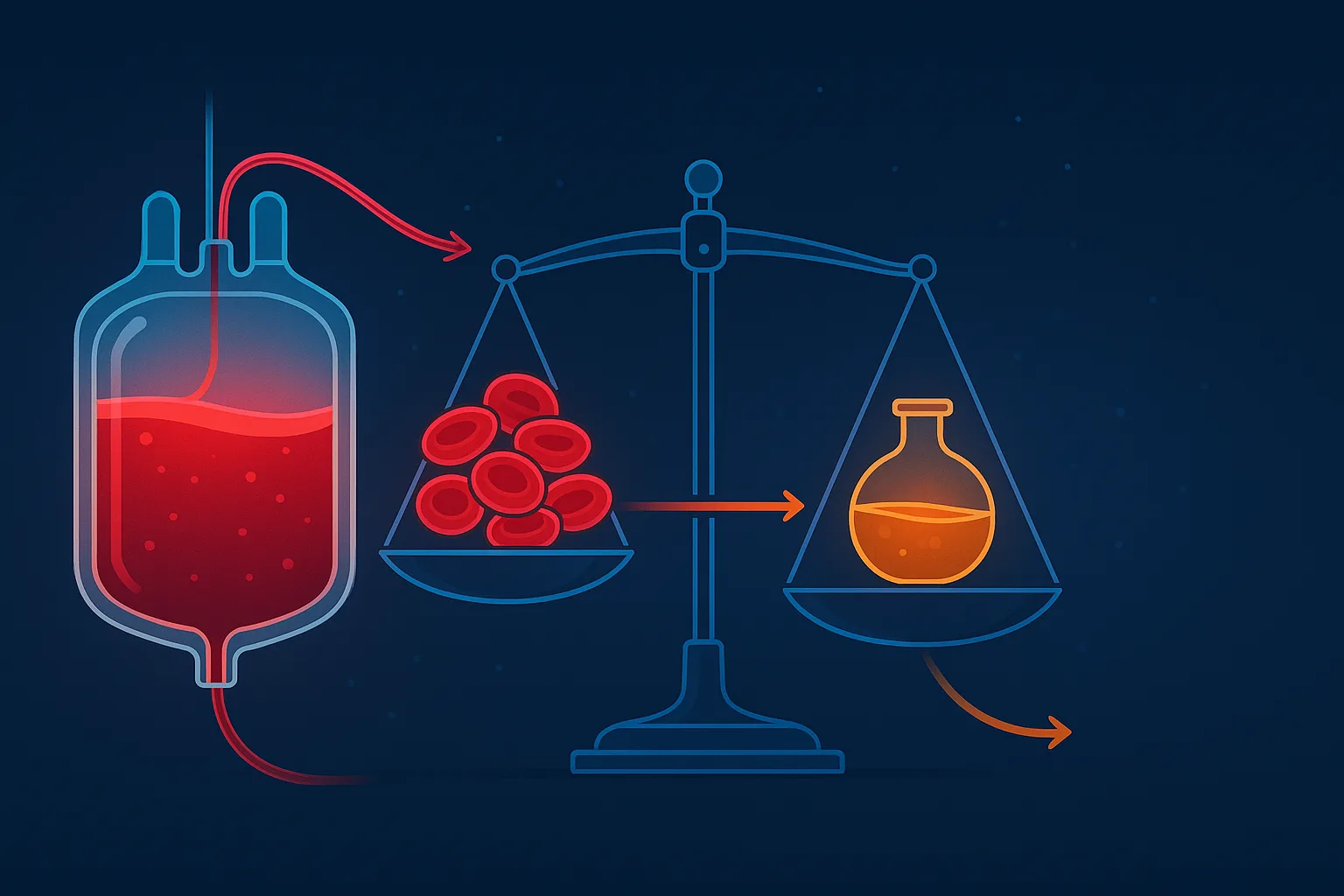
Here is the part that gets ignored. Every whole-blood donation removes roughly 200-250 mg of iron along with the red cells. And TRT is already draining your iron: testosterone suppresses hepcidin, the hormone that controls iron release, which pulls iron out of storage to feed red blood cell production.
Stack frequent donation on top of TRT's hepcidin suppression and you can end up in a strange place: high hematocrit and low ferritin at the same time. Your red cell line stays full while your iron storage tank empties. The result is fatigue, brain fog, exercise intolerance, restless legs, and hair shedding — symptoms that look exactly like low testosterone, which sends men chasing a higher dose when the real fix is iron.
This is why donation should never be done blind. Before you build a donation schedule:
Check ferritin, not just hematocrit. A CBC tells you red cell count; only ferritin (plus serum iron and transferrin saturation) tells you whether your iron tank is empty. Read the full mechanism in our low ferritin on TRT guide.
Don't over-donate. If your hematocrit only needs two or three donations a year to control, don't donate six times "to be safe" — you'll crater ferritin.
Replace iron carefully. If ferritin is genuinely low, modest iron repletion under guidance helps, but supplementing iron when ferritin is already adequate is useless and can worsen the picture. Test before you supplement.
The goal is balance: enough red-cell removal to keep viscosity safe, without emptying the storage tank that fuels your energy.
Timing It Around Your Bloodwork
One last mistake to avoid: do not donate right before your scheduled TRT labs to make the numbers look better. A donation a few days before a draw gives you an artificially low hematocrit that hides the true set point your protocol produces. Your doctor then thinks everything is fine while your real between-donation hematocrit is higher.
Test on your normal schedule first. Let the number reflect reality. Then decide whether donation, therapeutic phlebotomy, or a protocol change is the right response. If you are not sure how often you should be drawing labs in the first place, our TRT bloodwork schedule walks through exactly what to test and when.
The Bottom Line
You can donate blood on TRT, and for many men it is a genuinely useful, free way to keep hematocrit in a safe range while doing some good. But it is a tool, not a strategy. Donate based on what your labs actually show, not on a fixed schedule. If your hematocrit is high enough that donation can't keep up, the fix is therapeutic phlebotomy plus a protocol that lowers your set point — not breaking the 56-day rule. And watch your iron the entire time, because the cure for thick blood can quietly create a new problem if you stop checking ferritin.
The men who get this right are the ones whose clinics monitor the full picture — hematocrit, ferritin, and protocol together — instead of saying "go donate blood" and leaving you to manage the consequences. If your current provider isn't doing that, our independent comparison of TRT clinics shows which ones actually monitor what matters.
References
American Red Cross. Eligibility Criteria: Medications and Donation Frequency. redcrossblood.org.
Endocrine Society. Testosterone Therapy in Men With Hypogonadism: Clinical Practice Guideline. 2018.
Ohlander SJ, et al. Erythrocytosis Following Testosterone Therapy. Sexual Medicine Reviews. 2018.
Bachman E, et al. Testosterone Induces Erythrocytosis via Increased Erythropoietin and Suppressed Hepcidin. Journals of Gerontology. 2014.
Carter BloodCare. Testosterone Therapy and Blood Donation Eligibility. 2026.
Yes. Being on testosterone replacement therapy does not disqualify you from donating whole blood at most U.S. blood centers, including the American Red Cross. TRT is a prescribed medication, not a deferral. You may be asked what you take and why, but testosterone itself does not bar standard whole-blood donation. The main eligibility gates are the universal ones everyone faces: hemoglobin in range, no recent travel or tattoo deferrals, feeling well on donation day, and meeting weight and age minimums.
How often can someone on TRT donate blood?
Whole-blood donation is capped at once every 56 days (eight weeks) in the U.S. — roughly six times a year. For most men with mildly elevated hematocrit on TRT, donating three to four times a year is enough to hold the number steady. If your hematocrit climbs faster than that schedule can offset, the answer is not to donate more often than the law allows — it is therapeutic phlebotomy ordered by your doctor, or fixing the underlying protocol.
What is the difference between blood donation and therapeutic phlebotomy on TRT?
Blood donation is voluntary, capped at every 56 days, and the blood is used for transfusion if you meet donor criteria. Therapeutic phlebotomy is a medical procedure your doctor orders specifically to lower an elevated hematocrit; it can be done more frequently than 56 days, the volume and timing are prescribed, and the blood is usually discarded. If your hematocrit is genuinely high, therapeutic phlebotomy is the correct tool — donation is a bonus that happens to help.
Does donating blood on TRT cause iron deficiency?
It can. Each whole-blood donation removes roughly 200-250 mg of iron, and TRT already drains iron stores by suppressing hepcidin. Frequent donation on top of that can push ferritin low enough to cause fatigue, brain fog, and hair shedding even while hematocrit stays high. This is the classic high-hematocrit, low-ferritin paradox. Check ferritin alongside your CBC, and do not donate on a schedule so aggressive that it empties your iron tank.
Should I donate blood to bring my hematocrit down before TRT bloodwork?
No — that defeats the purpose. Donating right before labs gives you an artificially low reading that hides the real set point your protocol is producing. Test first on your normal schedule, see where hematocrit actually sits, then decide whether donation or therapeutic phlebotomy is warranted. Manipulating a single number for one blood draw does not change your underlying viscosity risk between draws.