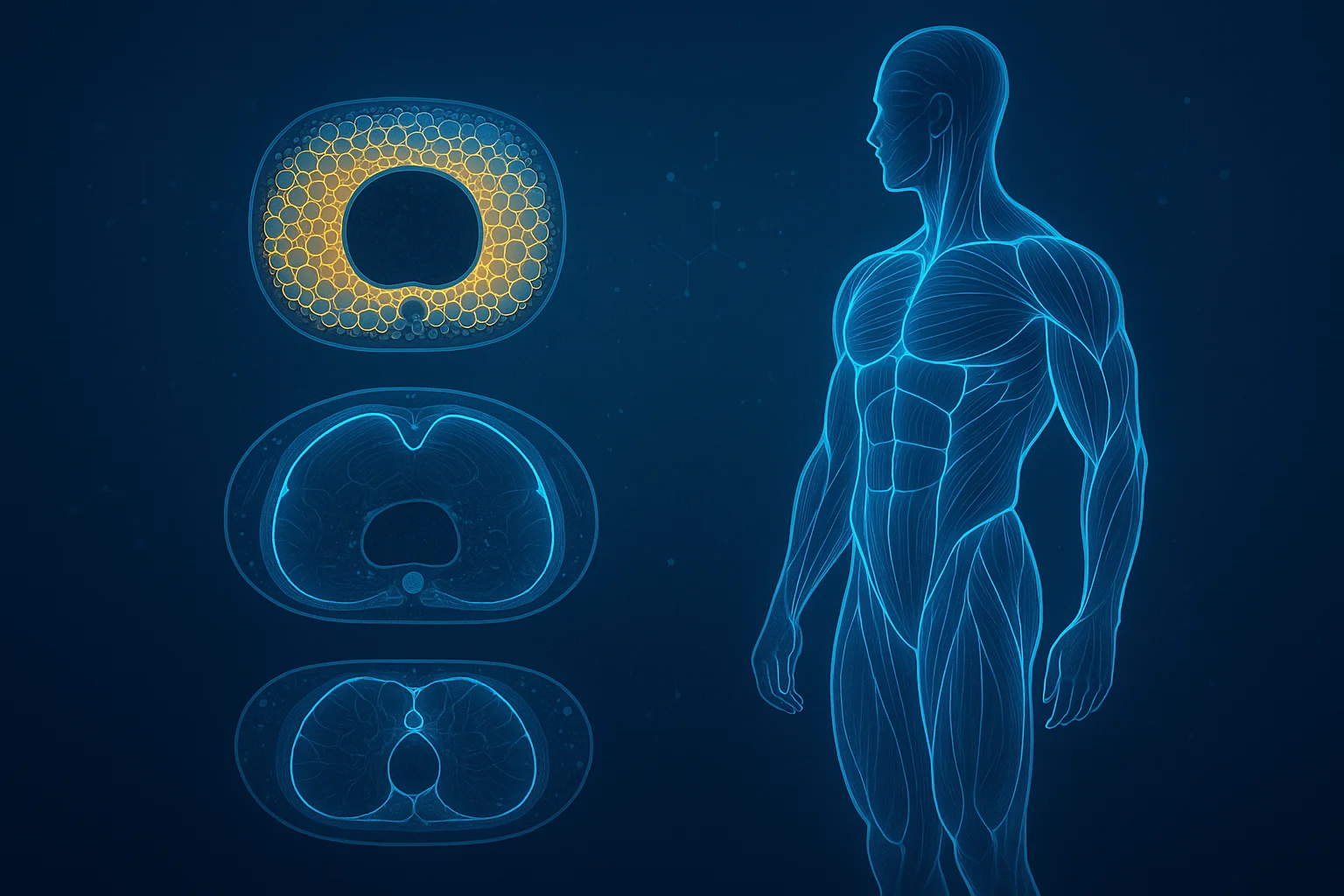
Key Takeaways: TRT at replacement doses produces real, measurable body composition changes: 5-10 lbs of lean mass gained and 5-10 lbs of fat lost in the first year for men who train consistently. The results are meaningful but not miraculous. The dramatic before-and-after transformations posted online often involve supraphysiological doses, aggressive training/dieting, and favorable lighting. Set expectations based on clinical data, not social media.
The Science of Testosterone and Body Composition
Testosterone is the primary anabolic hormone in men. It directly affects body composition through several well-characterized mechanisms. Understanding these mechanisms explains both what TRT can and cannot do.
How Testosterone Builds Muscle
Testosterone promotes muscle growth through:
Androgen receptor activation in muscle satellite cells -- testosterone binds intracellular androgen receptors, triggering gene transcription for muscle protein synthesis and satellite cell proliferation
Increased nitrogen retention -- positive nitrogen balance is the biochemical state required for muscle tissue growth
IGF-1 upregulation -- testosterone increases local IGF-1 production in muscle, amplifying the anabolic signal
Anti-catabolic effects -- testosterone antagonizes cortisol's catabolic effects on muscle, reducing muscle protein breakdown
Motor neuron potentiation -- androgens strengthen neuromuscular junction signaling, improving force output and training capacity
How Testosterone Reduces Fat
Testosterone promotes fat loss through:
Direct lipolysis -- androgen receptors on adipocytes, when activated, upregulate hormone-sensitive lipase and increase fat mobilization
Visceral fat targeting -- visceral adipocytes have higher androgen receptor density than subcutaneous fat, explaining the preferential visceral fat loss
Improved insulin sensitivity -- testosterone reduces insulin resistance, decreasing the hormonal drive to store fat
Increased basal metabolic rate -- more lean mass means higher daily energy expenditure at rest
Reduced lipogenesis -- testosterone decreases the activity of lipoprotein lipase in adipose tissue, reducing fat uptake
The Dose-Response Relationship
This is where honest expectation-setting becomes critical.
Bhasin et al. published landmark dose-response studies showing that the relationship between testosterone dose and muscle mass is dose-dependent but not linear. The key findings:
Even low replacement doses produce measurable lean mass increases in hypogonadal men
Muscle gain increases with dose, but with diminishing returns at each increment
The difference between 300 ng/dL and 600 ng/dL total testosterone produces more muscle gain than the difference between 600 and 900 ng/dL
Supraphysiological doses (above 1000-1200 ng/dL) produce significantly more muscle than replacement, but at the cost of increased side effects and health risks
What this means for TRT: Replacement doses that bring your levels to 600-1000 ng/dL produce real but moderate muscle gains. The enormous transformations associated with anabolic steroid use require doses 3-10x higher than TRT -- and carry proportionally greater health risks.
Clinical Data: What Studies Actually Show
Let's look at the hard numbers from major studies.
Bhasin et al. -- The Gold Standard
Bhasin's studies at Boston University are the most cited body composition research in testosterone therapy. Key findings relevant to TRT (replacement doses):
Outcome
Hypogonadal Men (Replacement Dose)
Notes
Lean mass gain (6 months)
+2.5 to +4.5 kg
Without structured exercise
Lean mass gain (6 months, with training)
+4 to +7 kg
Progressive resistance training
Fat mass loss (6 months)
-1.5 to -3.5 kg
Without structured exercise
Fat mass loss (6 months, with training)
-2.5 to -5 kg
Combined with caloric management
Thigh muscle volume
Significant increase
MRI-measured
Visceral fat
Significant decrease
CT-measured
The critical finding: training approximately doubled the body composition benefit of testosterone therapy. TRT without training produces modest changes. TRT with consistent, progressive resistance training produces meaningful transformation.
Saad et al. Registry Data
The Saad registry followed hypogonadal men on testosterone undecanoate for up to 12 years. Body composition findings at 12 months:
Lean mass increase: 4.1 kg average
Fat mass decrease: 5.7 kg average
Waist circumference decrease: 6.4 cm average
BMI decrease: 1.8 kg/m2 average
These are real-world results from clinical practice, not tightly controlled research settings. The numbers are encouraging because they represent what typical patients experience.
The TTrials (Testosterone Trials)
The TTrials enrolled men 65+ with low testosterone. Body composition substudy findings at 12 months:
Lean mass increased in testosterone group vs. placebo
Fat mass decreased in testosterone group vs. placebo
The effects were statistically significant but more modest than in younger populations
Your body composition results on TRT depend heavily on where you start.
Starting from Very Low Testosterone (Under 200 ng/dL)
Men with severely low testosterone often have:
Significant muscle wasting
High body fat percentage (especially visceral)
Poor exercise capacity and recovery
These men typically see the most dramatic relative improvement. Going from 150 to 800 ng/dL represents a 5x increase in the primary anabolic hormone. First-year results:
Metric
Expected Range
Lean mass gain
+8 to +15 lbs (with training)
Fat loss
+8 to +15 lbs
Waist reduction
-2 to -4 inches
Body fat % change
-4% to -8%
Starting from Moderately Low Testosterone (200-350 ng/dL)
This is the most common starting point. Results are real but less dramatic:
Metric
Expected Range
Lean mass gain
+5 to +10 lbs (with training)
Fat loss
+5 to +10 lbs
Waist reduction
-1 to -3 inches
Body fat % change
-2% to -5%
Starting from Low-Normal Testosterone (350-450 ng/dL)
Men in this range may qualify for TRT from some clinics but are at the borderline. Body composition changes are more subtle:
If you spend any time on r/testosterone or r/TRT, you will see transformation photos that range from genuinely impressive to seemingly impossible. It is worth understanding what is actually going on.
What Makes an Impressive Before-and-After
Several factors conspire to make online before-and-after photos look more dramatic than the average TRT experience:
Selection bias: Men who see amazing results post photos. Men with average results do not. You are seeing the tail end of the distribution, not the median.
Dose ambiguity: Many "TRT transformation" posts involve doses of 200-300 mg/week, which for many men produces supraphysiological testosterone levels (1200-1500+ ng/dL). This is not replacement therapy -- it is a low-dose steroid cycle marketed as TRT. Actual replacement (100-160 mg/week for most men) produces more modest results.
Concurrent interventions: The best transformations almost always involve simultaneous implementation of structured training programs, calorie-controlled diets (often significant caloric deficits), improved sleep, and sometimes additional compounds (GH peptides, etc.). TRT was one of several variables that changed.
Photography technique: Lighting, pump, flexing, posture, tan, and time of day can make a 10 lb difference look like 30 lbs. The "before" photo is taken at the worst possible moment. The "after" photo is taken at the best.
Timeline conflation: Some posts claim "3 months on TRT" but the actual timeline includes months of training before the photo was taken, with TRT accelerating gains that were already underway.
What Honest TRT Transformations Look Like
A genuine replacement-dose TRT transformation over 12 months, in a man who trains consistently, typically looks like:
Visibly fuller, denser muscles -- particularly shoulders, chest, and arms
Reduced midsection thickness and facial puffiness from fat loss
Better posture from improved core and posterior chain musculature
Healthier skin tone and appearance
An overall impression of vitality that is difficult to quantify but unmistakable
It looks like the same person who has been working out consistently and eating well for a year. Because, fundamentally, that is what happened -- TRT just ensured the hormonal environment was adequate for those efforts to produce results.
The Role of Training on TRT
TRT without training is like buying a sports car and never leaving the parking lot. The data is unambiguous: resistance training multiplies TRT's body composition effects by 2-3x.
Minimum Effective Training for TRT Body Recomposition
Frequency: 3-4 days per week of resistance training
Structure: Progressive overload (systematic increase in weight, reps, or volume over time)
Compound movements: Squat, deadlift, bench press, overhead press, rows -- these drive the most hormonal response and muscle recruitment
Volume: 10-20 hard sets per muscle group per week is the evidence-based range for hypertrophy
Progressive overload: If you are doing the same weight for the same reps for months, you are not giving your body a reason to grow
Why TRT Makes Training More Effective
Faster recovery: You can train more frequently or with higher volume before overreaching
Better protein synthesis: Each training session produces a larger and longer anabolic response
Improved motivation: The low-T lethargy that made training feel like a chore resolves
Reduced injury severity: Improved collagen synthesis and recovery means minor strains heal faster
Sustained energy: You can maintain intensity through an entire training session
The Role of Nutrition on TRT
Training provides the stimulus. Testosterone provides the hormonal environment. Nutrition provides the raw materials.
Protein Requirements
For men on TRT aiming to maximize lean mass gain:
Minimum: 0.7g protein per pound of body weight daily
Optimal: 1.0g per pound of body weight daily
Sources: Any complete protein source -- meat, fish, eggs, dairy, whey protein
Distribution: Spread across 3-4 meals for optimal muscle protein synthesis signaling
A 200 lb man should consume at least 140g of protein daily, ideally 200g. This single nutritional variable has an outsized impact on body composition outcomes.
Caloric Strategy
The optimal caloric approach depends on your starting body composition and goals:
If starting above 20% body fat: A modest caloric deficit (300-500 calories below maintenance) allows simultaneous fat loss and muscle gain, particularly in the first 6 months. TRT enables body recomposition (gaining muscle while losing fat) more effectively than without hormonal support.
If starting below 15% body fat: Eating at maintenance or a slight surplus (200-300 calories above) maximizes lean mass gain. Fat gain will be minimal with adequate testosterone levels.
If starting between 15-20%: Maintenance calories with high protein is the most practical approach. Body recomposition will occur naturally.
Hydration and Micronutrients
Water: Adequate hydration affects training performance, recovery, and can influence hematocrit readings
Vitamin D: Supports testosterone function and bone density; supplement if deficient
Zinc and Magnesium: Involved in testosterone synthesis and metabolism; ensure adequate dietary intake
Omega-3 fatty acids: Support cardiovascular health and reduce inflammation
Timeline of Visible Changes
Here is an honest timeline of when body composition changes become visible:
Comparing yourself to supraphysiological-dose transformations
Not tracking objectively (photos, measurements, DEXA) and relying on subjective mirror assessment
Not accounting for age-related limitations (a 55-year-old will not recompose like a 35-year-old)
Tracking Your Progress Properly
The best way to assess body composition changes on TRT:
Progress photos -- same lighting, same time of day, same poses, monthly. Front, side, and back.
Waist measurement -- most responsive and health-relevant metric
DEXA scan -- gold standard for lean mass and fat mass quantification. Baseline and 6-month follow-up.
Strength log -- progressive strength gains correlate with lean mass gains
How clothing fits -- a surprisingly reliable subjective measure
Do not rely on:
Scale weight alone (muscle and fat changes can cancel out)
BMI (completely meaningless during body recomposition)
Bioelectrical impedance scales (accuracy is poor and varies with hydration)
The Bottom Line on TRT Body Composition
TRT at replacement doses restores your body's ability to build muscle and lose fat at the rate your genetics would allow with healthy testosterone levels. It does not give you superhuman physique-building capacity.
The men who achieve the best body composition results on TRT are the ones who treat testosterone as the foundation and then build on it with consistent training, adequate protein, controlled calories, quality sleep, and patience.
Expect real, meaningful changes. Do not expect miracles. And measure your progress with objective tools rather than comparison to curated social media transformations. The right provider will help you optimize protocol and track progress -- see our clinic comparison.
This content is for informational purposes only and is not medical advice. Consult a qualified healthcare provider before starting any treatment.
Frequently Asked Questions
How much muscle can you realistically gain on TRT?
At replacement doses (100-200 mg/week testosterone cypionate), expect 5-10 lbs of lean mass in the first year with consistent training. This is significantly less than supraphysiological doses but meaningful for health and appearance.
Does TRT help lose belly fat specifically?
Yes. Testosterone preferentially reduces visceral (belly) fat through direct lipolytic effects on abdominal adipocytes and improved insulin sensitivity. Clinical studies show 15-25% visceral fat reduction in the first year.
Can you gain muscle on TRT without working out?
Modestly, yes. Clinical studies show 2-3 kg lean mass gain even in sedentary hypogonadal men. However, the gains are dramatically greater with resistance training -- 2-3x more in most studies.
Why don't I look like the TRT before-and-after photos online?
Most impressive transformation photos involve supraphysiological doses (not replacement TRT), professional lighting/posing, concurrent aggressive dieting, and significant training experience. Replacement-dose TRT produces real but more modest changes.
How long until body composition changes are visible on TRT?
Most men notice improved muscle fullness and subtle changes by month 3. Clearly visible changes typically appear at months 4-6. The most dramatic visual difference usually occurs between months 6-12.