Key Takeaways: A new study in Mayo Clinic Proceedings (Faubion et al., 2026) tracked menopausal hormone therapy use across a large US health database from 2007 to 2023. Use fell from 4.4% to 1.7% among women 40 and older -- the lowest rate since the early 2000s. Even in the prime-benefit group (ages 50-59), only about 3.5% were on hormone therapy in 2023. Both oral and transdermal use declined, and use was consistently lower among Black, Hispanic, and Asian American women than among white women. Researchers expected a rebound as menopause awareness rose; instead the decline continued. The drivers they identify: persistent misinformation about risk, limited clinician training in menopause medicine, and patient awareness gaps -- structural problems the FDA's November 2025 boxed-warning removal addresses only in part. The authors also flag low-dose vaginal estrogen as dramatically underused given its favorable safety profile. The practical takeaway: the gap between treatable symptoms and treated symptoms is still enormous, and the modern delivery model -- telehealth-first, specialist-prescribed -- is the fastest route into the 1.7%.
What the Study Found
The analysis, led by Dr. Stephanie Faubion -- director of Mayo Clinic's Center for Women's Health and medical director of The Menopause Society -- drew on a large US health-claims database spanning 2007 to 2023. A woman counted as a hormone-therapy user if she filled at least 180 days of prescriptions in a given year, a threshold that screens out one-off scripts and captures genuine ongoing treatment.
The headline numbers:
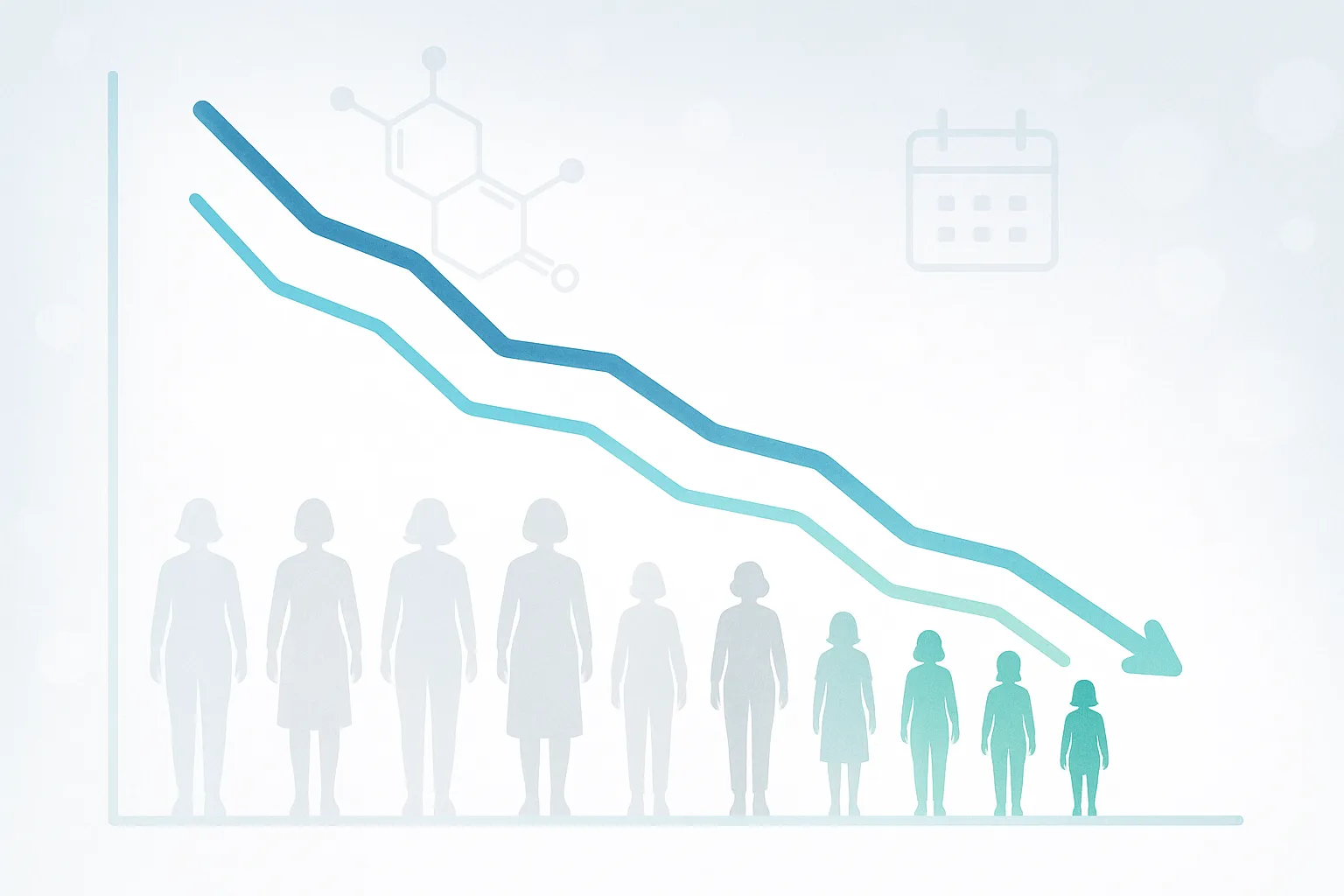
4.4% of women 40+ used hormone therapy in 2007
1.7% used it in 2023 -- a roughly 60% relative decline
~3.5% of women ages 50-59 (the prime-benefit group) used it in 2023
Use was consistently higher among white women than among Black, Hispanic, and Asian American women
Both oral and transdermal formulations declined; oral remained the most common route
The finding that surprised the researchers most was the direction over the back half of the study. Menopause has had an unmistakable cultural moment over the past five years -- bestselling books, celebrity advocacy, dedicated clinics, a wave of media coverage. The expectation was that this awareness would translate into rising treatment rates. It did not. Through 2023, use kept falling and settled at its lowest point since the immediate post-2002 collapse.
Why This Number Matters
Up to 75% of menopausal women experience symptoms like hot flashes and night sweats, and more than a million US women enter menopause every year. Set the 1.7% usage rate against that denominator and the scale of the gap becomes clear: the overwhelming majority of women with treatable symptoms are not being treated.
A few comparison points to calibrate how unusual this is:
For type 2 diabetes, roughly 85-90% of diagnosed patients receive some pharmacologic management.
For hypertension, roughly 70-75% of diagnosed patients are on at least one antihypertensive.
For menopausal symptoms, the dominant outcome -- by an enormous margin -- is no treatment at all.
Menopause symptoms are arguably the only major, well-characterized, highly treatable symptom cluster in adult medicine where "do nothing" is the default clinical pathway. This study quantifies that default and shows it has been deepening, not improving.
Women's HRT — Menopause-First Telehealth
Bioidentical estradiol, progesterone, and low-dose testosterone — all 50 states, unlimited physician access.
The reason this study landed in the medical press is the tension Dr. Faubion stated plainly: "We have strong evidence that hormone therapy is safe and effective for many women, but that hasn't translated into how it's used in clinical practice."
That gap -- between the evidence and the prescribing -- is the whole story. Consider what changed during the 2007-2023 window the study covers:
The 2007 reanalysis of the Women's Health Initiative showed that the absolute risks were small and concentrated in women starting therapy more than a decade after menopause.
The timing hypothesis matured into mainstream guidance: starting within 10 years of menopause onset, under age 60, carries a favorable benefit-risk profile.
Transdermal estradiol -- which bypasses the first-pass liver effect and carries a lower clot risk than oral estrogen -- became widely available and increasingly preferred by specialists.
Major societies (The Menopause Society, the Endocrine Society) issued position statements affirming HRT as first-line for vasomotor symptoms in appropriate candidates.
Every one of those developments should have pushed usage up. Usage went down. That is the disconnect, and it tells you the binding constraint is not the science.
What's Actually Driving the Decline
The authors point to three reinforcing barriers, none of which a single regulatory change fully resolves.
1. The Women's Health Initiative Shadow
The 2002 WHI trial reported elevated breast cancer, stroke, and cardiovascular event rates in women on combined conjugated equine estrogens plus medroxyprogesterone acetate. The headline -- "HRT causes cancer" -- cemented itself in public memory and in a generation of physicians' training. The subsequent two decades of reanalysis (small absolute risks, driven by late initiation, not generalizable to transdermal estradiol plus micronized progesterone) never achieved the same cultural penetration. Misinformation, as Dr. Faubion put it, is "one reason some women are not getting treatment."
2. Clinician Training Gaps
Menopause medicine is thinly covered in both OB/GYN and primary-care training. Many clinicians completed residency in the immediate post-WHI era, when the prevailing instruction was to avoid hormone therapy. A physician trained to be cautious does not become an enthusiastic prescriber because a guideline changed; confidence rebuilds slowly, and many clinicians simply route around the topic. The result is a supply-side bottleneck: even motivated patients struggle to find a prescriber who treats HRT as routine rather than exceptional.
3. The Silent Visit
The standard 15-minute primary-care slot is allocated to acute complaints and chronic-disease management. Menopause -- which the patient may not even name as menopause -- rarely surfaces. The patient assumes her doctor would raise it if it mattered; the doctor assumes the patient would raise it if it were bothering her. Neither does. The symptom goes unmanaged by mutual omission.
The Vaginal Estrogen Footnote That Isn't a Footnote
One specific point the authors emphasize: low-dose vaginal estrogen is dramatically underused. This matters because it sidesteps almost every objection to systemic HRT.
Vaginal estrogen treats the genitourinary syndrome of menopause -- vaginal dryness, painful intercourse, recurrent urinary tract infections, urinary urgency. Because the dose is local and systemic absorption is minimal, it does not carry the systemic risks that drove the WHI concerns. It is appropriate for many women who cannot or will not take systemic hormones, including many breast cancer survivors after specialist consultation. Yet a large share of women with these symptoms -- which tend to be progressive and do not spontaneously resolve -- receive no treatment.
This is the second major Mayo Clinic menopause-access study in recent months, and the two fit together. The earlier study -- a survey of nearly 5,000 women -- found that roughly 87% never sought medical care for their menopause symptoms. This new study measures the other side of the same coin: of the women who are in the system, only 1.7% are on hormone therapy.
Read together, they describe a two-stage funnel that leaks at both stages. Most symptomatic women never raise menopause with a clinician (the 87% finding). And among those who are engaged with care, the prescribing rate is still rock-bottom (the 1.7% finding). Closing the gap requires fixing both: surfacing the symptoms and connecting them to a clinician equipped to prescribe.
Why Telehealth Maps Onto the Barriers
The three barriers the study identifies -- misinformation, scarce trained prescribers, visits that never surface menopause -- correspond almost exactly to what well-run women's HRT telehealth clinics are built to solve:
Proactive intake screening. The first visit explicitly asks about hot flashes, sleep, mood, libido, energy, weight, joint pain, and genitourinary symptoms. The symptoms surface because the model is designed to surface them.
Specialist-level prescribing without a waitlist. The clinician is typically a menopause-trained NP or physician who prescribes modern transdermal estradiol plus micronized progesterone (and low-dose testosterone where appropriate) as the default, not as a niche request.
Mail-order pharmacy and async follow-up. The "too busy for another appointment" barrier disappears when medication ships to the door and titration happens by message.
Transparent, accurate counseling. A clinic whose business is menopause has every incentive to correct the WHI-era misinformation rather than route around it.
The trade-off is that telehealth platforms vary widely in protocol quality, transparency, and clinician training. Our best online HRT clinic for women breakdown grades platforms on diagnostic rigor, protocol depth, physician training, and pricing transparency -- the variables that actually determine whether a woman ends up on an appropriate regimen.
What the Data Doesn't Resolve
A few honest limitations:
Claims data, not symptom data. The study measures filled prescriptions, not who needed treatment. It cannot tell you what share of the 75% with symptoms wanted hormone therapy and were denied versus never asked.
Ends in 2023. The FDA boxed-warning removal (November 2025) and the broader menopause-awareness surge of 2024-2026 are outside the window. Whether 2024-2026 data shows a rebound is the open question this study sets up but cannot answer.
Database-specific population. A single large claims database skews toward the commercially insured. Uninsured and Medicaid populations -- where access barriers are typically worse -- may differ.
Racial/ethnic gaps are described, not fully explained. The study documents lower use among Black, Hispanic, and Asian American women but does not disentangle how much is access, clinician bias, patient preference, or differential symptom reporting.
None of these undermine the central finding. They sharpen it: the treatment gap is large, it deepened across a period when the evidence improved, and the structural fixes (clinician training, proactive screening, accessible prescribing) move on a slower timeline than regulatory headlines.
The Bottom Line
The new Mayo Clinic Proceedings study gives 2026 a hard number: menopausal hormone therapy use fell to 1.7% by 2023, the lowest in two decades, even as the safety case strengthened. The decline is not a science problem -- the evidence got better the whole time. It is a delivery problem: misinformation, too few trained prescribers, and clinical visits that never raise menopause.
The November 2025 FDA boxed-warning removal cleared one barrier. The infrastructure to close the rest -- certified menopause practitioners, modern transdermal formulations, telehealth-first delivery, integrated nonhormonal options -- now exists. Whether the 1.7% number starts climbing in the 2024-2026 data is the test of whether that infrastructure can convert into actual treatment.
If you are experiencing menopause symptoms, the practical implication is direct: you are statistically very likely to be untreated, and the most common reason is that no one prompted the conversation. The treatments work, the safety evidence is far better than the headlines you remember, and the route in is shorter than it has been in 20 years.
References
Faubion SS, et al. Trends in Menopausal Hormone Therapy Use in the United States, 2007-2023. Mayo Clinic Proceedings. 2026.
U.S. Food and Drug Administration. FDA Approves Labeling Changes to Menopausal Hormone Therapy Products. November 2025.
The 2022 hormone therapy position statement of The North American Menopause Society. Menopause. 2022;29(7):767-794.
Manson JE, Aragaki AK, Rossouw JE, et al. Menopausal Hormone Therapy and Long-term All-Cause and Cause-Specific Mortality: The Women's Health Initiative Randomized Trials. JAMA. 2017;318(10):927-938.
Stuenkel CA, Davis SR, Gompel A, et al. Treatment of Symptoms of the Menopause: An Endocrine Society Clinical Practice Guideline. J Clin Endocrinol Metab. 2015;100(11):3975-4011.
What did the new Mayo Clinic hormone therapy study find?
Published in Mayo Clinic Proceedings (Faubion et al., 2026), the study analyzed a large US health-claims database from 2007 to 2023 and found that menopausal hormone therapy use among women 40 and older fell from 4.4% in 2007 to 1.7% in 2023 -- the lowest level since the early 2000s. Even among women ages 50-59, the group most likely to benefit, only about 3.5% were using hormone therapy in 2023. The study defined a user as a woman with at least 180 days of filled hormone-therapy prescriptions in a year. Use was consistently higher among white women than among Black, Hispanic, and Asian American women, and both oral and transdermal formulations declined over the period.
Why is hormone therapy use still falling if the FDA removed the black box warning?
Timing. The data runs through 2023; the FDA removed the boxed warnings from menopausal hormone therapy products in November 2025. So this study captures the pre-removal era -- the long tail of the 2002 Women's Health Initiative scare. The deeper problem the authors flag is that the decline kept going even as the scientific case for HRT strengthened year after year. That means the barrier isn't only the old warning label. It's persistent misinformation, limited clinician training in menopause medicine, short primary-care visits that never surface menopause, and patient awareness gaps. Regulatory change removes one barrier; it does not automatically rebuild clinician confidence or patient demand.
Is hormone therapy safe for menopause symptoms in 2026?
For most women starting within 10 years of menopause onset and under age 60, yes. Modern transdermal estradiol plus oral micronized progesterone (for women with a uterus) reduces hot flashes by roughly 75%, protects bone, and has a favorable benefit-risk profile in that window. The FDA's November 2025 boxed-warning removal formally acknowledged that the 2002 WHI risk framing -- driven by older oral conjugated estrogens plus medroxyprogesterone in women who started therapy more than a decade after menopause -- does not apply to the modern drug, route, and population. The risk profile most women remember from the 2000s is not the risk profile of what menopause clinics prescribe today.
What is vaginal estrogen and why does the study call it underused?
Low-dose vaginal estrogen is a local treatment for genitourinary symptoms of menopause -- vaginal dryness, painful sex, recurrent urinary tract infections, and urinary urgency. Because the dose is local and systemic absorption is minimal, it carries essentially none of the systemic risk that drove the WHI concerns, and it is appropriate even for many women who cannot take systemic hormones. The Mayo authors single it out as dramatically underused relative to how many women have genitourinary symptoms. See our [vaginal estrogen guide](/learn/vaginal-estrogen-gsm-guide) for the practical detail.
If only 1.7% of women use HRT, how do I actually get evaluated?
The friction the study describes -- not enough menopause specialists, primary care that doesn't raise menopause, residual safety fear -- is exactly what well-run women's telehealth clinics now solve. Three paths, in order of friction: ask your primary-care or OB/GYN doctor directly and request a menopause-specialist referral; use the Menopause Society practitioner directory at menopause.org to find a clinician with formal menopause training; or use a women's HRT telehealth platform. Our [best online HRT clinic for women](/clinics/best-online-hrt-clinic-women?from=hrt-use-decline-mayo-2007-2023-study) comparison grades platforms on diagnostic rigor, protocol depth, and pricing transparency.
Does this study say anything about testosterone for women?
Not directly -- it tracked estrogen and progestogen prescriptions, not testosterone. But the same access logic applies, and more sharply: there is no FDA-approved female testosterone product in the US, so women relying on it are using off-label or compounded preparations that primary care almost never offers. If systemic estrogen use has fallen to 1.7%, the share of women getting the energy, mood, and libido benefits of low-dose testosterone is far smaller still. Our [testosterone for menopause](/protocols/testosterone-for-menopause) writeup covers where it fits in a complete regimen.