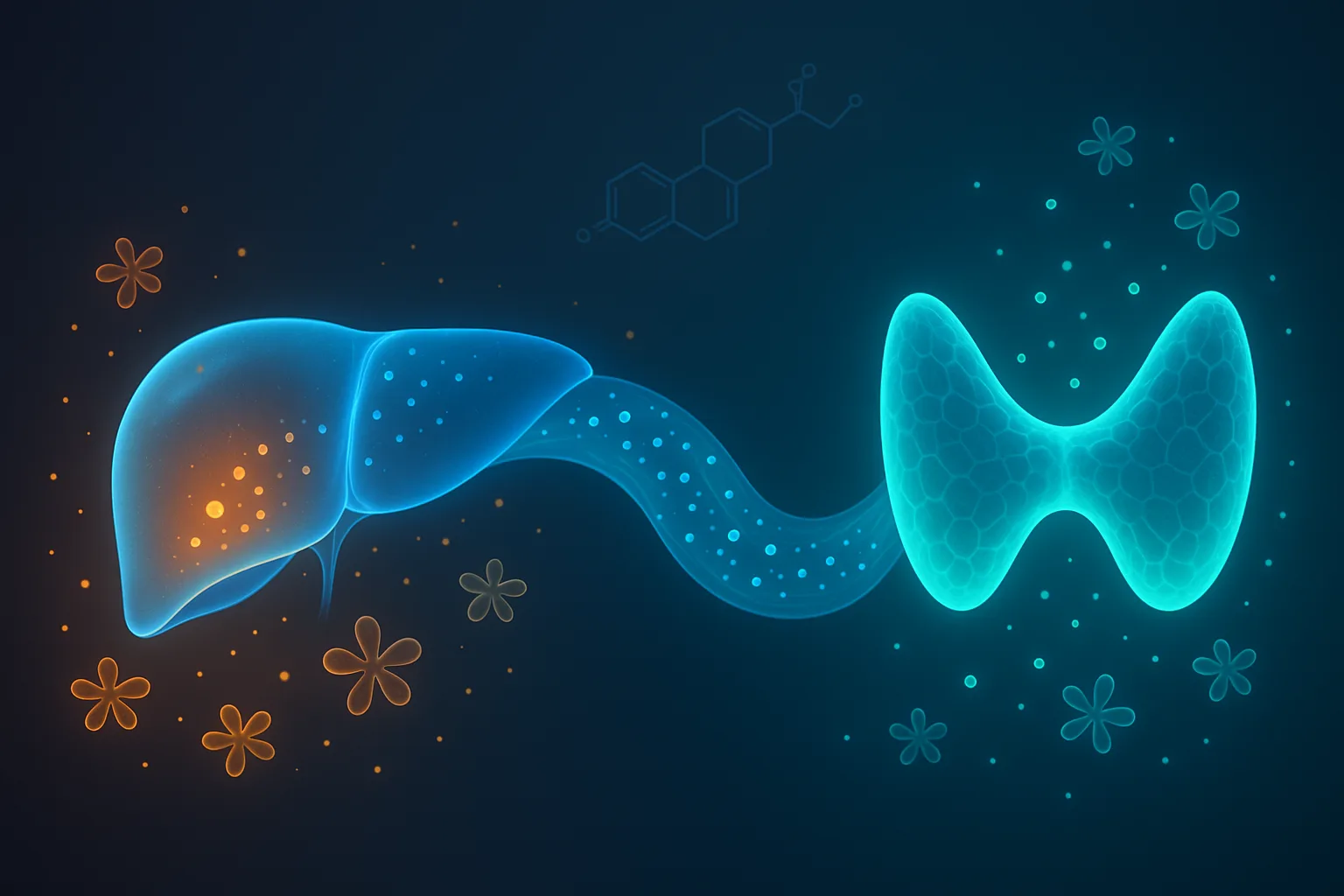
Key Takeaways: Oral estrogen raises thyroxine-binding globulin (TBG) in the liver, which binds up more circulating T4 and lowers the free, active fraction. Women on levothyroxine for hypothyroidism often need a 25 to 50 percent dose increase within 6 to 12 weeks of starting oral HRT. Transdermal estrogen -- patch, gel, cream, or pellet -- bypasses the liver and does not meaningfully change thyroid dosing in most women. Recheck TSH and free T4 about 6 to 8 weeks after starting or stopping oral HRT, or after switching between oral and transdermal estrogen. The route of estrogen matters more than the dose for this interaction.
The Interaction Most Women Are Never Told About
Hypothyroidism affects roughly 1 in 8 women, and the rate climbs in midlife. Many women on levothyroxine have spent years dialing in their dose, and a stable thyroid is part of their baseline. Then perimenopause arrives, hot flashes get worse, sleep falls apart, and hormone replacement therapy enters the conversation.
What rarely gets explained: starting oral estrogen can quietly push their thyroid status back into a hypothyroid state, even with no change in levothyroxine dose. The numbers on the lab report shift, free T4 drops, TSH creeps up, and within a couple of months the woman feels worse -- often blaming menopause when the actual problem is that her thyroid replacement is no longer adequate for her new hormonal context.
This is one of the most well-characterized but under-explained drug interactions in midlife women's health. The mechanism is straightforward, the lab evidence is clear, and the solution is simple if anyone bothers to mention it. The route of estrogen administration controls almost the entire effect.
The Mechanism: TBG and First-Pass Hepatic Effects
Thyroid hormone in the bloodstream travels almost entirely bound to carrier proteins. About 75 percent rides on thyroxine-binding globulin (TBG), the rest split between transthyretin and albumin. Only the tiny unbound fraction -- about 0.03 percent of total T4 -- is biologically active.
Estrogen tells the liver to make more TBG. When TBG rises, the bound fraction of T4 rises, and the free fraction drops until the system reaches a new equilibrium. In women without a thyroid problem, the thyroid gland senses the drop in free T4 and ramps up production -- the system self-corrects within weeks.
Women on levothyroxine cannot self-correct. They are not producing their own thyroid hormone in any meaningful amount. Their daily levothyroxine dose was calibrated to a specific TBG level. When estrogen raises TBG, the same dose no longer supplies enough free, active thyroid hormone. They drift into under-replacement.
Why Route Matters: The First-Pass Effect
The size of this effect depends almost entirely on how estrogen reaches the liver.
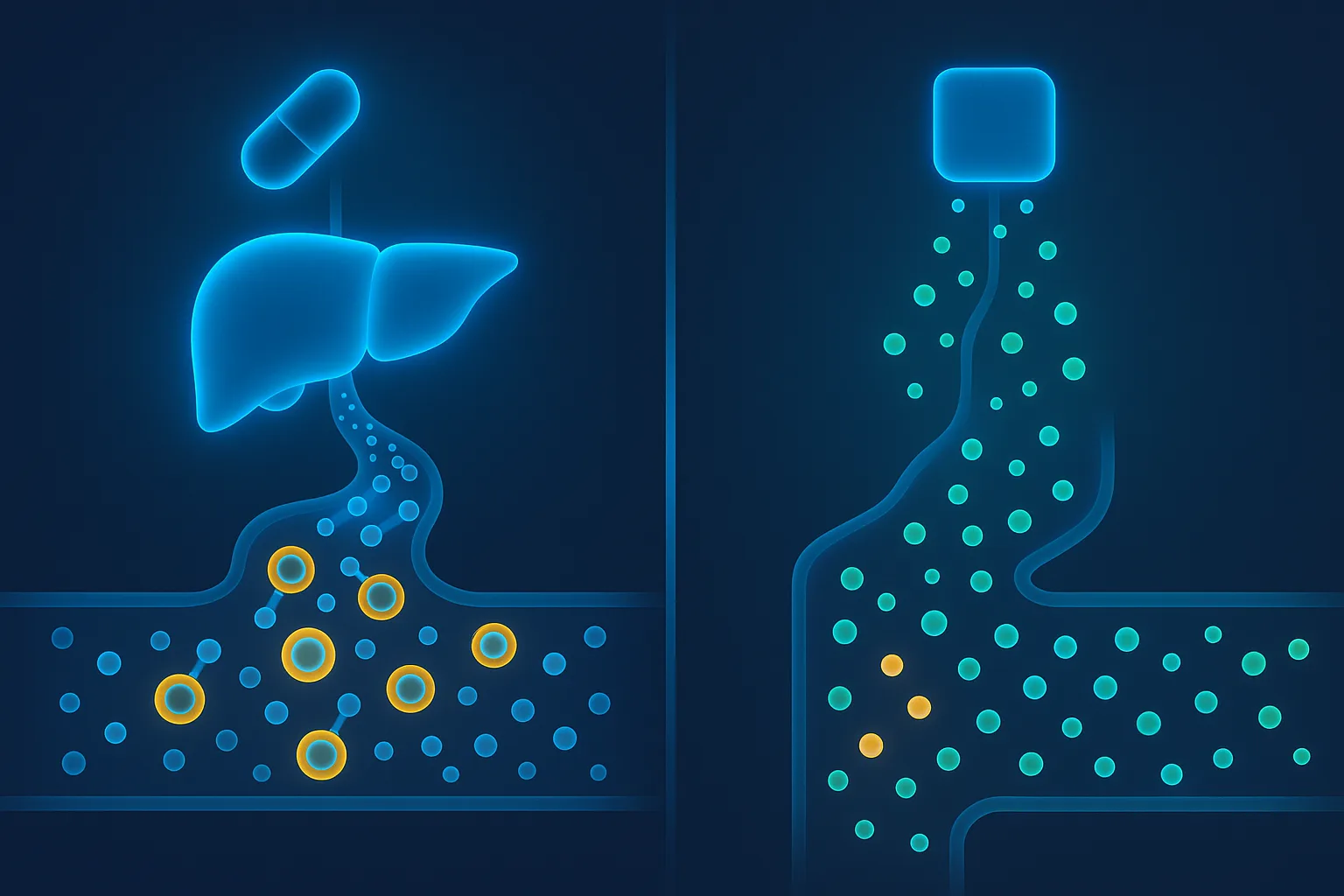
Oral estrogen is absorbed from the gut and travels through the portal vein straight to the liver before entering general circulation. The liver sees a high concentration of estrogen with every oral dose. In response, it ramps up production of TBG, sex hormone-binding globulin (SHBG), cortisol-binding globulin, ceruloplasmin, and several clotting factors. These are well-known first-pass hepatic effects of oral estrogen.
Transdermal estrogen -- patches, gels, creams, sprays, and pellets -- enters systemic circulation through the skin. The liver sees estrogen at the same concentration as every other organ, not the spike that oral dosing produces. TBG does not meaningfully rise.
This is not a small distinction. Multiple studies have measured TBG before and after oral versus transdermal estrogen in postmenopausal women. The oral route can roughly double TBG concentrations within weeks. The transdermal route produces minimal change. The dose of levothyroxine needed to maintain target free T4 follows the same pattern -- women on oral estrogen often need 25 to 50 percent more, women on transdermal estrogen typically need no change.
What the Lab Numbers Actually Do
Following a stable levothyroxine-replaced woman through the start of oral HRT, the typical pattern over 8 to 12 weeks looks like this:
- Week 0 (baseline before HRT). TSH 1.5 mIU/L, free T4 1.1 ng/dL, on 100 mcg levothyroxine daily. Patient feels well, no thyroid symptoms.
- Week 2 to 4. Oral estrogen started. TBG begins rising. No symptoms yet -- the change is subclinical.
- Week 4 to 8. Free T4 drifts down, TSH rises. Some women start noticing fatigue, cold intolerance, slight weight gain, or returning brain fog. These get attributed to menopause or to the HRT itself.
- Week 6 to 12. TBG approaches new steady state. TSH commonly lands in the 3 to 6 mIU/L range from a baseline near 1.5. Free T4 sits below the prior target.
- After dose adjustment. Levothyroxine increased by 25 to 50 percent. Repeat TSH and free T4 6 weeks after the change to confirm return to target.
The numbers reverse when women switch from oral to transdermal estrogen, or stop oral estrogen. TBG falls back toward baseline over similar time courses, and the levothyroxine dose needs to come back down. Failure to reduce levothyroxine at that point produces over-replacement -- low TSH, symptoms of hyperthyroidism, atrial arrhythmia risk in older women, and bone density loss with long-term over-replacement.
Free T4 vs Total T4
This is also why free T4 is the better monitoring lab in women on HRT. Total T4 measures all the bound and unbound hormone together. When TBG rises, total T4 rises with it, even though the active free fraction is falling. A doctor checking only total T4 in a woman who just started oral HRT can mistakenly read the numbers as reassuring while the patient is actually drifting into under-replacement. Free T4 -- the direct measurement of the active fraction -- and TSH together give the accurate picture.
Practical Protocol for Women on Levothyroxine Starting HRT
The clinical handling is straightforward once the mechanism is understood. The protocol below reflects the way endocrinologists and experienced menopause clinicians typically manage this.
If You Are Already on Levothyroxine and Considering HRT
The simplest path is to choose transdermal estrogen from the start -- patch, gel, cream, or pellet -- which avoids the interaction almost entirely. Transdermal estrogen also has independent advantages for cardiovascular and venous thromboembolism risk, particularly for women over 60 or with risk factors. The thyroid simplicity is a real bonus on top of those advantages.
If oral estrogen is preferred for cost, formulary, or other reasons, the protocol is:
- Baseline TSH and free T4 the week before starting HRT
- Start oral estrogen at the planned dose
- Recheck TSH and free T4 at 6 to 8 weeks
- Adjust levothyroxine if TSH has risen above target or free T4 has fallen below target
- Recheck again 6 weeks after any dose change to confirm stable replacement
This is a known, manageable adjustment -- not a contraindication to oral HRT for women who prefer it. But women need to be told it is coming.
If You Are Already on Levothyroxine and Switching Estrogen Route
Switching from oral to transdermal estrogen, or vice versa, triggers the same interaction in reverse. Recheck thyroid labs 6 to 8 weeks after the switch and adjust accordingly. Going from oral to transdermal estrogen frequently means dropping levothyroxine by 25 to 50 percent.
If You Develop Hypothyroid Symptoms After Starting HRT
Returning fatigue, weight gain, cold intolerance, constipation, dry skin, or brain fog after starting oral HRT should prompt thyroid retesting rather than HRT discontinuation. The fix is almost always a levothyroxine dose increase, not stopping the HRT.
Special Cases
- Women with hypothyroidism not yet on replacement. Subclinical hypothyroidism that did not require treatment before HRT may declare itself after oral estrogen starts. The bar for initiating thyroid replacement shifts slightly.
- Women with prior thyroid cancer. TSH suppression targets are tighter. These women need closer monitoring with any estrogen route, but particularly with oral.
- Women on combination thyroid replacement (T4 plus T3). The TBG effect is mostly on T4. Free T3 is less bound and less affected, so dose adjustments tend to focus on the T4 component.