TRT raises creatinine in most men — but it usually signals muscle gain, not kidney damage. How to read eGFR, when to worry, and when to request cystatin C.
This article explains why serum creatinine and eGFR change on testosterone replacement therapy, when those changes are benign, and when they warrant further evaluation. It is not medical advice. TRT requires a licensed prescriber for individual risk assessment, monitoring, and dose adjustments.
You start TRT. Three months later, your bloodwork comes back with a creatinine level that has crept up and an eGFR that has dropped below where it was at baseline. Your clinic flags it. You search "TRT kidney damage" and find a mix of reassurance and alarm. Here is what the clinical data actually shows.
Why Creatinine Rises on TRT
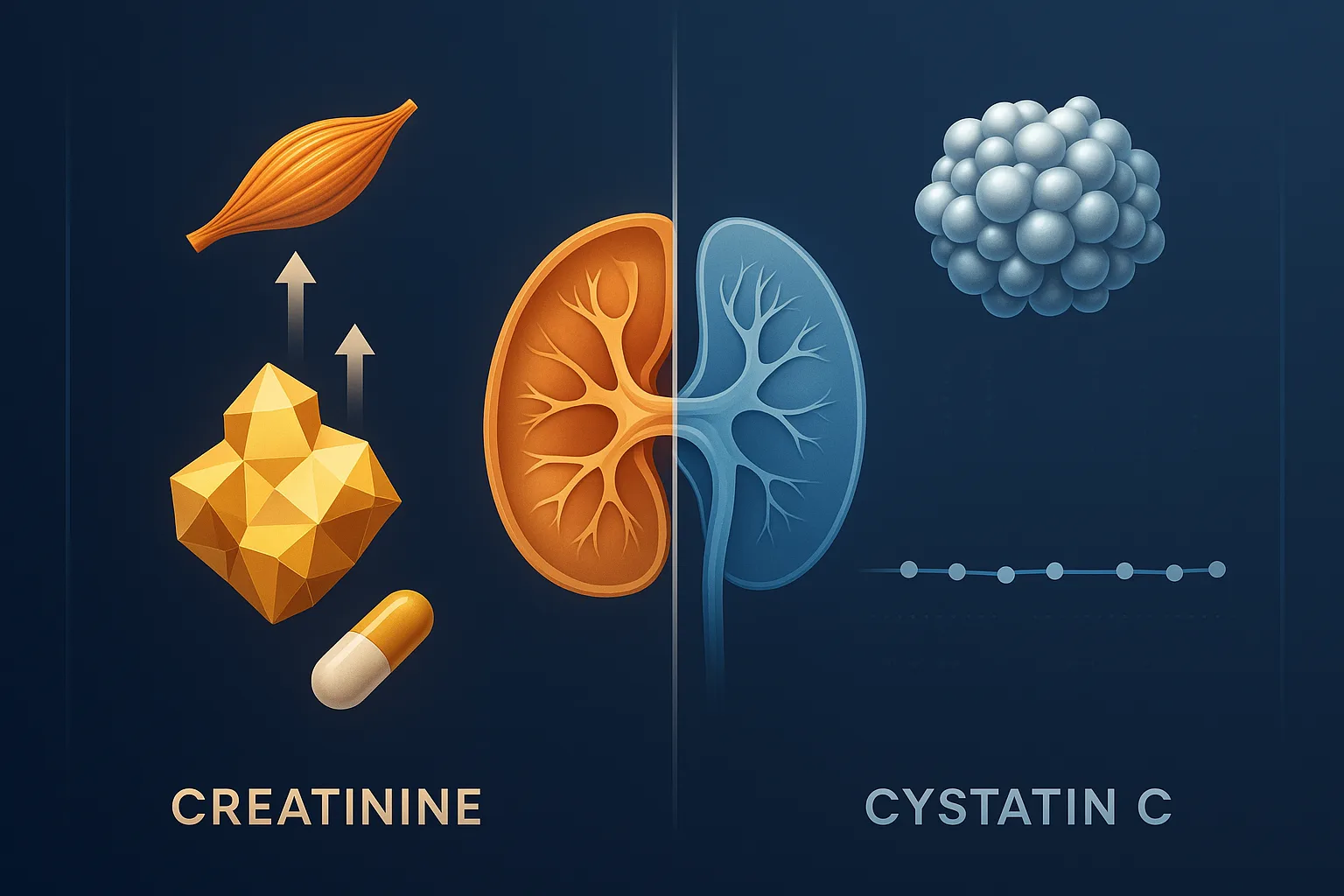
Creatinine is the metabolic end-product of creatine phosphate breakdown in skeletal muscle. The more muscle you carry, the more creatinine your body produces every day. This relationship is direct and well-established in renal physiology.
Testosterone replacement therapy increases lean body mass. Clinical trials consistently demonstrate 2-5 kg of lean mass gain in the first 6-12 months of TRT, even in men who do not resistance-train. In men who lift, the gains can be larger. More muscle means more daily creatinine production, which means higher serum creatinine on your next blood draw.
This is not kidney damage. It is a measurement artifact. Your kidneys are filtering the same amount of blood. The input to the filter increased.
The Numbers
Published data on TRT and creatinine show a consistent pattern:
Mean serum creatinine increase on TRT: 0.05 to 0.15 mg/dL above pre-treatment baseline in the first 6-12 months
Timeline: creatinine typically rises within the first 3-6 months and plateaus by 12-18 months as lean mass stabilizes
Magnitude: small enough that most values remain within the standard reference range (0.7-1.3 mg/dL), but large enough to trigger automated lab flags in men who started near the upper end
A 2021 observational cohort study following hypogonadal men on long-term testosterone therapy found that initial creatinine elevations plateaued after the first year, with no progressive increase suggesting renal deterioration over follow-up periods exceeding five years.
Estimated glomerular filtration rate — eGFR — is the number your lab report uses to summarize kidney function. It is calculated from serum creatinine using the CKD-EPI equation, which adjusts for age and sex. The equation assumes that creatinine production is roughly constant for a given person. That assumption breaks down on TRT.
When TRT raises your creatinine through increased muscle mass, the CKD-EPI equation interprets the higher creatinine as reduced kidney filtration. The result is a falsely low eGFR. A man whose true kidney function is perfectly normal at 95 mL/min might see his calculated eGFR drop to 78-85 mL/min purely because he gained 4 kg of lean mass on testosterone therapy.
This is not a theoretical concern. A 2023 study published in the Journal of Clinical Nephrology on the impact of muscle mass on creatinine-based eGFR found that muscular individuals had systematically lower calculated eGFR values than their actual measured GFR. The mismatch was clinically significant — large enough to misclassify healthy patients into chronic kidney disease stages they do not belong in.
What to Do About It
If your creatinine-based eGFR has dropped since starting TRT and you want to know whether it reflects real kidney function changes:
Request a cystatin C level. Cystatin C is a small protein produced at a constant rate by all nucleated cells. Its production is not affected by muscle mass, testosterone, or diet. An eGFR calculated from cystatin C (the CKD-EPI cystatin C equation) gives a much more accurate picture of true kidney filtration in men on TRT.
Get a urinalysis. The simplest screening test for kidney damage is a urine dipstick for protein (albuminuria) and blood. If your urinalysis is clean — no protein, no blood — the probability of significant kidney disease is very low regardless of what the creatinine-based eGFR says.
Compare to pre-TRT baseline. A creatinine increase of 0.1-0.2 mg/dL from a known pre-TRT baseline, in a man who has gained lean mass, is expected and benign. A creatinine increase of 0.5 mg/dL or more, or a jump from 1.0 to 1.5 mg/dL, warrants investigation.
When Creatinine Changes Are Not Benign
While most creatinine elevations on TRT are harmless measurement artifacts, there are situations where kidney function genuinely needs attention:
Red Flags That Warrant Investigation
Creatinine rising more than 30% above pre-TRT baseline without proportional lean mass gain
Protein in the urine (albuminuria) on urinalysis
Blood in the urine (hematuria) — this can also be caused by polycythemia, which is itself a TRT side effect worth monitoring
eGFR below 60 mL/min on a cystatin C-based calculation — this suggests true kidney filtration impairment regardless of muscle mass
Pre-existing risk factors including diabetes, uncontrolled hypertension, chronic NSAID use, or a family history of kidney disease
TRT-Adjacent Risks to Kidney Health
Several things commonly associated with TRT protocols can independently affect kidney function:
Polycythemia and blood viscosity. TRT raises hematocrit in most men. Severely elevated hematocrit (above 54%) increases blood viscosity, which can reduce renal blood flow and stress the kidneys over time. This is why disciplined TRT clinics monitor hematocrit every 3-6 months and have clear protocols for therapeutic phlebotomy when it exceeds thresholds.
NSAID use. Men who train hard on TRT often use ibuprofen or naproxen for joint pain and delayed-onset muscle soreness. Chronic NSAID use is a well-established cause of kidney injury. If you are on TRT and your creatinine is rising, NSAIDs should be the first thing to audit — not the testosterone.
Creatine supplementation. Oral creatine monohydrate (a common supplement on TRT protocols) increases serum creatinine because creatine is metabolized to creatinine. This is yet another source of measurement artifact on top of the muscle-mass effect. Men taking 5 g/day of creatine can expect an additional 0.1-0.3 mg/dL creatinine elevation that has nothing to do with kidney function.
Dehydration. Concentrated blood samples from dehydration produce artificially high creatinine values. Men on TRT should ensure adequate hydration before bloodwork draws.
The Monitoring Protocol That Works
The best TRT clinics build kidney function monitoring into their standard bloodwork cadence without over-reacting to expected creatinine changes. Here is what a proper monitoring protocol looks like:
Baseline (Before Starting TRT)
Serum creatinine and eGFR — establishes your personal reference point
Urinalysis — screens for pre-existing proteinuria or hematuria
Cystatin C (optional but valuable) — provides a muscle-mass-independent baseline GFR
3-6 Months After Starting TRT
Serum creatinine — compare to baseline
Expected finding: creatinine 0.05-0.15 mg/dL higher than baseline as lean mass increases
If creatinine increased and eGFR dropped: add cystatin C and urinalysis before making any protocol changes
If cystatin C eGFR is normal and urinalysis is clean: document and continue monitoring
Annually Thereafter
Creatinine as part of CMP at every routine blood draw
Cystatin C annually for men whose creatinine-based eGFR dropped below 75 mL/min after starting TRT
Urinalysis annually for men over 50 or those with diabetes, hypertension, or other kidney risk factors
When to Refer to Nephrology
eGFR below 60 mL/min on cystatin C-based calculation (confirmed on two measurements)
Persistent proteinuria (albumin-to-creatinine ratio above 30 mg/g on two separate urine samples)
Creatinine rising progressively over multiple blood draws without stabilizing
Concurrent uncontrolled diabetes or hypertension
What the Research Actually Shows About TRT and Kidneys
The clinical evidence on TRT and kidney function is reassuring for men with normal baseline renal function:
VA retrospective analysis (Veterans Affairs, 2020). A study of hypogonadal veterans with chronic kidney disease found that testosterone normalization was associated with delayed CKD progression compared to untreated controls. Men whose testosterone levels were restored to the normal range had slower eGFR decline over the follow-up period.
Long-term observational registry (Traish et al., 2021). A prospective registry of hypogonadal men on long-term testosterone therapy reported improvements in metabolic markers including serum uric acid and creatinine stabilization over follow-up periods exceeding five years. No progressive kidney function deterioration was observed.
Mendelian randomization (UK Biobank). A bidirectional Mendelian randomization study found that genetically predicted testosterone was associated with slightly higher creatinine but no causal association with impaired kidney function when measured by cystatin C-based GFR. This supports the hypothesis that the testosterone-creatinine relationship is mediated by muscle mass, not kidney damage.
TRAVERSE trial kidney safety. The TRAVERSE cardiovascular safety trial (5,246 men, median follow-up 33 months) included renal adverse events in its safety monitoring. No excess kidney injury signal was detected in the testosterone arm compared to placebo.
The weight of evidence is consistent: TRT at physiologic replacement doses does not cause kidney damage in men with normal baseline kidney function. The creatinine increase is real but reflects muscle metabolism, not nephrotoxicity.
Practical Steps for Your Next Blood Draw
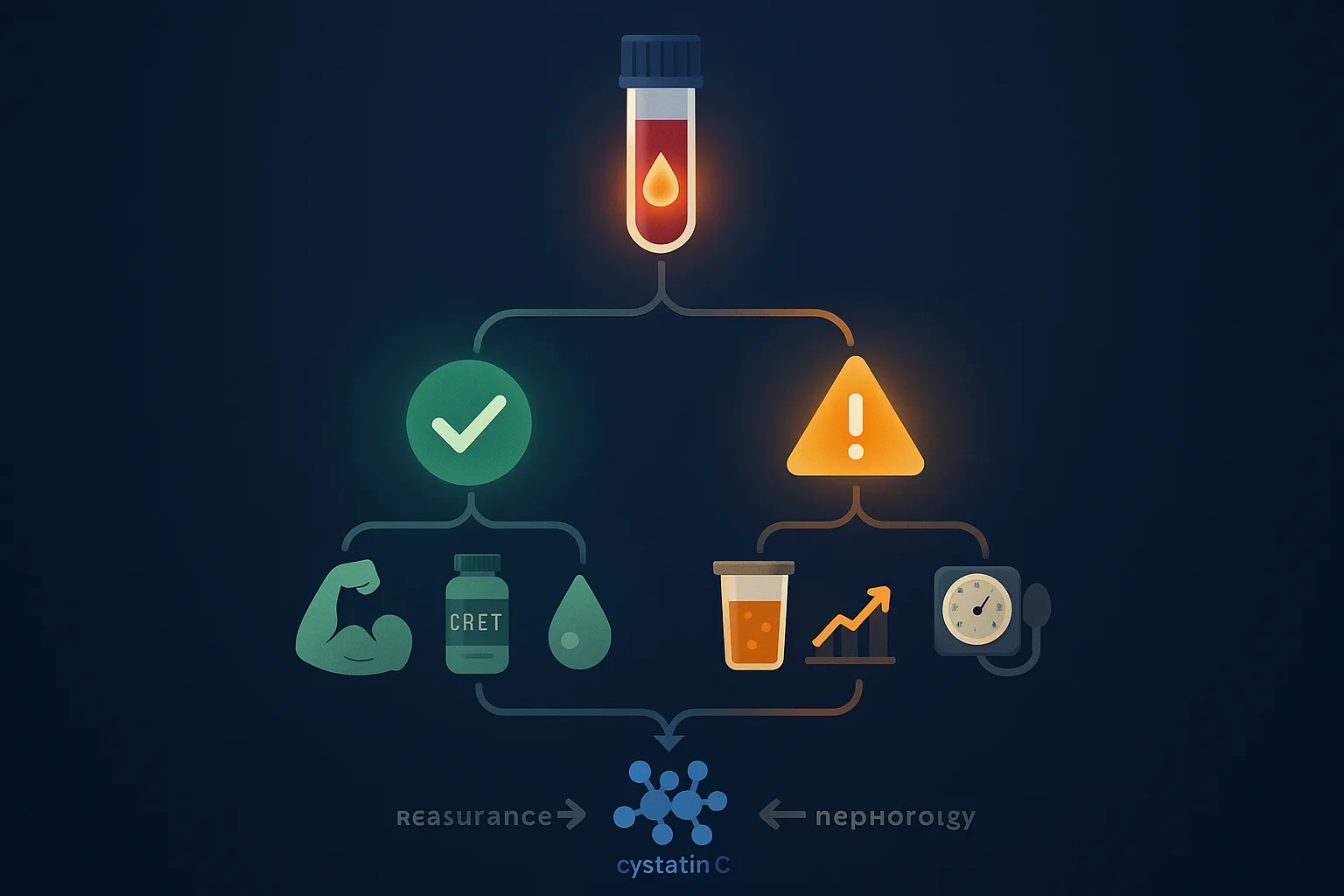
If you are on TRT and your creatinine is flagged high or your eGFR looks lower than expected, here is the decision tree:
Compare to your pre-TRT baseline. If creatinine went from 1.0 to 1.15 mg/dL and you have gained lean mass — that is expected. If it went from 1.0 to 1.5 mg/dL — that needs investigation.
Check the hydration context. Were you fasted and slightly dehydrated for the blood draw? A repeat test in a well-hydrated state can resolve borderline values.
Audit your supplements. If you take creatine monohydrate, that alone can add 0.1-0.3 mg/dL to your serum creatinine. Not a kidney problem.
Audit your NSAID use. Chronic ibuprofen and naproxen are far more likely to cause genuine kidney function changes than testosterone.
Request cystatin C. This is the definitive test. If your cystatin C-based eGFR is above 90 mL/min, your kidneys are fine regardless of what the creatinine-based number says.
Get a urinalysis. Clean urine — no protein, no blood — is strong evidence against significant kidney disease.
If your TRT clinic panics about a creatinine increase without checking cystatin C, urinalysis, or clinical context, that is a red flag about their sophistication, not about your kidneys. Clinics that understand TRT pharmacology know that creatinine rises are expected and have protocols to distinguish harmless measurement artifacts from genuine kidney signals.
Scholars Direct. "Testosterone Replacement Therapy (TRT) is Associated with Delayed Progression of Chronic Kidney Disease: A Retrospective Analysis of Testosterone Normalization in US Veterans." Annals of Nephrology and Renal Therapy, 2020. scholars.direct/Articles/nephrology/anp-5-014
Traish AM, et al. "Long-term Testosterone Therapy Improves Renal Function in Men with Hypogonadism: A Real-life Prospective Controlled Registry." Journal of Clinical Nephrology and Research, 2021. jscimedcentral.com
Schooling CM, et al. "The role of testosterone in chronic kidney disease and kidney function in men and women: a bi-directional Mendelian randomization study in the UK Biobank." BMC Nephrology, 2020. PMC7271464
Moranne O, et al. "Impact of Muscle Mass on the Performance of Creatinine-Based eGFR Equations and Mortality Risk Assessment After Kidney Transplantation." Nephrology Dialysis Transplantation, 2023. PMC12478446
Bhasin S, et al. "TRAVERSE: Testosterone Replacement Therapy for Assessed Cardiovascular Risk in Hypogonadal Men." New England Journal of Medicine, 2023. NCT03518034.
Grubb A, et al. "Questionable Validity of Creatinine-Based eGFR in Elderly Patients but Cystatin C Is Helpful in First-Line Diagnostics." Diagnostics, 2023. PMC10742602
Yeo S, et al. "Sex Differences in the Association Between Serum Testosterone and Kidney Function in the General Population." Scientific Reports, 2023. PMC10334405
No evidence from clinical trials or observational registries shows that physiologic-dose TRT causes kidney damage in men with normal baseline renal function. The creatinine increase seen on TRT is overwhelmingly attributed to testosterone-driven muscle mass gains, which raise creatinine production independent of kidney filtration. A VA registry study of hypogonadal veterans found TRT was associated with delayed progression of chronic kidney disease, not acceleration.
Why does my creatinine go up on TRT?
Creatinine is a waste product of muscle metabolism. When TRT increases your lean mass — even modestly — your muscles produce more creatinine daily. This higher creatinine production raises serum creatinine on blood tests without any change in how well your kidneys filter. It is a measurement artifact, not kidney dysfunction.
Should I worry about a low eGFR on TRT?
Not automatically. Standard eGFR formulas use serum creatinine as the primary input. Since TRT raises creatinine through increased muscle mass, the formula calculates a falsely low eGFR. If your eGFR dropped 5-15 mL/min after starting TRT but you have no other kidney risk factors and your urinalysis is clean, the drop is almost certainly from the creatinine production increase. Ask your clinician about cystatin C-based eGFR for confirmation.
What is cystatin C and why is it better on TRT?
Cystatin C is a protein produced by all nucleated cells at a constant rate. Unlike creatinine, its production is not affected by muscle mass, diet, or testosterone levels. An eGFR calculated from cystatin C gives a more accurate picture of true kidney filtration in muscular men and in men on TRT. The 2012 CKD-EPI cystatin C equation is the standard alternative.
When should I actually worry about kidney function on TRT?
Worry if creatinine rises more than 30 percent from your pre-TRT baseline without an obvious muscle-mass explanation, if your urinalysis shows protein or blood, if eGFR drops below 60 mL/min on a cystatin C-based calculation, or if you have risk factors like diabetes, hypertension, or NSAID overuse. Any of these warrants a nephrology referral, not just a repeat creatinine test.