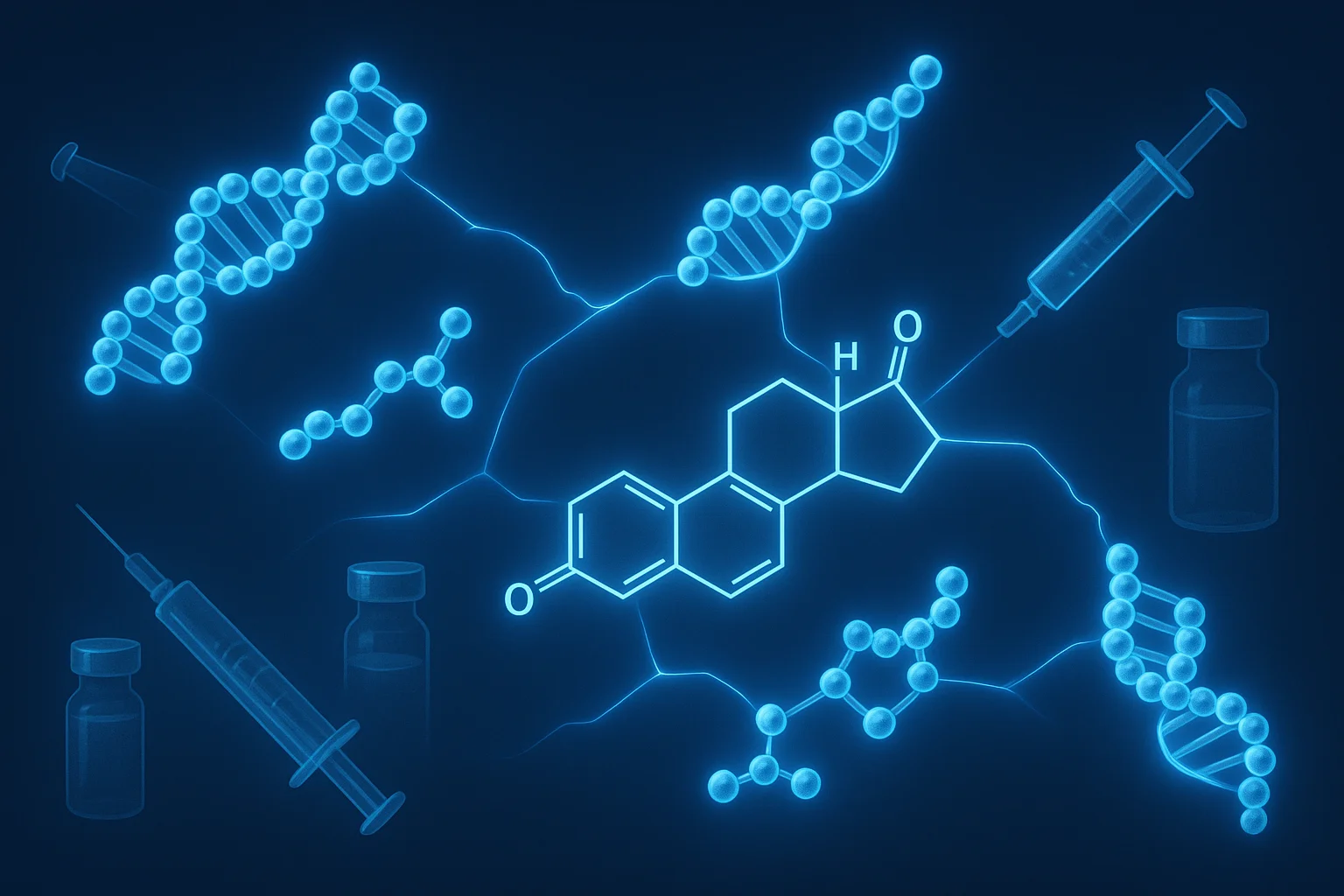
Testosterone replacement therapy addresses one piece of a larger hormonal picture. It restores testosterone to optimal levels, but it does not directly improve growth hormone output, accelerate soft tissue healing, or enhance neurological recovery. Peptides fill those gaps.
The men getting the best results from TRT in 2026 are not just injecting testosterone. They are layering in targeted peptides that amplify body composition changes, speed recovery from training, and address specific issues that testosterone alone cannot fix. This guide covers the most evidence-backed peptides used alongside TRT, with practical dosing and stacking protocols.
Why Peptides and TRT Work Synergistically
TRT optimizes the androgenic environment. Your muscles get stronger signaling to grow, your bones get denser, your red blood cell production increases. But testosterone does not meaningfully raise growth hormone levels, does not accelerate tendon or ligament repair, and has limited effects on connective tissue remodeling.
Peptides are short amino acid chains that signal specific receptors in the body. Unlike anabolic steroids, most therapeutic peptides work through the body's own signaling pathways rather than overriding them. This makes the combination with TRT complementary rather than redundant.
The practical result: TRT builds the anabolic base, and peptides extend the benefits into areas testosterone cannot reach. Growth hormone peptides improve fat loss and sleep. Healing peptides fix the joints and tendons that take a beating from heavier training on TRT. Sexual function peptides work through entirely different pathways than testosterone.
Growth Hormone Secretagogues: CJC-1295 and Ipamorelin
The most popular peptide combination in TRT clinics is CJC-1295 with Ipamorelin. These two peptides work through different but complementary mechanisms to stimulate your pituitary gland to release more growth hormone.
CJC-1295 is a growth hormone releasing hormone (GHRH) analog. It mimics the natural signal that tells your pituitary to produce GH. On its own, it raises baseline GH levels but produces a relatively blunt pulse.
Ipamorelin is a ghrelin mimetic (growth hormone secretagogue). It amplifies the GH pulse by acting on a completely different receptor. Ipamorelin is selective for GH release, meaning it does not significantly raise cortisol or prolactin like older secretagogues such as GHRP-6.
Combined, they produce GH pulses 3-5 times larger than either peptide alone. The clinical effects men report on TRT plus this combination include:
Improved body composition (more fat loss, particularly visceral fat)
Better sleep quality and deeper slow-wave sleep
Faster recovery between training sessions
Improved skin elasticity and appearance
Enhanced training capacity
Typical dosing: 100mcg CJC-1295 + 100mcg Ipamorelin, injected subcutaneously 2-3 times daily. Most protocols call for dosing on an empty stomach, with the most important dose given 30-60 minutes before bed to amplify the natural nighttime GH pulse. A common starting protocol is twice daily (morning and bedtime) for 8-12 weeks, followed by 4 weeks off.
Sermorelin: The Clinic-Friendly GH Option
Sermorelin is a 29-amino acid GHRH analog that has been used clinically since the 1990s. Many TRT clinics prescribe it as a first-line growth hormone peptide because of its long safety track record and FDA history (it was previously FDA-approved for pediatric GH deficiency).
Sermorelin stimulates GH release through the same GHRH receptor as CJC-1295, but with a shorter half-life of 10-20 minutes. This means it produces a more physiological GH pulse pattern rather than sustained elevation.
Typical dosing: 200-300mcg injected subcutaneously before bed, 5 days on and 2 days off. Some clinics prescribe up to 500mcg nightly. The before-bed timing is critical because sermorelin works synergistically with the natural nocturnal GH surge.
Men on TRT who add sermorelin commonly report improved sleep within the first 1-2 weeks, with body composition changes becoming noticeable by weeks 4-8. It is generally considered the most conservative entry point into GH peptides.
BPC-157: The Healing Peptide
BPC-157 (Body Protection Compound-157) is a 15-amino acid peptide derived from a protective protein found in gastric juice. It has become one of the most widely used peptides among men on TRT for a specific reason: heavier training loads accelerate joint and tendon wear.
When testosterone levels are optimized, men train harder. They lift heavier weights, recover faster between sessions muscularly, and push through discomfort they previously avoided. The problem is that tendons, ligaments, and joint capsules adapt far more slowly than muscle tissue. BPC-157 directly addresses this gap.
Research in animal models shows BPC-157 accelerates healing of tendons, ligaments, muscles, and the gut lining. It works through several mechanisms:
Upregulation of growth hormone receptors in injured tissue
Enhanced formation of new blood vessels (angiogenesis) at injury sites
Modulation of nitric oxide pathways
Acceleration of tendon-to-bone healing
Typical dosing: 250-500mcg per day, injected subcutaneously. Many users inject near the site of injury for localized effect, though systemic (abdominal) injection also works. Protocols typically run 4-8 weeks for a specific injury, or ongoing at lower doses (250mcg/day) for general joint support during heavy training blocks.
BPC-157 is often stacked with TB-500 for enhanced healing, a combination commonly referred to as the "recovery stack."
Thymosin Beta-4 (TB-500): Systemic Healing and Hair Support
TB-500 is a 43-amino acid peptide that plays a role in cell migration, blood vessel formation, and tissue repair throughout the body. Where BPC-157 tends to work more locally, TB-500 has broader systemic effects.
The most compelling use case alongside TRT is its dual role in healing and hair maintenance. Testosterone, particularly when it converts to DHT, can accelerate hair loss in genetically susceptible men. TB-500 has shown potential to support hair follicle function through its effects on stem cell migration and differentiation.
Beyond hair, TB-500 promotes healing of muscles, tendons, and ligaments through:
Promotion of cell migration to injured areas
Reduction of inflammatory cytokines
Regulation of actin, a protein critical for cell structure and movement
Decreased scar tissue formation
Typical dosing: Loading phase of 2.5-5mg per week (split into 2-3 injections) for 4-6 weeks, followed by a maintenance dose of 2.5mg every two weeks. Subcutaneous injection in the abdomen is the standard route.
TB-500 and BPC-157 combined cover both local and systemic healing pathways. Many TRT clinics now offer this combination as a standard add-on for men who train regularly.
PT-141 (Bremelanotide): Sexual Function Enhancement
PT-141 works through the melanocortin system in the brain, making it fundamentally different from PDE5 inhibitors like sildenafil or tadalafil. While PDE5 inhibitors increase blood flow mechanically, PT-141 enhances sexual desire and arousal at the neurological level.
This distinction matters for men on TRT. Testosterone typically improves libido significantly, but some men still experience situational erectile issues or want enhanced arousal beyond what optimized testosterone provides. PT-141 addresses the "want to" side of the equation rather than just the "able to" side.
PT-141 activates melanocortin-4 receptors (MC4R) in the hypothalamus, triggering a cascade that increases sexual desire, arousal, and erectile function. Clinical trials showed statistically significant improvements in erectile function and sexual satisfaction compared to placebo.
Typical dosing: 1.75mg injected subcutaneously 30-60 minutes before anticipated sexual activity. It should not be used more than 8 times per month, and not more than once in 24 hours. Common side effects include temporary nausea (in about 40% of users at first use) and facial flushing. The nausea typically diminishes with subsequent uses.
PT-141 is not an everyday peptide. It is used on-demand and works well as part of a broader TRT protocol for men who want peak sexual performance beyond what testosterone optimization alone provides.
GHK-Cu: Skin and Tissue Repair
GHK-Cu (glycyl-L-histidyl-L-lysine copper complex) is a naturally occurring tripeptide that declines significantly with age. At age 20, plasma GHK-Cu levels are around 200 ng/mL. By age 60, they drop to approximately 80 ng/mL.
This peptide attracts interest from men on TRT who want to address visible aging alongside hormonal optimization. GHK-Cu stimulates collagen synthesis, promotes skin remodeling, and has antioxidant properties. It is available in both injectable and topical forms.
Injectable dosing: 1-2mg per day subcutaneously, typically in 4-week cycles. Topical use: Applied as a serum or cream to the face and neck, 1-2 times daily. Topical GHK-Cu is widely available without prescription and is the most accessible peptide on this list.
The effects are subtle but cumulative. Men typically notice improved skin texture and firmness after 4-8 weeks of consistent use. It pairs well with the broader anti-aging effects of optimized testosterone and growth hormone peptides.
Stacking Considerations: Timing and Priority
Not every man needs all of these peptides. Here is how to prioritize based on your goals:
Tier 1 (highest impact for most men on TRT):
CJC-1295/Ipamorelin or Sermorelin for GH optimization
Tier 2 (add based on specific needs):
BPC-157 + TB-500 if you train hard and have joint or tendon issues
PT-141 if sexual function enhancement beyond TRT is desired
Tier 3 (quality of life additions):
GHK-Cu for skin and anti-aging
Timing matters. GH peptides should be taken on an empty stomach, ideally 2+ hours after your last meal. The pre-bed dose is the most important. BPC-157 can be taken any time, with or without food. PT-141 is used on-demand only.
When running multiple peptides, separate GH secretagogue injections from food by at least 30 minutes. BPC-157 and TB-500 can be combined in the same syringe. Do not mix GH peptides with other peptides in the same syringe unless specifically advised by your prescriber.
A practical daily schedule for someone running GH peptides and a recovery stack:
Time
Peptide
Dose
Morning (fasted)
CJC-1295 + Ipamorelin
100mcg + 100mcg
Post-training
BPC-157 (+ TB-500 on loading days)
250mcg (+ 1mg)
Before bed (2+ hrs after food)
CJC-1295 + Ipamorelin
100mcg + 100mcg
Legal Status and Sourcing
The regulatory landscape for peptides has shifted significantly. As of 2026, many peptides exist in a gray area between fully approved pharmaceuticals and unregulated research chemicals.
Compounding pharmacies are the most reliable legal source for peptides used alongside TRT. Many TRT clinics work with 503A or 503B compounding pharmacies that produce peptides to pharmaceutical standards. When your TRT clinic prescribes a peptide, it is typically filled by one of these pharmacies.
Telehealth TRT clinics have increasingly added peptide protocols to their offerings. This is the easiest path for most men: your existing TRT provider can evaluate you for peptide therapy, write the prescription, and ship the peptides along with your testosterone. Many of the clinics in our comparison now offer peptide add-ons alongside TRT.
Research peptides are available from various online vendors, but quality varies dramatically. Without third-party testing and certificates of analysis, there is no guarantee of purity or accurate dosing. If you go this route, demand current batch-specific COAs from an independent lab.
Always disclose all peptides to your prescribing physician
Get baseline bloodwork before starting any peptide protocol
Cycle GH peptides (8-12 weeks on, 4 weeks off) rather than running indefinitely
Start with one peptide at a time so you can identify what is working and what causes side effects
Store reconstituted peptides in the refrigerator and use within 30 days
The combination of TRT and targeted peptides represents a meaningful step beyond testosterone optimization alone. Start with GH peptides if body composition and recovery are your primary goals, add healing peptides if you train hard, and layer in specialty peptides as specific needs arise. Work with a knowledgeable provider who can monitor your progress and adjust protocols based on your individual response.
This content is for informational purposes only and is not medical advice. Consult a qualified healthcare provider before starting any treatment.
Frequently Asked Questions
Which peptides work best with TRT?
Growth hormone releasing peptides (Ipamorelin, CJC-1295) and recovery peptides (BPC-157, TB-500) are commonly used alongside TRT for enhanced results.
Is it safe to combine peptides with TRT?
Yes, most therapeutic peptides are safe to use with TRT under medical supervision, and many work synergistically for improved outcomes.