Retatrutide Hits 30% Weight Loss in TRIUMPH-1 Trial
5/24/2026
5 min read
By The TRT Catalog
Eli Lilly's triple-agonist retatrutide matched bariatric surgery in Phase 3. What 28-30% weight loss means for men with obesity-related low testosterone.
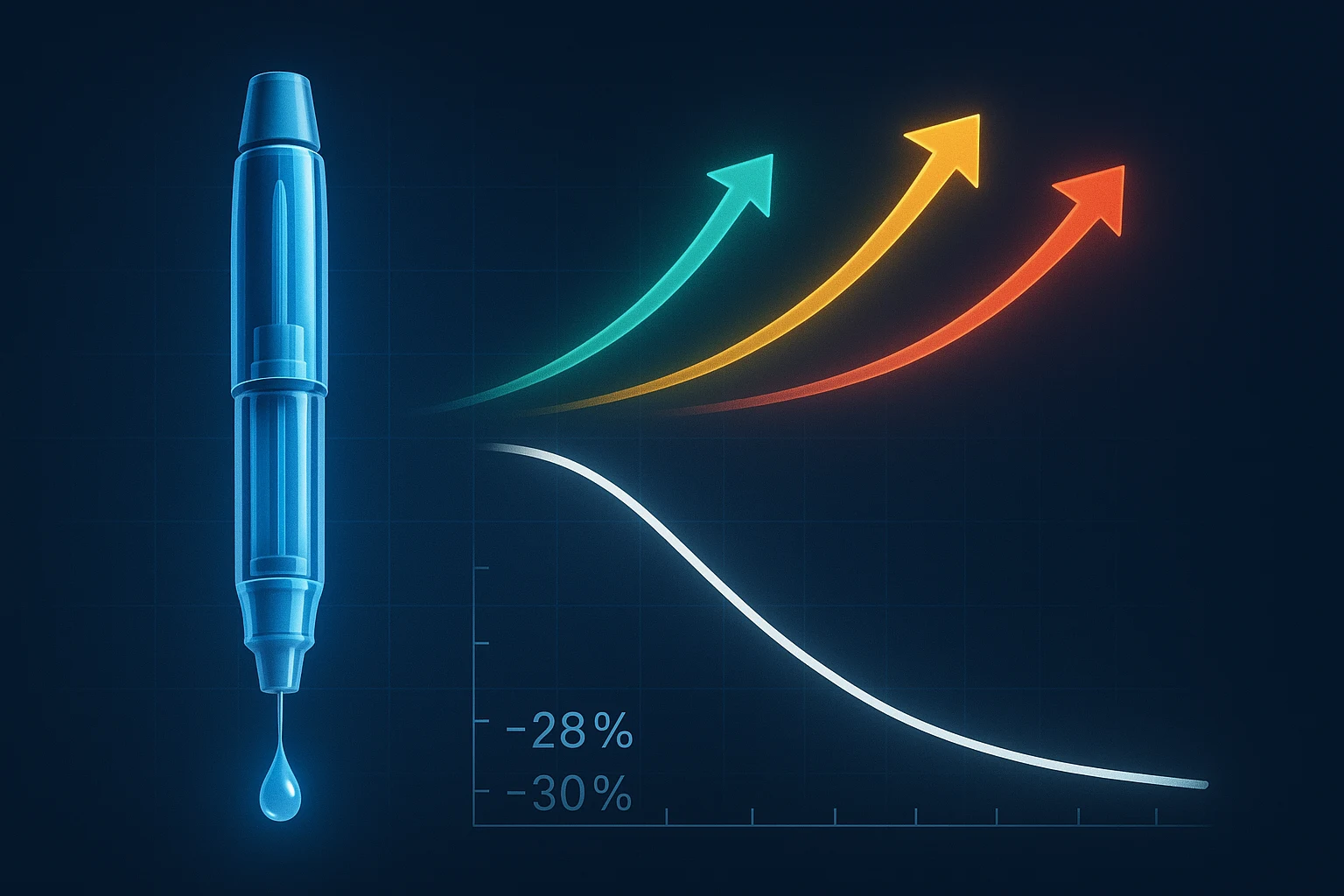
On May 21, 2026, Eli Lilly released topline results from TRIUMPH-1, the pivotal Phase 3 trial of retatrutide in adults with obesity. The numbers stopped the conversation: 28.3% average weight loss at the highest dose. 30.3% in the extension cohort. Nearly half of participants on 12 mg lost 30% or more of their body weight.
That level of weight loss has only been achievable through bariatric surgery -- until now.
For men with obesity-related low testosterone, TRIUMPH-1 changes the treatment calculus. Here is what the data show, what it means for testosterone, and whether it makes sense to wait.
Key Takeaways
TRIUMPH-1 Phase 3: retatrutide produced 28.3% average weight loss (70.3 lbs) at 12 mg over 80 weeks in 2,339 adults
Extension cohort (BMI 35+): 30.3% (85 lbs) at 104 weeks -- first pharmaceutical to match bariatric surgery
Triple-agonist mechanism (GLP-1 + GIP + glucagon) drives more fat loss than dual or single agonists
Not yet FDA-approved; NDA filing expected late 2026, potential approval late 2027
Major implications for obesity-related low testosterone: 28-30% weight loss should produce significant testosterone recovery
The trial enrolled 2,339 adults with obesity or overweight plus at least one weight-related comorbidity, without diabetes. Participants received once-weekly subcutaneous retatrutide or placebo for 80 weeks.
Weight loss by dose (80 weeks):
Dose
Average weight loss
Pounds lost
4 mg
19.0%
47.2 lbs
9 mg
25.9%
--
12 mg
28.3%
70.3 lbs
Placebo
2.2%
--
All three doses met the primary and key secondary endpoints. The 12 mg dose produced clinically meaningful improvements in cardiometabolic risk factors alongside the weight loss.
In an extension arm, participants with baseline BMI of 35 or higher who continued on 12 mg reached 30.3% average weight loss (85 lbs) at 104 weeks. At that dose, 45.3% of participants crossed the 30% threshold -- a benchmark historically reserved for Roux-en-Y gastric bypass.
Why Triple Beats Dual and Single
Retatrutide is the first triple hormone receptor agonist to reach Phase 3. The three targets work on different metabolic levers:
GLP-1 receptor: Suppresses appetite and slows gastric emptying. This is what semaglutide does alone.
GIP receptor: Improves glucose-dependent insulin secretion and may enhance fat tissue metabolism. Tirzepatide adds this to GLP-1.
Glucagon receptor: Increases hepatic fat oxidation and energy expenditure. This is what retatrutide adds on top of dual agonism.
The glucagon arm is the differentiator. It does not just reduce calorie intake -- it increases calorie burn, particularly from liver and visceral fat stores. In head-to-head comparisons across trials:
Semaglutide (single): approximately 15% weight loss
Tirzepatide (dual): approximately 20-22% weight loss
Retatrutide (triple): 28.3% weight loss
The step-up at each level is not marginal. Each additional receptor pathway compounds the metabolic effect.
Reduced GnRH means reduced LH secretion from the pituitary
Reduced LH means reduced testosterone production by the testes
This creates a self-reinforcing cycle: more fat leads to lower testosterone, lower testosterone leads to more fat accumulation, and the cycle deepens.
Weight loss breaks the cycle by removing the aromatase-rich tissue. Prior research establishes the dose-response:
10-15% weight loss (bariatric surgery data, GLP-1 trials): total testosterone increases by approximately 100-150 ng/dL
20%+ weight loss: total testosterone increases by approximately 150-250 ng/dL, often enough to move men from symptomatic-low into the normal range
Bariatric surgery patients (25-35% weight loss): studies show testosterone normalization in 50-80% of men who were hypogonadal before surgery
At 28-30% weight loss, retatrutide should produce testosterone recovery comparable to what bariatric surgery delivers -- without the operating room.
Add to this the AUA 2026 finding that GLP-1 receptor agonists raise testosterone through a mechanism independent of weight loss alone. A retrospective cohort of more than 1,600 men showed median total testosterone rose from 320 to 419 ng/dL on GLP-1 therapy, and the increase did not track tightly with BMI change. If retatrutide activates the same direct pathway through its GLP-1 component, the total testosterone recovery could exceed what weight loss alone would predict.
Side Effects at These Doses
The trade-off for more aggressive weight loss is more gastrointestinal burden.
At the 12 mg dose (80 weeks):
Side effect
Retatrutide 12 mg
Context
Nausea
42.4%
Higher than semaglutide (~30%)
Diarrhea
32.0%
Higher than tirzepatide (~20%)
Constipation
26.1%
Comparable to other GLP-1s
Vomiting
25.3%
Higher than dual agonists
Dysesthesia
12.5%
Unique to triple agonists
Discontinuation rate
11.3%
Moderate
The 4 mg dose was substantially better tolerated, with a 4.1% discontinuation rate, while still producing 19% average weight loss. Clinicians will likely use gradual dose titration to manage side effects, starting low and escalating based on tolerance -- similar to how semaglutide and tirzepatide are already prescribed.
When You Can Actually Get It
Retatrutide is not yet FDA-approved. No New Drug Application has been filed as of May 2026.
Expected timeline:
NDA submission: late 2026 or early 2027
FDA review period: 10-12 months (standard review)
Potential approval: late 2027 to early 2028
Broad availability: 2028 at earliest
Retatrutide is not covered under Medicare's GLP-1 Bridge program (effective July 1, 2026) or any insurance formulary because it has not been approved. Initial pricing, if approved, will likely be premium -- comparable to or higher than tirzepatide at launch.
What to Do Now if You Have Obesity and Low T
You do not need to wait 18 months for retatrutide. The current evidence supports several paths depending on your situation:
If obesity is driving your low testosterone (functional hypogonadism):
Available GLP-1 receptor agonists (semaglutide, tirzepatide) already produce significant testosterone recovery through the same weight-loss and direct-hormonal mechanisms
TRIUMPH-1 shows that retatrutide will eventually offer a more potent option, but the class effect is already accessible
If you need testosterone relief now:
TRT remains the fastest, most direct path to symptom resolution
Many telehealth clinics prescribe both TRT and GLP-1 drugs, letting you address both obesity and hormone levels simultaneously
If you want to preserve fertility:
GLP-1 drugs do not suppress the HPG axis the way TRT does
They preserve or may even improve spermatogenesis
Retatrutide, when available, would be the most potent fertility-preserving approach to obesity-related low testosterone
The right choice depends on severity of symptoms, fertility goals, and whether obesity is the primary driver. A clinic that handles both metabolic and hormone optimization can evaluate all of these factors. Compare online TRT clinics that offer integrated metabolic and hormone care.
The Bigger Picture
TRIUMPH-1 is not just an obesity trial. It marks the beginning of a new class of metabolic drugs that will reshape how low testosterone gets treated -- not by replacing the hormone, but by fixing the metabolic environment that suppressed it.
For the estimated 15 million American men with both obesity and low testosterone, the treatment decision is no longer binary. TRT addresses the hormone directly. GLP-1 drugs address the root cause. Triple agonists like retatrutide promise to address the root cause more aggressively than anything before.
The practical question is timing. Semaglutide and tirzepatide are available now. Retatrutide is 18-24 months away. TRT works immediately. The best approach for many men will be a combination -- or a sequence -- rather than picking one and hoping it covers everything.
References
Eli Lilly and Company. "Lilly's triple agonist, retatrutide, delivered powerful weight loss in pivotal Phase 3 obesity trial." Press release, May 21, 2026.
Kohler TS et al. "GLP-1 Receptor Agonists and Testosterone Levels in Men." Presented at AUA 2026 Annual Meeting, Washington D.C., May 15-18, 2026.
Corona G et al. "Body weight loss reverts obesity-associated hypogonadotropic hypogonadism: a systematic review and meta-analysis." European Journal of Endocrinology, 2013.
Haider KS et al. "Long-term testosterone therapy improves body composition and metabolic parameters in hypogonadal men." Journal of Steroid Biochemistry and Molecular Biology, 2016.
Retatrutide is Eli Lilly's investigational once-weekly injection that activates three metabolic hormone receptors simultaneously: GLP-1 (appetite suppression), GIP (glucose metabolism), and glucagon (energy expenditure and fat burning). That triple mechanism separates it from semaglutide (single agonist) and tirzepatide (dual agonist). The TRIUMPH-1 Phase 3 trial showed 28.3% average weight loss at the 12 mg dose over 80 weeks, matching bariatric surgery outcomes for the first time with a pharmaceutical.
How much weight did participants lose in TRIUMPH-1?
At 80 weeks, average weight loss by dose was: 4 mg -- 19.0% (47.2 lbs), 9 mg -- 25.9%, 12 mg -- 28.3% (70.3 lbs). Placebo lost 2.2%. In an extension cohort of participants with baseline BMI of 35 or higher, the 12 mg group reached 30.3% (85 lbs) at 104 weeks. Nearly half (45.3%) of participants on the highest dose lost 30% or more of their body weight.
Does retatrutide raise testosterone?
TRIUMPH-1 did not measure testosterone as an endpoint, but the hormonal logic is strong. Obesity is the most common reversible cause of low testosterone in men. Visceral fat tissue contains aromatase enzymes that convert testosterone to estrogen, suppressing the HPG axis. Weight loss of 15-20% has been shown to raise total testosterone by 100-200 ng/dL in prior studies. At 28-30% weight loss, the testosterone recovery could be larger. An AUA 2026 retrospective cohort of 1,600 men found that GLP-1 receptor agonists raise testosterone independent of weight loss alone, suggesting an additional direct hormonal effect. See the [GLP-1 raises T without weight loss study](/treatment/glp1-testosterone-independent-weight-loss-aua-2026).
When will retatrutide be available?
Retatrutide is not yet FDA-approved. Eli Lilly has not filed a New Drug Application as of May 2026. Based on typical timelines, an NDA filing is expected in late 2026 or early 2027, with a potential approval in late 2027 to early 2028 following a standard 10-12 month FDA review. If approved, initial availability will likely be limited and expensive, similar to the early rollout of tirzepatide.
Should I wait for retatrutide instead of starting TRT?
That depends on why your testosterone is low. If obesity is the primary driver -- BMI over 30, functional hypogonadism, testes still working -- waiting for retatrutide (or starting an available GLP-1 now) makes sense as a first approach. If you have primary hypogonadism (testicular failure) or severe symptoms that need relief now, TRT remains the faster, proven option. Many clinics already prescribe GLP-1 drugs alongside or instead of TRT for the right patients. Compare options at [/clinics](/clinics?from=retatrutide-triumph-1).
How does retatrutide compare to tirzepatide and semaglutide?
Semaglutide (single GLP-1 agonist) produces approximately 15% weight loss at standard doses. Tirzepatide (dual GLP-1/GIP agonist) produces approximately 20-22% weight loss. Retatrutide (triple GLP-1/GIP/glucagon agonist) produced 28.3% weight loss at the highest dose in TRIUMPH-1. The glucagon receptor activation is the key differentiator -- it drives energy expenditure and hepatic fat oxidation on top of appetite suppression. More weight loss means more visceral fat reduction, which means greater potential testosterone recovery in obese men.
What are the side effects of retatrutide?
Gastrointestinal side effects were the most common at the 12 mg dose: nausea (42.4%), diarrhea (32.0%), constipation (26.1%), vomiting (25.3%), and dysesthesia or abnormal skin sensation (12.5%). The discontinuation rate due to adverse events was 11.3% at 12 mg and 4.1% at 4 mg. These rates are higher than semaglutide but in line with what clinicians expected given the more aggressive metabolic activation.